Category:
 Author:
 Date:Apr 29, 2026
Trading Without a Stop Loss: Risks, Psychology, and Real Consequences
Using a stop loss is treated as a settled question in trading education. Cap the downside, define the risk before entry, let the platform enforce the exit so you do not have to. It is close to the first rule anyone is taught.
The behavior of real accounts looks nothing like that. When we measured how often traders in our dataset attach a stop loss to their trades, the majority turned out to use one rarely or never. And the relationship between stop-loss usage and account outcomes is not the straight line the rule implies.
What does trading without a stop loss actually mean?
Trading without a stop loss means opening a position without a predefined exit level attached to the order. The trade has an entry and a plan, but no instruction sitting with the broker to close it if price moves against you by a set amount. The exit, if it comes, is a decision taken later.
In practice it takes three forms: no exit level at all, a level held in the trader's head rather than placed with the broker, and a stop that is placed and then moved when price approaches it. All three leave the same thing missing, which is a downside that was fixed before the position was opened. In TradeMedic AI data, the first two are visible as an unprotected trade at entry, while the third shows up as a moved stop.
How many traders use a stop loss?
Across the trader accounts in our analysis, 28.0% never set a stop loss on a single trade, 27.9% use one on fewer than one trade in five, 16.7% use one on 20% to 50% of their trades, 12.9% on 50% to 80%, and 14.5% on more than 80%.
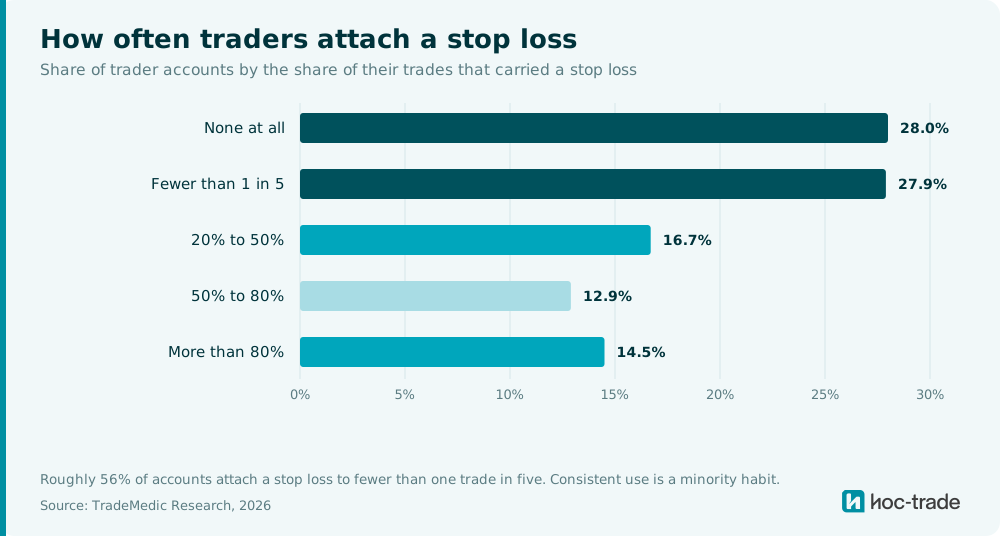
Two numbers stand out. About 28% of accounts never set a stop loss on a single trade over their whole trading history. And fewer than 1 in 7 accounts use a stop loss on more than 80% of their trades.
Put those together and roughly 56% of accounts attach a stop loss to fewer than one trade in five. Consistent stop-loss use, the version described in every beginners' guide, is a minority habit.
What does the data say about trading without a stop loss?
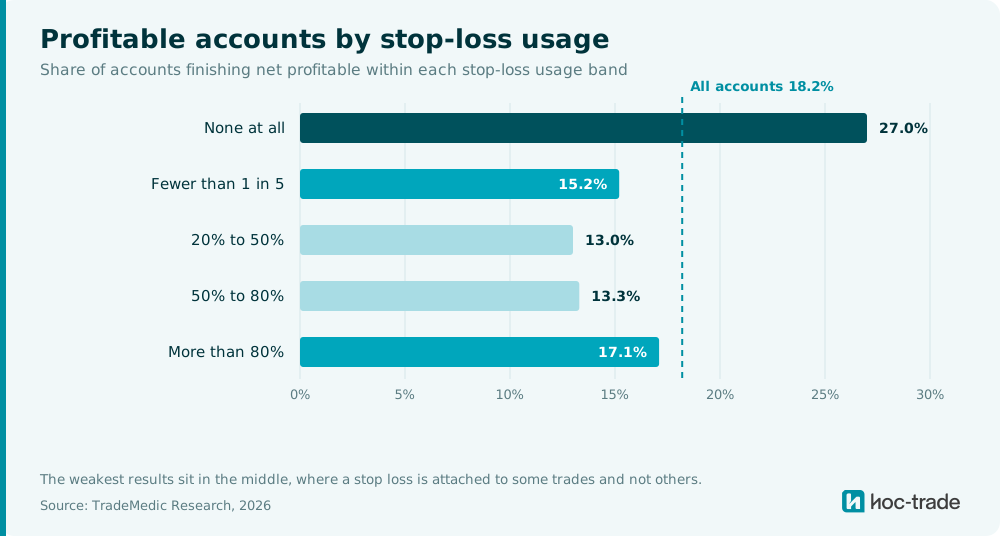
This is where it stops being simple. If stop-loss usage worked the way the rule suggests, the share of profitable accounts would climb steadily from left to right. It does not. It dips in the middle and rises at both ends.
Accounts that never set a stop loss finish net profitable at 27.0%. Those using one on fewer than one trade in five finish at 15.2%, on 20% to 50% of trades at 13.0%, on 50% to 80% at 13.3%, and on more than 80% at 17.1%. The baseline across the full analysis population is 18.2% of accounts profitable.
So the two middle groups sit at 13.0% and 13.3%, close to a third below the baseline and the weakest part of the distribution. The group using a stop loss on more than 80% of trades sits at 17.1%, close to baseline. And the group using none at all sits at 27.0%, the highest band on the chart.
Before anyone builds a strategy on that last row, read the two sections below. But first, the finding worth keeping: the worst place to sit is not either end. It is the middle.
We checked this against multiple broker datasets, each with its own baseline profitability, rather than only the pooled figure. The dip in the middle appears in all of them, which makes it unlikely to be an artifact of one broker's client mix or one platform's data capture. Which middle band is weakest varies between them, so the finding worth keeping is the shape rather than the exact band: partial use sits below both consistent habits.
Why partial stop-loss use lines up with the weakest results
A trader who never sets a stop loss has one method. A trader who sets one on almost every trade has one method. A trader who sets one on a third of their trades has two, and something decides between them in the moment.
That something is rarely the setup. It is more often how the position is behaving, or how the day has gone so far. The trade that gets a stop is the one entered calmly. The trade that does not is the one entered after a loss, or the one already moving against the position while the trader waits to see whether it comes back.
We cannot confirm that selection mechanism from this dataset, and we are not claiming it as a finding. What the numbers do show is that partial application lines up with weaker outcomes than either consistent habit, and that the pattern holds across independent datasets.
There is a measurement consequence too. If your risk per trade is defined on some trades and open-ended on others, your own performance record becomes hard to read. Expectancy, average loss, and risk-reward ratio all assume a defined downside. Remove it from a third of your trades and those numbers describe something other than your actual strategy.
What are the real risks of trading without a stop loss?
The first risk is the one the rule was written for: the worst outcome of the position is no longer a number you chose. It is whatever the market does while you are deciding. A stop loss does not exist to raise your win rate. It exists so that the size of the worst trade is set in advance.
The events that make that matter are the ones you cannot trade through. Weekend gaps open the market away from your level, news spikes move faster than a manual exit, and thin liquidity turns an orderly move into a jump. None of them announce themselves, and all of them happen while the position is open rather than while you are watching it.
The second risk is the exit you do not control. Without a stop, the only certain exit is the broker's. A stop out happens when margin runs out, at a price the market chooses and a level your broker's margin rules set. It is the one form of risk management that is guaranteed to exist, and it is the one designed to protect the broker rather than your account.
The third risk is slower and shows up in the rest of your trading. An open-ended loss changes the size of the next decision: the position that has to be recovered, the trade taken to make it back, the day extended past the point it should have ended. That is where the patterns further down this article begin.
Is trading without a stop loss profitable?
The honest answer is that this dataset cannot tell you, and neither can the 27.0% figure above.
That number is a headcount. It counts what share of accounts in a band finished net positive. It says nothing about how much the accounts that did not finish positive lost, how close any account came to a margin call, or what the worst single trade in each band looked like. Two accounts both counted as unprofitable can be down 4% and down 100%. The metric treats them the same.
That matters more here than anywhere else in the dataset, because the whole argument for a stop loss is about the shape of the tail rather than the middle, and the events described in the section above do not show up in a count of how many accounts ended net positive.
There is a second limit. Stop-loss usage is not assigned at random. Accounts that never use one differ from accounts that always use one in trading style, instrument, holding period, position sizing, hedging, and whether an automated system is placing the orders. None of that is controlled for here. Some of the gap between bands is likely to be those differences rather than the stop loss itself.
So the defensible reading is narrow: whether a stop loss is attached to a trade does not, on its own, predict which accounts end up net positive, and partial use lines up with the weakest band. That is a statement about a correlation in one dataset, not a statement about what a stop loss does to your risk.
Is it ever okay to trade without a stop loss?
Yes, under one condition: the downside has to be capped by something else, and that something has to exist before the position is opened.
Three arrangements do that. A position sized so that the worst realistic outcome is affordable, where the cap comes from size rather than from an exit order. A defined-risk structure such as a hedged pair, where the maximum loss is set by the construction of the position. And an automated system that manages exits on rules you can state, where the exit is code rather than judgment.
What none of them permit is the common version: a normal-sized position, no exit level, and a plan to watch it. That is not a strategy without a stop loss. That is a strategy whose stop loss is decided later, under pressure, by the person least able to decide it at that moment.
The test is simple. If you cannot say what the worst outcome of this position is before you open it, you do not have a defined risk. Whether that definition lives in an order, in your position size, or in code matters less than whether it exists.
Is a mental stop loss good enough?
A mental stop is a level you intend to exit at but never place with the broker. It is the most common form of trading without a stop loss, and it fails in a specific way.
The level itself is usually sound, because it was chosen calmly. What fails is the execution, because the moment it is reached is the moment the case for waiting feels strongest. The price is already moving, a reason to hold appears, and the exit that was going to be automatic becomes a decision.
There is a practical problem too. A mental stop only works while you are watching. Gaps at the weekly open, news spikes, and connection failures all happen without you, and the intention has no effect at all in those minutes.
In your trade record, a mental stop and no stop look identical, which is why the usage figures above count only stops attached to the order.
Do professional traders use stop losses?
Professional risk management is less about the order type and more about the fact that the limit is not the trader's to move. A desk trader works to position limits, drawdown limits, and a risk function that closes positions when those are breached, whether or not a stop order sits on any individual trade. A fund runs to a mandate. A prop firm challenge enforces a daily loss limit at the account level.
So the honest answer is that professionals rarely rely on willpower, which is what a retail trader is relying on when they skip the stop and plan to watch. The instrument varies. The constraint does not.
Retail traders are the only group where the person taking the risk is also the only person who can enforce the limit. That is an argument for making the limit automatic, not for trusting yourself more.
Why do traders avoid stop losses?
The reasons are mostly psychological, even when they get described as strategy.
Loss aversion is the strongest of them. A stop loss converts a floating loss into a realized one. Leaving the trade open keeps the outcome undecided, and an undecided loss is easier to sit with than a settled one. Skipping the stop in the first place avoids the decision entirely.
Memory is selective in the same direction. A trader who watched price tag their stop and then reverse into profit remembers that trade in detail. The trades where the stop prevented a much larger loss leave no comparable mark, because nothing dramatic happened.
Confidence in manual management plays a role too, and it is the belief that survives longest. Traders who have held through drawdowns and come out fine build a sense that they can handle it live. That works until the move is faster than a human, or until a router drops, or until something outside the screen takes their attention at the wrong minute.
And once a position is deep in the red without a stop, waiting starts to feel like conviction rather than avoidance.
What does the research say about not using a stop loss?
The clearest finding comes from experimental economics rather than from trading. Alex Imas, writing in the American Economic Review in 2016, showed that risk-taking after a loss depends on whether the loss was realized. After a loss a person has taken, they become more cautious. After the same loss left open on paper, they take on more risk.
That distinction is the stop loss. Closing at a predefined level converts the loss into a realized one, and the evidence says what follows is a more careful trader. Leaving the position open keeps the loss on paper, and what follows is a trader more willing to add risk.
The reluctance itself is well documented. Terrance Odean, studying 10,000 brokerage accounts in 1998, found investors were roughly one and a half to two times more likely to sell a winner than a loser, the pattern Shefrin and Statman named the disposition effect in 1985. Holding losers and banking winners early is the default, not the exception.
None of this means a stop loss always improves returns. Kaminski and Lo, in the Journal of Financial Markets in 2014, showed that if prices moved randomly, stopping out would reduce expected returns, while in markets showing momentum stop-loss rules can add value. Their equity study found certain stop rules added 50 to 100 basis points a month during the periods they were out of the market. The value of a stop depends on what the market does after it triggers. What the behavioral evidence adds is that it also depends on what the trader does next, and that part is more predictable.
What do traders do instead of taking the loss?
A position without a stop loss still gets closed eventually. The question is what happens in between, and the most common answer is the most expensive one: adding to it.
Doubling down is what a trade without a defined exit invites. The position is already against you, the original entry now looks like a better price than the current one, and adding more lowers the average entry so that a smaller recovery gets you back to flat. It feels like taking control of the loss rather than accepting it.
In TradeMedic AI data, accounts where doubling down is the single biggest behavioral issue finish net profitable at 5.3%. The baseline across all analyzed accounts is 18.2%. That is the lowest figure attached to any of the patterns commonly triggered by a loss, and it sits well below both the accounts where revenge trading dominates, at 13.4%, and those where failing to stop after a heavy day dominates, at 6.3%.
These are separate measurements rather than a chain we have traced trade by trade, and each figure describes accounts where that pattern is the largest single issue, not every account that shows it. What they have in common is a starting point: a loss that grew past the size the trader had planned for, which is what an open-ended position produces.
This is also the honest reply to the 27.0% figure earlier in this article. A stop loss does not only cap one trade. It removes the moment where adding to a loser looks like a plan.
How TradeMedic AI detects trading without a stop loss
TradeMedic reads the trade history from your connected MT4 or MT5 account and calculates what share of your trades carried a stop loss when they were opened. That share is shown against the distribution above, so you can see where your own habit sits rather than guessing at it.
Most traders overestimate their own number. The report also shows how that share moves over time, which is where partial use becomes visible: a stop-loss rate that drops on particular days, or after particular results, is a different problem from one that is simply low.
Trading without a stop loss is classified as a risk observation rather than a performance pattern. It does not carry a dollar effect in the report, because the cost of an uncapped position is not something a past track record can price. It is flagged as exposure, alongside the other risk metrics in your account.
See where your own stop-loss usage sits. Connect your trading account to TradeMedic AI free.
How to make stop-loss use consistent
1. Measure your real rate first. Not your intended rate. Pull the share of your last 100 trades that had a stop loss attached at entry. The gap between that number and the one you would have guessed is the size of the problem.
2. Find the trades that are missing it. Look at what the exceptions have in common: time of day, instrument, whether they followed a loss, whether they were planned or taken on the spot. Consistency problems are almost always concentrated somewhere specific.
3. Set the level before the entry, not after. A stop decided once the position is open is priced against the trade going against you, which is the moment least suited to the decision.
4. Size the stop to the setup, not to your comfort. Stops placed inside normal noise get taken out by nothing, and stops placed far away to avoid that turn a small planned loss into a large one. Both failure modes are covered separately in stop loss too tight and stop loss too wide, and both are tracked in your TradeMedic AI report.
5. Treat a moved stop as a broken one. Widening a stop mid-trade produces the same open-ended downside as never setting one, while leaving the appearance of risk management in your trade record.
The right stop distance is specific to your instruments, your holding period, and your entry timing. TradeMedic calculates yours from your own trade history rather than from a general rule.
Why does my stop loss always hit?
Usually because it is sitting inside the range the instrument moves anyway. A stop placed a few pips from entry on a market with a 2% daily range is not protecting the trade, it is scheduling the exit. The result feels like being hunted, and the fix is to place the stop where the trade idea is wrong and size the position down to keep the risk the same. We cover that pattern in detail in stop loss too tightBelieving your stop was too tight is usually a perception rather than a measurement. In TradeMedic AI data, stops that are measurably too tight show up in 3.3% of accounts, while stops that are too wide show up in 26.4%, about eight times as often. The more common problem is the opposite of the one traders complain about.
The bottom line
Around 28% of trader accounts never set a stop loss, and roughly 56% use one on fewer than one trade in five. Consistent use is rarer than the rule would suggest. In this dataset, the band with the lowest share of profitable accounts is not either extreme but the middle, where a stop loss is attached to some trades and not others.
That is a correlation in observational data, not a case for trading without a stop. A share-of-profitable figure counts outcomes at the middle of the distribution and is blind to the tail, which is the only place the argument for a stop loss is decided. What the behavioral evidence adds is what happens next: an unrealized loss invites more risk, and the accounts where that turns into doubling down finish profitable at 5.3% against an 18.2% baseline.
See where your own stop-loss usage sits. Connect your trading account to TradeMedic AI free.
Learn how TradeMedic analyzes behavioral patterns across your trading. More about TradeMedic.
Frequently asked questions about trading without a stop loss
Stop loss vs stop limit: what is the difference?
A stop loss becomes a market order when your level is reached, so it fills at whatever price is available. A stop limit becomes a limit order, so it fills only at your price or better and may not fill at all. In fast markets a stop loss exits you at a worse price, while a stop limit can leave you in the position. TradeMedic AI counts a trade as protected when an exit level was attached at entry, whichever of the two you use.
Does a stop loss guarantee your exit price?
No. A stop loss guarantees an exit attempt at your level, not a fill at it. Gaps over the weekend, news spikes and thin liquidity can all fill you below your stop, which is called slippage. TradeMedic AI measures whether a stop was set rather than how well it filled, so slippage shows up in the size of the realized loss rather than in the stop-loss metric.
What happens if you never set a stop loss on MT4 or MT5?
Nothing until margin runs out, at which point the broker closes positions for you at whatever price is available. A stop out is the broker protecting itself, and the level is set by its margin rules rather than by your trade idea. TradeMedic AI flags trading without a stop loss as a risk observation for this reason: the exposure does not appear in past results until the day it does.
What share of my trades should have a stop loss?
The data does not give a target, but it does show that partial use lines up with the weakest results, so consistency matters more than any particular share. The useful first step is finding your real rate rather than your assumed one. TradeMedic AI calculates the share of your trades that carried a stop at entry and shows how that share changes after wins and losses.
Do prop firms require a stop loss?
Most do not require one on each trade, but nearly all enforce a daily loss limit and a maximum drawdown at the account level, which caps the downside in a different way. A trader without stops can still breach a daily limit inside a single position. TradeMedic AI shows your stop-loss rate alongside your heaviest trading days, which is where most challenge breaches come from.
Research behind this article
Imas, A. (2016). The Realization Effect: Risk-Taking after Realized versus Paper Losses. American Economic Review, 106(8), 2086-2109.
Kaminski, K. M., and Lo, A. W. (2014). When do stop-loss rules stop losses? Journal of Financial Markets, 18, 234-254.
Odean, T. (1998). Are Investors Reluctant to Realize Their Losses? The Journal of Finance, 53(5), 1775-1798.
Shefrin, H., and Statman, M. (1985). The Disposition to Sell Winners Too Early and Ride Losers Too Long: Theory and Evidence. The Journal of Finance, 40(3), 777-790.
All trading statistics: TradeMedic Research, 2026, based on a dataset of more than 500,000 trading accounts.
Frequently asked questions
Stop loss vs stop limit: what is the difference?
A stop loss becomes a market order when your level is reached, so it fills at whatever price is available. A stop limit becomes a limit order, so it fills only at your price or better and may not fill at all. In fast markets a stop loss exits you at a worse price, while a stop limit can leave you in the position. TradeMedic AI counts a trade as protected when an exit level was attached at entry, whichever of the two you use.
Does a stop loss guarantee your exit price?
No. A stop loss guarantees an exit attempt at your level, not a fill at it. Gaps over the weekend, news spikes and thin liquidity can all fill you below your stop, which is called slippage. TradeMedic AI measures whether a stop was set rather than how well it filled, so slippage shows up in the size of the realized loss rather than in the stop-loss metric.
What happens if you never set a stop loss on MT4 or MT5?
Nothing until margin runs out, at which point the broker closes positions for you at whatever price is available. A stop out is the broker protecting itself, and the level is set by its margin rules rather than by your trade idea. TradeMedic AI flags trading without a stop loss as a risk observation for this reason: the exposure does not appear in past results until the day it does.
What share of my trades should have a stop loss?
The data does not give a target, but it does show that partial use lines up with the weakest results, so consistency matters more than any particular share. The useful first step is finding your real rate rather than your assumed one. TradeMedic AI calculates the share of your trades that carried a stop at entry and shows how that share changes after wins and losses.
Do prop firms require a stop loss?
Most do not require one on each trade, but nearly all enforce a daily loss limit and a maximum drawdown at the account level, which caps the downside in a different way. A trader without stops can still breach a daily limit inside a single position. TradeMedic AI shows your stop-loss rate alongside your heaviest trading days, which is where most challenge breaches come from.