Category:
 Author:
 Date:May 16, 2026
Why Calm Recovery Defines Your Decision Quality After a Loss

Losses cluster. They don't arrive in isolation. They land inside moments when the market is already moving fast, prices are shifting quickly, and signals blur together. In those conditions, a losing trade doesn't just impact your PnL. It changes how you think. The minutes after a loss can feel more intense than the hours before it. The market seems to demand an immediate response, as if acting now is the only way to matter. And that's exactly when your next decision becomes vulnerable.
Many traders respond by jumping back in quickly, trying to smooth over the discomfort of being wrong. Others see the loss as temporary imbalance. In fast markets, both can look like decisiveness. In reality, both often flip from analysis to reaction, where the next trade stops being about what the setup demands and starts being about what your emotions need.
What is calm recovery in trading?
Calm Recovery is the capacity to absorb a losing trade without immediately jumping into another one to fix the pain. It's the choice to pause instead of chase. To let the loss be what it is rather than trying to neutralize it through quick action.
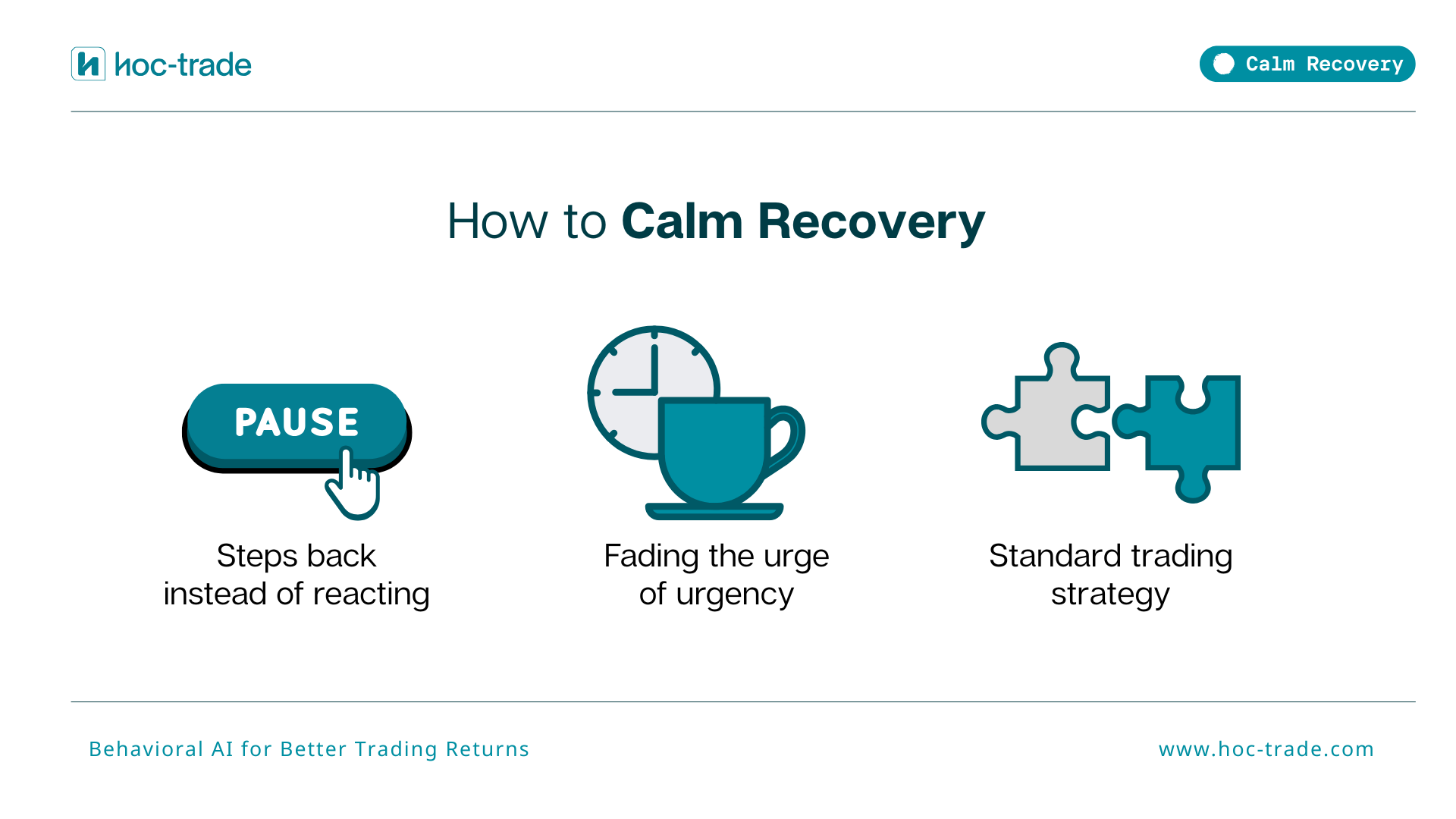
The strength isn't about preventing losses or acting like they don't matter. It's about preserving clear decision-making after a loss has already happened. Many traders face a choice between acting to relieve the emotional weight of the loss, or trading as if they're owed a win. Calm Recovery is different. It's the ability to sit with that moment without letting it dictate your next move.
Taking a break after a loss creates space. It allows the emotional charge to fade and makes the next trade much more likely to come from a focused, rational state. In practice, this means sustaining your process even when recent outcomes would normally disrupt it. Traders who demonstrate calm recovery often have a profitable baseline strategy. What they show is that strategy works even better when decisions stay clean, unclouded by the need to recover from the last outcome. It's a sign that your edge already exists. What matters now is protecting it from emotional interference.
Which behavioral biases affect traders after losses?
Calm Recovery focuses on interrupting three powerful biases that typically emerge when traders are trying to recover from a loss: Outcome Bias, Loss Aversion, and Gambler's Fallacy.
Outcome Bias causes traders to overweight recent results and ignore the bigger picture. A few losses can convince a trader to abandon an otherwise profitable strategy without waiting for meaningful sample sizes. This feeds strategy-hopping instead of properly evaluating long-term expectancy. Calm Recovery counters this by staying composed, absorbing the loss without jumping to conclusions, and waiting for statistically valid results.
Loss Aversion explains why losses feel two or three times more painful than equivalent gains feel good. That pain creates urgency to recover quickly, which pushes traders to take bigger risks or move outside their plan. The result is that post-loss trades become emotional and detached from the trading framework. This is revenge trading: acting to fix pain rather than acting on setup quality.
Gambler's Fallacy distorts how traders judge probability after streaks of similar outcomes. In trading, a series of losses creates the illusion that a win is now overdue, encouraging higher risk-taking to try to recover. The odds haven't actually shifted, but the belief that they have is powerful. Calm Recovery emphasizes that each trade exists independently. A loss doesn't make a win more likely on the next entry.
Together, these biases create a trap: you lose, feel the pain, convince yourself a win is due, and size up to make it back. Each element feeds the next. Calm Recovery neutralizes this sequence by creating time before the next decision.
How does calm recovery show up in your trading?
Calm Recovery is visible in restraint. After a loss, there is no rush to re-engage just to restore balance. Instead, the trader creates a gap before committing to the next position. That gap transforms what happens next. The following trade looks less like a reflex and more like the trader's baseline execution quality, a natural continuation of their actual strategy.
One of the clearest places this shows up is in the absence of revenge trading. The danger after a loss is the pull toward immediately recovering what was just lost, often through impulsive decisions or larger risk. When that happens, the reason for the next trade gets tangled with the previous one. The trade isn't only about the current setup anymore. It's also about repairing the last outcome. Calm Recovery breaks that connection. By pausing, the trader avoids the emotional loop where one loss increases the odds of another simply because they jumped back in.
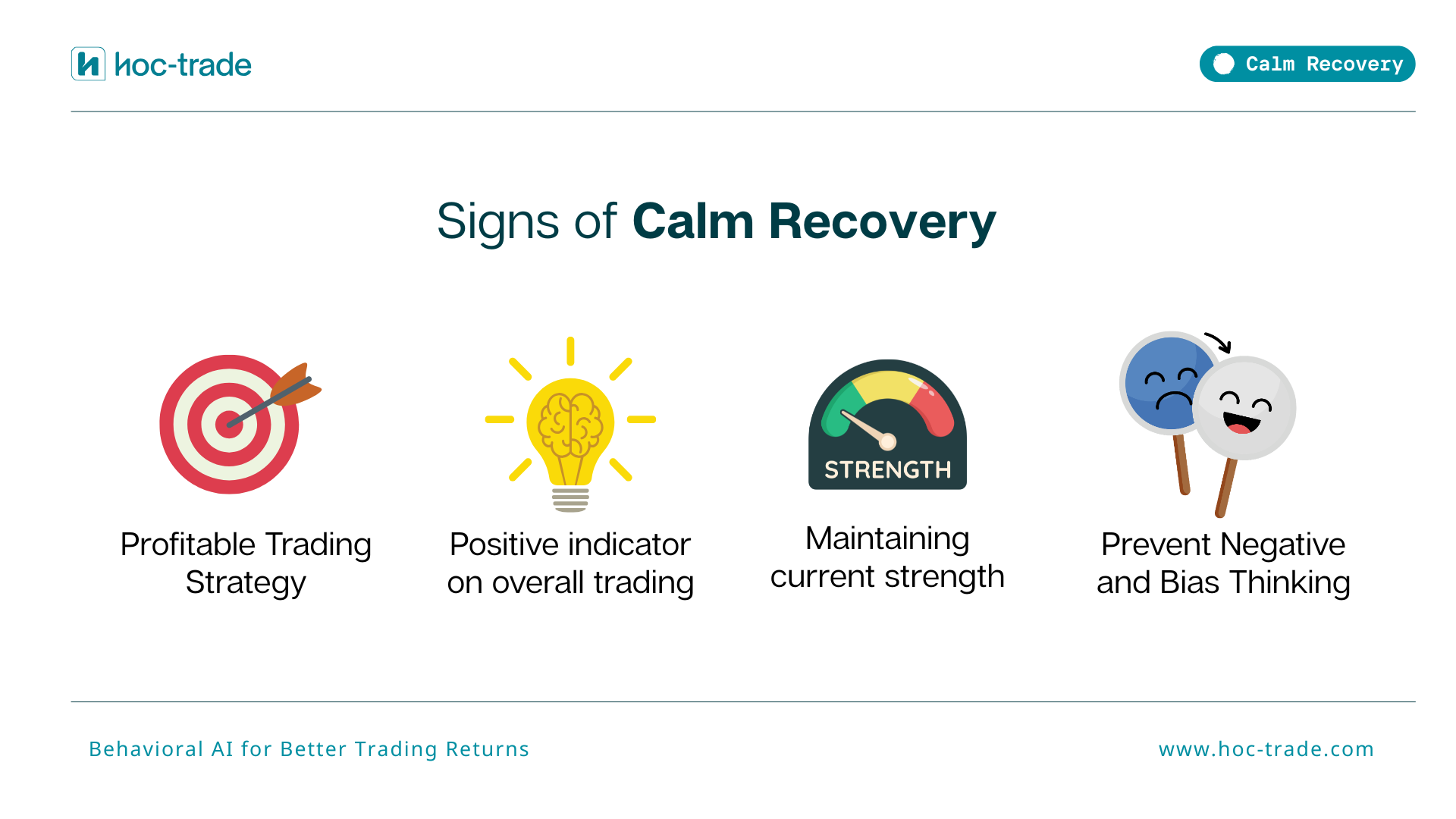
Over time, this creates a recognizable pattern. When Calm Recovery is present, trades that follow losses don't carry the signature of haste. The interval between the loss and the next entry becomes a stabilizing feature of the trader's execution, not an absence of engagement. It's the trader consciously re-entering only after they've returned to a state where they can see the market without the last trade distorting their view.
Why is calm recovery a trading edge?
Losing a trade is normal. Most traders experience losses regularly. What's not normal is the ability to prevent one loss from cascading into a series of rushed, emotion-driven trades. That's where calm recovery functions as an edge. It reduces the probability that a single negative outcome turns into multiple impulsive moves.
When a trader gives themselves a break after a loss, they dramatically improve their odds of returning to their normal, clear thinking. This makes overall performance less dependent on whether the last trade happened to win or lose. Instead, performance becomes more about whether execution stays consistent even as emotional conditions shift.
Calm Recovery also has clear environmental fit. It matters most when volatility and speed create the false impression that immediate action is required to stay relevant. In those conditions, the market can reward reactive participation in isolated moments, but it punishes it over time. Calm Recovery doesn't claim superiority in every environment. It simply represents a reliable pattern: when traders grant themselves space after a loss, their next trade tends to be selected and managed from a more stable decision frame.
When this capability is present, profitability shifts away from trying to make back a loss and toward avoiding the secondary errors that typically follow it. The move from emotional repair toward decision integrity is what makes the behavior repeatable and measurable.
What does the data reveal about calm recovery?
TradeMedic detects Calm Recovery by analyzing the relationship between the length of time traders pause after a loss and the performance of their next trade. Across our dataset of 500,000+ trader accounts, we observe clear patterns: traders who take longer breaks after losses show meaningfully better average performance on the trades that follow. This isn't random variation. The correlation holds consistently, and traders with this pattern demonstrate profitable baselines. What this means is that Calm Recovery isn't just a behavioral preference. It's a measurable, repeatable edge with concrete performance consequences.
How does Hoc-trade measure calm recovery?
Hoc-trade detects Calm Recovery by examining the specific relationship between post-loss breaks and subsequent trade performance. The system classifies trades based on the duration of the break taken after each loss. It then compares how the next trade performs across different break-length categories. When longer breaks consistently align with better average outcomes, and when those trades contribute to overall profitability, it clarifies the behavior as a genuine edge rather than a coincidence.
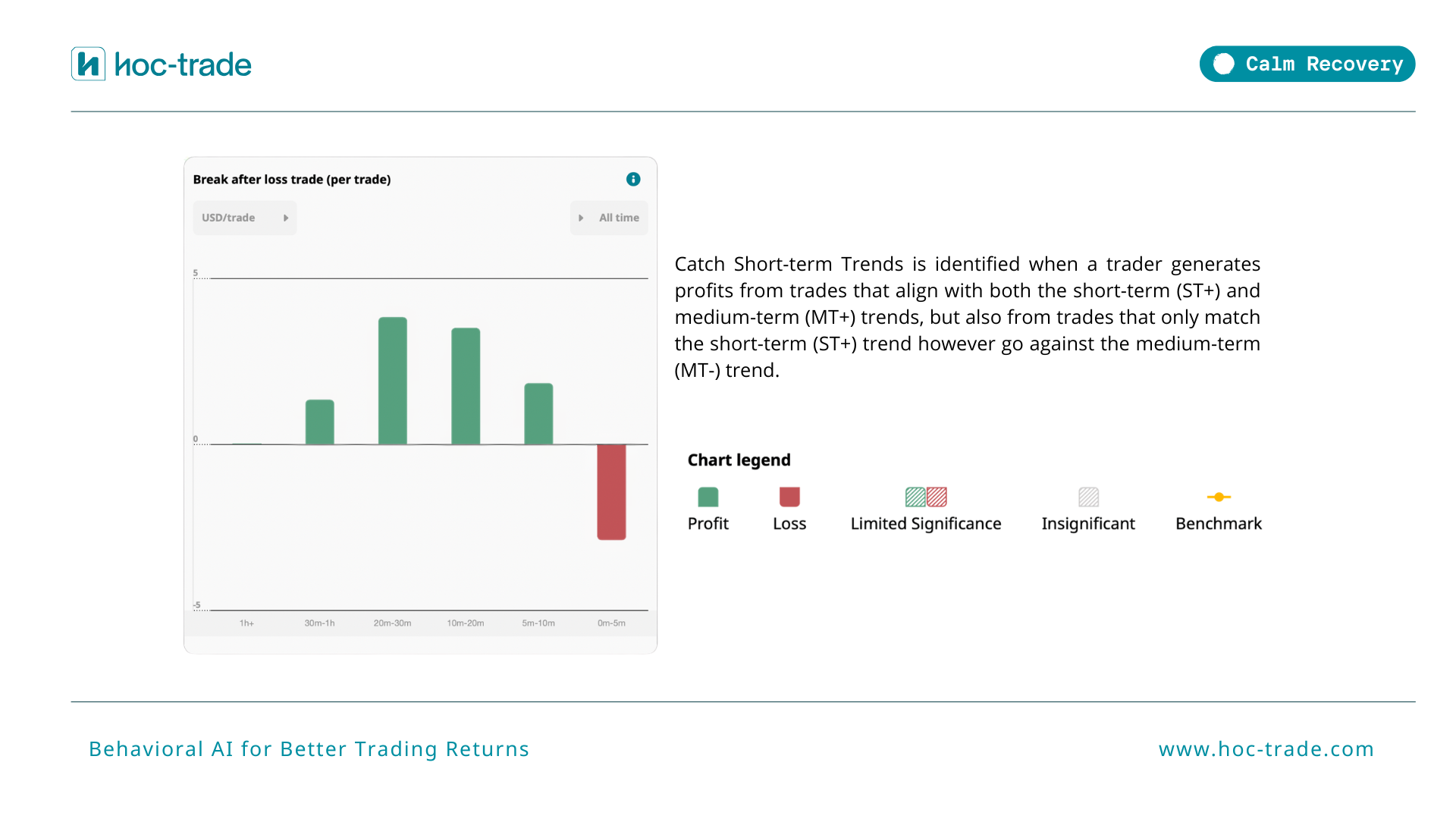
This analysis also reveals contrast. If you show profitability when taking longer breaks but underperform when breaks are short, that difference becomes visible and actionable. The edge isn't just about taking breaks in general. It's about a specific behavioral condition: the moment when your execution returns to form, when your thinking is calmer and more grounded, and when that psychological state translates into measurable outcomes.
How to develop calm recovery
Calm Recovery isn't defined by the loss. It's defined by what happens after. The strength lives in the space where most traders accelerate and where discipline is hardest to maintain: the interval following something that went wrong. When you consistently resist the urge toward revenge trading, you preserve the independence of each trade. Each entry stands on its own merits. When you step back from the gambler's fallacy and stop assuming a win is due, you protect the integrity of probability in your decision-making. These aren't small moves. They're the difference between a strategy that works and one that works while staying true to its own logic.
TradeMedic AI analyses over 60 behavioural patterns, including blindly following momentum, across 500,000+ trader accounts. Visit TradeMedic to see how it works and get your own personal analysis.
Watch Why Calm Recovery Defines Your Decision Quality After a Loss