Category:
 Author:
 Date:May 20, 2026
Manual Profit Taking: A Reactive Trading Edge
Profitable trades don't always move cleanly. Price advances, creating unrealized gains, then momentum stumbles. The tape becomes volatile, the original push toward your take-profit target loses conviction, and the trade's path to success becomes unclear. In fast markets, the gap between 'still viable' and 'headed back to entry' can close in just a few candles.
This is where mechanical exits create problems. When the market stops rewarding you in the way your setup promised, the question isn't limited to being right or wrong. It's about recognizing that reaching your preset take-profit has become unlikely, even as the position remains green.
What defines manual profit taking?
Manual profit taking is the ability to close a winning position before it hits your preset take-profit level. This happens when a trader recognizes that the trade is unlikely to reach that target and exits while still profitable rather than risk the position turning against them.
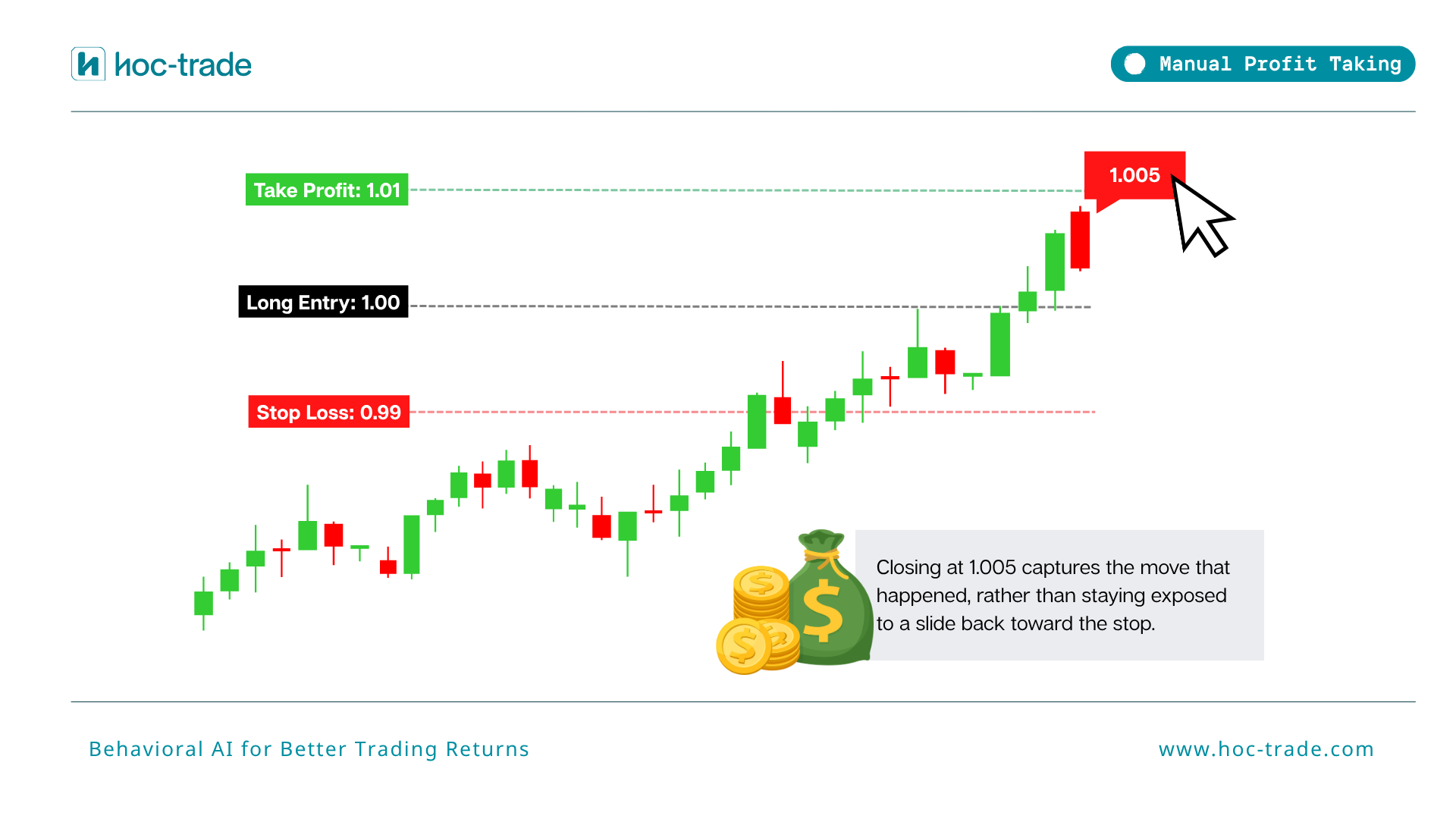
This is distinct from panic selling or cutting profits due to fear of losing unrealized gains. The strength lies in selective, deliberate timing. A trader using manual profit taking closes the position because the market's current behavior no longer supports the original plan, not because emotions drive the decision. The skill is recognizing when the probability distribution has shifted, even before the trade fails.
How manual profit taking appears in live trading
This edge shows up as active position management, not passive waiting. Instead of simply holding and observing whether the initial setup plays out, traders with this strength continuously reassess their trade. They compare current price action against the original plan and notice when alignment breaks.
Common scenarios include closing when clear reversal signals appear or when momentum slows before the target. The trade is still profitable, but the phase of easy continuation is finished. The exit becomes about securing what the market has already offered before the opportunity window closes. Another typical trigger is market news that changes the existing environment and invalidates the original trade setup.
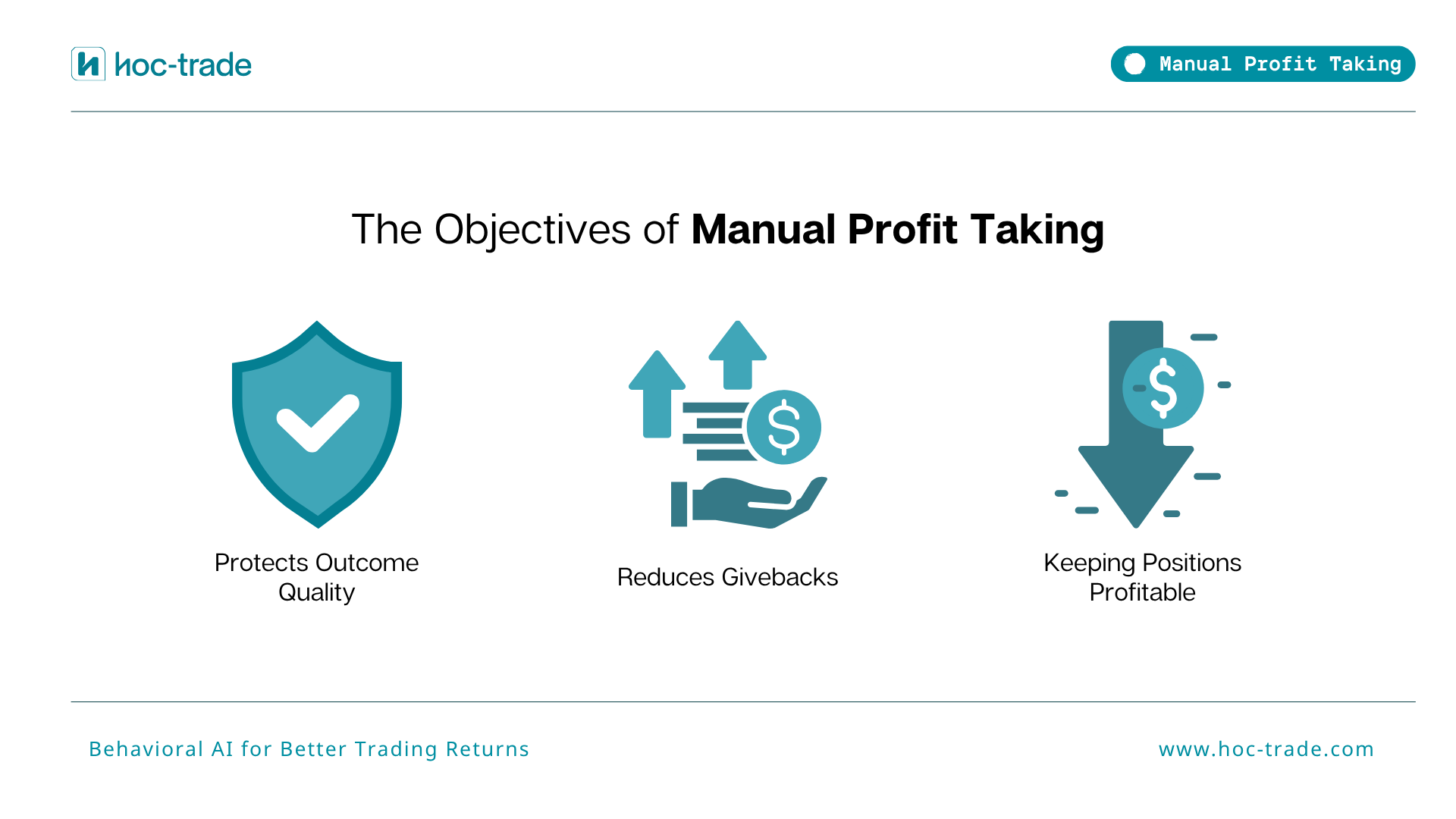
Skilled traders understand their strategies as probability-based, not deterministic. Even strong setups don't work 100 percent of the time. Many profitable systems have hit rates below 50 percent but win more on winners than they lose on losers. This means many trades simply won't unfold as planned. Managing these outcomes is just as critical as managing successful trades for long-term profitability.
A trader constantly reassesses whether their position still has positive expected value or whether staying in means accepting randomness and potential negative value. When a trade setup is invalidated, that's the signal to exit regardless of current profit or emotional attachment to the trade. This flexibility matters most in volatile, fast-moving markets where price swings can reshape a trade's path very quickly.
Why this becomes a trading advantage
Manual profit taking converts exits from fixed outcomes into responsive decisions. Over time, the difference between trades that nearly hit target and those that reverse into a stop loss is the difference between smooth equity curves and choppy, drawdown-heavy ones.
This edge also reflects repeatability in decision quality. The advantage isn't in perfectly predicting reversals. It's in consistently spotting when the payoff profile has deteriorated while profit is still within reach. When exits made manually outperform what would have occurred under static bracket rules, it suggests a trader is extracting information that mechanical rules cannot capture.
Manual profit taking works as an edge because it aligns with markets where momentum shifts, reversals, and acceleration don't respect preset levels. It's less about optimizing individual trades and more about fitting a style of management to environments where conditions change mid-trade.
How this strength is identified and measured
Identifying manual profit taking requires comparing actual outcomes to what would have happened under mechanical rules. TradeMedic's analysis looks at trades closed manually in profit and simulates what would have occurred if the trader had left their take-profit and stop-loss untouched.
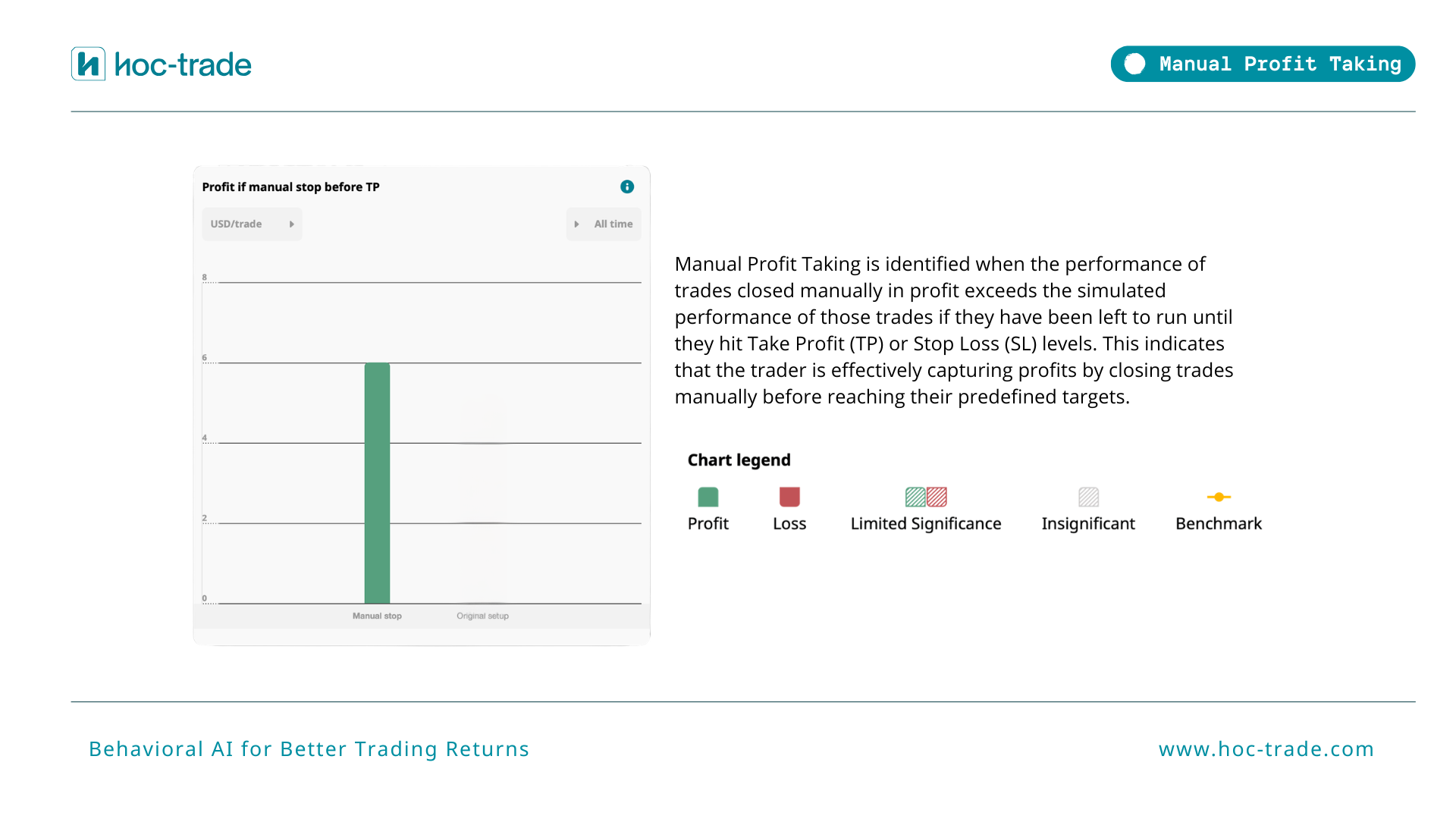
By comparing the realized profit from the manual exit against the simulated result where the preset brackets remain in place, it becomes clear whether manual decisions are actually additive. When performance improves in manually closed trades and the simulation shows worse outcomes from passive waiting, manual profit taking emerges as a measurable execution strength rather than just a post-hoc explanation.
What the data shows about manual profit taking
TradeMedic detects manual profit taking patterns across a dataset of 500,000+ trader accounts. By comparing individual exit behavior against simulated outcomes, the analysis identifies traders who consistently outperform preset rules through reactive position management. This pattern ranks among the meaningful execution strengths that separate consistent performers from others. A detailed breakdown with specific performance metrics is available in our forthcoming manual profit taking data analysis.
Building and refining manual profit taking
Manual profit taking rests on a core principle: trade management is a continuous process, not a one-time commitment to preset levels. The strength is visible in traders' willingness to reassess regularly, to act when the market diverges from the original plan, and to accept smaller wins when the alternative is larger losses.
What matters most is consistency over time. The edge isn't the size of any single successful exit. It's the repeated ability to protect profitable positions from the late-stage reversals that transform winning trades into unnecessary losses. When this pattern shows up reliably across many trades, it becomes a stable and repeatable skill.
TradeMedic AI analyses over 60 behavioural patterns, including blindly following momentum, across 500,000+ trader accounts. Visit TradeMedic to see how it works and get your own personal analysis.
Watch Why Manual Profit Taking is A Reactive Trading Edge