Category:
 Author:
 Date:May 20, 2026
Trend Following: When Directional Alignment Becomes a Repeatable Advantage
Markets move in phases. Sometimes prices organize into clear directional structures where momentum builds, pullbacks resolve quickly, and direction carries further than it first appears. In these windows, the cost of hesitation can be high. But so is overreacting to noise. The real skill isn't predicting the next price move. It's recognizing when the market is already leaning into a direction, and having the discipline to stay aligned until that lean converts into profit.
What is trend following in trading?
Trend following describes a specific execution capability: the ability to consistently profit by entering trades that align with the prevailing market direction. When your trade direction matches both the short-term and medium-term trend environment, performance tends to cluster around outperformance. This might look like taking long exposure in a bullish context, but the underlying principle is constant: you're not fighting direction. You're flowing with it.
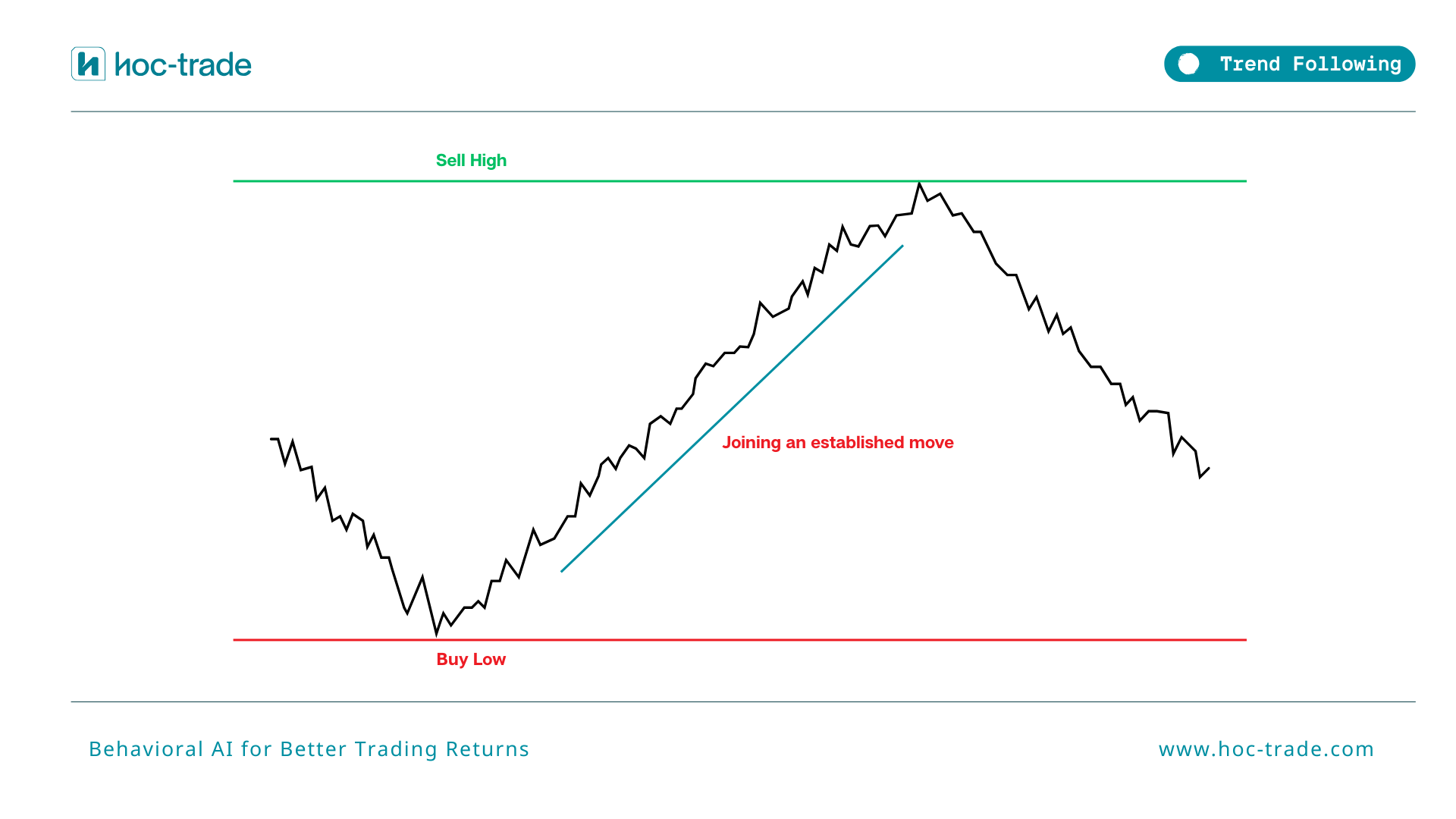
The strength isn't found in any single trade idea. It lives in the execution: taking positions in moves that already have structural directional organization and converting that structure into returns. In its purest form, it includes early recognition of when these trend conditions exist, and the ability to secure profits before a potential reversal erodes the directional advantage that made the trade compelling in the first place.
How do traders profit from trend following?
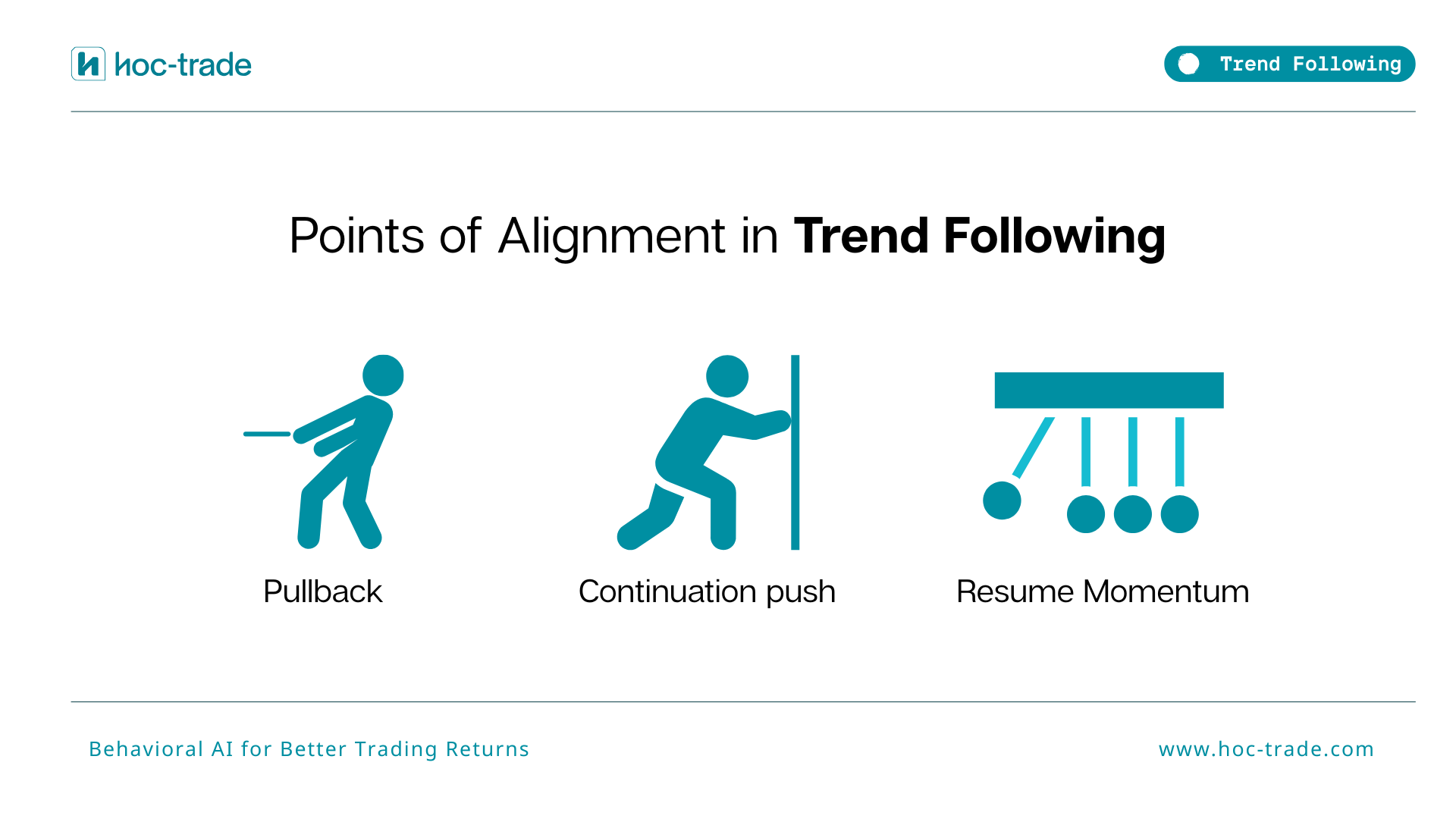
In real execution, trend following shows up as a clear preference for trades that 'agree' with the market structure across more than one timeframe. The best outcomes tend to occur when both short-term and medium-term conditions point in the same direction as the position you're holding. The entry might come during a pullback, a continued push, or a moment of resuming momentum, but the characteristic remains the same: the broader trend is supporting the trade, not fighting it.
Trade management in these conditions tends to stay coherent with trend context. Entries are taken with the assumption that continuation is statistically more likely than immediate reversal. Exits reflect something different: an acute awareness that trends can reverse without warning. Many traders find trailing stop losses or exits at early reversal signals effective because these approaches don't artificially cap upside if the move extends further than initially expected. The result is a recognizable pattern: profits concentrate not from isolated predictions, but from repeatedly capturing the more frequent and more predictable movement that emerges when short-term sentiment and broader price direction align.
Over time, this creates a distinctive footprint. Performance improves measurably in trend-consistent conditions and becomes less dependent on any single outsized win. You're not simply in the market. You're in the market when direction is clearly supportive.
What makes trend following a reliable trading edge?
Trend following becomes an edge because it anchors performance to a specific market environment where execution can be consistently repeated. When the market delivers aligned short- and medium-term direction, decision-making simplifies not because prices are easy to read, but because the universe of valid trade setups narrows significantly. That narrowing supports consistency in a way that general market-taking does not.
The edge also reduces reliance on perfect entry or exit timing. In a trend-aligned context, multiple entry moments and multiple exit moments can work because the broader directional force is carrying part of the load. Over dozens of trades, environmental fit matters more than the precision of any single trade execution. The actual edge is the ability to repeatedly identify and express alignment, capturing price swings that have higher statistical probability of extending, while still treating reversals as a genuine boundary condition rather than an abstract risk that only affects other traders.
How to identify trend following in your trading data
Identifying this strength in your own trading requires comparing performance across different market conditions. The key question is simple: do your trades perform better when they align with the current trend? Specifically, if you classify trades based on the current market trend environment and your trade direction, do positions entered along the prevailing trend show higher average profitability than positions that fight direction?
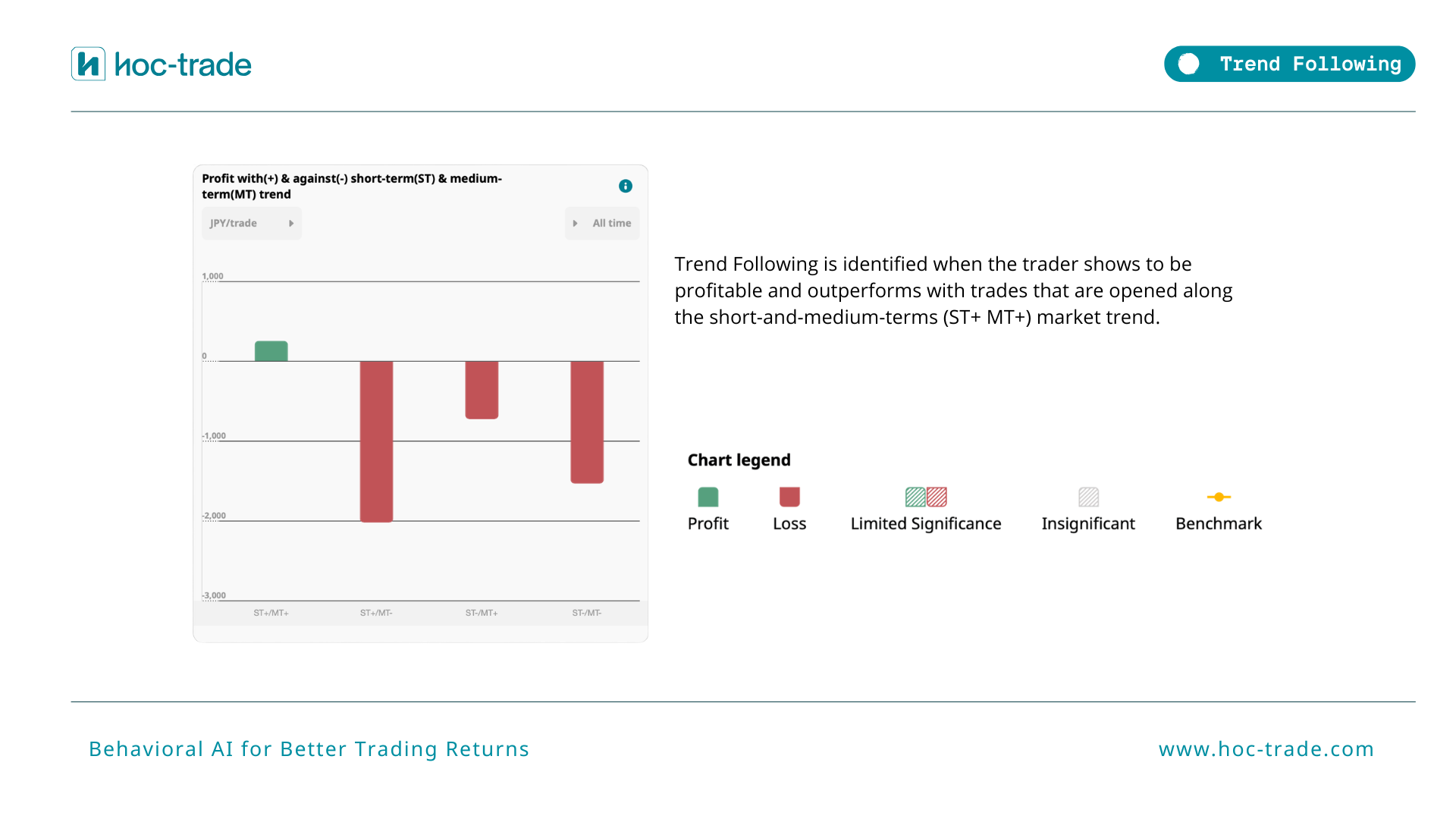
The trend environment can be defined using moving averages on different timeframes. A short-term timeframe like M15 (15-minute) and a medium-term timeframe like H4 (4-hour) provide different perspectives. When both point in the same direction, you have aligned conditions. By comparing average trade outcomes in aligned conditions versus misaligned conditions, you can surface whether directional consistency is consistently associated with better results. This isn't about whether you had a lucky streak. It's about whether directional alignment is a repeatable, detectable characteristic of your profitable trading.
What does the data say about trend following?
TradeMedic AI detects trend following behavior across a dataset of 500,000+ trader accounts and calculates each trader's personal strength in this specific pattern. In our analysis, traders who show strong trend-following capability rank among the highest performers in terms of overall profitability consistency. A detailed statistical breakdown of how trend following correlates with trading performance is available in our dedicated trend following analysis, where we measure both the frequency with which this pattern appears and the performance lift it generates across different market regimes.
Trend following is neither complicated nor rare. Your best trades likely already cluster around moments when you were directionally aligned with the market. The question isn't whether this pattern exists in your trading. The question is whether you can recognize it, measure it, and structure your execution to express it more consistently. When you shift focus from prediction to alignment, from isolation to structure, the market often becomes a little less random and your results a little more repeatable.
TradeMedic AI analyses over 60 behavioural patterns, including trend following as a trading strength, across 500,000+ trader accounts. Visit TradeMedic to see how it works and get your own personal analysis.
Watch: How trend following becomes a repeatable advantage
Frequently asked questions
What exactly is trend following in trading?
Trend following is the ability to consistently profit by entering trades aligned with the prevailing market direction. Rather than trying to predict where prices will go, trend followers recognize established directional structures and stay aligned long enough for that direction to pay. This reduces reliance on perfect timing and concentrates profits in higher-probability movements.
How is trend following different from other trading approaches?
Trend following emphasizes environmental fit over prediction accuracy. Most traders focus on being right about the next move. Trend followers focus on being aligned when the market structure supports their position. This shift from prediction to alignment creates a more repeatable edge because it reduces the number of decision points and anchors performance to conditions where execution can be consistently applied.
How do you know if you have a trend following edge?
Compare your average trade outcomes when they're directionally aligned with short-term and medium-term trends versus when they're not. If trades that match both timeframes significantly outperform trades that fight direction, trend following is likely a real strength in your trading. This isn't about luck; it's about whether directional consistency is statistically associated with your profitability.
Can trend following work in all market conditions?
Trend following works best when markets are organized and directional. In choppy, sideways conditions without clear structure, the edge diminishes because direction isn't carrying the work. The real skill is recognizing when trend conditions exist and staying disciplined about only expressing this pattern in environments where it's likely to pay off.
Is trend following about holding trades forever?
No. Trend following includes early recognition of when trends are ending or reversing. Many traders use trailing stops to let profits extend while protecting against large reversals. The goal is capturing substantial directional moves, not holding through every reversal. The discipline is knowing when to exit before directional advantage erodes.