Category:
 Author:
 Date:May 15, 2026
Selective Trading: How Trading Less Improves Results
Selective trading describes a specific behavioral pattern: generating consistent profits by focusing on a small number of high-quality setups rather than reacting to every opportunity the market presents. It is a style defined not by how much a trader does, but by how deliberately they choose when to act.
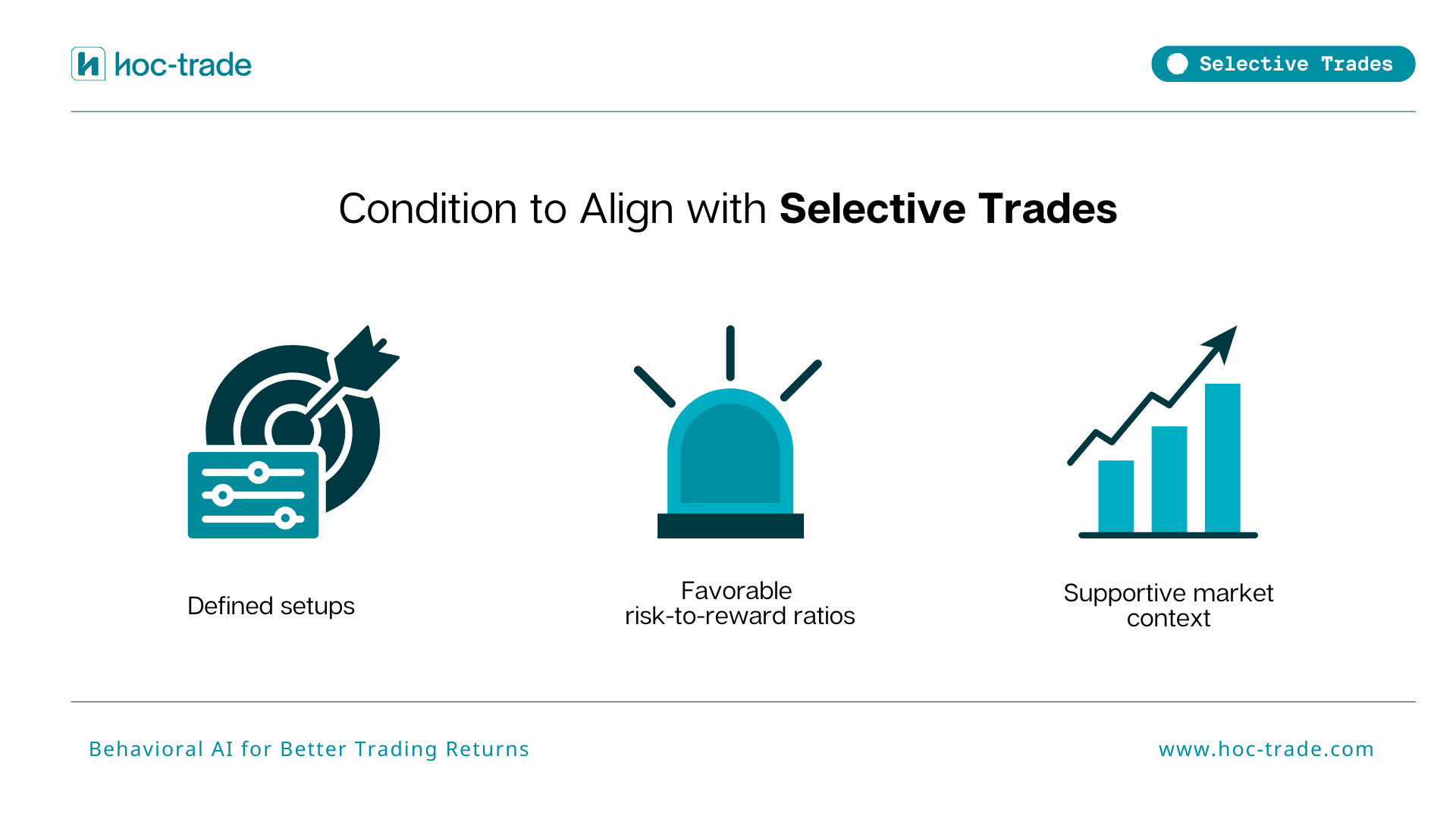
Traders who trade selectively filter each potential setup through clear, predefined criteria. Market structure, risk-to-reward ratio, and broader context all factor into whether a trade gets taken. When those conditions are not met, the response is simple: wait.
That filtering reduces the number of positions entered each session, sometimes considerably. And that restraint is not passive. It creates space for more careful entry planning, tighter risk management, and a calmer mental state throughout the trading day. Overtrading tends to produce the opposite: rushed execution, emotional interference, and diminishing quality across each successive trade.
What does selective trading look like in practice?
In real markets, selectivity does not look dramatic. There is no single visible moment of restraint. It shows up in patterns over time.
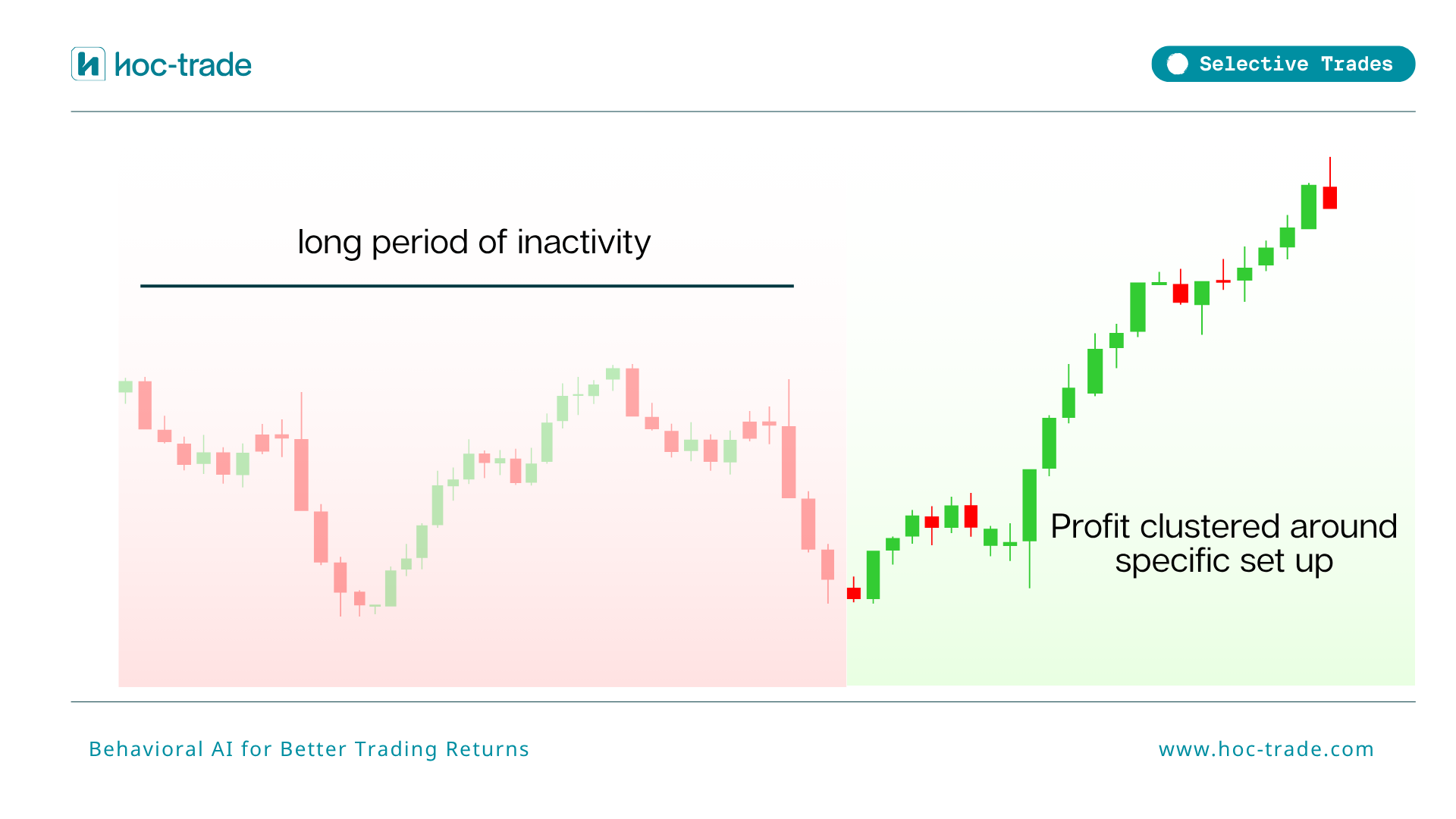
Profits tend to concentrate around specific types of setups. Long periods of inactivity pass without triggering impulsive action. Entries are calm and deliberate, supported by a plan rather than driven by price movement.
Being on the sideline is part of the process. Screening the market for setups that align with your strategy, and waiting for them to appear, is as much a part of trading as the entry, management, and exit itself. That patience reflects a clear understanding of what conditions need to be present before a position is worth taking.
From the outside, a selective trader can look overly cautious. In practice, what looks like hesitation is confidence. It is the ability to accept that not every market movement requires a response, because the edge is not in catching every move. It is in catching the right ones.
Why does trading less often produce better results?
Every trade carries two types of cost: market risk and cognitive load. Most traders monitor the first closely. The second tends to go untracked until it begins to show up in performance.
As trade frequency climbs, so does mental fatigue. Emotions start to influence decisions. Fear, frustration, and the pull of dopamine, where the excitement of being in a trade starts to replace the discipline of choosing good ones, all begin to creep into execution. Trades get taken not because conditions are right, but because inaction feels uncomfortable.
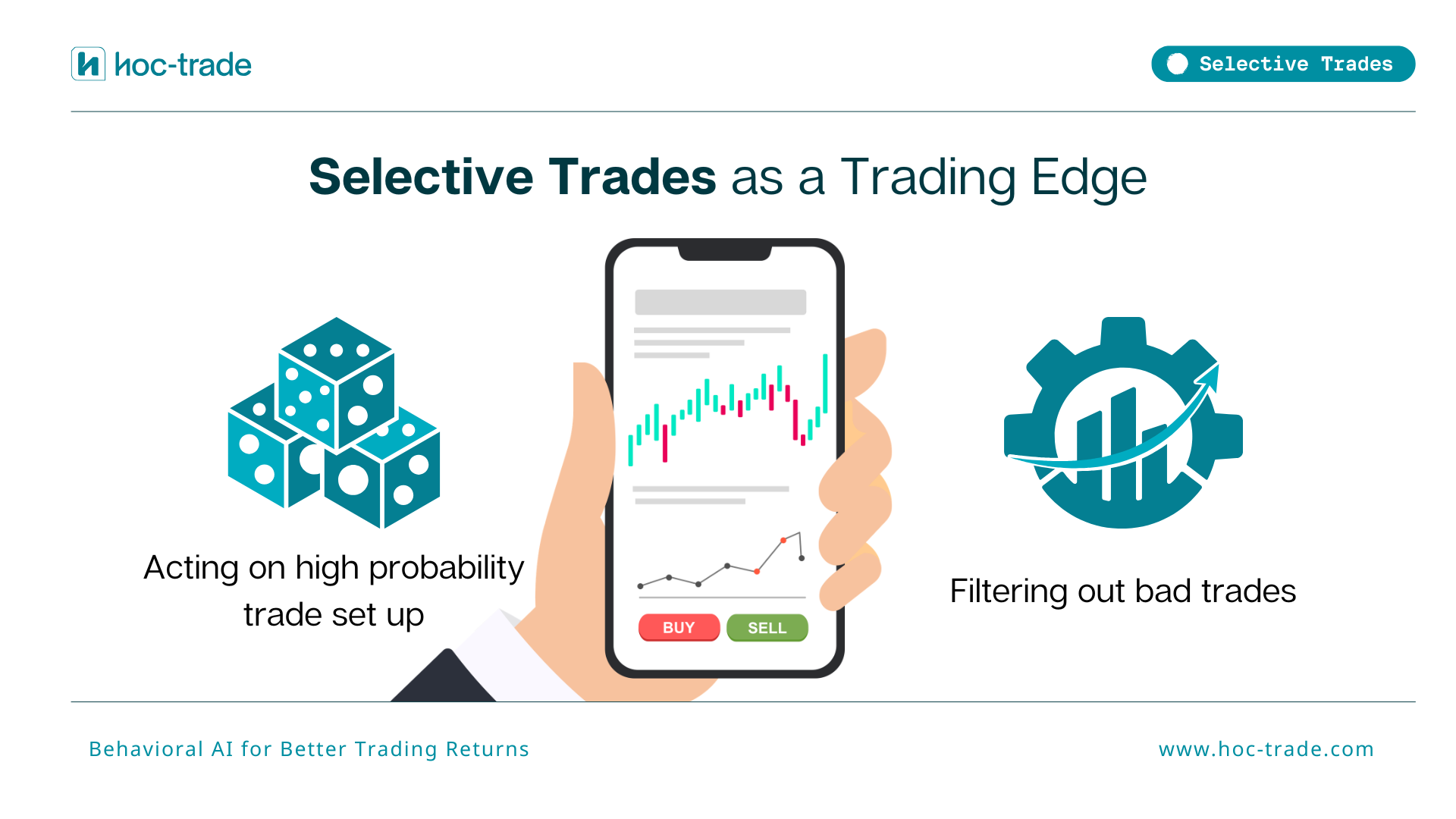
Reducing trade frequency disrupts that cycle. With fewer positions to manage, attention sharpens. Setups can be evaluated without the distraction of an open trade competing for focus. Exits become more precise. Price action gets more of the attention it deserves.
Over time, this shift from activity-driven execution to quality-driven decision-making produces more consistent performance. Not because the market becomes easier, but because the decisions get cleaner.
How does TradeMedic identify selective trading in your data?
TradeMedic identifies selective trading by examining the relationship between trading activity and performance across multiple sessions, rather than applying a label based on perceived intent.
Each session is classified by the number of trades executed that day. That classification lets TradeMedic compare high-activity days with more restrained ones within the same trader's history and track how performance per trade shifts between them.
Selective trading is identified when reduced activity consistently aligns with stronger average performance per trade, while still producing profitable results overall. In this context, trading less does not simply limit losses. It improves execution quality. When profit per trade increases as trade frequency decreases, it points to a trader who is filtering for better setups, not stepping back from the market.
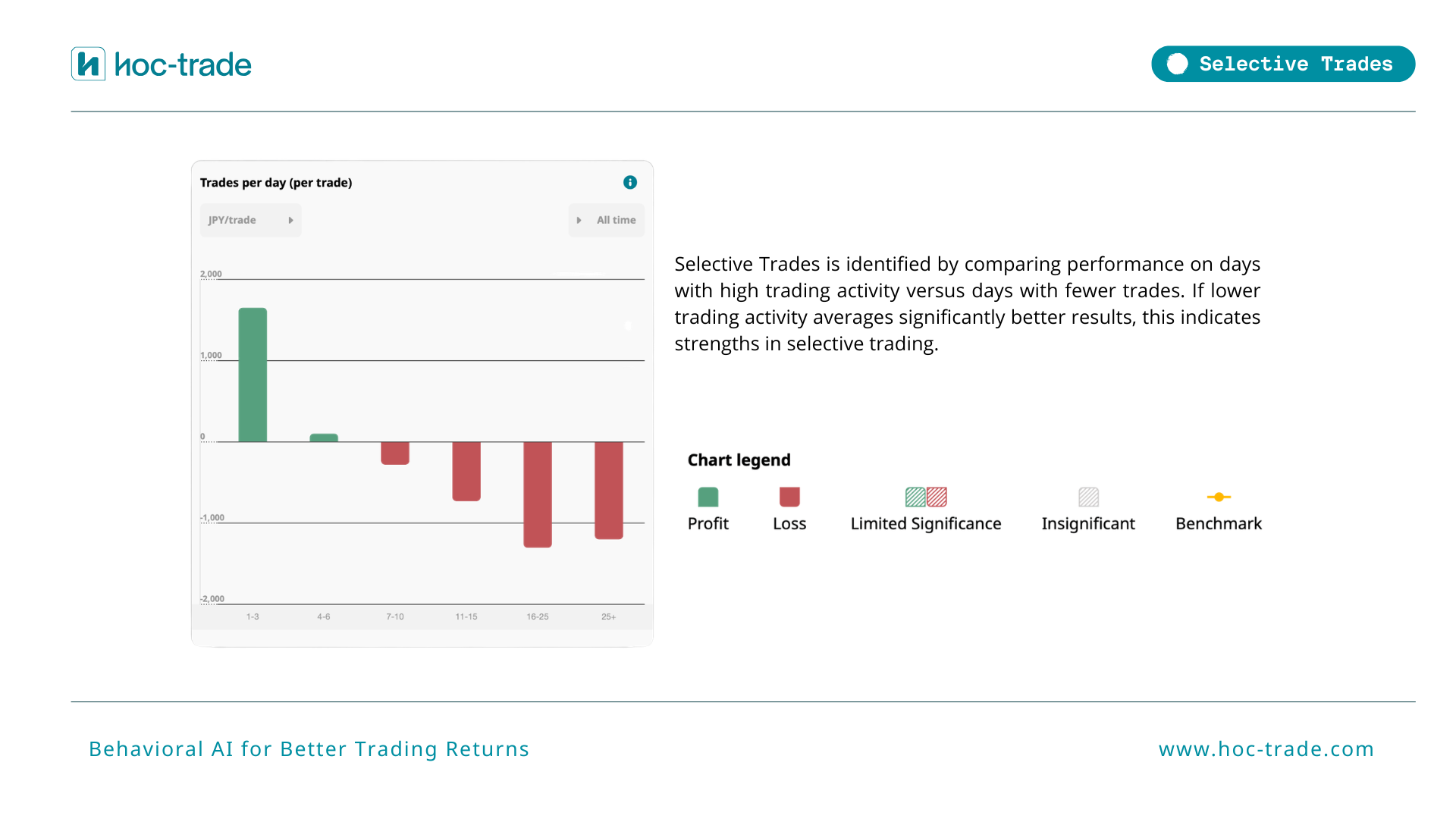
That distinction matters. Lower activity can also reflect uncertainty or a response to a recent drawdown. TradeMedic separates real selectivity from avoidance by confirming that low-activity sessions remain productive and contribute positively to overall results. When restraint reliably leads to better outcomes, selectivity is identified as a measurable behavioral strength, not a defensive response.
How common is selective trading across real trading data?
TradeMedic™ AI detects selective trading across a dataset of 500,000+ trader accounts, measuring each trader's personal behavioral profile by tracking how performance shifts relative to activity levels across sessions.
In that dataset, selective trading ranks among the clearer and more consistent positive behavioral signals we observe. When present, it tends to show up across multiple sessions and correlates with above-average performance stability over time. A detailed breakdown with session-level statistics is available in our selective trading analysis (coming soon).
If you want to see how your own trading frequency maps to performance, TradeMedic gives you a personalised view of that relationship.
What does your selective trading data say about your edge?
When selective trading shows up in a trader's data, it points to something specific: results are being driven by the quality of decisions, not the volume of them. That is a real edge. And it is not one most traders can easily identify without the right reference point.
Patience, structure, and emotional control do not always feel like strengths in the moment. Staying flat during noisy conditions can feel like inaction. Watching price move without participating can feel like opportunity missed. But if the numbers tell a different story, if your best sessions are also your most restrained ones, that relationship is worth understanding and building on.
TradeMedic's research shows that the habits which support long-term performance are often the quiet ones. Knowing your own edge is part of building on it. Visit TradeMedic to see how it works and get your own personal analysis.
Watch How Trading Less Improves Results