Category:
 Author:
 Date:Apr 12, 2026
Golden Times: How Your Best Trading Window Becomes a Repeatable Edge

Trading the same strategy at different times of the day can produce completely different results. Not because the strategy changes, but because the conditions around it do. Market liquidity shifts as global sessions open and close, participation rotates between financial centres, and volatility contracts or expands in ways that reward some approaches and punish others. If your execution quality is noticeably stronger during certain hours, that's worth paying attention to. It may be the most straightforward edge you haven't fully mapped yet.
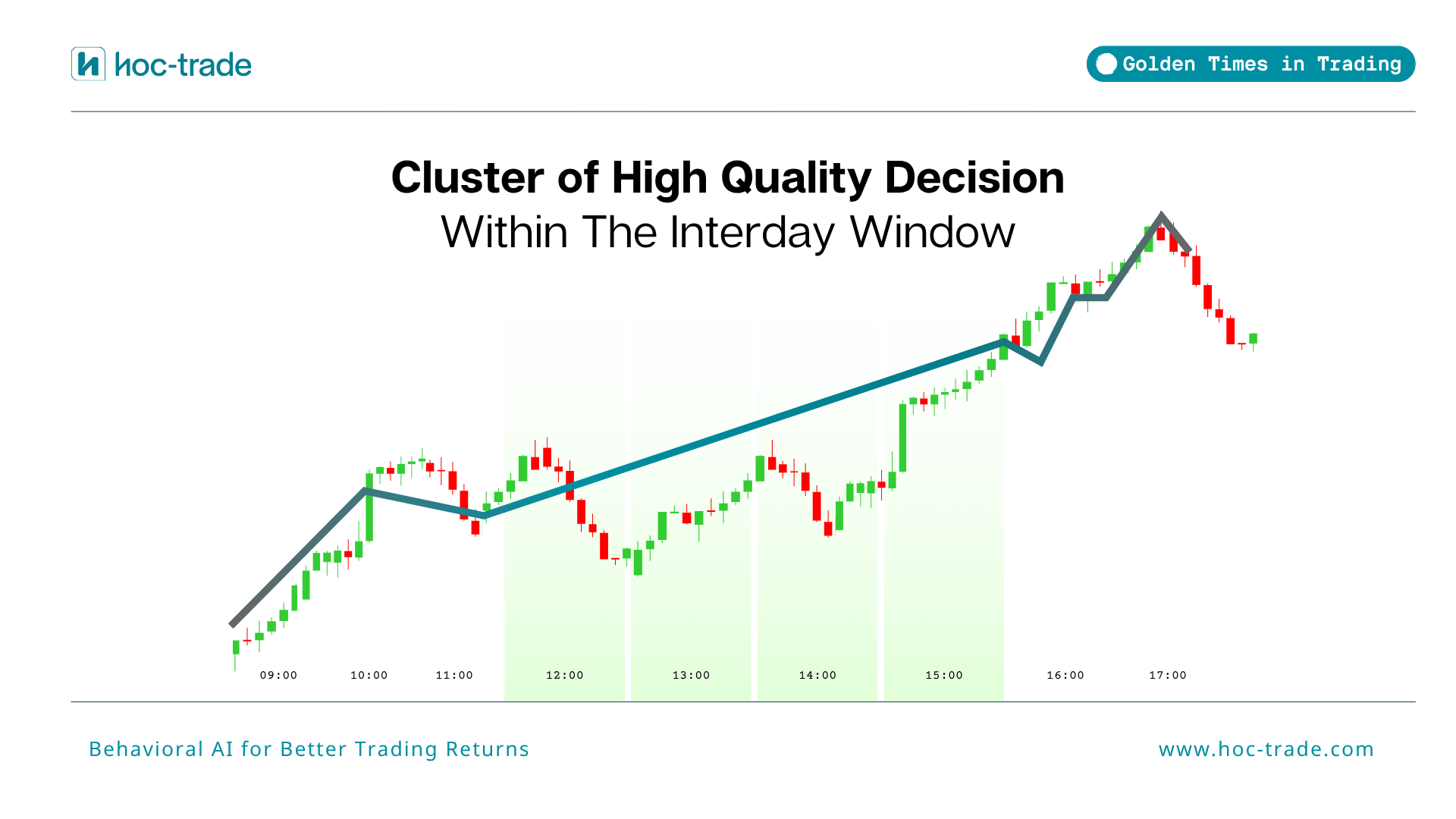
What does Golden Times mean in trading?
Golden Times describes a trader's tendency to consistently outperform during a specific intraday window. It's not about trading more frequently in that period. It's about the quality of what happens there: decisions feel cleaner, execution follows through more reliably, and the trades taken carry a different signature compared to trades opened outside that window.
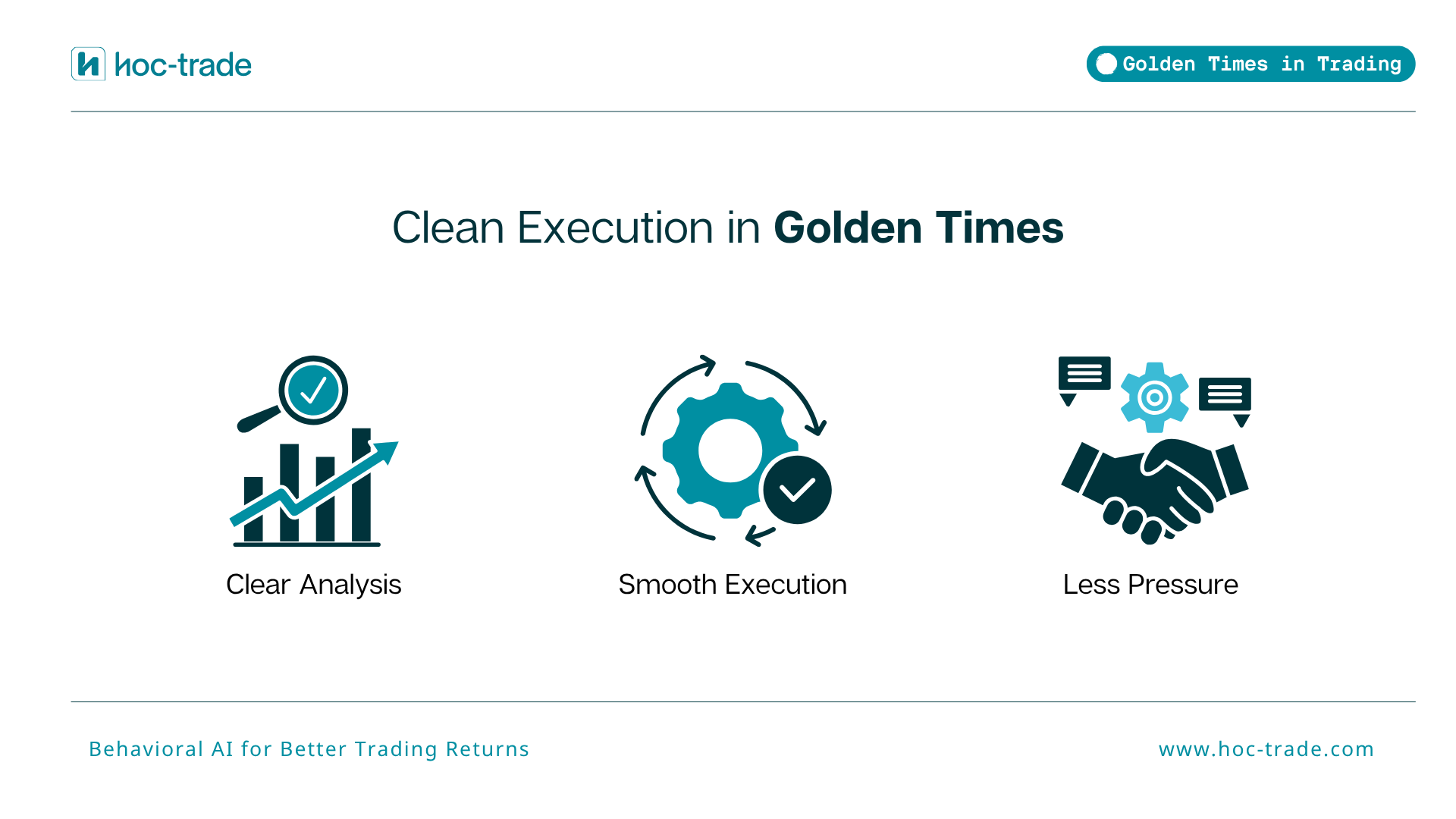
The pattern sits at the intersection of two things: when you're most capable of clear thinking, and when the market is most suited to the way your edge works. Both matter. A trader who's most focused in the morning may still underperform if the session is structurally too thin for their strategy to function. Golden Times is where those two factors reinforce each other rather than pull apart.
How does a Golden Times pattern show up in real trading?
In practice, the pattern shows up as a cluster of better outcomes tied to a recurring time-of-day window. The trades opened there tend to have fewer concessions: less chasing, cleaner entries, exits that follow the plan. Outside that window, the same trader can look meaningfully different, with more forced decisions and a higher rate of compromises made under pressure or distraction.
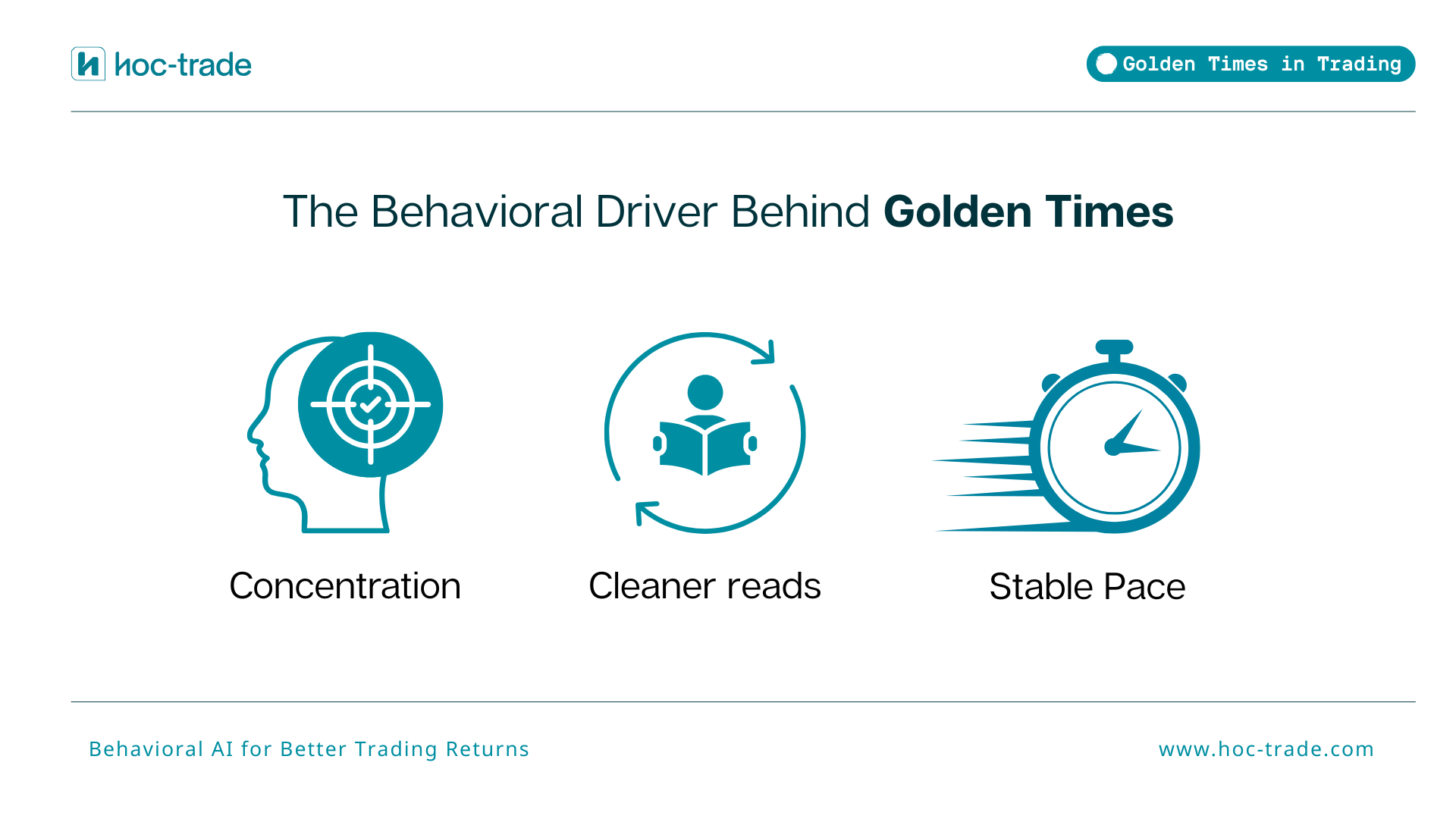
Personal circumstances often drive part of this. Some hours come with fewer interruptions, sharper concentration, or a more settled routine. When attention isn't fragmented, the ability to read and execute improves. A trader might reliably perform better early in the day when they're fresh, or later in the session when distractions have dropped away and their focus finally settles.
Market structure reinforces the same effect. The forex market, for example, has well-defined session textures: the Asian session runs roughly GMT 00:00 to 08:00, the European session from 08:00 to 13:00, the European-American overlap from 13:00 to 17:00, and the remainder through the American session. The overlap window carries stronger liquidity and more decisive movement, which can make execution more straightforward for traders whose edge depends on clear directional participation. Strategy type matters here too: a range-based approach may suit the quieter Asian hours, while a breakout strategy may align better with the volatility of the overlap.
Why is knowing your Golden Times a trading edge?
An edge doesn't have to come from a new idea or a better strategy. It can come from deploying the same strategy in the conditions where it works best. When a trader repeatedly outperforms in a particular intraday window, it signals a stable alignment between their decision quality, their strategy's requirements, and the market's behaviour. That alignment recurs because both the trader's patterns and the market's intraday structure are consistent.
Over time, that stability has real value. Consistency in trading tends to emerge when execution quality stays intact across similar contexts. A trader with a recognised Golden Times window can concentrate their activity where the conditions favour them, reduce exposure during hours where their results are noisier, and build routines around the times when they tend to perform at their best. Individual trades still vary, but the repeating outperformance points to a capability that can be tracked, protected, and built on.
How does TradeMedic detect your Golden Times?
TradeMedic analyses the relationship between the time a trade is opened and the outcome of that trade across your full trading history. It classifies trades by intraday window and looks for a positive correlation between a specific time period and stronger performance, checking whether the pattern recurs rather than appearing randomly across the data.
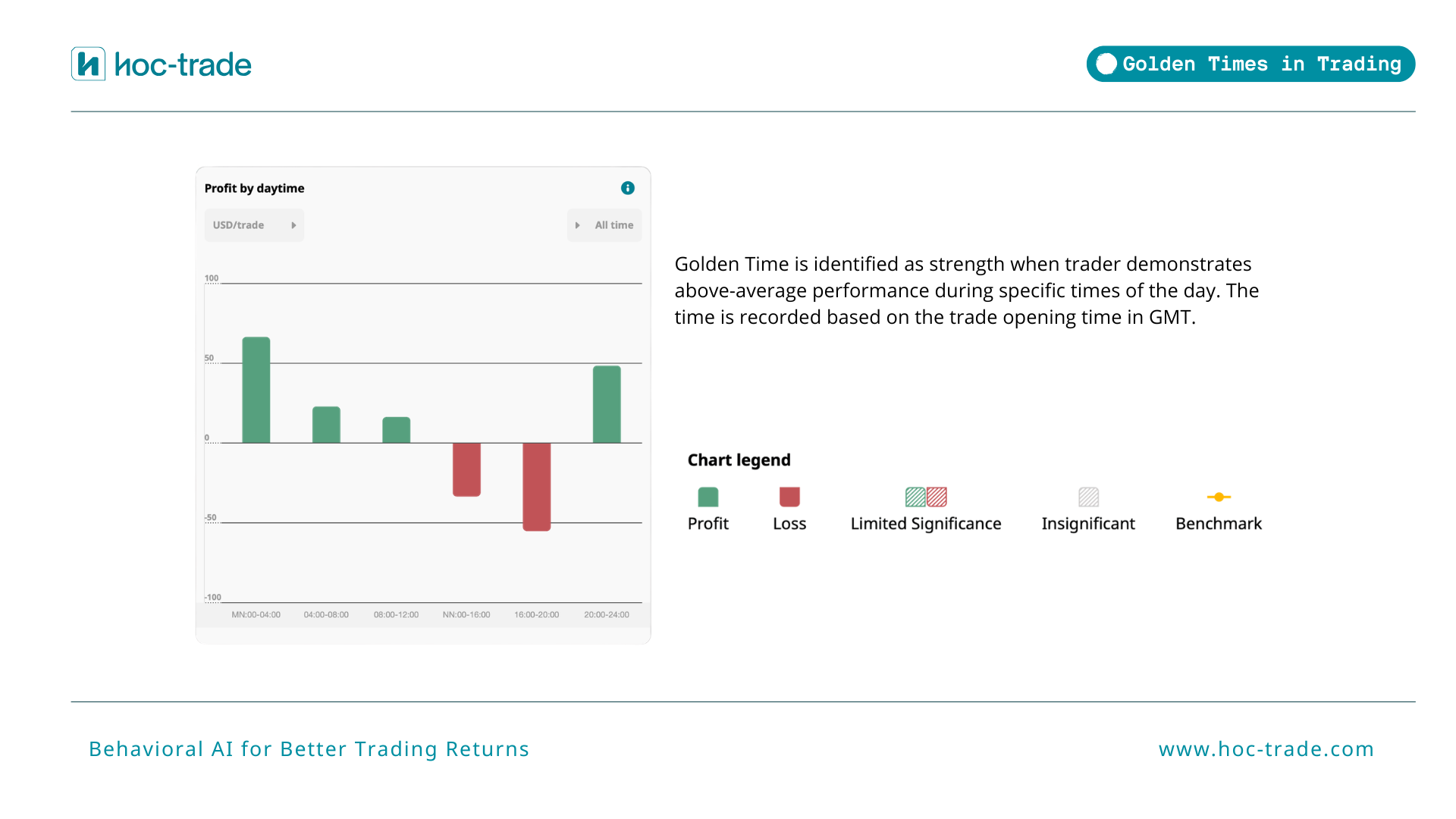
The validation rests on recurrence. If a particular window surfaces repeatedly as a higher-performing context, rather than appearing as a one-off concentration, TradeMedic flags it as a genuine behavioural edge. The emphasis on recurrence matters: a single strong stretch in the morning session isn't Golden Times. The same window producing better outcomes week after week is. For a broader view of how behavioural patterns are identified and measured, the TradeMedic research methodology explains the approach in detail.
What does the data say about time-of-day performance patterns?
TradeMedic detects Golden Times across a dataset of 500,000+ trader accounts, analysing each account individually to calculate where execution quality concentrates through the trading day. In our dataset, time-of-day performance clustering ranks among the most clearly identifiable patterns in the data. Many traders have a Golden Times window without knowing it because the pattern only becomes visible once you look across a large enough sample of their own trades.
TradeMedic's analysis calculates each trader's personal intraday performance profile, surfacing which windows consistently deliver better outcomes and which tend to underperform. A detailed breakdown of the data is available in our Golden Times pattern analysis. [LINK: coming soon]
How can you use Golden Times to improve your trading?
The clearest application is concentration. Once a trader knows which hours consistently produce their best results, they can shift the weight of their activity toward those windows and treat off-peak periods with more caution. This doesn't mean avoiding all trading outside the Golden Times window. It means applying a different level of selectivity, reducing size, or simply not forcing trades in conditions that historically haven't suited them.
Golden Times isn't a fixed trait. It can shift as a trader's routine changes, as their strategy evolves, or as market conditions move through different regimes. Treating it as a live, observable signal rather than a permanent label is what gives it ongoing value. Traders who track patterns like this alongside other behavioural tendencies, such as how they respond to drawdowns or whether they show signs of overtrading, tend to build a more complete picture of where their edge actually sits.
The same trader can look very different across the trading day. Golden Times is the data-backed way to find out when they look their best.
TradeMedic AI analyses over 60 behavioral patterns, including Golden Times, across 500,000+ trader accounts. Visit TradeMedic to see how it works and get your own personal analysis.
Watch: How golden times reveal your best trading window
Frequently asked questions
What is Golden Times in trading?
Golden Times refers to a trader's tendency to consistently outperform during a specific time-of-day window. It reflects the alignment between a trader's best decision-making state and market conditions that consistently suit their strategy. TradeMedic detects this pattern by analysing each trader's intraday performance across 500,000+ accounts.
Why do traders perform better at certain times of day?
Two factors combine: personal concentration levels and market structure. A trader may be more focused and less distracted during specific hours, which improves execution quality. At the same time, global market sessions create distinct intraday textures, with some windows offering stronger liquidity and clearer directional movement that suits certain strategies better than others.
How does TradeMedic identify a trader's Golden Times window?
TradeMedic classifies each trade by the time it was opened, then looks for a positive correlation between a specific intraday window and stronger outcomes. The pattern is only flagged as Golden Times if it recurs consistently across the trading history rather than appearing as an isolated cluster. Recurrence is the key validation test.
Which trading session has the most favourable conditions for active traders?
The European-American overlap (roughly GMT 13:00 to 17:00) is often cited for its stronger liquidity and more decisive price movement. However, the best session for any individual trader depends on their strategy type and personal schedule. A range-based trader may find the quieter Asian session suits them better than the volatile overlap.
Can Golden Times shift over time?
Yes. Golden Times is an observable pattern, not a fixed trait. It can change as a trader's daily routine shifts, as their strategy evolves, or as broader market conditions change. Treating it as a live signal to monitor rather than a permanent label keeps it useful as a practical edge.