Category:
 Author:
 Date:Jun 9, 2026
Initial Trade Setup: Where Trading Edge Begins

The first decision in a trade carries more weight than most traders give it credit for. Not because markets are predictable, but because the quality of that initial decision determines what options remain when things don't go to plan. A well-constructed entry can survive adverse movement without escalating intervention. A poorly constructed one is already relying on what comes next.
Initial Trade Setup is the capability to identify and execute trade opportunities that hold positive expected value on their own, without needing repair work after they move into loss. It's a foundational edge, and one that's more distinct than it might sound.
What does Initial Trade Setup mean in practice?
A trader with strong Initial Trade Setup can produce a sequence of trades that reach their take-profit or close in profit, without depending on follow-on positions to rescue those outcomes. The edge sits at the front of the trade: in the selection of the opportunity, the timing of the entry, and the structural soundness of the idea before price confirms or denies it.
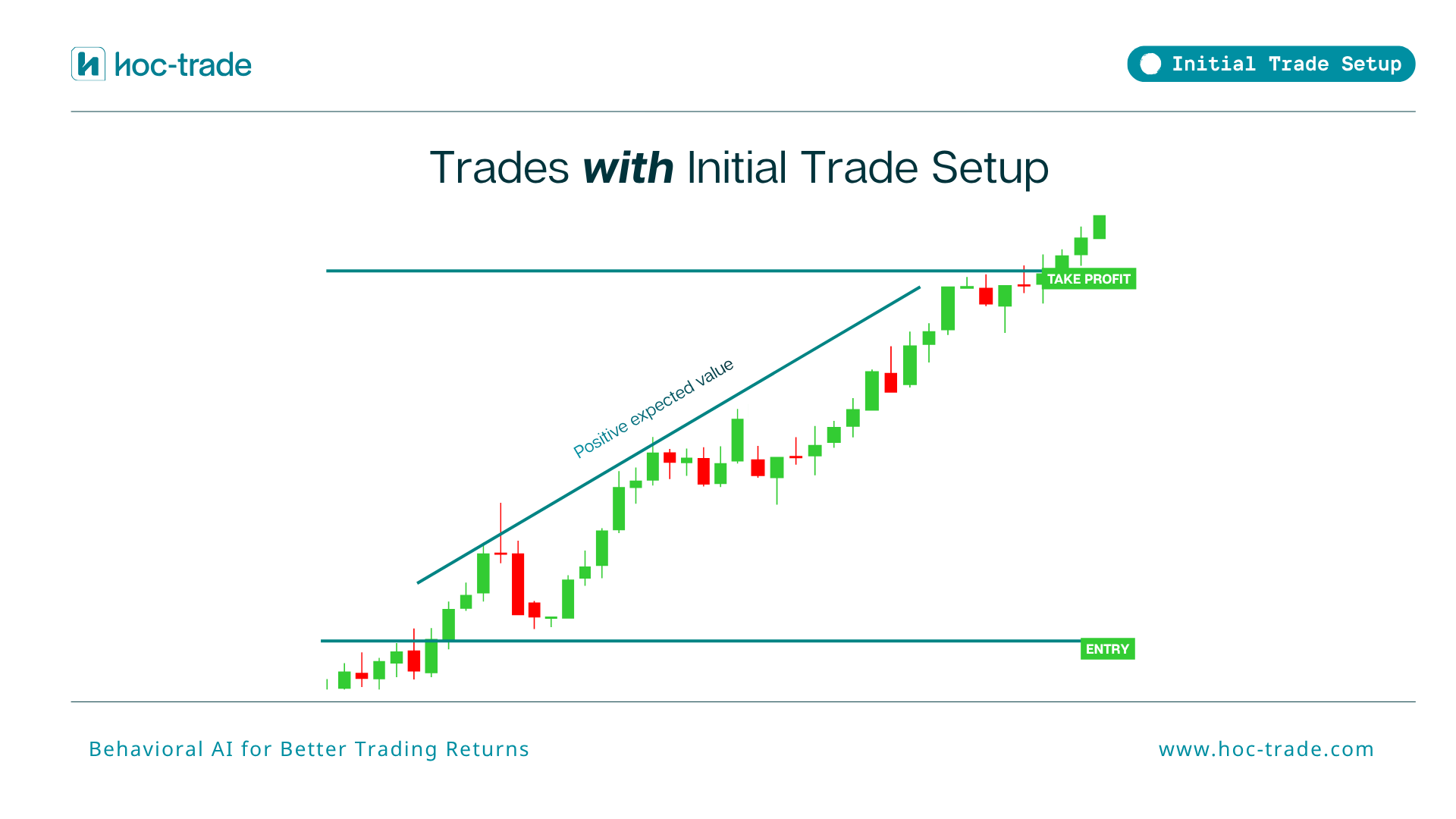
What makes this capability recognisable is also what makes it fragile in practice. Many traders who demonstrate clear Initial Trade Setup strength simultaneously undermine it by refusing to accept a loss when it arrives. A trade that starts well becomes the seed of a doubling-down sequence, and the original edge gets buried under the weight of everything added afterward.
Why do traders with good entries still end up losing?
The answer, in most cases, isn't the entry. It's the response to the entry once it moves into loss.
When a loss trade isn't accepted, it transforms. What begins as a single position becomes a DCA sequence: new trades added at worse prices, each one adding exposure in an attempt to recover what the original trade couldn't on its own. At scale, this behaviour starts to resemble Martingale logic, where positions double until either breakeven is reached or the sequence ends with a very large loss, including the possibility of a margin call.
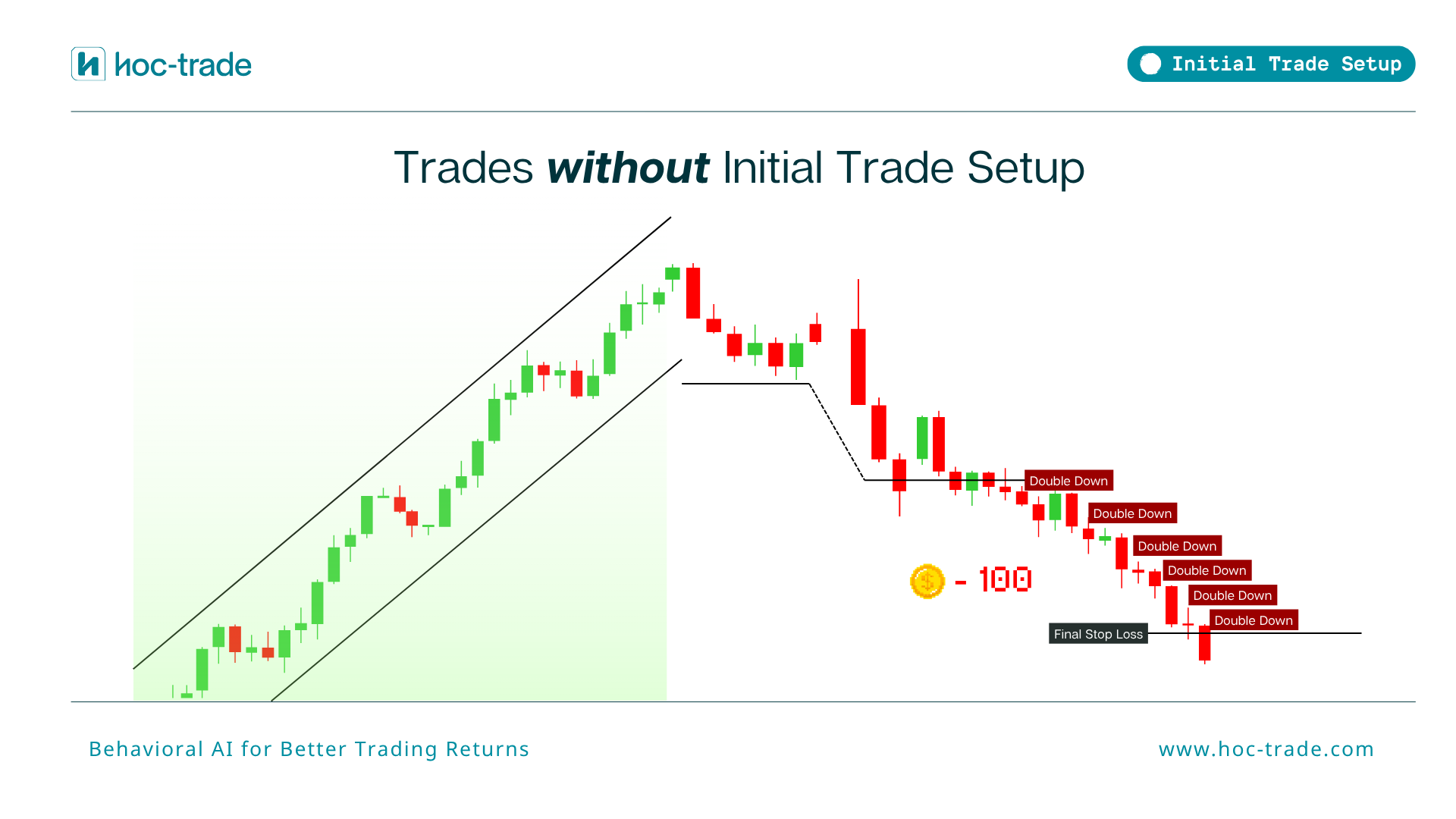
A concrete example makes the asymmetry visible. A trader runs a series of profitable entries, accumulating 200 pips across well-executed trades. Then one trade moves against them. Instead of closing it, they pull the stop and begin adding. The initial position produces a 100-pip loss, manageable on its own. But by the time the sequence ends, the additions have created a total loss of 400 pips on that single trade. The 200 pips built carefully over many trades gets more than erased by one decision not to accept a loss.
How does doubling down affect overall trading performance?
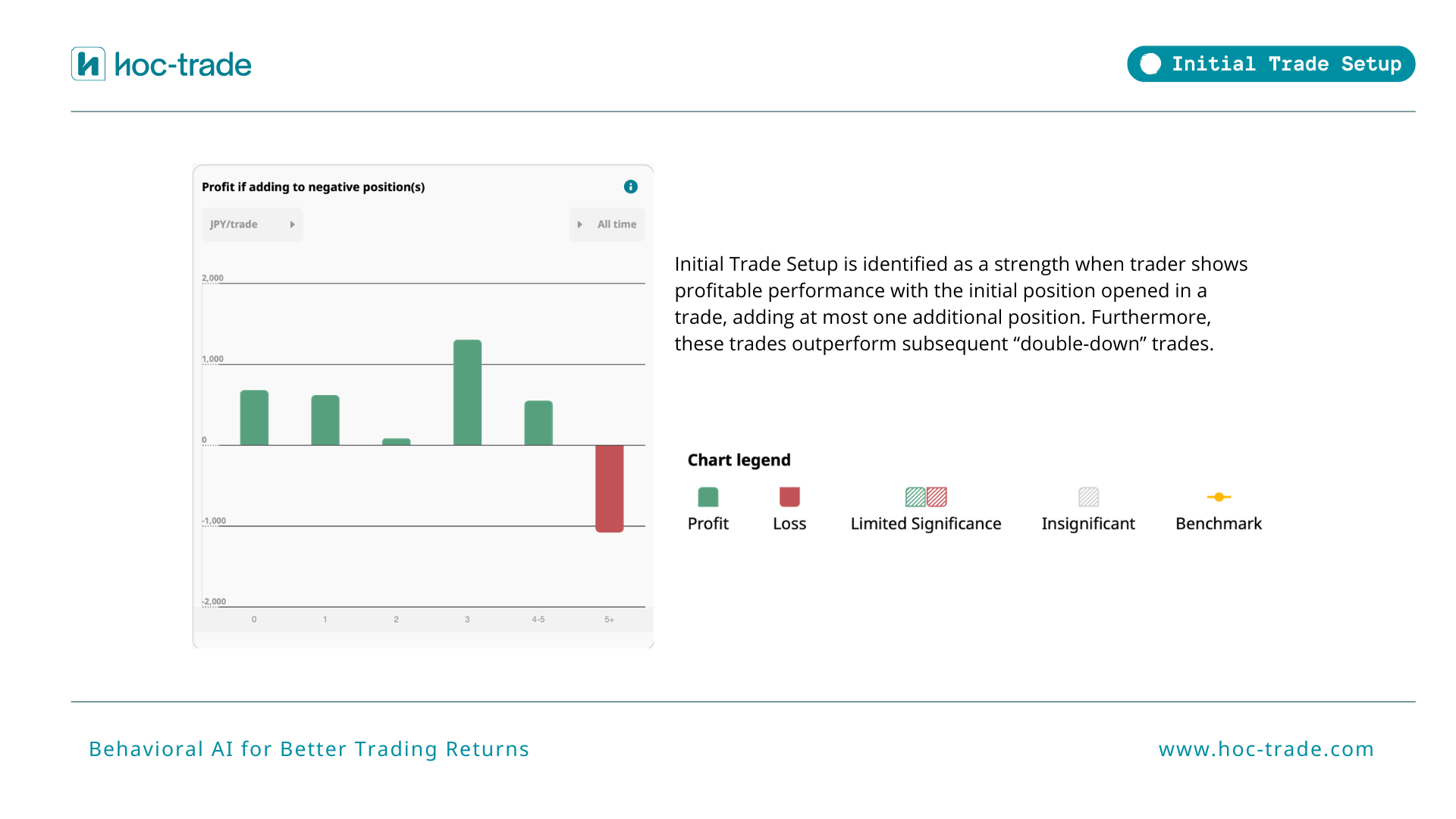
The performance impact of DCA behaviour isn't uniform. TradeMedic's analysis looks specifically at how outcomes shift as the number of loss-position additions increases, and the pattern is consistent: performance tends to stay positive when the original trade is held close to its initial structure, with at most one or two follow-on positions. As additional DCA trades accumulate, that outperformance fades.
This creates a split within the same trading behaviour. In the minimal-doubling group, the trader's Initial Trade Setup shows up clearly: the entries carry real positive expected value, and the results reflect it. In the extended-DCA group, those same entries become indistinguishable from the outcomes they're buried under. The edge doesn't disappear, but its contribution is overwhelmed.
For a detailed breakdown of how DCA trading behaviour is measured and categorised, see the TradeMedic research page.
What is the connection between Initial Trade Setup and trading edge?
An edge, in trading, is repeatable. A single good outcome isn't an edge; a consistent source of positive expected value is. Initial Trade Setup qualifies as an edge precisely because it produces that consistency from a stable origin: the quality of the opportunity and the execution, not the scale of the adjustment required to recover it.
When profitability depends on escalating trade repair rather than initial setup quality, the performance profile becomes uneven. A small number of heavily expanded loss sequences can outweigh a long run of well-constructed trades. The initial entries may be strong throughout, but the account result doesn't reflect them.
The distinction matters for how traders approach improvement. Focusing on entry quality, stop discipline, and the ability to accept a single loss as a single outcome (rather than the start of a recovery sequence) protects the edge that's already present. It also tends to surface other related patterns worth examining, including overtrading tendencies that compound the problem.
What does the data say about Initial Trade Setup behaviour?
TradeMedic detects Initial Trade Setup across a dataset of 500,000+ trader accounts, analysing the relationship between DCA frequency and performance to identify whether a trader's edge lives in their entries or in their adjustments. The detection approach compares trade groups by the number of open loss positions active at the time of each additional entry, which surfaces whether outcomes cluster around minimal-intervention trades or around extended doubling-down sequences.
Where Initial Trade Setup strength is confirmed, TradeMedic calculates each trader's personal risk profile for this behaviour, including the point at which DCA additions begin to erode rather than support overall performance. A detailed data breakdown is available in the Initial Trade Setup pattern analysis.
How can traders protect their Initial Trade Setup edge?
The clearest intervention is also the most difficult one: treating a loss trade as a completed outcome rather than an open problem. Traders who can do this consistently preserve the performance their entries are already producing.
In practice, that means setting clear rules around when follow-on trades are and aren't acceptable, and holding to them when a position is in drawdown. One or two DCA positions are often consistent with positive expected value, depending on the setup. Beyond that, the data tends to show diminishing returns and increasing exposure to the kind of outlier loss that resets a long run of good work.
Understanding which category you're in requires looking at your own data rather than relying on intuition. Traders who believe their entries are strong and their DCA behaviour is controlled often find, when the numbers are broken down, that the two groups tell different stories. TradeMedic's analysis is designed to make that split visible.
TradeMedic AI analyses over 60 behavioural patterns, including Initial Trade Setup as a trading strength, across 500,000+ trader accounts. Visit TradeMedic to see how it works.
Watch How Initial Trade Setup is A Trading Edge
Frequently asked questions
What is Initial Trade Setup in trading?
Initial Trade Setup refers to a trader's ability to identify and execute trade opportunities that carry positive expected value without requiring adjustments after the trade moves into loss. It measures whether the edge lives in the entry itself rather than in the recovery work that follows. Traders with strong Initial Trade Setup can produce profitable outcomes from the quality of their first decision alone.
Why do traders undermine their own trade setups with doubling down?
When a trade moves into loss, closing it means accepting a defined outcome. Many traders find this psychologically difficult and instead add to the position, hoping to recover at a better average price. This DCA behaviour can produce short-term recoveries, but it increases risk exposure significantly and can turn a manageable loss into a very large one if the position continues to move against them.
How does DCA trading affect performance over time?
The impact of DCA behaviour depends on how far it extends. TradeMedic's analysis of 500,000+ trader accounts shows that performance tends to remain positive when a loss position involves only one or two follow-on trades. As additional DCA positions accumulate, performance typically deteriorates. A small number of heavily expanded loss sequences can erase the gains from a long run of well-executed entries.
What is the difference between DCA trading and Martingale behaviour?
DCA trading involves adding to a losing position at progressively better prices to reduce the average entry cost. When this behaviour escalates, doubling position size with each addition until breakeven or a large loss is reached, it begins to resemble Martingale logic. The key risk is that while the strategy can recover small losses repeatedly, a single large adverse move can produce catastrophic drawdowns, including a margin call.
How does TradeMedic identify Initial Trade Setup strength in a trader's account?
TradeMedic analyses trading accounts by grouping trades based on how many open loss positions exist at the point each additional trade is entered. By comparing performance across these groups, the tool can identify whether a trader's positive results cluster around minimal-intervention trades (indicating strong Initial Trade Setup) or around extended doubling-down sequences. This analysis is applied across a dataset of 500,000+ accounts to calculate each trader's personal risk profile for this behaviour.