Category:
 Author:
 Date:Jun 13, 2026
Why Open P&L Pressure Changes the Way Traders Decide
What Is Emotionless Trading?
Emotionless trading describes a trader's ability to keep making rational decisions while other positions are still open and still moving. It is not about switching feeling off entirely. It is about how steady a trader's process stays when unrealized profit or loss is sitting on the table in real time. When open exposure is small, most traders execute closer to their original plan. Once a position swings meaningfully into profit or loss, that steadiness tends to slip, even for experienced traders.
How Does Open Profit and Loss Affect Trading Decisions?
Two different pressures show up depending on the direction of the swing. A large unrealized gain tends to push traders toward overconfidence: sizing up, holding past the original target, or chasing a bigger number simply because the position is already winning. A large unrealized loss tends to push in the opposite direction, toward impulsive decisions that abandon the plan altogether, closing early out of fear or adding to the position out of frustration.
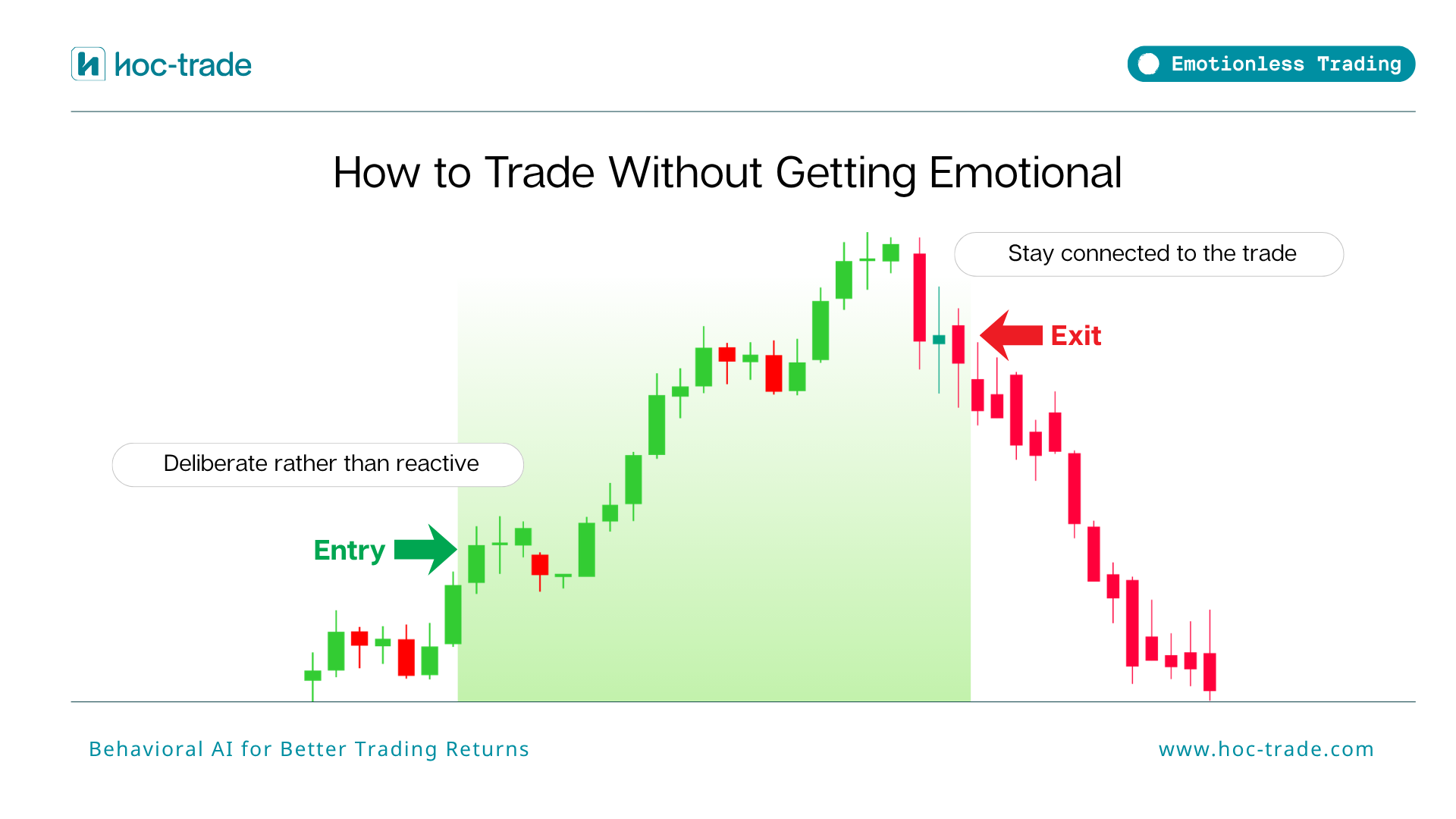
Neither response looks like weakness on its own. Both are simply what happens when attention shifts from the trade itself to the number sitting next to it. The traders who keep their edge are the ones whose entries and exits look roughly the same whether the open P&L reads plus two percent or minus two percent.
Why Does Emotionless Trading Give Traders an Edge?
Repeatability is the real prize here. A strategy only works if it gets executed the same way trade after trade. When decisions bend around whatever is currently open, results start to reflect mood and market noise more than the strategy itself. Keeping execution anchored during neutral open P&L stretches protects that repeatability, reduces self-inflicted variance, and lets the underlying edge show up in the numbers instead of getting buried under reactive decisions.
How Does TradeMedic Detect Emotionless Trading?
TradeMedic looks at the relationship between a trader's open positions and the outcome of new trades entered alongside them. Each new entry gets tagged with the open P&L state of other positions live at that moment, whether that state is minor, strongly positive, or strongly negative. Performance is then compared across those states. When results are consistently stronger during minor open P&L and weaker during large swings in either direction, the system flags emotionless trading as an active strength rather than a hopeful self-assessment.
What Does the Data Say About Emotionless Trading?
TradeMedic™ AI tracks this pattern across a dataset of 500,000+ trader accounts, comparing execution quality against the open P&L conditions present at the moment of each new trade. Traders who show this strength consistently post steadier results when unrealized P&L stays small, a pattern that tends to show up alongside related behaviours like anxious trade exits and overtrading. A full statistical breakdown of this pattern is coming soon on the TradeMedic research page.
How Can Traders Build This Strength?
This is often framed as a discipline problem, and discipline is part of it. But there is more going on underneath: the brain reacts to a live, moving number the same way it reacts to any open loop, with rising urgency the bigger that number gets. Traders working on this strength often do better by deliberately timing new entries for moments when other positions are quiet, or by setting a personal threshold, a specific unrealized gain or loss level, past which they slow down and double check the plan before acting.
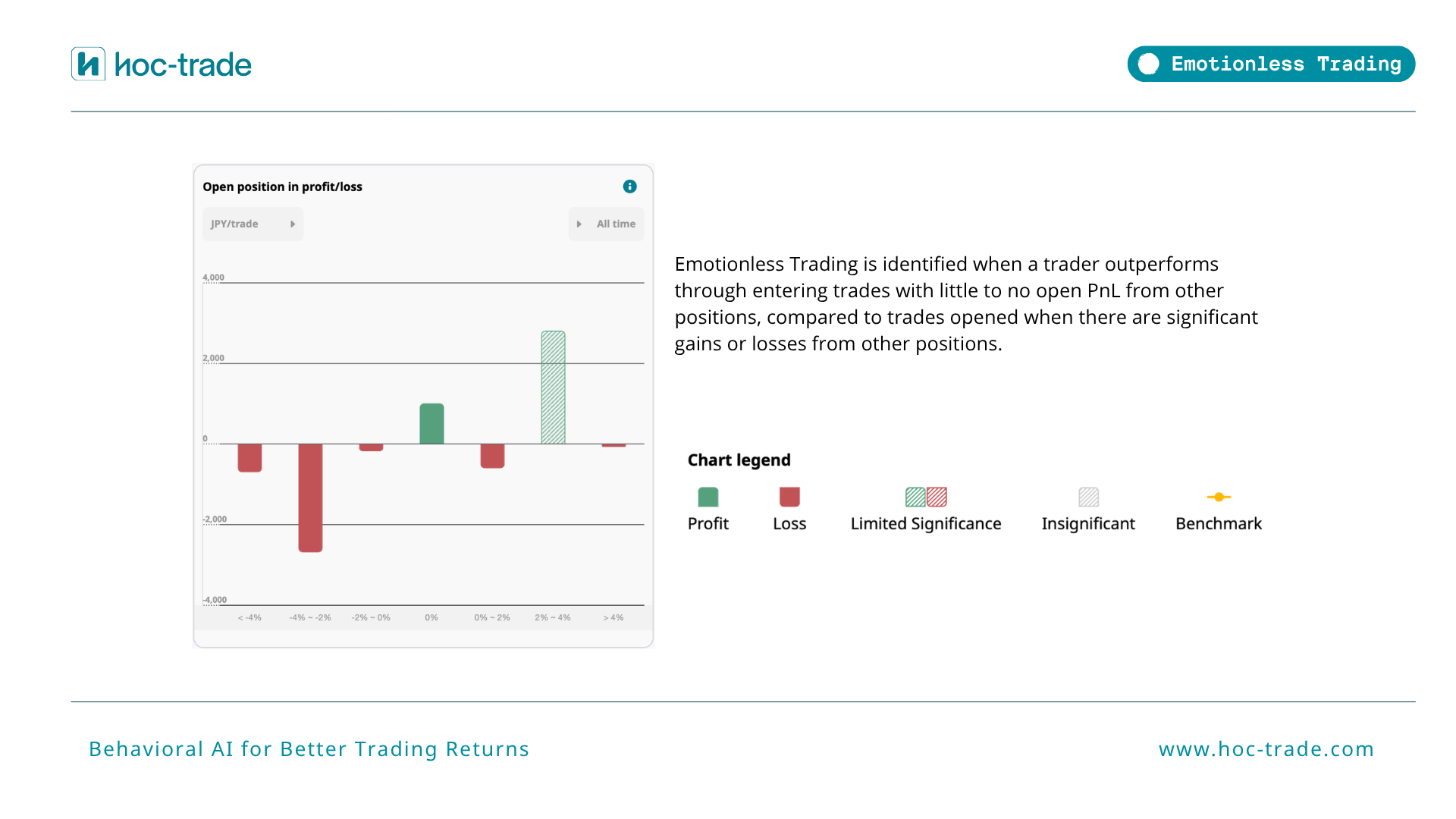
The goal isn't to feel nothing. It's to keep the trade itself in view even when the scoreboard gets loud. Tools like TradeMedic exist to make that gap between scoreboard and plan visible, so traders can see exactly where their own threshold sits and build the habit on purpose rather than by accident.
TradeMedic AI analyses over 60 behavioral patterns, including Emotionless Trading as a trading strength, across 500,000+ trader accounts. Visit TradeMedic to see how it works.
Watch How Open P&L Pressure Changes the Way Traders Decide
Frequently asked questions
What is emotionless trading?
Emotionless trading is a trader's ability to make consistent decisions without being swayed by the size of unrealized gains or losses in open positions. It shows up most clearly when open P&L stays minor, since attention remains on the trade itself rather than the running total. TradeMedic tracks this as a specific behavioural strength within its 500,000+ account dataset.
Why does a big unrealized profit affect trading decisions?
A large open gain often pushes traders toward overconfidence, holding longer than planned or taking on extra risk to chase a bigger result. The position already winning creates pressure to protect or extend that outcome rather than follow the original plan. This is one of two directions open P&L pressure can pull execution.
Why does a big unrealized loss affect trading decisions?
A large open loss tends to trigger impulsivity, closing early out of fear or adding to the position out of frustration. Both reactions move the trader away from their original strategy. TradeMedic's data shows performance typically weakens once unrealized losses grow large at the moment new trades are entered.
How does TradeMedic detect emotionless trading?
TradeMedic classifies each new trade by the open P&L state of a trader's other live positions, minor, strongly positive, or strongly negative, then compares performance across those states. When results are consistently stronger during minor open P&L, the system flags emotionless trading as an active strength.
How can traders build this strength?
Traders can set a personal unrealized P&L threshold that signals when to slow down and recheck the plan before acting. Timing new entries for moments when other positions are relatively quiet also helps keep decisions anchored to the trade instead of the scoreboard.