Category:
 Author:
 Date:Mar 20, 2026
Catching Short-Term Trends: Where Fast Markets Meet Fast Decisions

Some of the sharpest moves in the market last minutes, not days. An intraday break, a brief surge in momentum, a window that opens and closes before most traders have finished reading the chart. Short-term trend trading is about being ready for those moments. From the outside it can look reactive, almost impulsive. In practice, traders who do this well are running a precise, repeatable process. The spontaneity is a performance, the skill underneath it is anything but.
What does it mean to Catch Short-Term Trends in trading?
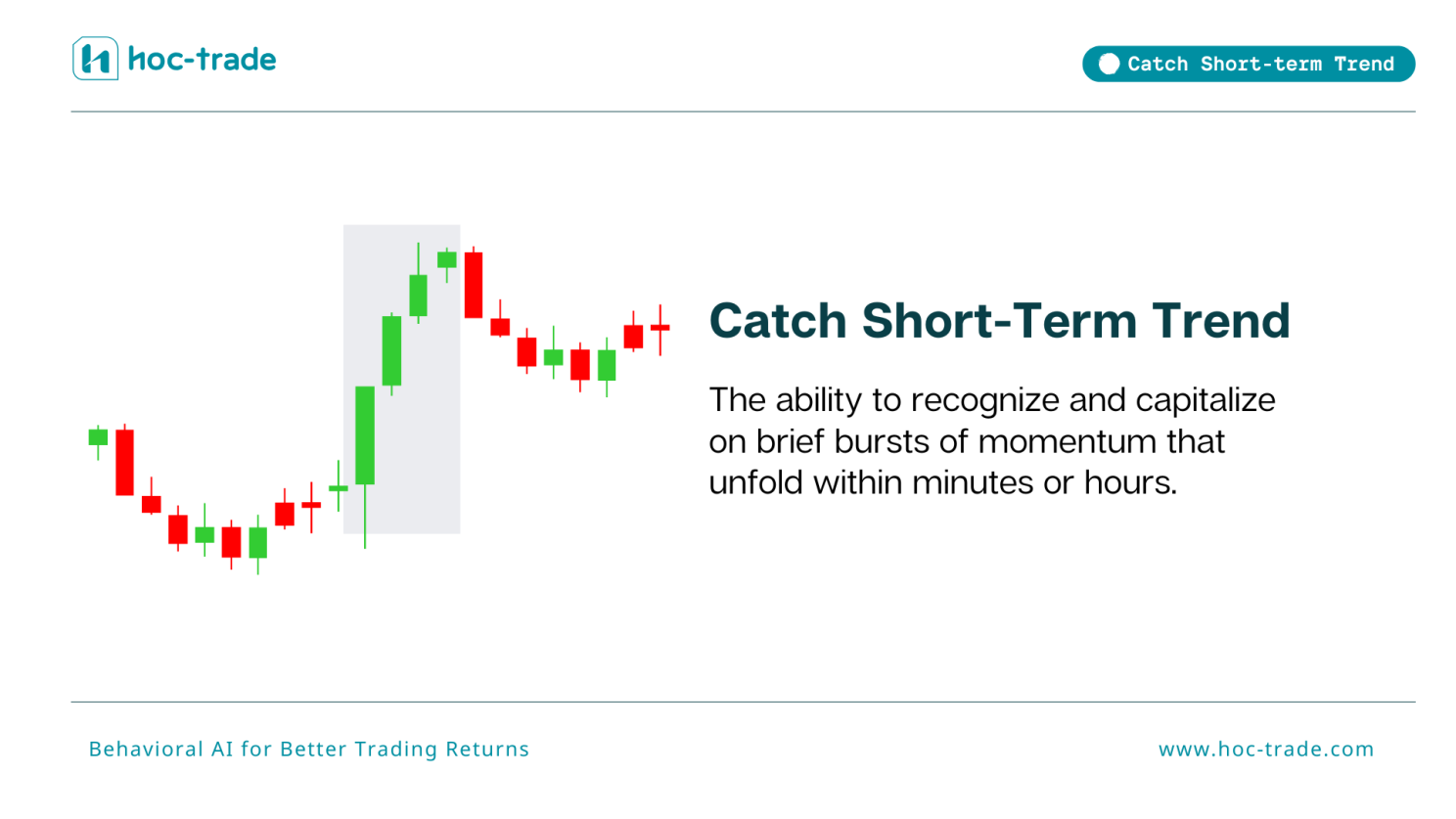
Catching Short-Term Trends refers to identifying and profiting from brief sub-trends that form within a wider market structure. These are typically traded on lower timeframes, M5 or M15 being common, and they can run with or against the longer-term direction. The defining feature is the focus on immediate price behaviour: entering near the start of the move, capturing the bulk of it, and exiting before or the moment momentum fades.
This isn't the same as reversal trading. Short-term trend traders aren't trying to call tops and bottoms. They're spotting the early stages of a directional move and riding it while it lasts. That requires rapid recognition, precise timing, and a decision-making framework anchored in what's happening right now, not what happened last week.
What signals do short-term trend traders look for?
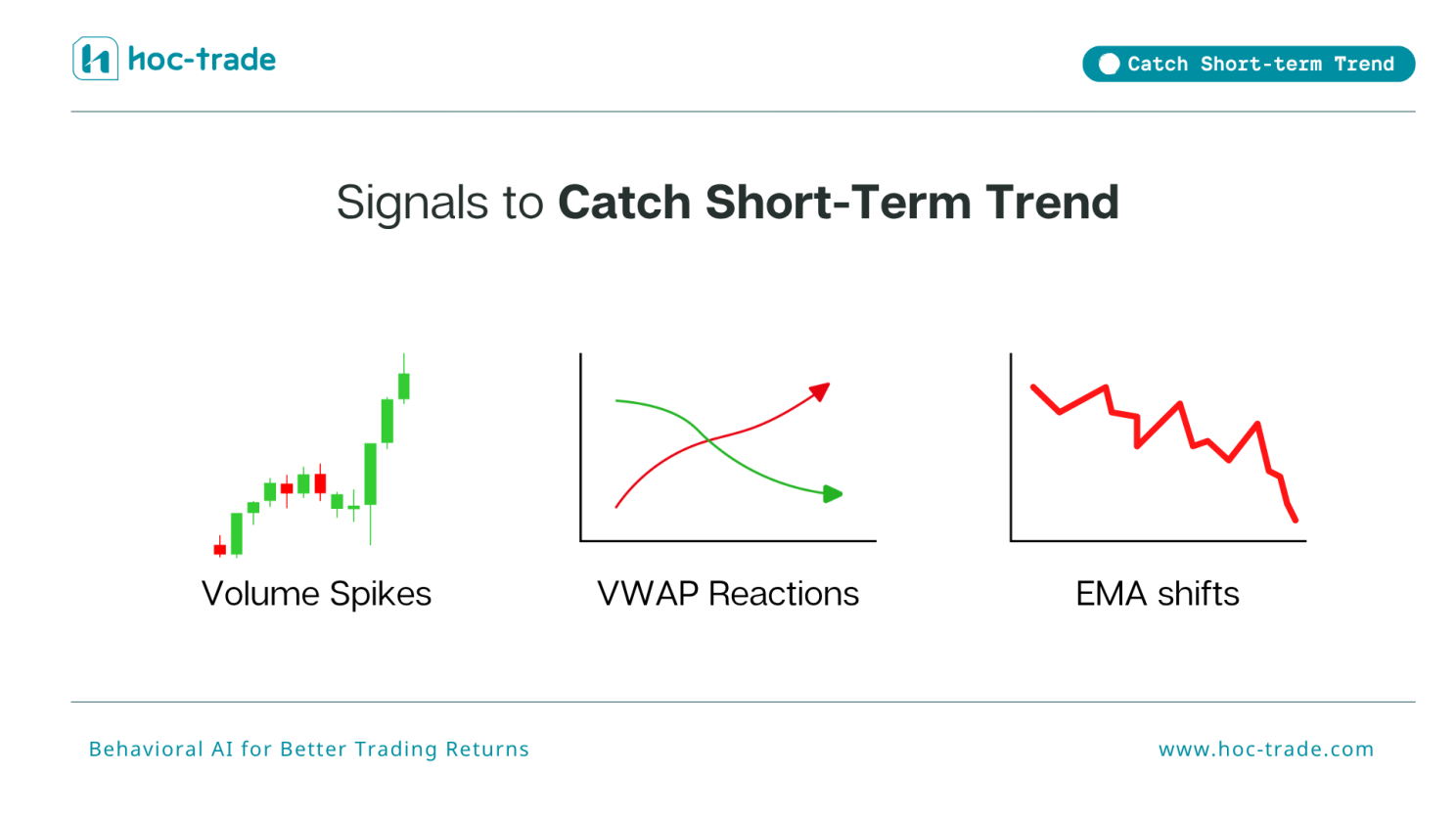
The entry typically comes before the majority of traders have reacted. Skilled short-term trend traders pick up on early cues: volume bursts that precede price acceleration, shifts in VWAP, EMA alignment across short timeframes, or micro breakouts from tight consolidation. These aren't exotic signals. What separates those who use them well is recognition speed, noticing the pattern while it's forming rather than after it's confirmed.
The entry point sits in a specific zone: early enough to capture the move, late enough to avoid the false starts that look identical to reversal setups. Getting that balance right consistently is what makes this a skill rather than a guess.
How do short-term trend traders manage their positions?
Trade management is where this style becomes most distinctive. Short-term trend traders don't hold positions on conviction. They monitor for signs that momentum is softening: fading volume, weakening continuation candles, early reversal cues. When those appear, they're out. Quickly and without hesitation.
This creates a consistent trading pattern: rapid recognition, efficient entry, active monitoring, and fast disengagement once the move has run its course. Scaling out at early signs of exhaustion is common. Holding through a full reversal because the original thesis felt strong is not. Emotional detachment from open positions is a core part of why this approach works.
Why is short-term trend trading an edge in choppy markets?
Longer-term trend strategies depend on sustained directional moves. When markets are choppy or uncertain, those moves don't materialise and performance suffers. Short-term trend traders operate in a different regime. The brief, sharp movements that longer-term traders dismiss as noise are precisely the opportunities they're built to exploit.
Speed and precision create an asymmetric advantage. Short-term trend traders extract gains from movements that are too brief for most strategies to even register. They don't need the market to be trending over days or weeks. They need it to trend for the next thirty minutes.
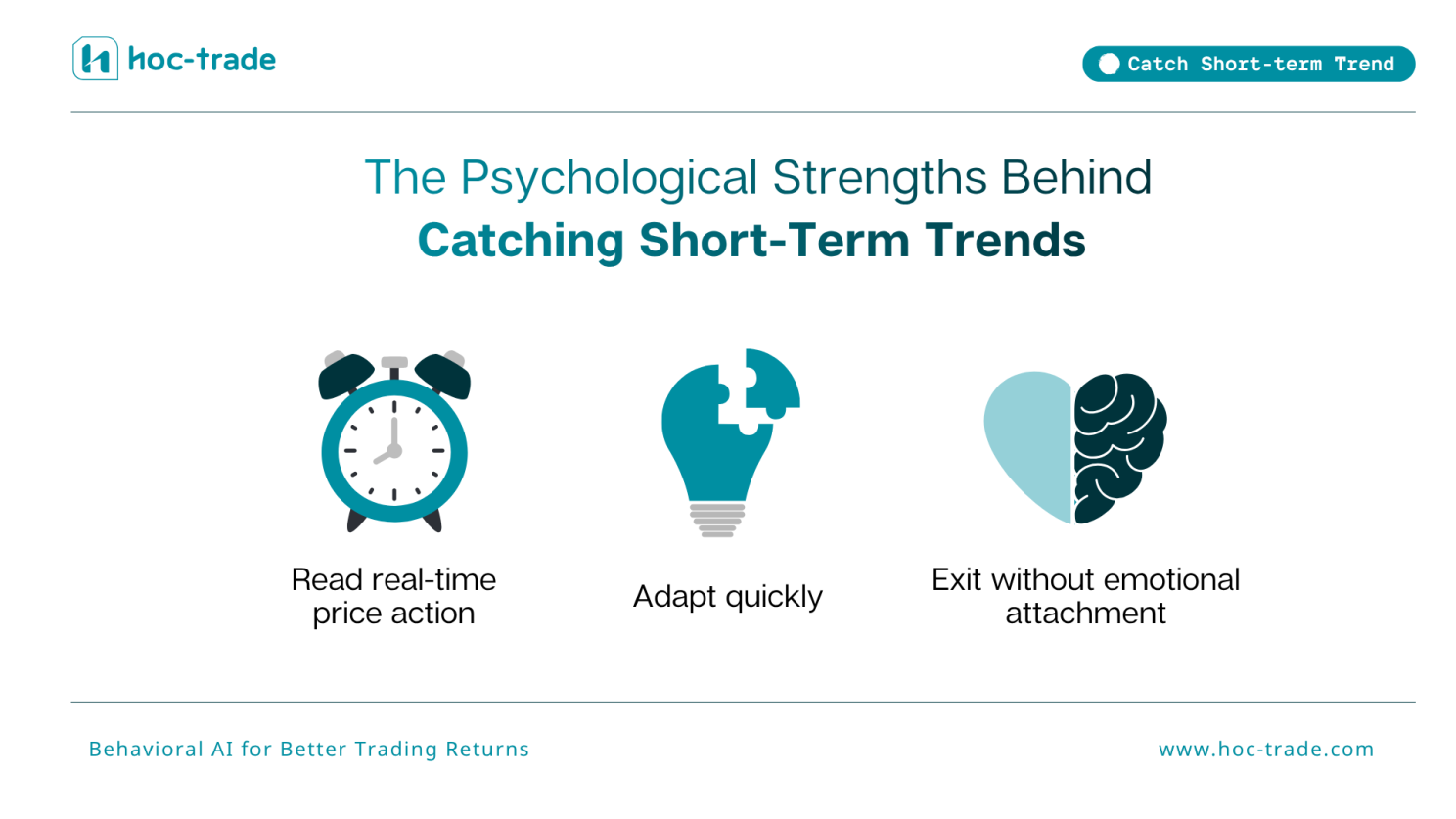
Psychologically, this style demands fast pattern recognition, comfort sitting in uncertainty, and disciplined execution with no room for second-guessing. The traders who do it well are not reckless. They're fast in a way that comes from preparation. They respond without hesitation and exit without emotional attachment, which directly reduces the likelihood of holding losing trades out of hope. Traders who struggle with revenge trading or position sizing errors often have the opposite profile. If that sounds familiar, it's worth reading about those patterns separately.
How does consistency become the edge for short-term trend traders?
Short-term trends rarely produce large individual winners. The edge comes from volume and control. A high hit rate, tight management of losing trades, and clean execution across many positions build a stable performance foundation that individual big trades can't replicate.
Many successful traders using this style deliberately narrow their focus to a small set of instruments. Tracking fewer symbols means sharper attention to each one, better familiarity with how they move, and less dilution across positions that don't quite fit the pattern. Breadth is not a virtue here. Depth is.
What does the data say about short-term trend trading performance?
TradeMedic™ AI detects Catching Short-Term Trends across a dataset of 500,000+ trader accounts and calculates each trader's personal performance profile for this behaviour. By classifying trades as aligned or countertrend relative to short- and medium-term moving averages on M15 and H4, the tool identifies whether this pattern is a genuine, repeatable strength or a coincidental run of results.
A detailed statistical breakdown of how this pattern appears in real trading data is available at hoc-trade.com/research.
How does TradeMedic detect Catching Short-Term Trends in your trading?
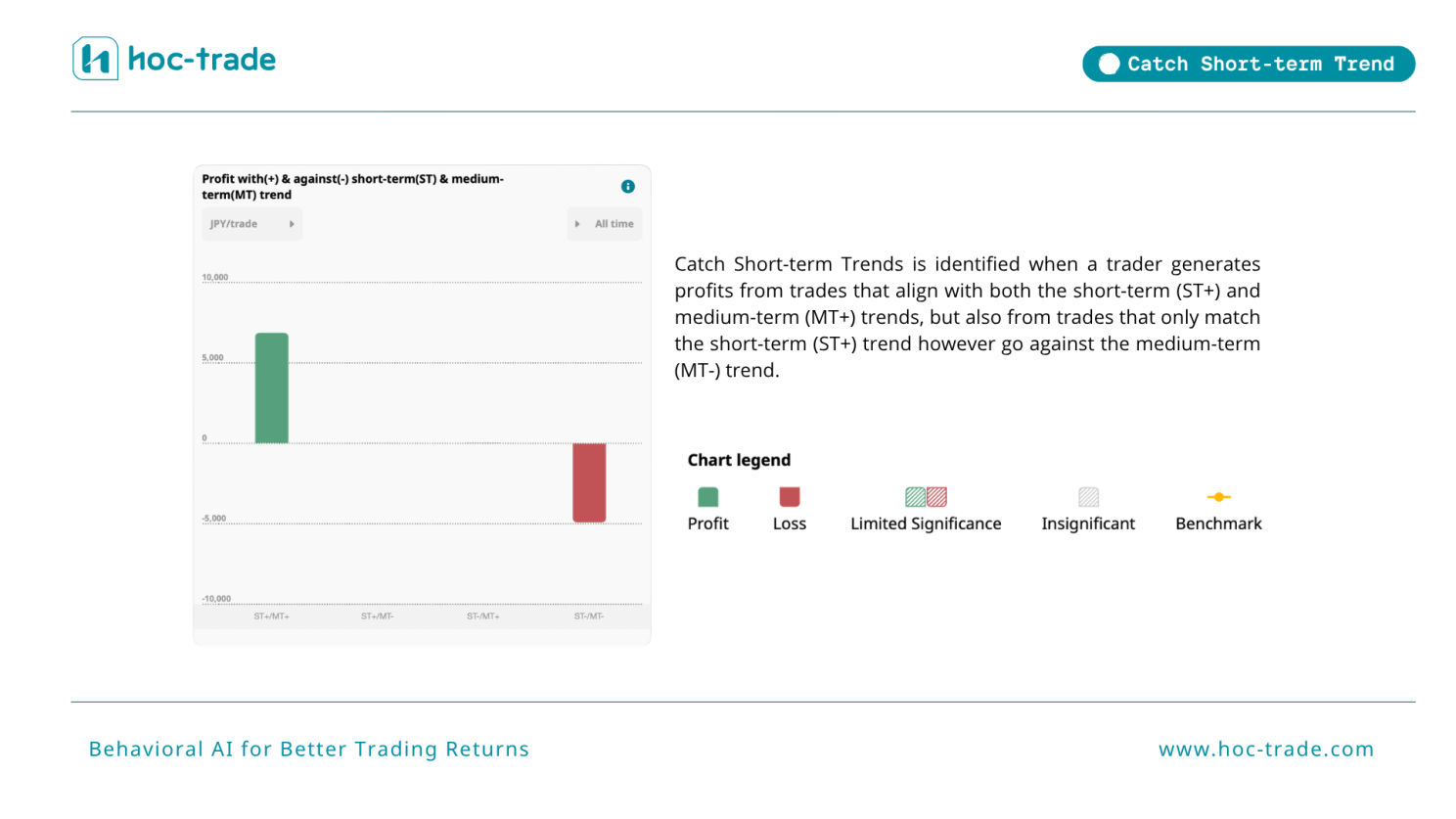
The detection process looks at how your performance shifts relative to the short-term trend environment. Each trade is classified as aligned or countertrend using short- and medium-term moving averages across M15 and H4. If trades taken with the short-term trend consistently outperform those taken against it, TradeMedic flags this as a validated strength: one built on repeatable, structured behaviour rather than isolated wins.
That distinction between skill and randomness is harder to make than it sounds. Many traders sense they perform better in trending conditions but don't have the data to confirm it. TradeMedic converts that intuition into a measurable result.
How can identifying this strength improve your trading decisions?
Knowing where your edge actually lies changes how you approach the market. When you can see clearly that short-term trend alignment predicts your better results, you can start mapping the conditions where you excel and avoid forcing trades that work against the current direction. Reversal setups, for example, may look similar on the surface but carry a different performance profile for traders whose strength is in catching trends.
TradeMedic works as a mirror for your actual performance patterns. The goal isn't to change your style. It's to give you the data to make more informed decisions about when to lean in and when to step back.
Frequently asked questions
What is “Catching Short-Term Trends”
Catching short-term trends describes a trader’s ability to recognize and profit from brief sub-trends that form within the broader market structure, often traded on lower timeframes like M5 or M15.
How Catching Short-Term Trends Shows Up in Your Trades
This strength appears clearly in how traders construct and manage their positions.
Why does short-term trend trading work in choppy markets?
Longer-term trend strategies depend on sustained directional moves that don't materialise in choppy conditions. Short-term trend traders profit from the brief, sharp movements that longer-term approaches dismiss as noise. This makes the style particularly valuable during uncertain or range-bound market phases when other approaches stall.
How do short-term trend traders know when to exit a position?
Exits are triggered by signs that momentum is fading: declining volume, weakening continuation candles, or early reversal signals. Short-term trend traders don't hold positions based on conviction about a longer-term move. Fast disengagement when a trend loses steam is a deliberate feature of the approach, not a lack of patience.
How does TradeMedic identify Catching Short-Term Trends as a trading strength?
TradeMedic classifies each trade as aligned or countertrend using short- and medium-term moving averages on M15 and H4 timeframes. If trend-aligned trades consistently outperform countertrend trades, the tool flags this as a validated strength across 500,000+ trader accounts. This turns a trader's intuition about their own performance into a measurable, data-backed insight.