Category:
 Author:
 Date:May 25, 2026
Revenge Trading: What 500,000 Accounts Reveal About Trading After a Loss
Revenge trading is opening a new trade shortly after a loss to win the money back, because the loss hurt rather than because the market offered a real setup. The name comes from the feeling behind it: the urge to get even with the market.
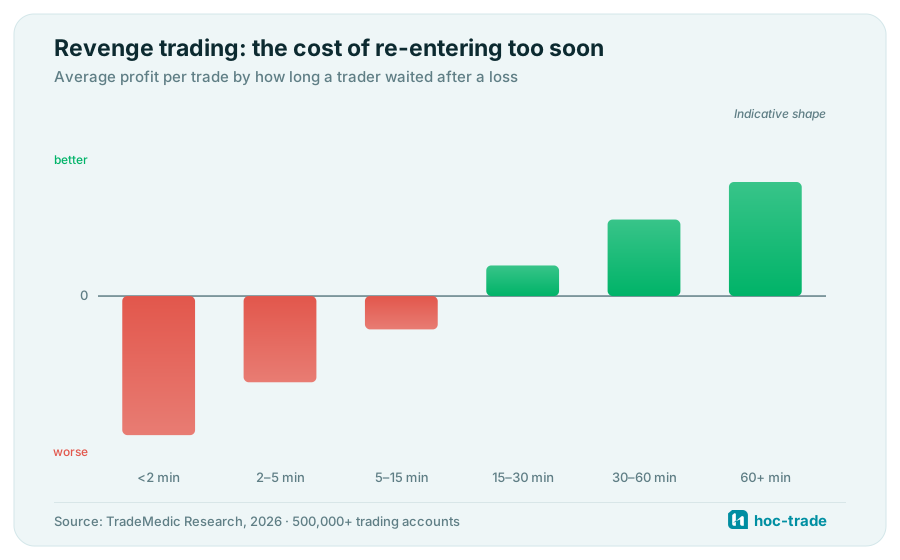
It is also common in real trading data. In an analysis of more than 500,000 trading accounts, TradeMedic found a measurable revenge trading effect for around 37% of traders. Scalpers are hit hardest, with around 47% of them affected. The first 15 minutes after a loss carry the highest risk of a revenge trade.
But the same analysis found something most traders get wrong about it. Measured by what it costs, revenge trading is one of the milder patterns in the data. For the traders who show it, it costs around $1,917 over the life of an account, roughly a fifth of what doubling down costs. It is the famous mistake, not the expensive one. That matters, because traders spend a lot of energy fearing the wrong thing. Revenge trading is worth fixing, but it is rarely the thing draining an account fastest.
What is revenge trading?
In practice, the goal quietly shifts from making a good decision to undoing a bad outcome. That shift is what makes the next trade dangerous: it is taken for emotional reasons rather than because the market is offering an opportunity.
The typical sequence is familiar. A trade closes at a loss. The loss feels less like a normal cost of trading and more like a problem that has to be corrected right now. A new position goes on within minutes, often larger than usual and without the same standards applied to a normal entry. Sometimes it works and the feeling passes. Often it adds a second loss to the first.
One point matters before looking at the numbers. Revenge trading is detected from the relationship between the break a trader takes after a loss and the performance of the trade that follows. It is about the timing of re-entry after a realised loss, not about position size or holding on to a losing position. A trader is flagged only when the pattern is consistent across their trades, when trades placed soon after losses reliably underperform their own trades placed after a longer pause, not when they occasionally re-enter quickly. The fuller detection method is described later in this article.
How common is revenge trading, and what does it cost?
Across the 500,000+ accounts analysed, revenge trading shows a measurable effect for around 37% of traders. The figures here are drawn from accounts with enough trade history to establish a reliable pattern rather than a one-off, so they reflect persistent behaviour, not the occasional fast re-entry that every trader has done at some point.
The more revealing finding is what it costs relative to everything else. For the traders who show it, revenge trading costs around $1,917 per affected trader over the life of an account, equivalent to roughly 10% of that trader's total losses. That figure is measured against the total amount a trader loses across all their losing trades, not their overall profit or loss, so it captures how much of their losing comes specifically from trading too soon after a loss. That proportion stays fairly stable across deposit sizes, from accounts of a few hundred dollars to tens of thousands. Larger accounts lose more in absolute terms, but only because they trade larger size, not because they are proportionally more prone to it.
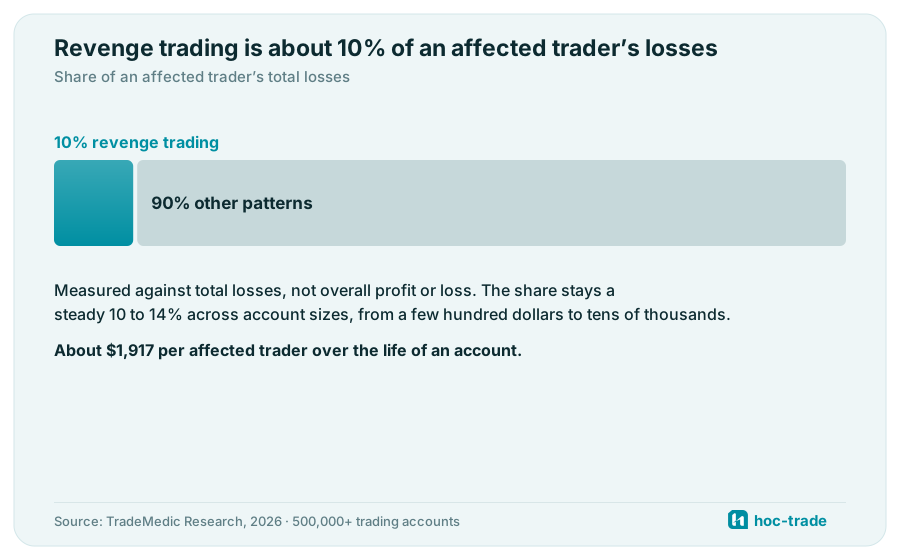
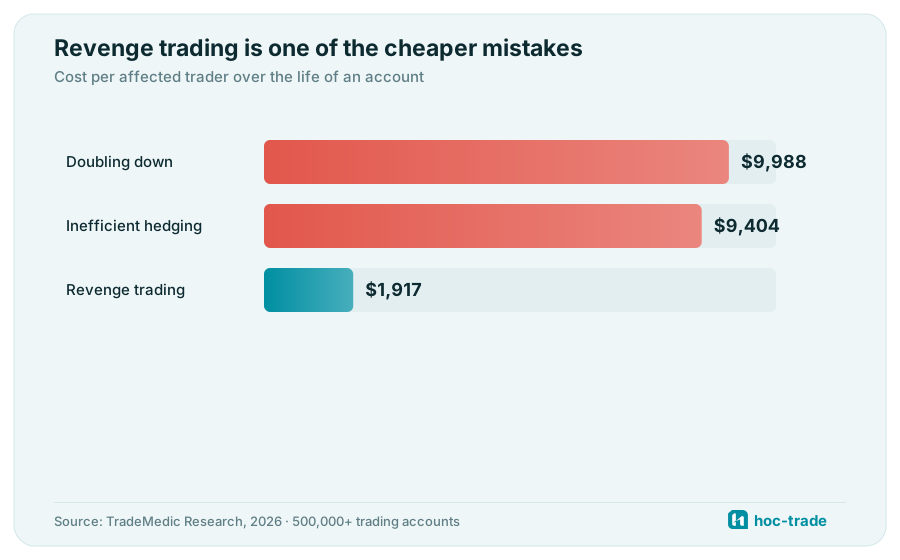
This is where the common view breaks down. When every pattern TradeMedic tracks is ranked by what it costs per affected trader, revenge trading sits around 15th out of 22, in the bottom third. Doubling down on a losing position costs roughly $9,988 per affected trader, and inefficient hedging around $9,404, both close to five times more than revenge trading. The patterns that drain accounts fastest are quieter and far less discussed.
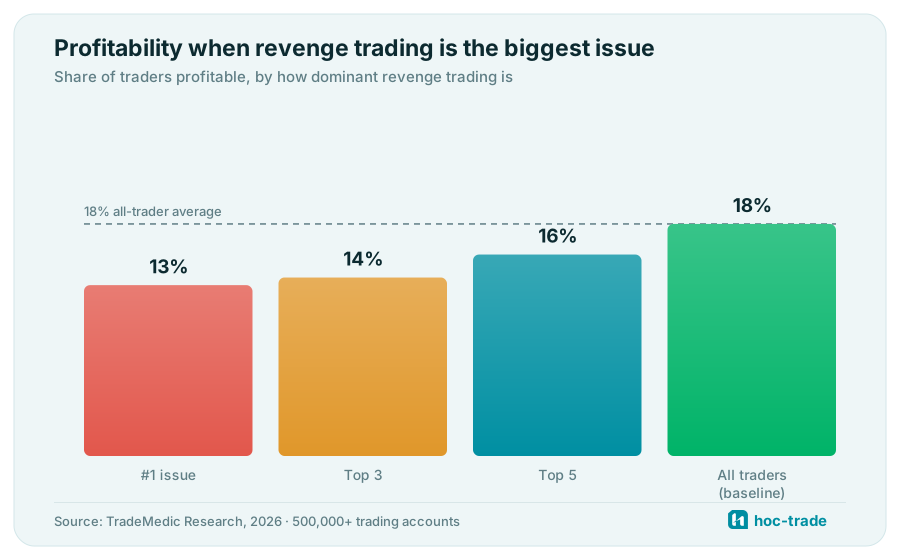
None of this means revenge trading is harmless. When it becomes a trader's dominant problem it does bite. Among traders whose single biggest issue is revenge trading, the share who are profitable falls to about 13%, against roughly 18% across the dataset, close to a third less likely to be profitable than the average trader. So while it is a modest drag on average, it is costly for the smaller group where it dominates. Those are the traders worth flagging. We published a dedicated analysis on the profitability of different trading styles.
Who is most likely to revenge trade?
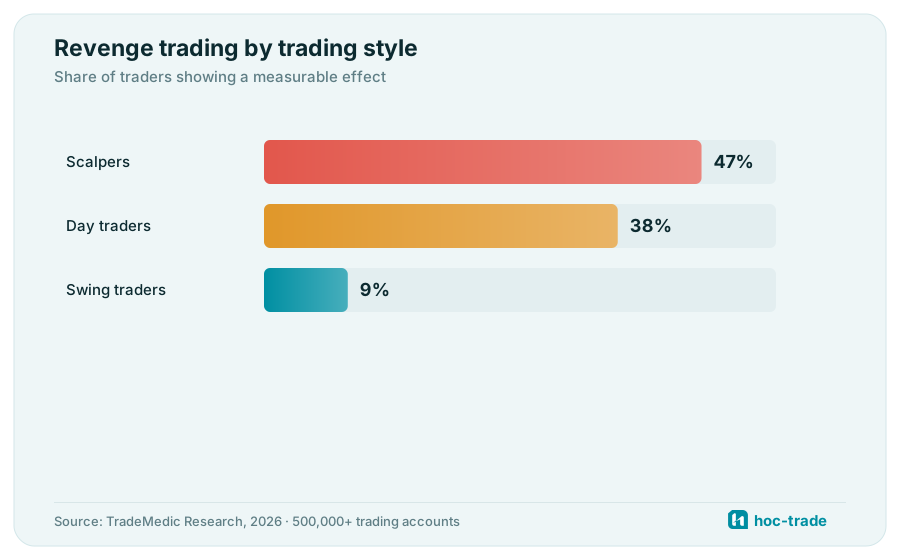
Revenge trading is most pronounced for scalpers, around 47% of whom show some effect, because faster trading leaves less time between a loss and the next entry for the emotional charge to fade. Day traders sit at about 38%, and swing traders at about 9%, since a slower style leaves a natural gap between the loss and the next opportunity.
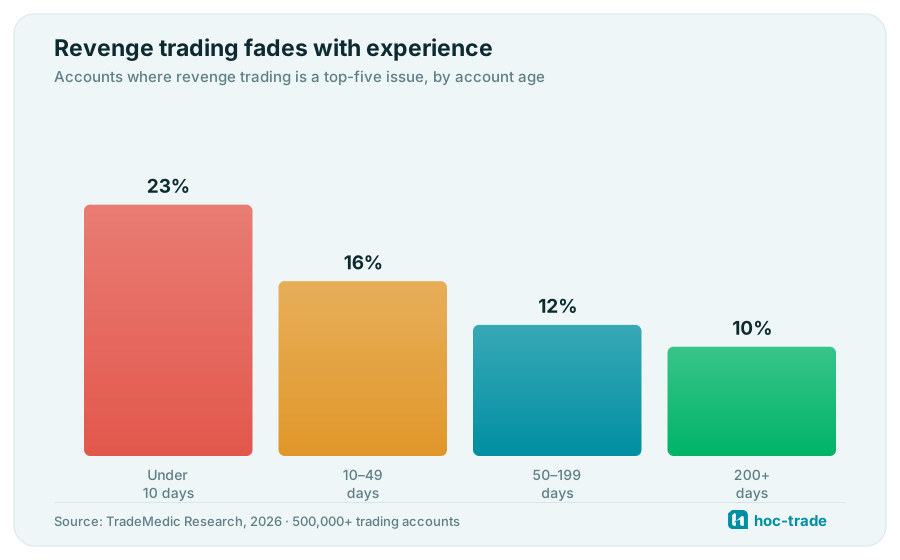
It is also mainly a newer trader's pattern. Revenge trading is a top-five issue for about 23% of accounts under ten trading days, falling to around 16% by 50 days, 12% by 200 days, and 10% beyond that. It fades as a dominant problem with experience. Either traders learn to contain it, or the ones it affects most never make it past the early stage while it is still driving their decisions. Both are probably true. Either way, if you are in your first weeks of trading, this is one of the patterns most worth watching.
What causes revenge trading? The psychology behind it
Revenge trading is not purely a discipline problem, though discipline plays a part. Several well-studied behavioural tendencies sit underneath it, and understanding them tends to make the behaviour easier to change than willpower alone.
Loss aversion. The foundation is loss aversion, one of the most established findings in behavioural economics, from the work of Kahneman and Tversky. A loss of $1,000 produces more emotional pain than the pleasure of gaining $1,000. The asymmetry is roughly two to one. After a loss, a trader does not feel neutral about the money; they feel a deficit that needs correcting, and that need feels urgent.
There is a neural layer to this. Research by Sokol-Hessner and colleagues has shown that the size of a person's loss-averse response is linked to activity in the brain's threat-processing centre, the amygdala, when facing potential losses. The same research found that this response, and the loss aversion that comes with it, can be reduced through emotion regulation. The pain is real and physical, but it is also trainable, which is why structure works better than willpower for most traders.
Action bias. Loss aversion creates the discomfort. Action bias is what turns it into a trade. Action bias is the pull to do something rather than sit with a bad feeling, because acting feels like regaining control while waiting feels like helplessness. After a loss, doing nothing means sitting with the result and the uncertainty of whether it was bad luck or a bad decision. Opening another trade replaces that helpless feeling with the sense of doing something about it. The relief is immediate, which is what makes it so hard to resist, even though the most useful response to most losses is to do nothing at all for a while. The fastest available action is another trade, so that is the one the urge reaches for.
The gambler's fallacy. The third piece is the story the mind tells to justify the trade. The gambler's fallacy is the belief that after a run of losses, a win is somehow "due." The logic feels sensible: what are the odds of six losses in a row, so surely the next one is more likely to win. It is backwards. Each trade is independent, and the market has no memory of the last result. A coin that has landed heads five times is still 50/50 on the sixth flip. But the belief that a win is owed makes the revenge trade feel safer than it is.
These three combine: the loss hurts (loss aversion), the urge to act takes over (action bias), and a reason to act arrives on cue (gambler's fallacy). None of them require a character flaw. They are standard wiring, which is exactly why a system that does not rely on willpower works better than trying harder.
What other trading mistakes come with revenge trading?
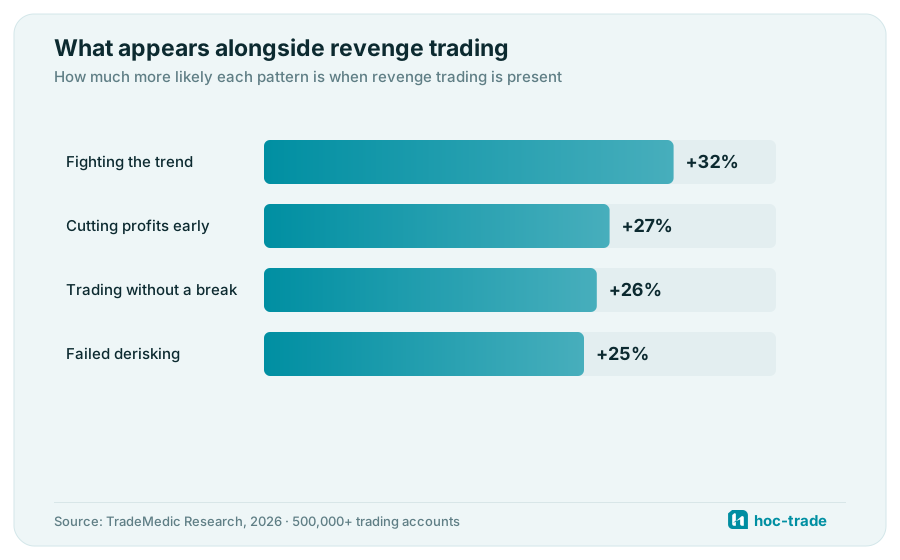
Looking at which other patterns become more likely when revenge trading is present points to a shared root in how a trader handles a loss. When revenge trading shows up, cutting profits early is around 27% more likely to also appear, the clearest signal that the same difficulty accepting a result shows up on the winning side too: banking gains early to avoid giving them back is the mirror image of chasing losses. Fighting the trend is about 32% more likely, failed derisking around 25% more likely, and trading without a break about 26% more likely. These are indicative connections rather than proof of a single cause, but the through-line, an emotional reaction to recent outcomes, is hard to miss.
How TradeMedic AI detects revenge trading
TradeMedic™ AI groups each trader's history by how long they waited after a loss before entering again, then measures average performance across each of those windows. If trades placed shortly after a loss consistently underperform that trader's own baseline, in both win rate and loss size, the pattern is flagged and its dollar impact calculated. The detection looks for a persistent pattern across all of a trader's trades, not the occasional fast re-entry, and it works from realised losses, the moment a losing trade is closed and a new one is opened. Revenge trading is one of more than 60 behavioural patterns the system analyses per trader.
How to stop revenge trading
The standard advice, take a break and stay disciplined, is true but rarely specific enough to act on. A few concrete approaches tend to help more.
Know your personal recovery window. The point at which trades stop underperforming after a loss varies by trader. Across the dataset a break of around fifteen minutes is a reasonable average, but some traders need five minutes and some need forty-five. Trading on a generic number is guessing; the useful version is your own.
Use limit orders only in your recovery window. When the urge to re-enter is strongest, willpower is unreliable. Allowing only limit orders after a loss, no market orders, forces a defined entry, target and stop before any position opens. That blocks the impulsive re-entry structurally rather than relying on you to resist it.
Set a daily loss limit in advance. Decide the maximum you are willing to lose in a day before the session starts, and stop when you reach it. Setting the boundary while calm removes the decision at the moment you are least able to make it well.
Think in R, not dollars. Measured in units of risk, a loss is expected rather than a defeat: you risked one unit and lost one unit, which is the cost of doing business. Framing results in risk rather than money takes much of the emotional charge out of a single loss.
Above all, keep it in proportion. Revenge trading is worth tidying up, but for most traders there are bigger leaks to plug first. Knowing where it ranks for you is half the battle, and that is a question the data can answer where instinct usually cannot. The wider skill, recovering from a loss without letting it drive the next trade, is what separates traders who grow out of this from those who do not.
The bottom line on revenge trading
Revenge trading is the most recognised mistake in trading and one of the most misread. It is common, affecting around 37% of traders, but it accounts for only about 10% of what affected traders lose, and it sits in the bottom third of patterns by cost. It hits hardest for newer traders and for the smaller group where it becomes the dominant issue. It is real, it is worth fixing, but the patterns that quietly drain accounts fastest are the ones nobody warns you about.
Want to understand how TradeMedic™ analyses revenge trading and more than 60 other patterns in a single account? Learn more about TradeMedic.
See if revenge trading appears in your own trading: connect your trading account to TradeMedic™ AI free.
Watch How Revenge Trading is Cycle of Loss-Driven Trading
Frequently asked questions about revenge trading
Why do I keep revenge trading?
Because a loss triggers three standard reactions at once: loss aversion makes it feel urgent, action bias pushes you to act, and the gambler's fallacy says a win is now due. It is also more common early on and in fast trading styles: it is a top-five issue for about 23% of accounts in their first ten trading days, and around 47% of scalpers show it.
How much does revenge trading cost?
For traders who show it, revenge trading costs around $1,917 over the life of an account, roughly 10% of their total losses. Ranked by cost per affected trader, it sits around 15th of 22 patterns, well behind doubling down at about $9,988.
How long should you wait after a loss before trading again?
The first 15 minutes after a loss carry the highest risk of a revenge trade. Across the dataset a break of around fifteen minutes is a reasonable average, but the right window is personal: some traders need five minutes and some need forty-five.
Does revenge trading get better with experience?
Mostly, yes. Revenge trading is a top-five issue for about 23% of accounts under ten trading days, falling to around 12% by 200 days and about 10% beyond that. Either traders learn to contain it, or those it affects most do not last long enough to show up later.
Is revenge trading the same as overtrading?
No. Revenge trading is about timing: trades opened shortly after a loss perform worse than the same trader's trades placed after a longer pause. Overtrading is about volume: performance per trade drops as the number of trades in a day rises. A trader can have one without the other.
Is revenge trading the same as doubling down?
No, and they tend to show up in different traders. Revenge trading means closing the loss and quickly opening a new trade, while doubling down means keeping the losing position and adding to it. When revenge trading is present, doubling down is far less likely to be one of the trader's biggest issues.
Can revenge trading ever be profitable?
A single revenge trade can win, which is part of what keeps the habit going. On average, though, trades placed shortly after a loss win less often and lose more than the trader's own baseline. Among traders whose biggest issue is revenge trading, about 13% are profitable, against roughly 18% across all traders.
How can I tell if I am revenge trading?
Group your trades by how long you waited after a losing trade, then compare the average result of each group. If trades opened within minutes of a loss consistently do worse, in win rate and in loss size, you are revenge trading. TradeMedic AI runs this check automatically on a connected MT4 or MT5 account and shows your personal recovery window.
Research behind this article
Loss aversion: foundational work by Kahneman, D., & Tversky, A. (1979). Prospect Theory: An Analysis of Decision under Risk. Econometrica, 47(2), 263-291.
Loss aversion and the amygdala, and its reduction through emotion regulation: Sokol-Hessner, P., Camerer, C. F., & Phelps, E. A. (2013). Emotion regulation reduces loss aversion and decreases amygdala responses to losses. Social Cognitive and Affective Neuroscience, 8(3), 341-350; and Sokol-Hessner, P., et al. (2009). Thinking like a trader selectively reduces individuals' loss aversion. PNAS, 106(13), 5035-5040.
Action bias: the tendency to favour action over inaction, even when waiting is the better choice, documented across behavioural research including Bar-Eli, M., Azar, O. H., Ritov, I., Keidar-Levin, Y., & Schein, G. (2007). Action bias among elite soccer goalkeepers: The case of penalty kicks. Journal of Economic Psychology, 28(5), 606-621.
All trading statistics: TradeMedic Research, 2026, based on a dataset of more than 500,000 trading accounts.
Frequently asked questions
Why do I keep revenge trading?
Because a loss triggers three standard reactions at once: loss aversion makes it feel urgent, action bias pushes you to act, and the gambler's fallacy says a win is now due. It is also more common early on and in fast trading styles: it is a top-five issue for about 23% of accounts in their first ten trading days, and around 47% of scalpers show it.
How much does revenge trading cost?
For traders who show it, revenge trading costs around $1,917 over the life of an account, roughly 10% of their total losses. Ranked by cost per affected trader, it sits around 15th of 22 patterns, well behind doubling down at about $9,988.
How long should you wait after a loss before trading again?
The first 15 minutes after a loss carry the highest risk of a revenge trade. Across the dataset a break of around fifteen minutes is a reasonable average, but the right window is personal: some traders need five minutes and some need forty-five.
Does revenge trading get better with experience?
Mostly, yes. Revenge trading is a top-five issue for about 23% of accounts under ten trading days, falling to around 12% by 200 days and about 10% beyond that. Either traders learn to contain it, or those it affects most do not last long enough to show up later.
Is revenge trading the same as overtrading?
No. Revenge trading is about timing: trades opened shortly after a loss perform worse than the same trader's trades placed after a longer pause. Overtrading is about volume: performance per trade drops as the number of trades in a day rises. A trader can have one without the other.
Is revenge trading the same as doubling down?
No, and they tend to show up in different traders. Revenge trading means closing the loss and quickly opening a new trade, while doubling down means keeping the losing position and adding to it. When revenge trading is present, doubling down is far less likely to be one of the trader's biggest issues.
Can revenge trading ever be profitable?
A single revenge trade can win, which is part of what keeps the habit going. On average, though, trades placed shortly after a loss win less often and lose more than the trader's own baseline. Among traders whose biggest issue is revenge trading, about 13% are profitable, against roughly 18% across all traders.
How can I tell if I am revenge trading?
Group your trades by how long you waited after a losing trade, then compare the average result of each group. If trades opened within minutes of a loss consistently do worse, in win rate and in loss size, you are revenge trading. TradeMedic AI runs this check automatically on a connected MT4 or MT5 account and shows your personal recovery window.