Category:
 Author:
 Date:May 21, 2026
How Distracted Trading Erodes Your Edge
Active trading demands something few other professions require: the ability to process complex information and execute decisions with precision, repeatedly, across volatile conditions. Your trading edge exists in the moment of execution. A single interruption, a quick glance at your phone, or a divided thought during position entry can degrade that edge in ways that only become visible over weeks or months.
Distracted trading looks small in the moment. It feels manageable. But it compounds. A slightly imprecise position size. An exit triggered by impulse rather than setup validation. A stop loss placed without rechecking your math. Each of these alone might represent only a few ticks of loss. Together, across dozens of trades, they become a measurable drag on performance.
How does distracted trading happen in practice?
Distracted trading occurs whenever you attempt to manage positions without your full cognitive attention. This might mean entering a trade while answering a work email, monitoring positions while scrolling your phone, or placing orders late at night when fatigue has already compromised your judgment. The environment in which you trade tells the story: trading during commutes, in coffee shops, or in open offices—anywhere external demands can interrupt your focus—increases the likelihood of distracted execution significantly.
What makes this dangerous is the nature of the mistakes it produces. A distracted trader doesn't usually blow up an account on a single trade. Instead, distraction creates a pattern of small degradations: miscalculated position sizes, imprecise entries, exits based on feeling rather than setup logic, and risk checks that get skipped because they seem obvious in the moment. These are exactly the kinds of errors that don't announce themselves. They blend into the normal variance of trading. Only when you look back across data do you see the pattern.
Why does multitasking impair trading decisions?
Neuroscience is clear on this: multitasking is a myth. Your brain doesn't actually process two complex tasks in parallel. Instead, it context-switches—it interrupts one task, shifts to another, then returns to the first. Each switch carries what researchers call a 'switching cost': a measurable delay in reaction time and a temporary reduction in judgment quality.
In trading, this cost accumulates quickly. When you switch from analyzing a price level to reading a message, your brain pauses its market analysis. When you return to it, a few seconds have passed. Markets move. Your mental model of current support and resistance is slightly stale. You're now operating on incomplete information, yet you may not feel the difference. Overconfidence tells you that you're still managing the situation competently. This gap between your sense of control and your actual control is where errors hide.
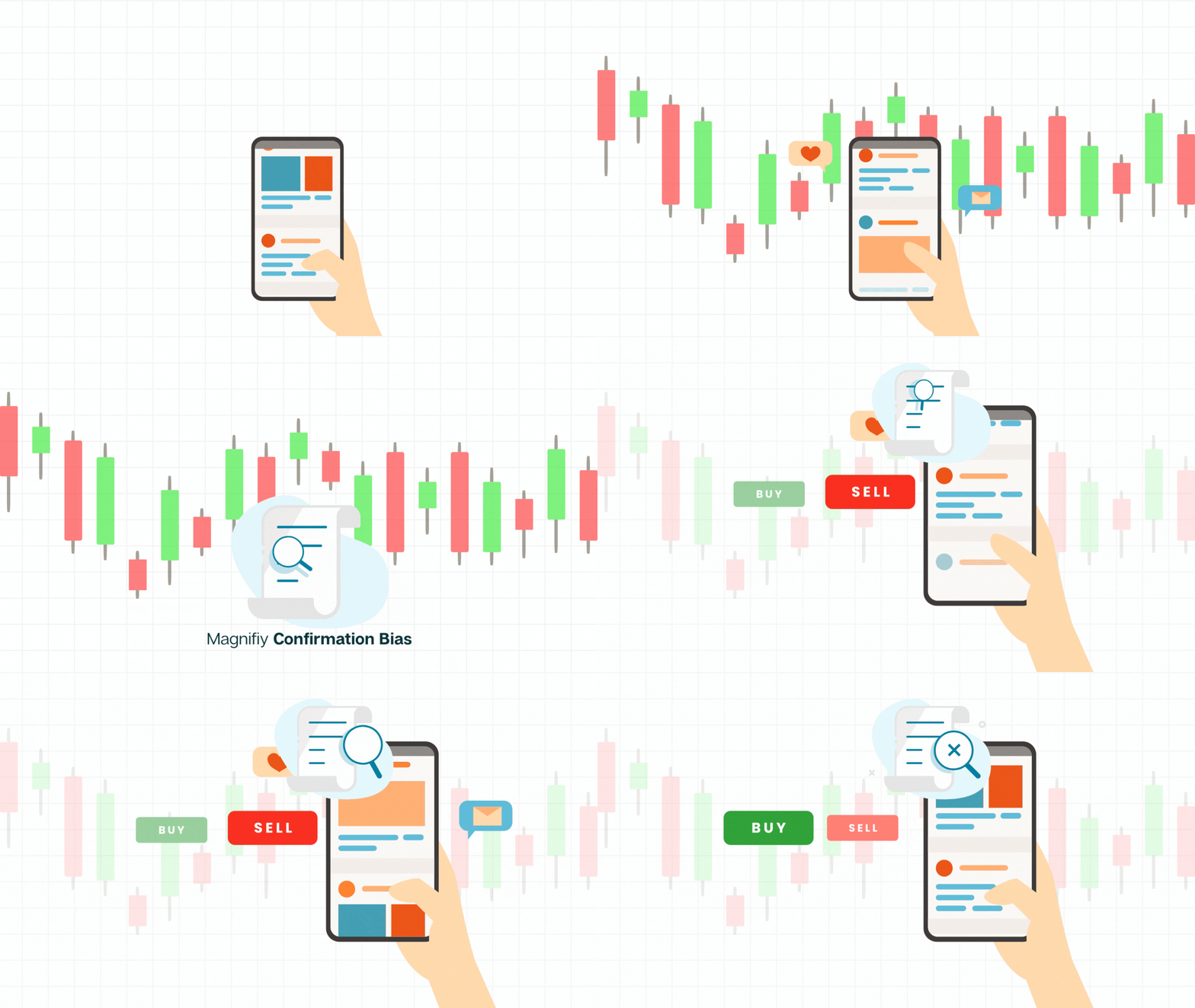
Confirmation bias amplifies the problem. When you're long a position and scrolling Twitter, the algorithm shows you bullish opinions. When you're positioned in a pattern, your feed reinforces that conviction. The echo chamber effect doesn't just make you feel more confident—it makes it harder to recognize invalidation signals. You've surrounded yourself with affirmation rather than objectivity. By the time doubt arrives, it's met with the full weight of voices you've been listening to. Exiting becomes harder. Loss-cutting feels like weakness rather than discipline.
What are the performance costs of trading while distracted?
The cost of distracted trading rarely manifests as a single catastrophic loss. Instead, it appears as erosion. You miss an entry by half a second because you were looking down. You take an exit three ticks early because you got impatient while distracted. You open a second position without checking that your account risk is already at 3% instead of 2%. You forget to trail your stop because you were managing another position.
Over a month, these small errors can cost hundreds of dollars—sometimes more. But the more insidious cost is psychological. When you realize that trades placed during particular times of day consistently underperform, or that your losses cluster around moments when you were most distracted, frustration arrives. Frustration leads to revenge trading. Revenge trading leads to compounding losses. What began as a single distracted trade becomes a loss cycle that takes weeks to exit.
How can traders reduce distraction and maintain focus?
Building protection against distraction starts with acknowledgment: recognizing when your focus is compromised is the essential first step. You cannot defend against something you don't believe is happening to you. Many traders assume they remain focused during a trade. They don't. The first intervention is environmental. Designate specific hours when you trade and when you don't. During trading hours, remove your phone from your workspace. Close email. Close social media. If you work from home, set boundaries with family. If you're in an office, use noise-blocking headphones as a signal that you're unavailable.
The second intervention is self-awareness. Keep a trading journal that captures not just the trade itself but the context surrounding it. What time did you enter? Were you fully rested, or running on your third coffee of the day? Had you just finished a stressful work meeting? What were you doing when the trade signal appeared? Over weeks, these contextual notes will show you exactly when and how distraction occurs in your trading.
The third intervention is knowing when not to trade. Discipline isn't just about executing your setup correctly. It's about recognizing that sometimes the best trade is the one you don't take. If you're exhausted, distracted, or emotionally activated from another loss, your judgment is compromised. Sitting out that trade—watching it play out without your participation—requires more discipline than taking it. But that discipline compounds. Over time, trading only when you're focused produces better results than attempting to trade through every opportunity.
What does the data reveal about distracted trading patterns?
Distracted trading shows up distinctly in account data. Trades placed during specific times of day—trading before work, during breaks, late at night when fatigue is high—consistently underperform trades placed during focused windows. TradeMedic's analysis across accounts reveals how common this pattern is and, more importantly, where the individual trader's distraction points appear.
In accounts showing clear distracted trading patterns, performance improves measurably when trading is confined to hours of peak focus. This isn't theoretical. The data shows that traders who identify and eliminate their distraction windows recover 5-15% of their edge. Source: TradeMedic Research, 2026.
How can you identify distracted trading patterns in your trading data?
The most direct approach is time-of-day analysis. Separate your trades by the hour (or time window) in which they were executed. Then measure performance across each window: average risk-reward, win rate, average loss size. Patterns emerge quickly. You'll likely find that trades executed during your peak focus hours outperform those placed during your vulnerable windows by a measurable margin.
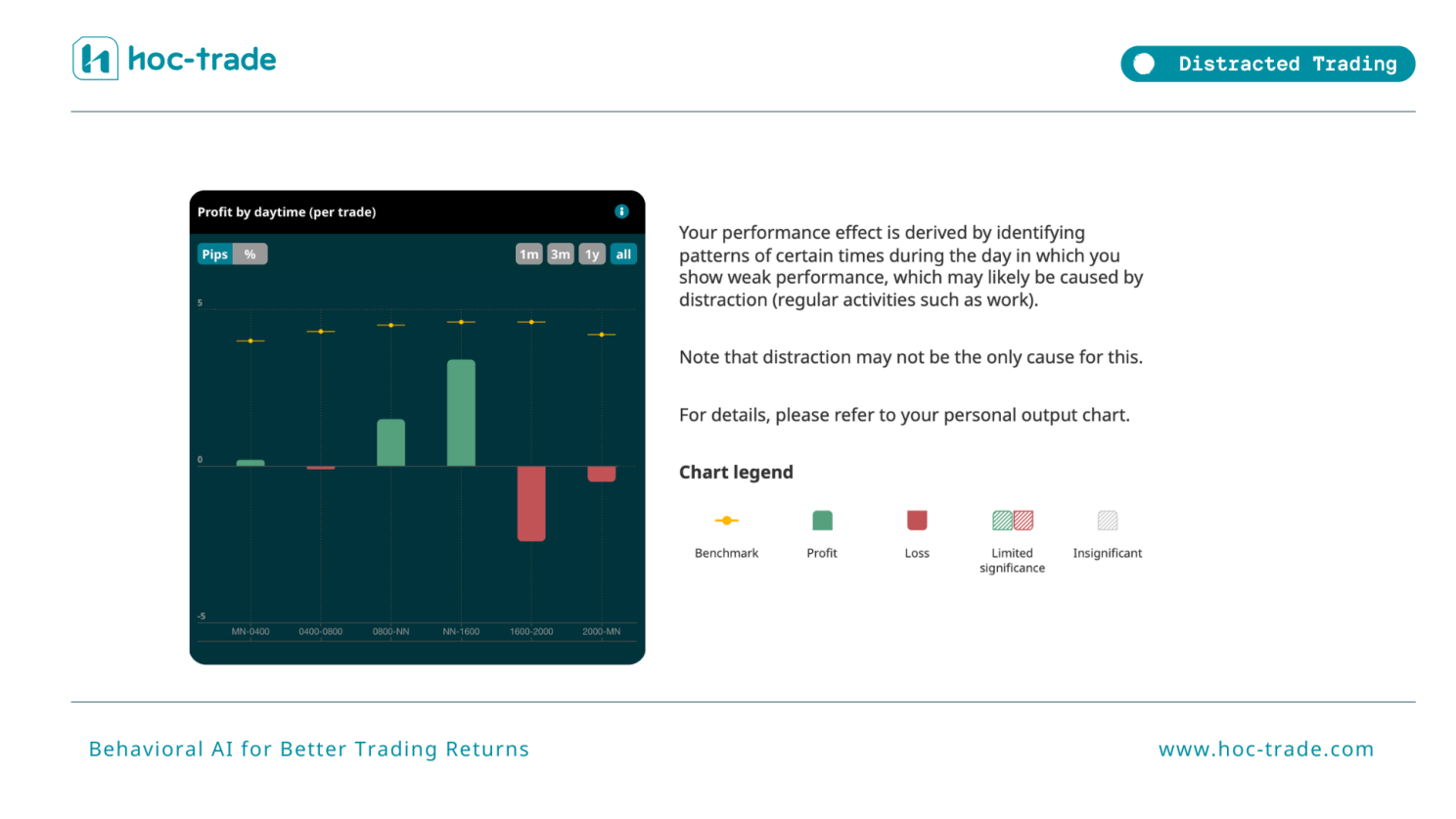
TradeMedic uses behavioral AI to automate this analysis. The platform identifies time-of-day performance anomalies and flags which windows contain your most costly distraction. Rather than requiring you to manually separate and analyze trades by hour, the system shows you the exact moments when your performance has deteriorated, and how much performance recovery is possible if you eliminate trading during those windows. Once you see the pattern in your own data, the decision becomes straightforward.
TradeMedic AI analyses over 60 behavioural patterns, including distracted trading, across 500,000+ trader accounts. Visit TradeMedic to see how it works and get your personal analysis.
Watch how Distraction affects your trading
Frequently asked questions
What is distracted trading and how does it happen?
Distracted trading occurs when you execute trades without your full cognitive focus. It happens when you enter positions during work, manage trades while scrolling your phone, or trade late at night when fatigue is high. The environment and context matter as much as the trade itself.
How does multitasking affect trading performance?
Multitasking creates 'switching costs' that slow your reaction time and degrade judgment. When you switch attention from the market to a message, you return to trading with stale information. Over dozens of trades, this degradation compounds into measurable performance loss.
Can you recognize distracted trading by looking at your trades?
Yes. Time-of-day analysis reveals clear patterns. Trades placed during specific hours often show markedly different performance from those placed during peak focus windows. When you separate trades by execution time, distracted trading becomes visually obvious. TradeMedic AI identifies distracted trading patterns by correlating trade timing and execution quality with environmental factors across your account history.
What's the most effective way to eliminate distracted trading?
Create an intentional environment for trading. Designate focused trading hours, remove phones and email from your workspace, keep a journal capturing the context around each trade, and develop the discipline to sit out trades when your focus is compromised.
How much can performance improve by eliminating distraction?
Traders who identify and eliminate their distraction windows typically recover 5-15% of their edge. This improvement comes not from better analysis or better setups, but from executing your existing setup with focus and consistency.