Category:
 Author:
 Date:May 25, 2026
Stop Loss Too Tight: Why It Backfires
A stop loss exists for one reason: to contain losses and protect capital. In practice, most traders understand this intellectually. Yet many set their stops so close to entry that the market's natural movement triggers an exit before the trade ever has a chance to work. This is the tightrope every trader walks, and it's where most traders fall off.
The result isn't tighter risk control. It's the opposite. Traders who set stops too close end up exiting positions during normal price fluctuations, accepting small losses repeatedly, only to watch the market move exactly where they intended. The pattern repeats. Confidence erodes. The strategy itself becomes the problem.
What does a stop loss that's too tight actually mean?
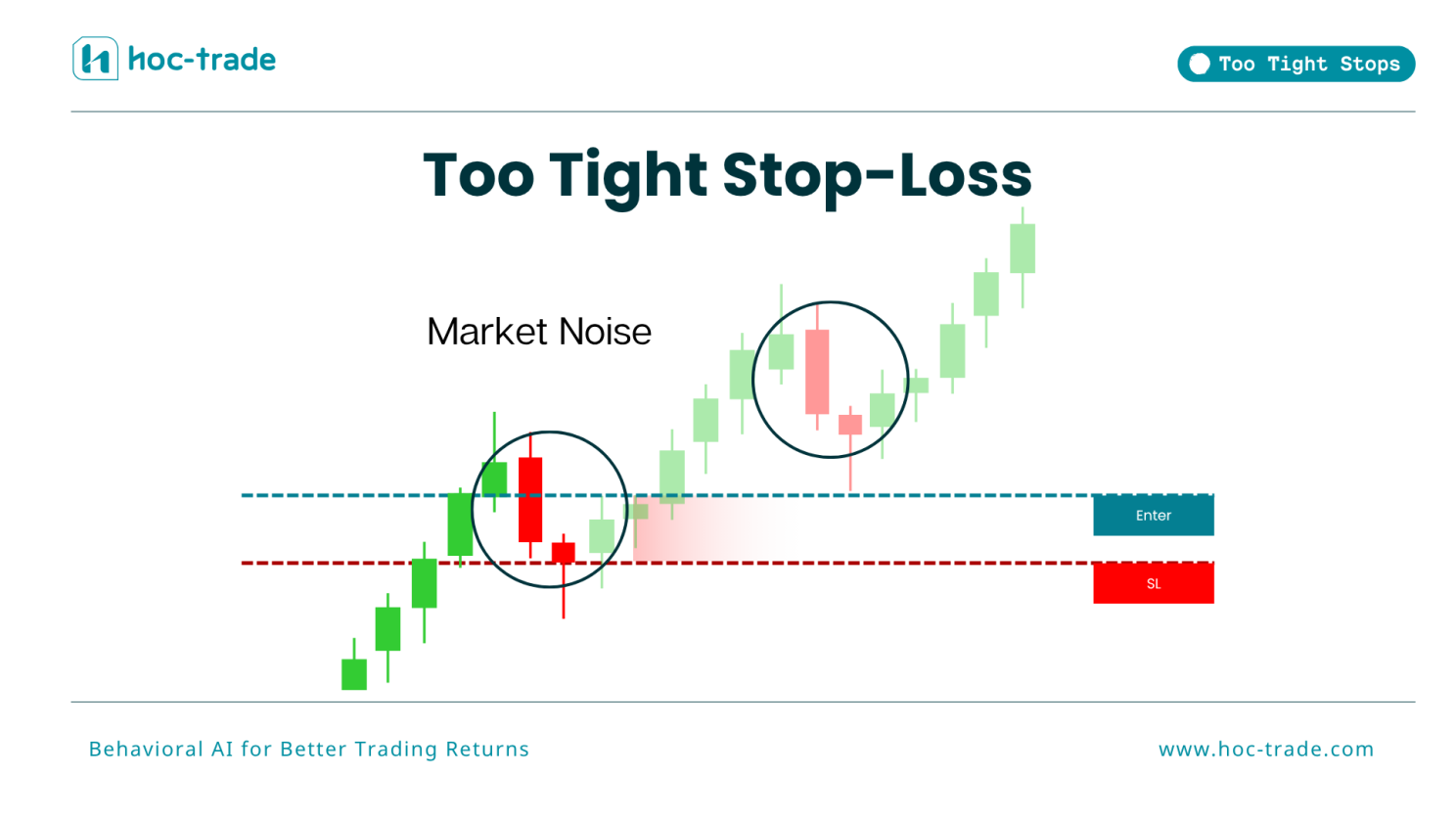
A stop placed unrealistically close to your entry point, with little margin for the market's normal volatility. The trader might justify this by saying a tighter stop keeps risk small. But this logic ignores a fundamental reality: markets breathe. Prices oscillate around support and resistance. Temporary pullbacks are not trade invalidation.
Consider a trader entering a long on EUR/USD at 1.1000 with a 10-pip stop at 1.0990. The pair is in an uptrend. But a minor pullback or a single bar's wick taps that level and triggers the stop. The trader exits at a loss while the market continues toward the original profit target. This scenario plays out hundreds of times across trading accounts every single day.
The trader had the trade direction right. The trade setup was sound. But the stop was placed in the path of noise, not signal.
Often, traders pair tight stops with larger position sizes, believing this keeps their dollar-based risk constant. Mathematically, it does. Psychologically and practically, it doesn't. A larger position amplifies the emotional pressure every time price moves against you. Slippage and spreads become more painful. And when the inevitable stop-out happens, the frustration compounds.
Why do traders set stops too tight?
On the surface, tight stops look disciplined. They prevent large losses and demonstrate control. Underneath, they're usually driven by one of four psychological forces that have nothing to do with strategy.
First is the illusion of control. Markets are inherently noisy and unpredictable. A trader who sets a stop precisely 15 pips away might feel they're managing risk with surgical precision. In reality, they're trying to micromanage something that can't be managed at that level. This reflects a misplaced belief that you can control short-term price movements if you're just careful enough.
Second is fear of being wrong. Some traders set tight stops as a coping mechanism. It lets them exit quickly and avoid the discomfort of watching a losing position. Rather than fixing the root causes, improving entry quality or understanding volatility, they simply make it easier to quit. This creates a cycle of frequent small losses instead of addressing why losses happen in the first place.
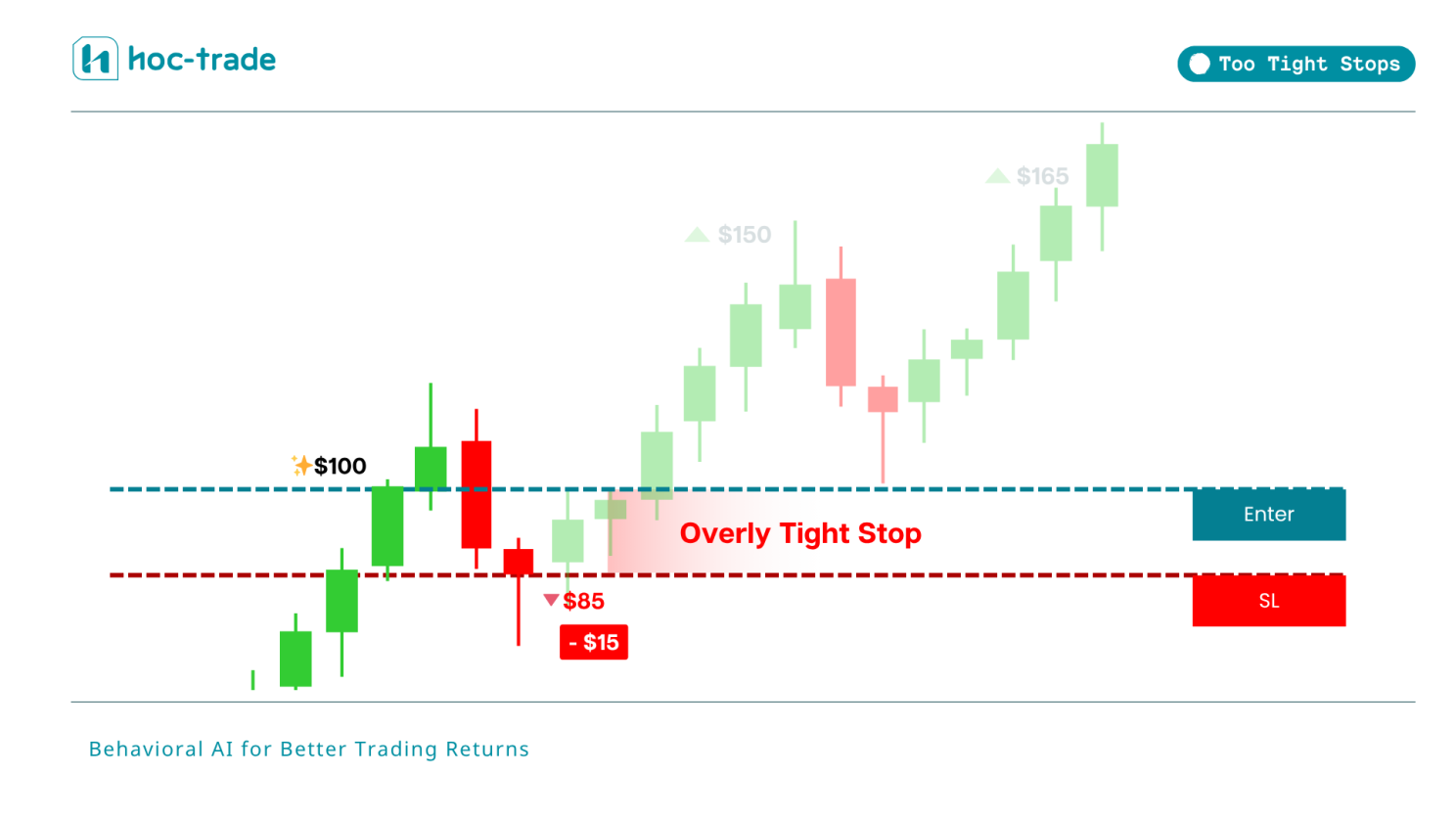
Third is overconfidence in entry timing. Many traders believe their entry point is so precise that any movement against them means the setup has failed. This ignores a reality all successful traders accept: even strong, well-reasoned entries experience pullbacks. A trade doesn't invalidate because price dips 10 pips; it invalidates when it breaks through a logical structural level or a volatility measure that defined the setup.
Fourth is overcompensation through position sizing. To keep their dollar risk constant, traders increase position size to offset the tight stop. While this balances the math, it amplifies the emotional toll. Larger positions create sensitivity to every tick. Spreads and slippage hurt more. The stop gets hit more frequently because the position size drives up anxiety, leading to even tighter stops and a downward spiral.
These four patterns rarely occur in isolation. Most traders who struggle with tight stops experience a combination of all four.
What's the real cost of being stopped out too frequently?
The visible cost is the accumulated losses. But the hidden cost is far larger. Every time you're stopped out of a trade that later moves in your intended direction, you're not just losing the trade, you're damaging the most valuable thing you have as a trader: your confidence in your own analysis and entries.
When this happens repeatedly, traders begin to question their method. They start tinkering. They try new indicators. They move to shorter timeframes. They add more confirmation signals. Each change is driven by the false conclusion that the setup was bad, when the actual problem was that the stop was in the wrong place.
This leads to what we call the 'optimization trap.' The trader keeps adjusting things in search of a system that somehow avoids the natural breathing room trades need. No such system exists. Markets require volatility buffers. Setups require pullback room. Entries require time to work. Fighting this reality is expensive.
Over a trading lifetime, the cost isn't measured in a few lost pips. It's measured in the time spent chasing phantom improvements, the trades not taken due to lost confidence, and the compounding effect of small frequent losses instead of larger less-frequent losses with higher hit rates.
How can you set stop losses that actually protect capital?
The first step is acknowledging that a stop loss needs breathing room. This isn't weakness or poor discipline. It's accepting market reality. Your stop should be placed beyond the normal volatility expected during the trade setup period, not within it.
Use volatility as your guide. If you're trading on a 4-hour chart in a pair with normal 20-30 pip swings, a 10-pip stop is fighting the chart, not respecting it. If you're trading support and resistance, place your stop below support, not just barely below it. If you're using technical levels, give them breathing room. The market will test them. Your stop shouldn't be the first line of defense; it should be the last.
Backtesting your stop distances is revealing. Run your strategy with your current stops, then run it again with stops widened by 2, 3, or 5 pips. You'll likely find that the wider stops result in more winners and fewer of those heartbreaking early exits. Yes, the win rate might improve enough to outweigh the larger stops. The math often works in favor of breathing room.
Finally, recognize that your position size should stay consistent across your trading, regardless of your stop distance. The stop size is determined by market structure and volatility. Your position size is determined by your account risk tolerance. Don't let a tighter stop drive you to oversizing. This temptation is one of the strongest signals that your stop is in the wrong place.
What does the data say about stop loss placement?
TradeMedic's behavioral analytics across 500,000+ trader accounts reveals that premature stop-outs during normal volatility rank among the most prevalent performance drains. Traders often don't realize how frequently they're being stopped out by market noise rather than actual trade invalidation. When these traders widen their stops to match volatility levels, their win rate improves significantly, often enough to create net positive expectations despite the slightly larger individual losses.
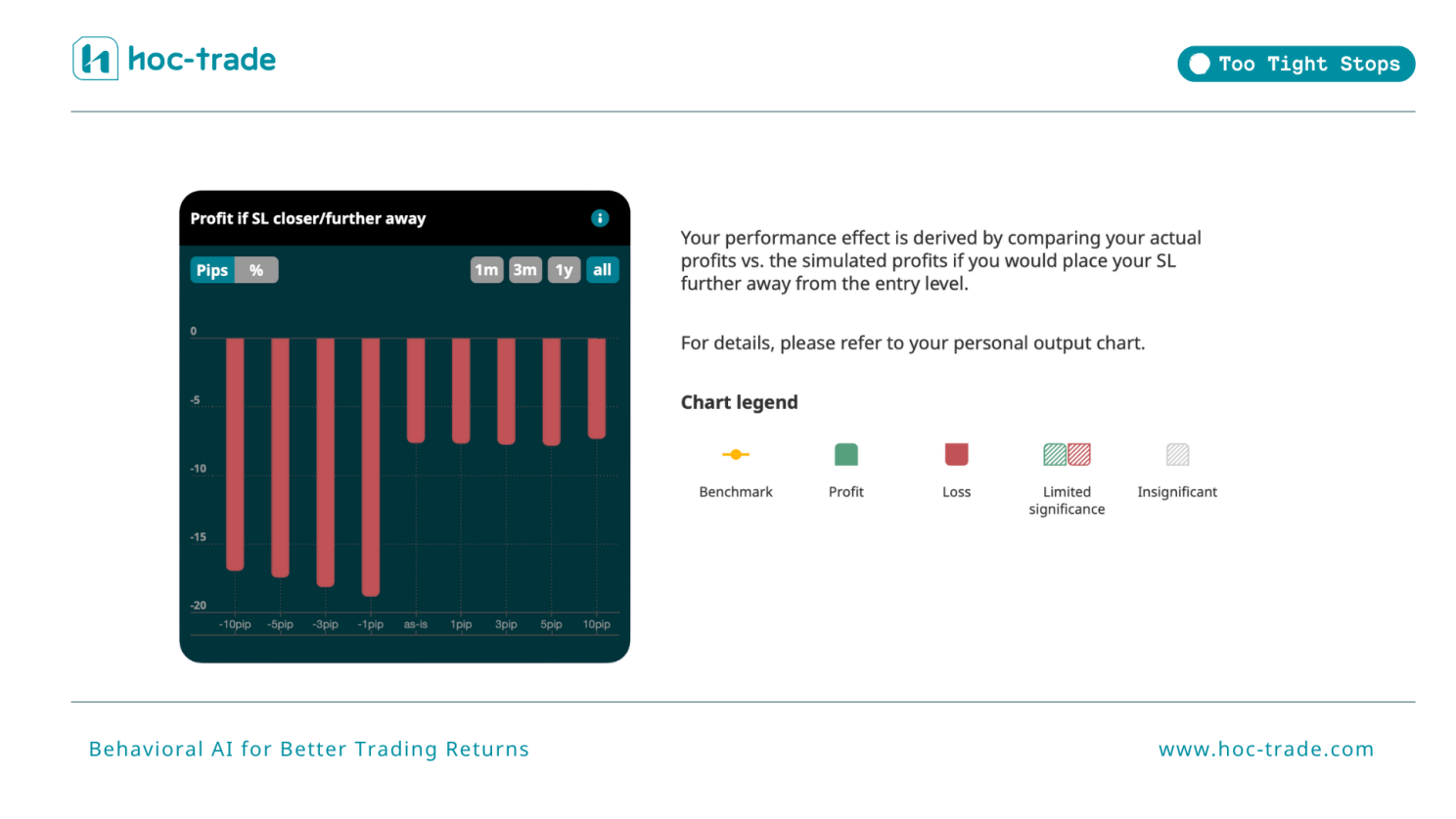
The pattern is consistent: the traders who improve fastest aren't those who tighten their discipline further. They're the ones who align their stop placement with market reality and give their trades room to work.
Successful trading requires more than precision. It requires perspective. The traders who win over time aren't those with the tightest stops, they're the ones who've learned to distinguish between market noise and actual trade invalidation. That distinction is everything. Once you make it, the rest of risk management becomes simpler. Your stops move to where they should be. Your confidence in your entries returns. And the real work of trading, executing your edge consistently, can finally begin.
TradeMedic AI analyses over 60 behavioural patterns, including too tight stop losses, across 500,000+ trader accounts. Visit TradeMedic to see how it works and get your own personal analysis.
Watch Why It Backfires when Stop Loss Too Tight
Frequently asked questions
What is a stop loss that's too tight?
A stop placed unrealistically close to entry with little room for normal market volatility. It triggers on minor price moves instead of actual trade invalidation, causing premature exits even when the trade direction is correct.
Why do tight stops backfire in trading?
Tight stops expose you to being stopped out by market noise rather than signal. They create a cycle of small frequent losses, erode confidence in your entries, and lead traders to abandon sound setups just before they work out as intended.
How do you know if your stop loss is too tight?
If you're frequently stopped out during normal price volatility rather than at actual structural breaks, your stop is too tight. Backtesting with wider stops that improve your win rate is a strong signal your original stops were fighting the market.
What should you base stop loss placement on?
Place stops based on market volatility, support and resistance levels, or technical invalidation points—not arbitrary pips. The stop should be beyond normal market breathing room, positioned where the trade thesis actually breaks, not where normal fluctuations might tap it.
Should position size change if you widen your stop loss?
No. Your position size should align with your account risk tolerance and remain consistent. Your stop size is determined by market structure. Adjusting position size to fit a tight stop creates additional risks and is usually a sign the stop itself is wrongly placed.