Category:
 Author:
 Date:May 25, 2026
Delayed Trade Exits: How Indecision Erodes Your Edge
The moment you identify a trade setup, the pressure begins. Entry feels significant—you've spotted an opportunity, confirmed your signal, and committed capital. But what often matters more for your bottom line is knowing when to leave. Many traders struggle here. They hold positions beyond the point where they should have closed them, waiting for more profits on winners or convinced that reversal is coming on losers. This hesitation—what we call anxious trade exits—quietly undermines otherwise solid trading approaches. The gap between optimal exit and actual exit can be the difference between consistent profitability and repeated disappointment.
What are anxious trade exits?
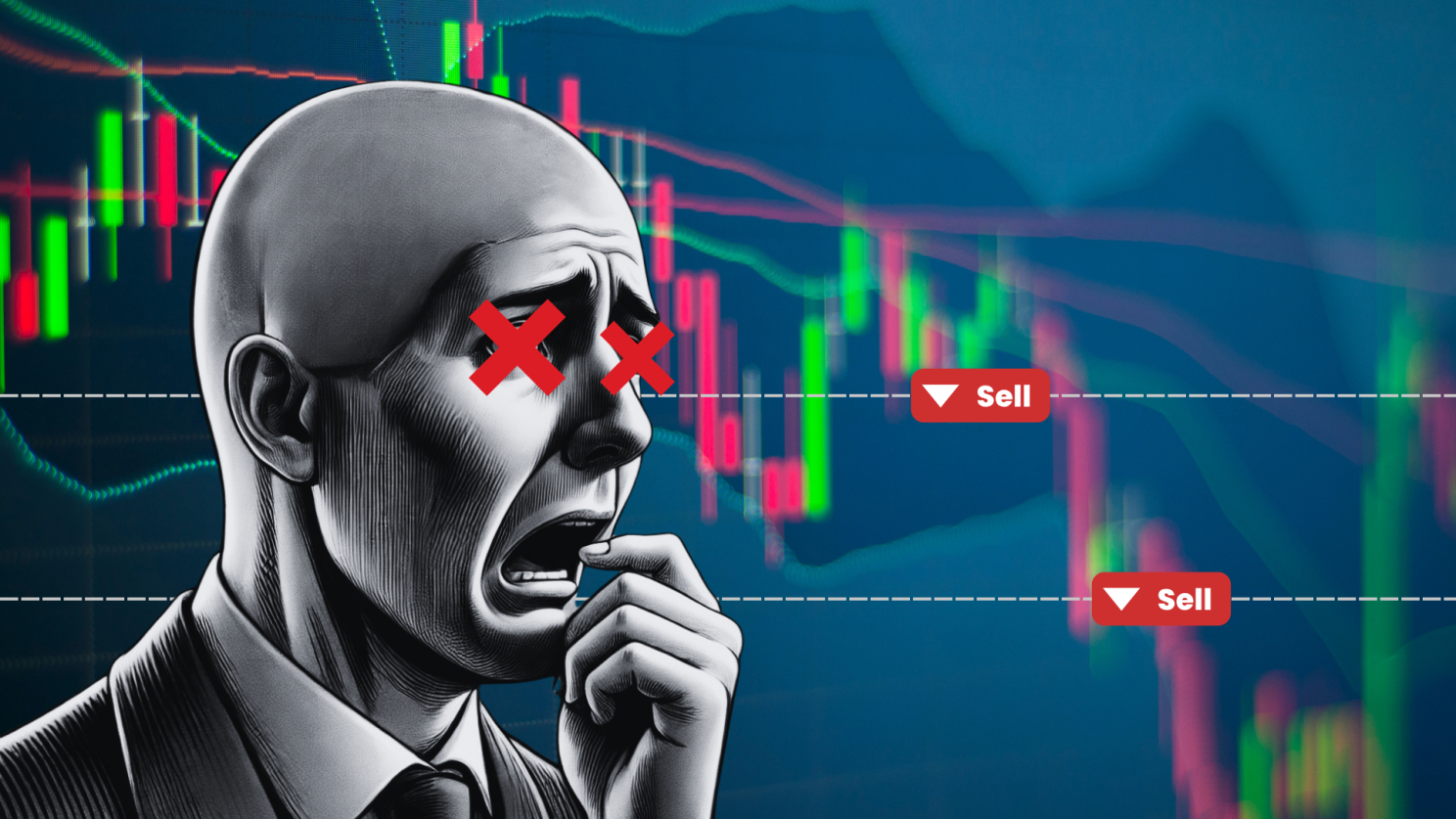
Anxious trade exits describe a pattern where traders close positions later than would be optimal. The behavior appears in two common forms. On winning trades, a trader might hold hoping for bigger gains, only to watch the position reverse back through their entry price. On losing trades, they hold longer than risk management suggests, hoping the market will turn in their favor. In both cases, the hesitation stems from emotional conflict rather than technical analysis. The trader knows the exit signal has arrived, but something—fear, hope, or simple indecision—prevents action. This delay transforms manageable outcomes into worse ones.
Why do traders hold onto positions too long?
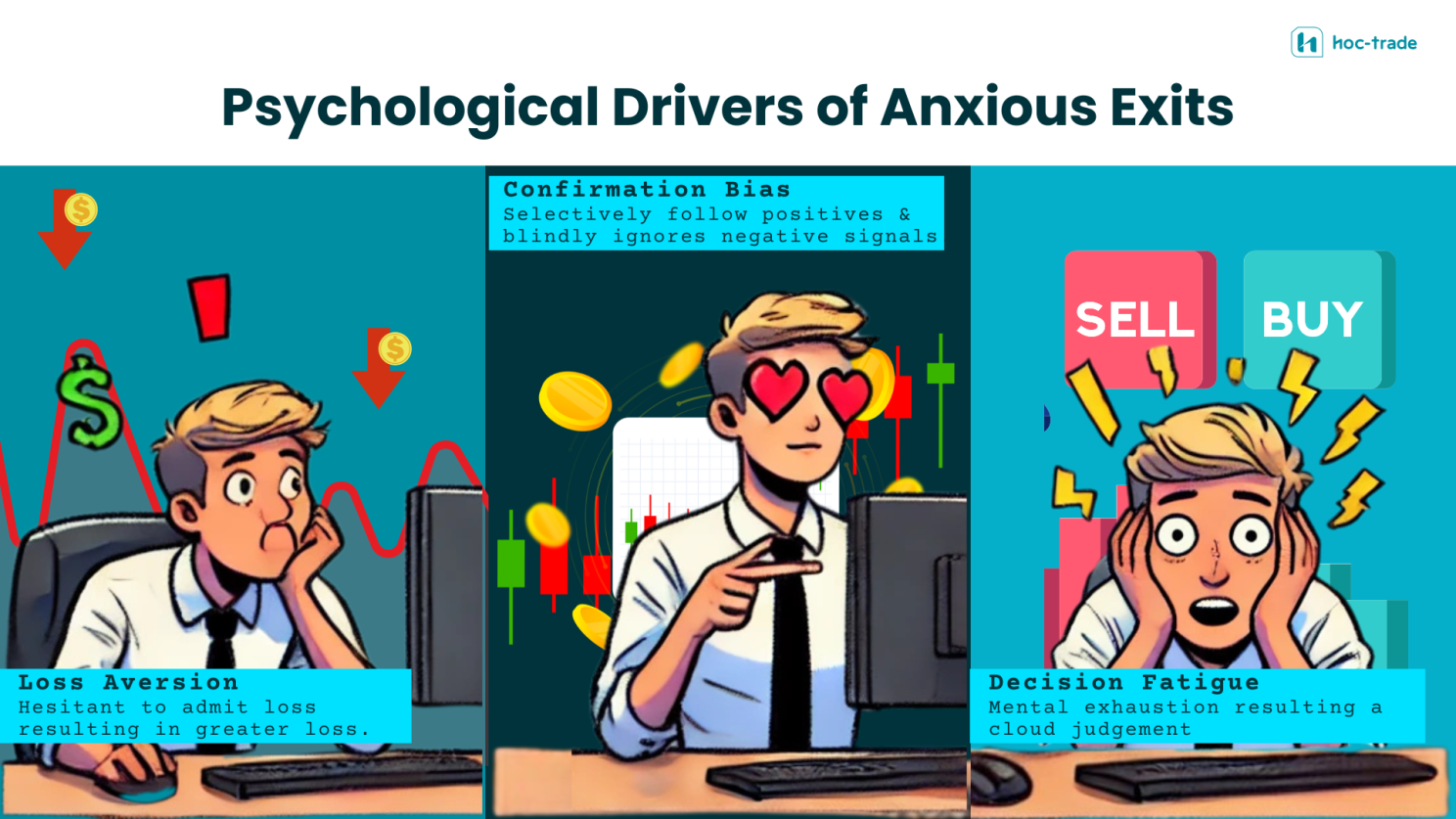
The roots of delayed exits lie in how human psychology handles uncertainty and loss. Loss aversion is perhaps the most powerful influence. The discomfort of accepting a loss feels disproportionately painful compared to the satisfaction of an equivalent gain. When traders face a losing position, this asymmetry drives risk-seeking behavior—they hold longer and often increase position size, hoping to recover the loss rather than locking it in. This same bias works on winning trades: traders fear missing the "big move" and hold past peak profit, watching gains evaporate.
Fear layers onto loss aversion. Fear of missing out compounds on winning trades. Fear of admitting failure keeps traders in losing trades. Confirmation bias amplifies the effect—traders unconsciously seek market signals supporting their hope for recovery, while filtering out or rationalizing contradictory signals. Meanwhile, decision fatigue erodes discipline. After hours of monitoring price action and processing information, mental exhaustion clouds judgment. Your best exit rules feel restrictive when you're tired. Your discipline feels like you're leaving money on the table. These forces don't act alone—they reinforce each other, creating a persistent pattern that affects most traders at some point.
How can traders overcome delayed exits?
The first step is recognition. You can't address a pattern you don't see. Review your trading history and look for the signature: where do your best exits happen versus where you actually close the position? How often do you exit at your predetermined stop loss or profit target versus moving it? How many trades would have been more profitable if you'd exited one candle earlier?
Once you've confirmed the pattern, use mechanical constraints. Define your take profit and stop loss before entry, not during the trade. This decision happens outside the noise of open P&L. An exit checklist with specific metrics—support/resistance broken, technical signal confirmed, risk-reward violated—creates a framework that functions even when emotions surge. Incremental adjustments work better than dramatic changes. If you're consistently exiting two candles too late, don't overhaul your entire strategy. Tighten your profit target by a small amount. Run that for ten trades. Observe. Then adjust again if needed. This prevents overfit and builds genuine adaptation.
What does the data say about anxious exits?
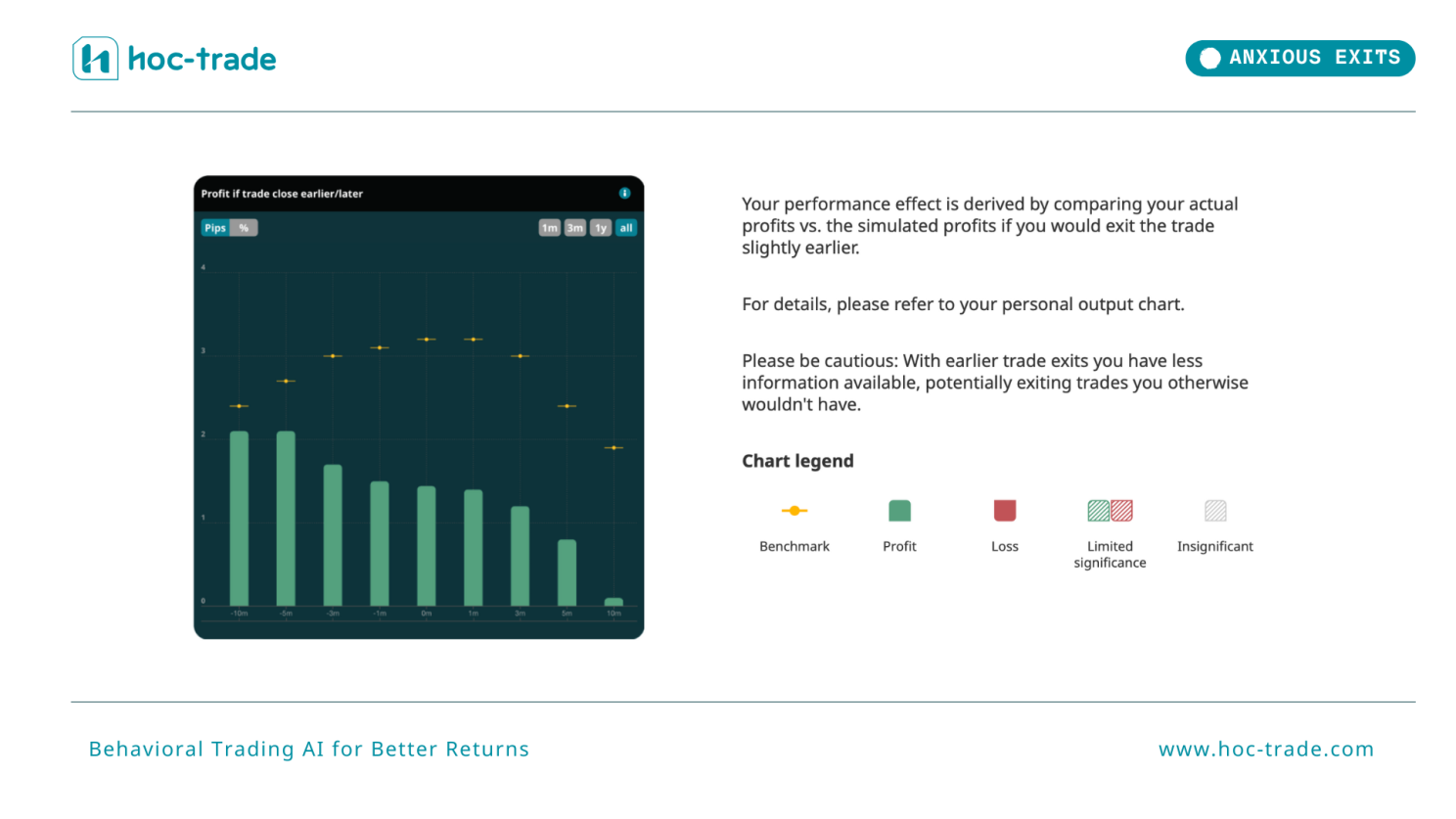
Delayed exits appear across TradeMedic's dataset of 500,000+ trader accounts with striking consistency. Our behavioral AI identifies this pattern by simulating earlier exit points for each trade and comparing hypothetical outcomes against actual results. When a trader consistently shows higher profitability at earlier exit points across a range of trades over time, the pattern flags. The analysis goes further—we classify trades by duration, market conditions, and strategy type to understand when and why the pattern emerges. For traders showing this behavior, the cumulative cost is substantial. Missing optimal exits by even one or two candles compounds across a portfolio of trades, eroding edge faster than most traders realize.
How can you identify your own anxious exit patterns?
Manual analysis is possible but time-intensive. Review your last 20 winning trades. For each one, identify where you took profits. Then look back and mark where your stop loss or technical exit signal would have triggered. Calculate the difference. Do this for losing trades too. If the pattern is consistent—if you're always one or two bars too late—you've found your leak.
The faster path is using analysis tools that flag the pattern automatically. Systems like TradeMedic compare your actual exits across your portfolio, identify correlation between earlier closing times and better outcomes, and surface these insights as behavioral feedback. This removes guesswork and gives you concrete data on the size of the problem. It also lets you track whether your adjustments actually work. After you tighten your exit rules, you can measure directly: are exits coming earlier? Is performance improving? Real feedback replaces hope.
Anxious exits are fixable. They're not a character flaw or a discipline failure—they're a predictable response to the uncertainty built into trading. The traders who improve fastest don't ignore emotion. They build systems that work despite it. Your exit rules don't need to be perfect. They need to be mechanical. Your data feedback doesn't need to be extensive. It needs to be accurate. Start with recognition, move to mechanics, then verify with data. That sequence transforms hesitation into consistency, one close at a time.
TradeMedic AI analyses over 60 behavioural patterns, including anxious trade exits, across 500,000+ trader accounts. Visit TradeMedic to see how it works and get your own personal analysis.
Watch How Delayed Trade Exits Erodes Your Edge
Frequently asked questions
What is an anxious trade exit?
An anxious trade exit is the pattern of closing a position later than the optimal exit point. This happens both on winning trades (where traders hope for bigger gains and watch profits evaporate) and losing trades (where they hesitate to accept the loss and hold hoping for reversal). The delay stems from emotional conflict rather than analytical signal.
What causes traders to hold losing positions longer than they should?
Loss aversion—a cognitive bias that makes losses feel more painful than equivalent gains—is the primary driver. Traders unconsciously seek to avoid accepting the loss, so they hold the position hoping for reversal. This behavior is amplified by fear of admitting failure and confirmation bias, where traders filter out signals that contradict their hope.
How does decision fatigue affect exit decisions?
After extended trading sessions or constant market monitoring, mental exhaustion clouds judgment and discipline. Traders become more vulnerable to emotional decision-making and more likely to rationalize breaking their exit rules. This fatigue makes strict exit rules feel restrictive in the moment, even though they're designed to protect performance.
What is the most effective strategy to fix anxious exits?
Define your take profit and stop loss before entry, when emotion is low. Use an exit checklist with specific metrics to remove interpretation from the moment of exit. Make small, incremental adjustments to your rules rather than wholesale changes, and track the impact with data over time.
How can behavioral analysis tools help identify anxious exit patterns?
Tools like TradeMedic simulate earlier exit points for each trade and compare hypothetical outcomes against actual results. When consistent patterns emerge across your portfolio over time—where earlier exits would have been more profitable—the system flags the behavior and quantifies the cost.