Category:
 Author:
 Date:Jul 4, 2026
Excessive Risk Taking in Trading: When Confidence Becomes Exposure
Two very different moods lead traders to the same mistake. A winning streak makes bigger positions feel earned. A losing streak makes them feel necessary. Either way, the size of the bet creeps up while the strategy underneath stays exactly the same, and that gap between position size and account resilience is where most serious drawdowns start.
This is often framed as a discipline problem, and discipline is part of it. But there's more going on underneath: a shift in how much of the account is put at risk on any single idea, one that happens gradually enough that it rarely feels like a decision at all.
What Is Excessive Risk Taking in Trading?
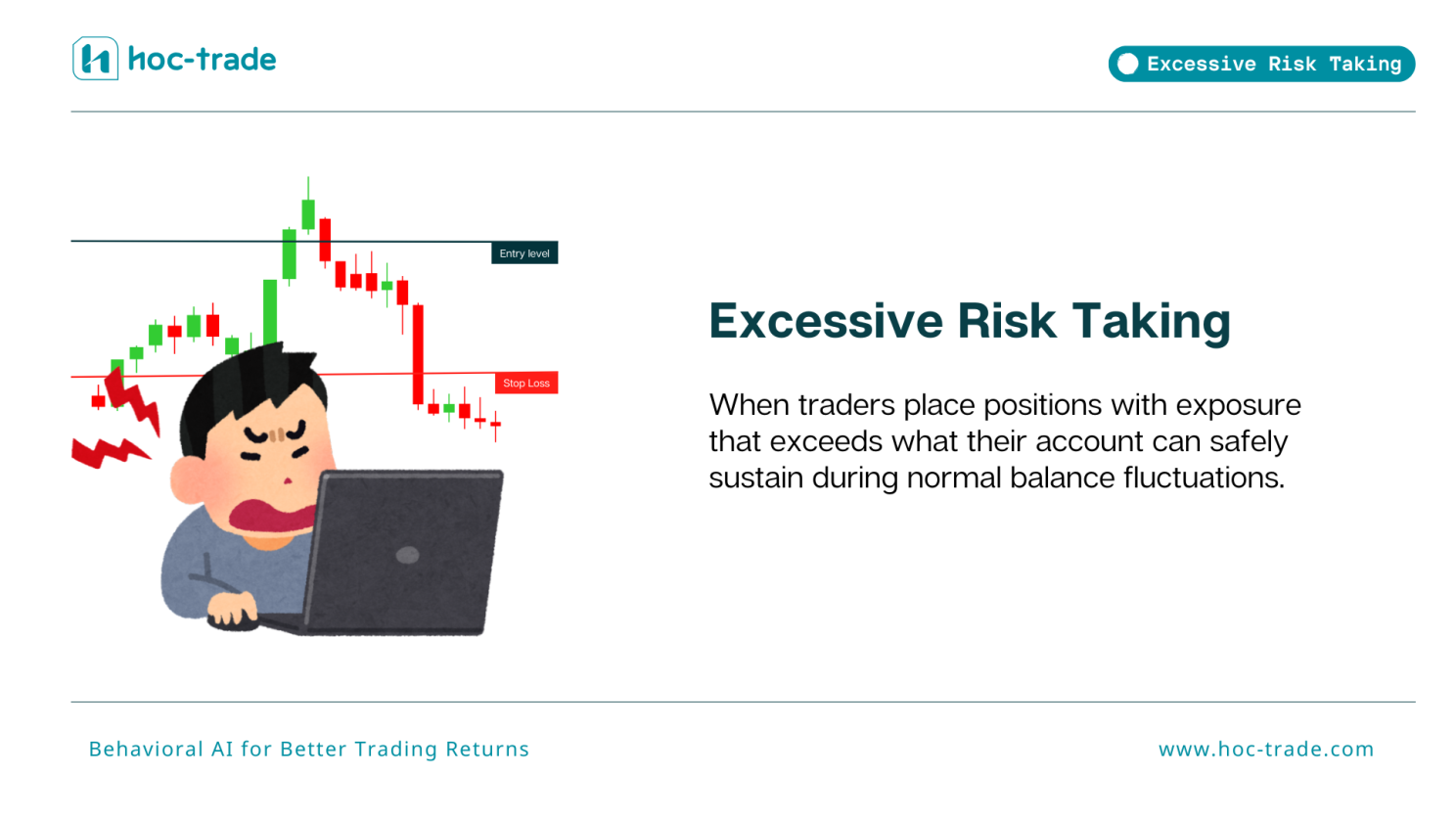
Excessive risk taking means placing trades with exposure that goes well beyond what an account can absorb during a normal run of losing trades. In practice, this usually shows up as committing a large share of total equity, 5%, 10%, or more, to a single position or to a cluster of correlated trades. It can look like conviction from the outside. Underneath, it leaves the account exposed to swings that can turn into a serious drawdown or a margin call far faster than the trader expects.
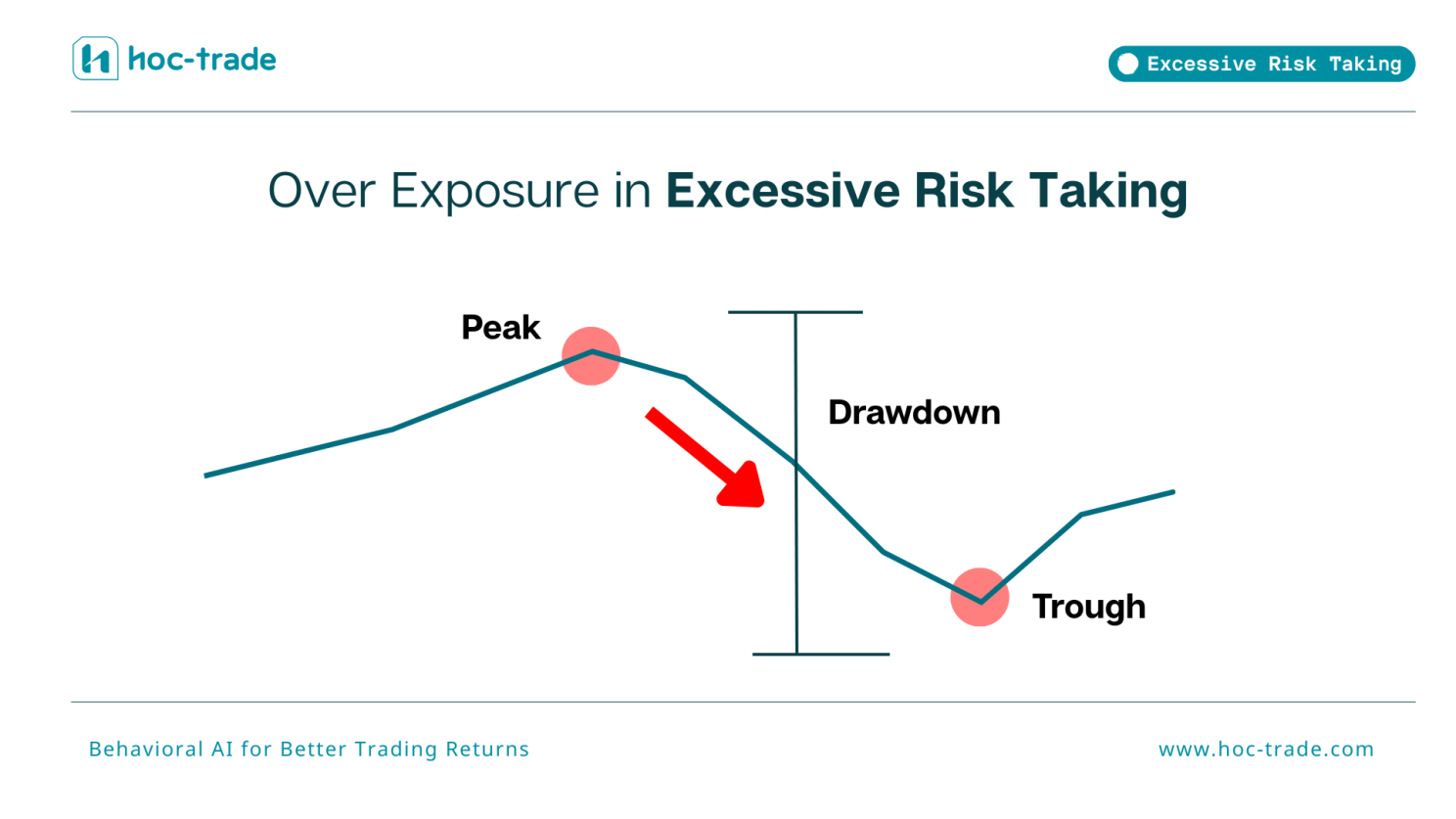
Losing streaks happen to every trader, regardless of skill level. What separates traders who recover from traders who don't is rarely the strategy itself. It's how much capital was put at stake on the trades that didn't work. A trader who keeps risk steady can absorb a run of losses and come back from it. A trader who lets position size climb faces damage that compounds faster than it can be recovered.
How Much Drawdown Risk Does a 10% Position Size Create?
The maths behind this is worth sitting with. Picture a genuinely strong strategy: a reward-to-risk ratio of 1.5 and a 50% hit rate, the kind of edge most traders would be glad to have. Now apply 10% risk per trade, on the logic that a strong edge deserves to be backed heavily. Run that strategy across a large sample, say 1,000 trades, and the odds of hitting a drawdown of 70% or worse land at roughly 91.6%. Close to certain.
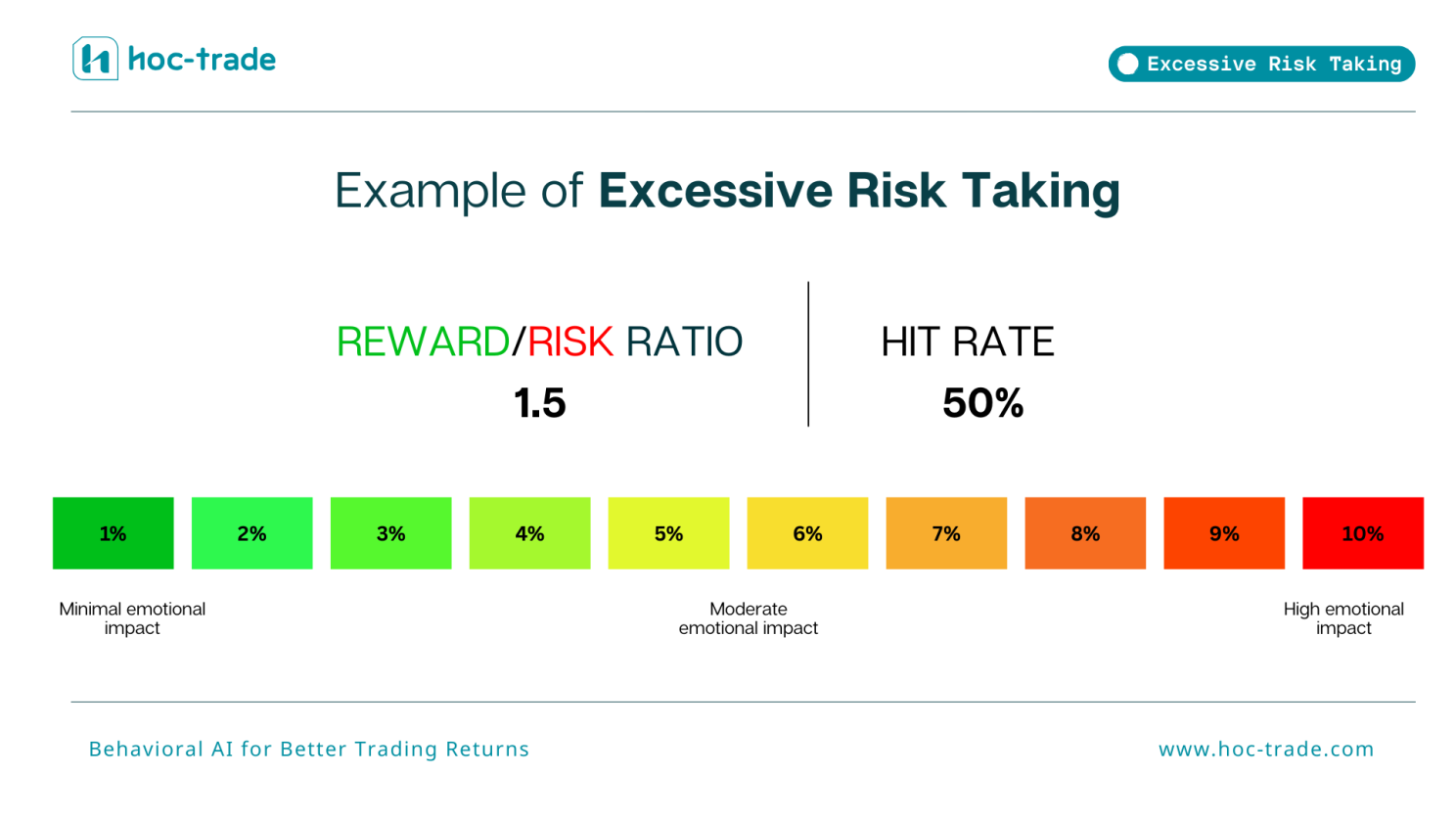
That number doesn't change because the strategy is good. It changes because the position size is too large for the account to absorb a normal losing streak. Once a drawdown of that size hits, the odds of revenge trading, or of abandoning the plan altogether, rise sharply. Traders who want to check their own numbers can run the same scenario through any publicly available risk of ruin calculator.
The lesson isn't that the strategy failed. It's that no strategy, however sound, survives risk sized past what the account can sustain. What usually ends the account is unsustainable position sizing, not an unprofitable system.
Why Do Traders Increase Risk After Wins or Losses?
Nobody sets out to gamble with their account. The shift towards bigger risk almost always feels rational in the moment, which is exactly why it's hard to catch. After a winning streak, overconfidence bias makes the market feel newly predictable, and each win adds to the sense that the trader has cracked something the market hasn't priced in yet. That feeling builds a loop: bigger wins feel deserved, so bigger risk feels justified.
Losses trigger a different but related pattern. Revenge trading shows up when a trader can't sit with a setback and increases size to recover it quickly, reframing risk as recovery rather than danger. The gambler's fallacy makes this worse: the mistaken sense that a win is now statistically overdue after a run of losses. Instead of stepping back, the trader doubles down, convinced persistence alone will restore the balance.
Underneath both patterns sits loss aversion, the tendency to feel a loss roughly twice as sharply as an equivalent gain. That asymmetry makes it hard to accept a loss at a reasonable size, so the trader risks a bigger one instead of realising a smaller one. Over time, confidence fuels risk, risk fuels emotion, and emotion keeps clouding the next decision.
How Can Traders Prevent Excessive Risk Taking?
The fix starts with treating risk as fixed rather than as something that moves with mood. Most traders are better served by a set risk-per-trade percentage, typically one to two percent of total equity, applied the same way regardless of whether the last few trades won or lost. When hit rates dip, cutting position size becomes the safeguard that keeps losses manageable and keeps judgement intact. Consistent stop-loss placement does the same job from a different angle: it removes the moment-by-moment decision about how much a losing trade is allowed to cost.
Prevention is as much psychological as mechanical. Watching how position size moves after a win or a loss is one of the clearest ways to catch confidence turning into exposure before it shows up in the account balance. A consistent risk structure isn't a limit on performance. It's what lets performance actually reflect skill instead of mood, and that steadiness is what carries a trading account through the years, not just the good months.
How Does Hoc-trade Detect Excessive Risk Taking?
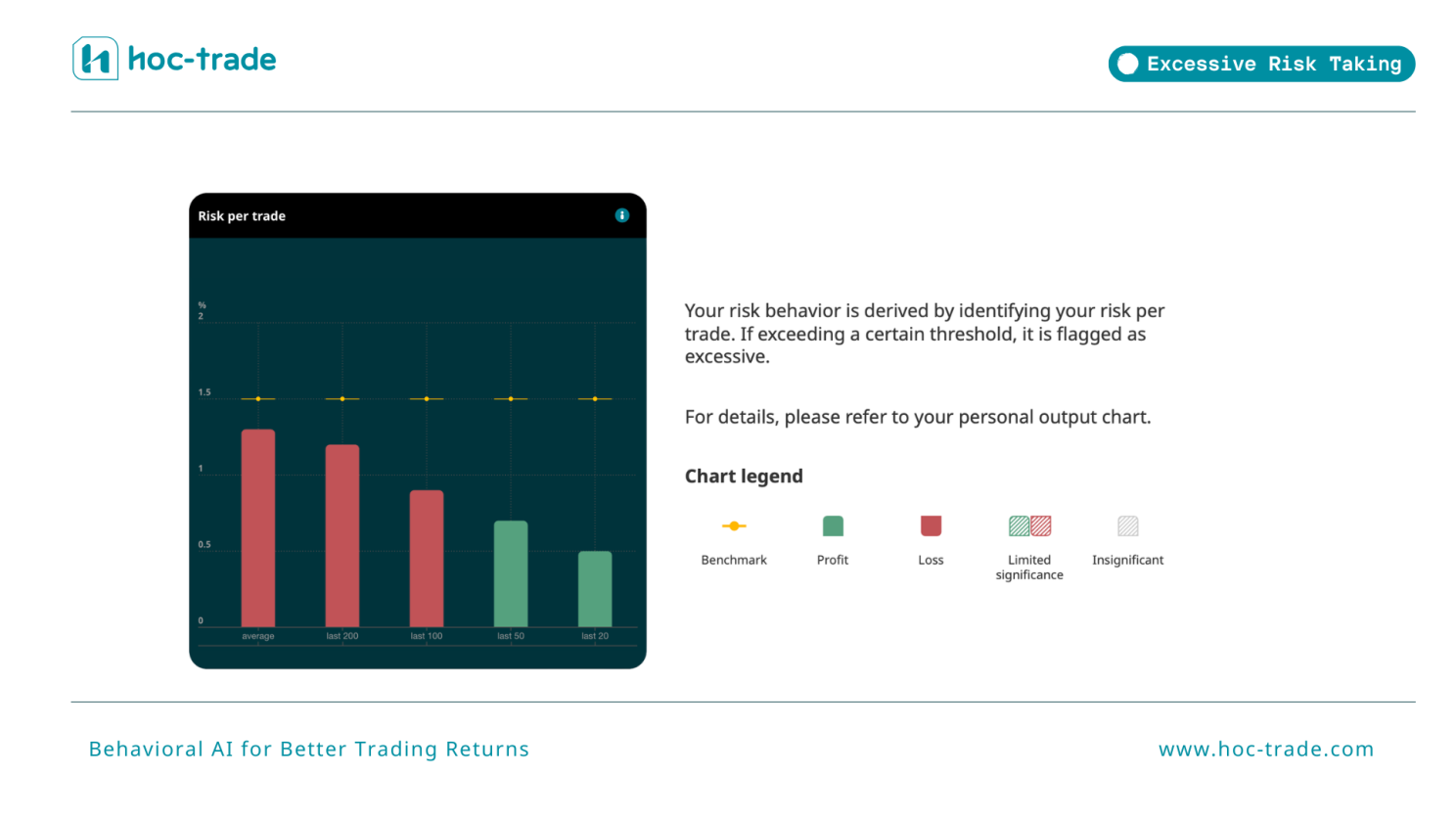
TradeMedic's behavioural AI turns this pattern from something felt into something measured. By reading each trade's position size, entry, stop-loss, and account balance, TradeMedic calculates a trader's average risk per trade as a share of total equity, then tracks that figure against the trader's own recent history to see whether exposure has drifted past a sustainable range.
When average risk crosses a defined threshold, it flags a pattern of overexposure that might not show up in performance yet, but that signals a higher chance of severe drawdowns once volatility picks up. Because the system also tracks how risk levels move after wins and losses specifically, it can catch the moment confidence starts turning into risk escalation, well before the account feels the impact.
What Does the Data Say About Excessive Risk Taking?
TradeMedic AI detects excessive risk taking across a dataset of over 500,000 trader accounts and calculates each trader's personal risk profile for the behaviour, tracking how position sizing shifts around winning and losing streaks. Within that dataset, overexposure ranks among the improvement opportunities most closely tied to severe drawdowns, and a full breakdown of the underlying numbers is available through TradeMedic's ongoing research.
Excessive risk taking rarely comes down to a lack of knowledge. Almost every trader who has been through a margin call already knew, in principle, that they were oversized. What's harder to hold onto is control once confidence, or the urge to recover, starts making bigger risk feel reasonable. The pattern doesn't show up as one bad trade. It builds through repeated overexposure that compounds quietly, trade after trade, until a normal losing streak turns into something the account can't absorb. Seeing that shift early, in the data rather than after the drawdown, is what tends to separate traders who last from traders who don't.
TradeMedic AI analyses over 60 behavioral patterns, including Excessive Risk Taking across 500,000+ trader accounts. Visit TradeMedic to see how it works and get your own personal analysis.
Watch How Excessive Risk Taking in Trading
Frequently asked questions
What is excessive risk taking in trading?
Excessive risk taking is placing trades with exposure that significantly exceeds what an account can sustain during a normal losing streak, typically 5% or more of total equity on a single trade or a cluster of correlated trades. It often looks like conviction, but it leaves the account exposed to drawdowns or margin calls far sooner than expected.
Why does risking 10% per trade lead to such a high chance of a severe drawdown?
Even a profitable strategy with a 1.5 reward-to-risk ratio and a 50% hit rate carries close to a 91.6% chance of a 70%+ drawdown across 1,000 trades if risk per trade is set at 10%. The strategy's edge doesn't change this, the position size does.
What psychological biases drive excessive risk taking?
Overconfidence bias after winning streaks, revenge trading and the gambler's fallacy after losses, and loss aversion all push traders towards larger position sizes. Each bias reframes bigger risk as rational rather than dangerous in the moment it's taken.
How much should a trader risk per trade?
Most sustainable trading plans use a fixed one to two percent of total equity per trade, applied consistently regardless of recent wins or losses. Reducing position size when hit rates decline helps keep losses manageable and protects long-term decision-making.
How does TradeMedic detect excessive risk taking?
TradeMedic analyses each trade's position size, entry, stop-loss, and account balance to calculate a trader's average risk per trade as a percentage of equity, then compares that figure against their own trading history. It flags when exposure drifts beyond a sustainable range, including how risk shifts after wins and losses specifically.