Category:
 Author:
 Date:Jun 29, 2026
Emotional Loss Streaks: Why Risk Quietly Rises After a Losing Run
Every trader takes losses. They're part of the job, not a sign that something has gone wrong. What separates traders over the long run is rarely the losses themselves, but the decisions that follow them. A few setbacks in a row, and something shifts. Patience thins, the urge to recover takes over, and risk starts to creep upward with each new attempt to claw the account back. That slow upward drift in risk has a name, and once you can see it, you can manage it.
This pattern is called an emotional loss streak: the tendency to raise your risk per trade after several losses in a row. From the outside it can look like grit, a refusal to back down. Underneath, it's usually something more familiar. The need to feel in control when the market keeps saying you're not.
What is an emotional loss streak in trading?
An emotional loss streak happens when a run of consecutive losses pushes a trader to increase their risk exposure rather than dial it back. Instead of trimming position size or stepping away to reassess, they commit more, convinced the rebound is one trade away.
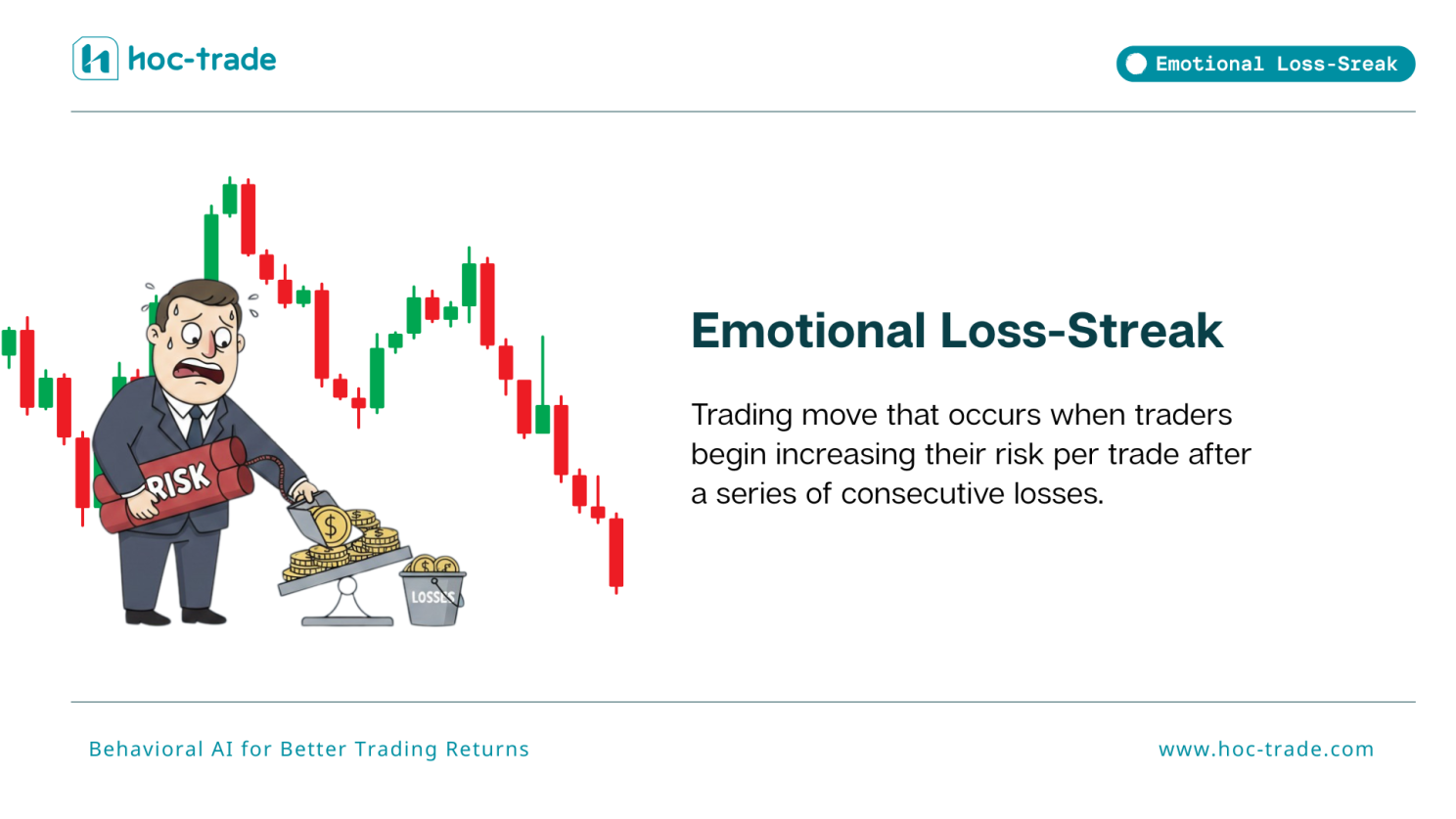
Picture someone who has just lost three positions back to back. Annoyed and impatient to fix it, they size up on the next setup and risk double their usual amount. The trade feels charged, as though landing it would wipe out the money lost and the frustration along with it. Repeat that a few times and the losses stack faster than any single win can repair, which is how emotion ends up steering decisions that logic used to handle.
Why do traders increase risk after a losing run?
Most of this traces back to a well-documented mental shortcut: the gambler's fallacy, the belief that after a string of losses a win is somehow owed. We're poor at reading probabilities in moments like these. Think of a roulette wheel landing on red fifteen times in a row. The mind insists black is now overdue, because surely sixteen reds can't happen. So the bet grows. But the wheel has no memory, the odds haven't moved an inch, and the certainty is an illusion. In trading, that same illusion arrives dressed up as instinct: the quiet sense that this next trade is the one that squares the books.
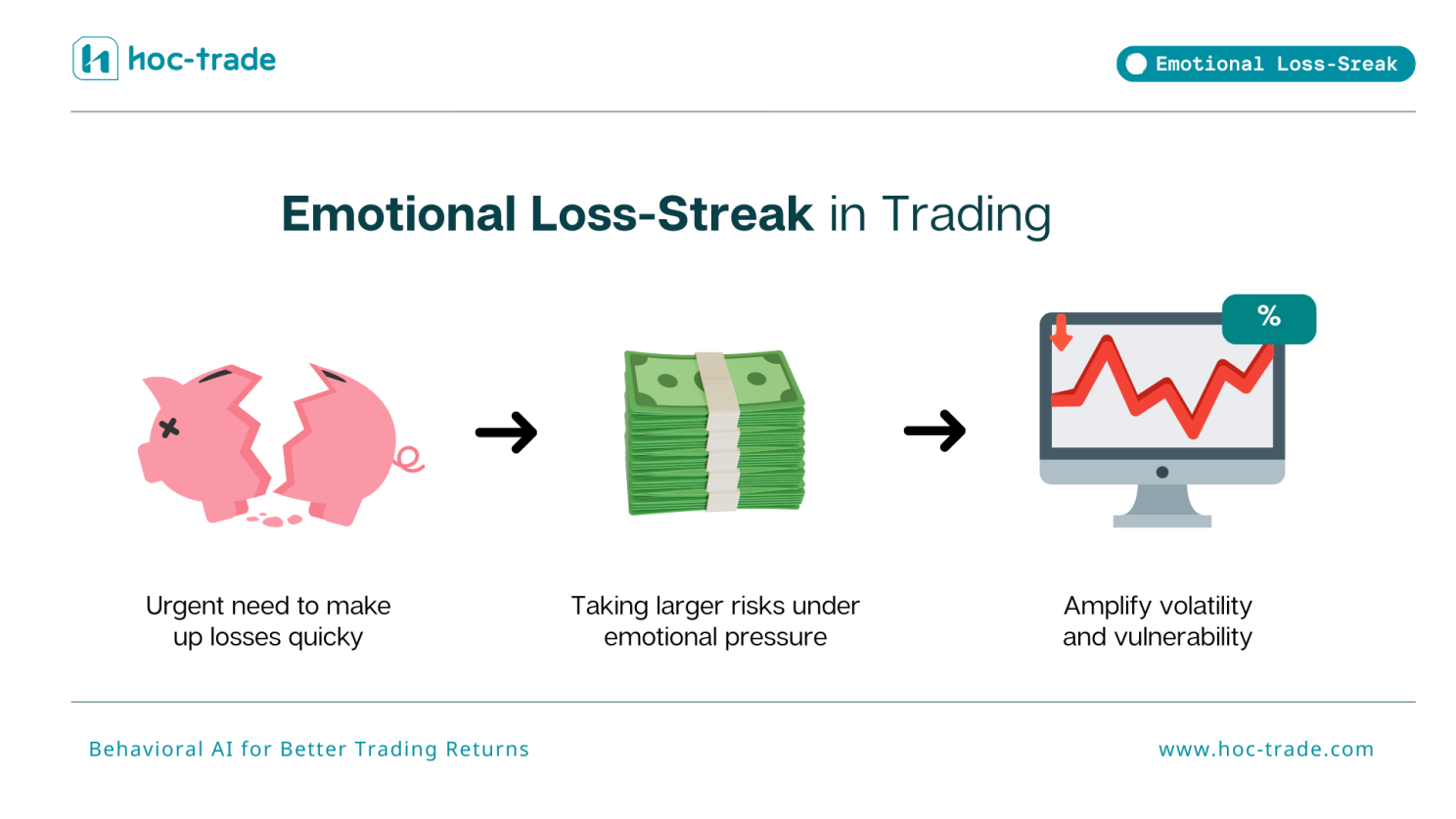
Once that belief settles in, structure starts to give. Positions get bigger. Stop-losses drift wider to avoid being proven wrong. The strategy that was supposed to be the anchor bends under the weight of frustration, and choices stop coming from a plan and start coming from a need to be made whole.
How does an emotional loss streak lead to revenge trading?
Sitting with a loss is uncomfortable, and discomfort wants relief. That pull toward doing something to restore the balance is where revenge trading takes root. Exposure climbs not because a better setup appeared, but because sitting in uncertainty has become unbearable. Each reaction feeds the next, recovery turns into escalation, and what began as an attempt to get even quietly becomes a faster way to lose. It's often framed purely as a discipline problem. Discipline is part of it. But there's more going on, and it has more to do with how the brain handles loss than with willpower.
How does TradeMedic detect an emotional loss streak?
hoc-trade's behavioural AI turns this emotional cycle into something you can see on a chart. TradeMedic tracks how a trader's risk per trade, measured as a percentage of account balance, moves in the wake of a losing run. When risk rises in step with the number of preceding losses, that positive correlation gets flagged as an emotional loss streak. Every trade is read in sequence, so it becomes clear whether risk-taking is holding to plan or starting to mirror frustration.
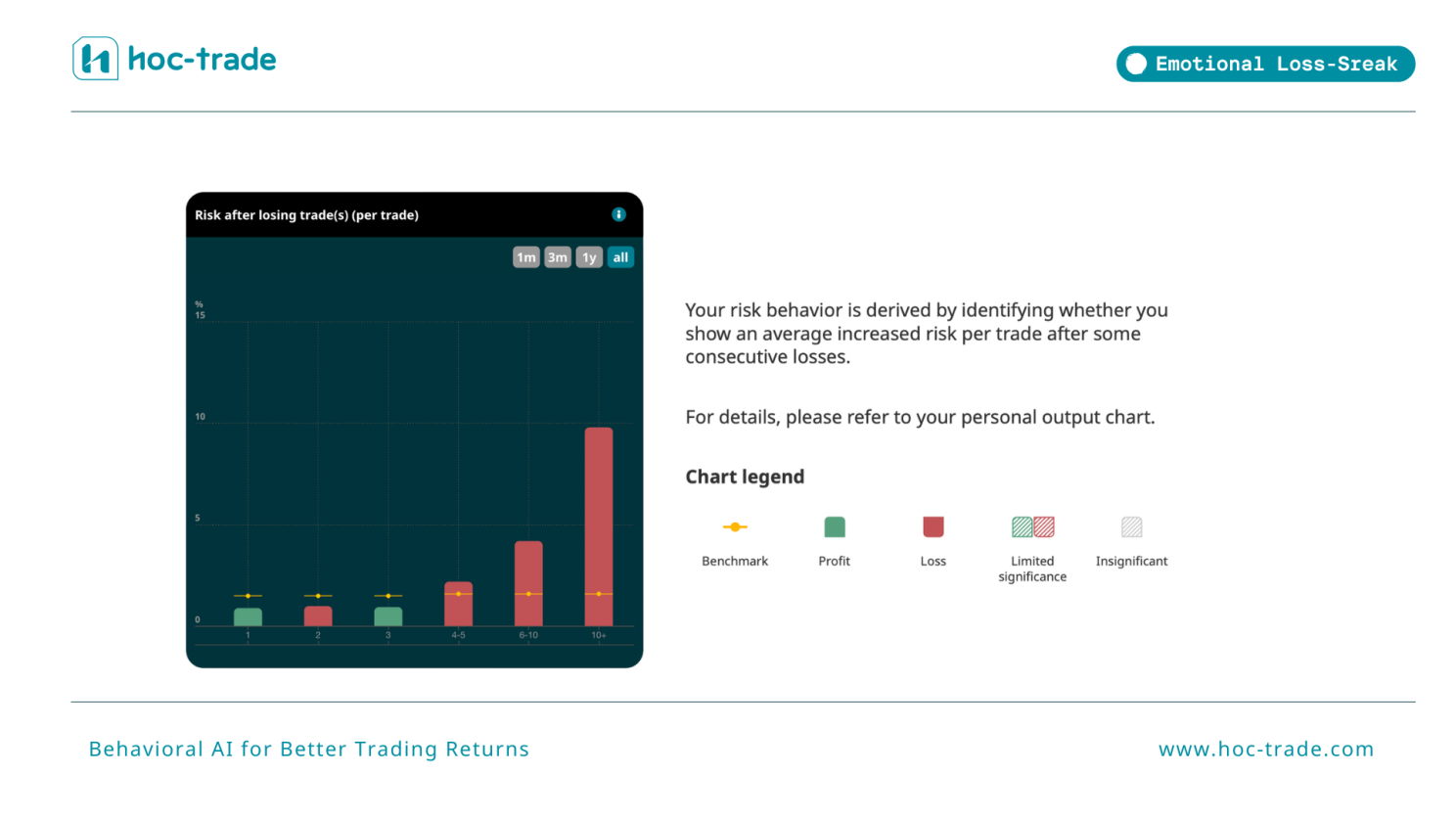
That's the part that matters most. The method takes something that usually feels invisible and makes it observable. Seeing the exact point where discipline slips is what gives you the chance to pause, reassess and rebuild structure. Repeated over time, that awareness reshapes how you respond to losses, so volatility becomes information rather than a trigger.
What does the data say about emotional loss streaks?
TradeMedic™ detects emotional loss streaks across a dataset of more than 500,000 trader accounts and calculates each trader's personal risk profile for the behaviour. Within that dataset, escalating risk after losses sits among the most impactful improvement opportunities the system surfaces, closely linked to the same impulses behind overtrading. A detailed breakdown with specific statistics is covered in our research findings. Source: TradeMedic Research, 2026.
How can traders break an emotional loss streak?
There's a moment in every account where logic hands the wheel to emotion, usually when the wish to recover outweighs the willingness to wait. The emotional loss streak is that moment made visible: the point where frustration starts setting the size of the next trade. Catching it isn't about self-blame. It's about awareness, and awareness is what gives you somewhere to stand.
By converting these reactions into measurable signals, hoc-trade shows you the exact spot where discipline begins to slip, early enough to do something about it. In markets where emotion drives so many decisions, that clarity becomes the real edge. The market will forget your losses soon enough. The decision you make right after them is the one that sticks.
TradeMedic AI analyses over 60 behavioral patterns, including Emotional Loss Streak across 500,000+ trader accounts. Visit TradeMedic to see how it works and get your own personal analysis.
Watch How Emotional Loss Streak Quietly Eating Your Gains
Frequently asked questions
What is an emotional loss streak in trading?
An emotional loss streak is the tendency to raise your risk per trade after several consecutive losses. Rather than reducing position size, the trader commits more in the belief that a rebound is imminent. It looks like persistence but usually reflects an emotional need to recover rather than a genuine improvement in the setup.
Why do traders take bigger risks after losing?
It's largely driven by the gambler's fallacy, the belief that a win is owed after a run of losses. The odds of each trade don't change, but the mind perceives a rebound as overdue and sizes up accordingly. That misread of probability is what pushes risk higher at exactly the wrong time.
Is an emotional loss streak the same as revenge trading?
They're closely related but not identical. An emotional loss streak describes the measurable rise in risk after losses, while revenge trading is the wider behaviour of trading to recover losses quickly. An emotional loss streak is often where revenge trading begins, as escalating risk and the urge to get even feed each other.
How does TradeMedic identify an emotional loss streak?
TradeMedic analyses how risk per trade, as a percentage of account balance, changes after a sequence of losses. When risk rises in line with the number of preceding losses, that positive correlation is flagged. Each trade is assessed in order, showing whether risk-taking stays aligned with strategy or starts reflecting frustration.
How can I stop increasing my risk after losses?
The first step is recognising the pattern as it happens, which is why measurement matters. Once you can see the point where risk starts climbing with each loss, you can pause, return to your planned position size and reassess before continuing. Awareness of the trigger is what makes it possible to rebuild structure rather than escalate.