Category:
 Author:
 Date:Sep 18, 2026
Overtrading Affects 50% of Traders. Here's All You Need to Know
Overtrading is one of the most searched mistakes in trading, and one of the most common in real trading data. Across more than 500,000 trading accounts analysed by TradeMedic AI, almost exactly every second trader (49.5%) shows overtrading as a measurable cost in their results. For those traders, it has cost an average of $7,248 each.
That puts overtrading among the most expensive habits a trader can have. It is the third most common issue to appear among a trader's five biggest improvement areas, and among the traders who show it, it causes a larger share of losses than all but four of the 23 patterns we track. This article covers what overtrading is, how common it is, who is most affected, the signs to look for, the psychology behind it, and how to stop. What is overtrading?
Overtrading means taking more trades than your edge can support. The number of trades on its own does not define it. A scalper placing 40 trades a day may be trading exactly to plan, while a swing trader placing four may be overtrading badly. What defines overtrading is what happens to the quality of your trades as the count climbs: each additional trade in a day performs worse than the ones before it, until the extra trades start costing money.
The typical loop is easy to recognise. A trader starts the day with a plan and takes the first one or two setups that meet it. Then the standards slip. A trade that almost meets the criteria gets taken because the market is moving. A loss creates the urge to make it back on the next one. A win makes the next setup feel more certain than it is. By the end of the session, the trades placed late in the day look very different from the ones placed early, and they perform accordingly.
What keeps the loop running is rarely the chart. Placing a trade is rewarding in itself: the moment of entry, the open position, the uncertain outcome all activate the brain's dopamine-driven reward system, whether the trade ends up making money or not. Add a tendency to overrate your own read of the market and the discomfort of sitting still, and the next trade becomes very hard to skip. We look at this psychology in depth further down in this article.
So the meaning of overtrading in trading comes down to one relationship: more trades, lower quality per trade, worse results.
Let's start by looking at how common overtrading is.
How common is overtrading, and what does it cost?
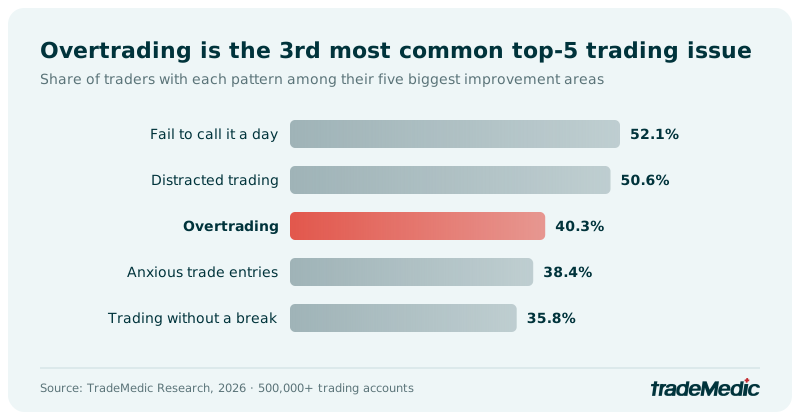
Overtrading is detected in 49.5% of the traders in our dataset. For 40.3% it is one of their five biggest improvement areas, which makes it the third most common top-five issue, behind failing to call it a day (52.1%) and distracted trading (50.6%). For 10.5% of traders, overtrading is the single biggest issue in their trading.
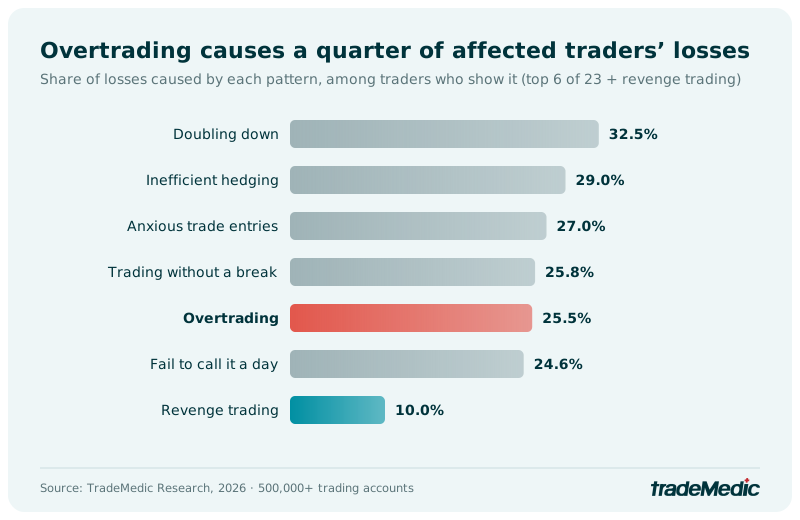
Being common does not automatically make a pattern expensive, so the next question is what it costs. Among traders who show overtrading, it causes 25.5% of their losses, an average of $7,248 per trader. In other words, about a quarter of everything these traders lost can be traced back to trading too much.
For comparison, revenge trading is the pattern traders are warned about most, yet among traders who show it, it causes 10.0% of their losses. For the traders affected, overtrading takes a share of losses two and a half times larger than revenge trading. Only four patterns take a larger share from the traders who show them: doubling down (32.5%), inefficient hedging (29.0%), anxious trade entries (27.0%) and trading without a break (25.8%). Each figure is measured on its own group of affected traders, and many traders carry several patterns at once, so the shares cannot be added together.
Because overtrading is so common, its impact across the whole market is large too: measured across all traders in the dataset, overtrading accounts for 17.9% of all trading losses.
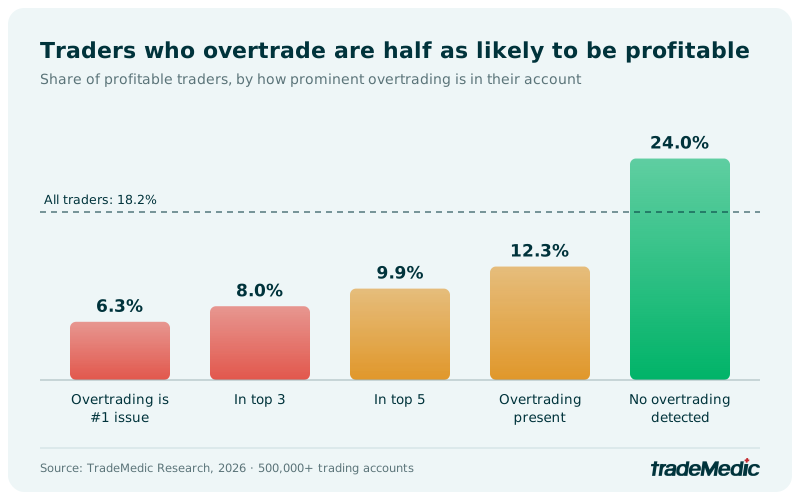
The losses show up in profitability too. Only 12.3% of traders with overtrading are profitable, compared with 24.0% of traders where it is not detected. The more dominant the pattern, the lower the rate: when overtrading is in a trader's top five, 9.9% are profitable; in the top three, 8.0%; and when it is the single biggest issue, only 6.3% are profitable, about a third of the 18.2% rate across all traders.
44.4% of loss-making traders have overtrading in their top five, compared with 21.8% of profitable traders. These are associations, and many losing accounts carry several problems at once. But the gap is large, and it widens steadily as overtrading becomes more prominent in an account.
Knowing that overtrading is both common and costly, the next step is to find out who is most likely to show it. The answer is not who most people would expect.
Who is most likely to overtrade?
Overtrading is often described as a beginner mistake, but the data points the other way. Overtrading is detected in 15.4% of accounts under 10 days old, rising to 51.2% at 10 to 49 days, 65.6% at 50 to 199 days, and 70.3% of accounts trading for 200 days or more. From 50 days onward, it is the most common issue in traders' top five.
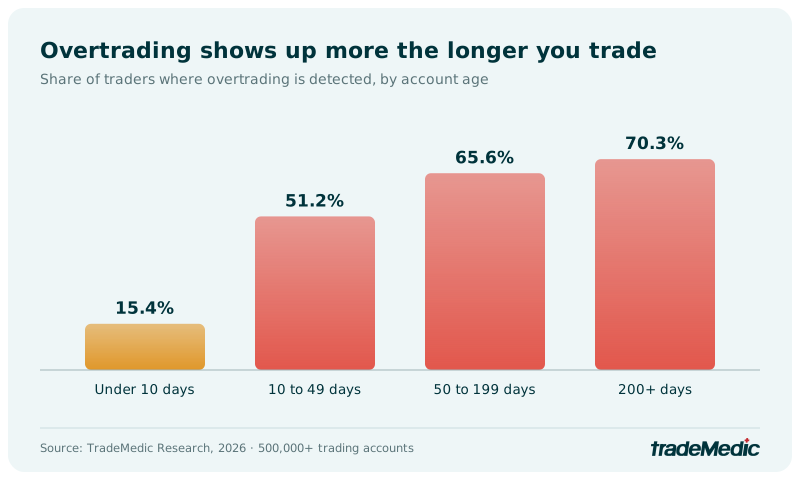
Part of this is mechanical. An account with a longer history gives the analysis more trading days to work with, which makes a consistent pattern easier to detect. But overtrading also becomes more prominent the longer traders stay in the market: its share of top-five issues climbs from 13.3% in the first 10 days to 55.2% past 200 days.
The psychology offers a plausible explanation. The brain's dopamine response is strongest for rewards that are new and unexpected, and it fades as the same reward becomes familiar. For a new trader, every trade is new: a handful of positions is enough to deliver the excitement. For a trader who has placed thousands of trades, a single entry no longer produces the same kick, and it can take more activity to feel the same. Our data cannot prove this mechanism, but it fits the pattern of overtrading growing the longer traders stay in the market.
Trading style tells a similar story. Scalpers trade the most, averaging 47 trades a day, yet only 23.9% have overtrading in their top five, compared with 41.7% of day traders and 43.3% of swing traders. Day traders in the dataset average 17 trades a day.
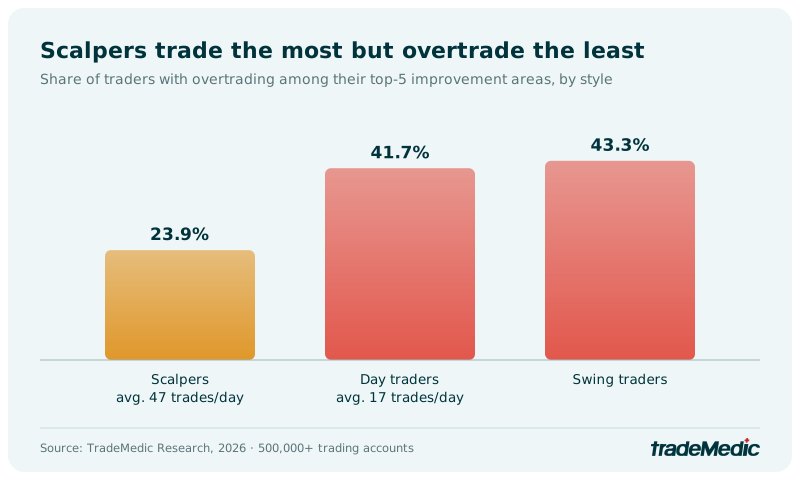
This makes sense once you look at how overtrading is measured. It compares each trader against their own pattern, not against a fixed number. A scalper's strategy is built around volume, so 40 trades is a normal day and the setups stay consistent. For a swing trader or a day trader, a day with several extra trades is a clear break from routine, and those extra trades are rarely the planned ones. There is a separate analysis of how profitable different trading styles are if you want to compare the styles directly.
If overtrading can affect any trader at any stage, the practical question is how to recognise it in your own trading.
What are the signs of overtrading?
Most traders who overtrade know the feeling but miss the pattern, because each individual trade seems reasonable at the time it is placed. These are the signs worth checking.
Your late trades do not look like your early ones. Compare the first two trades of your busiest days with the last two. If the later ones have looser setups, weaker reasons and worse results, the day ran past your edge.
You trade because the market is moving, not because a setup appeared. Movement is not an opportunity by itself. If you cannot name the setup before you enter, the trade is filling time.
Quiet markets make you restless. Days with little movement are where overtrading often starts, because doing nothing feels like falling behind. Traders who can stay patient in low-volatility markets tend to be the more profitable ones.
You keep going after a big win or a big loss. A strong day feels like a reason to push, and a bad day feels like a reason to recover. Both are versions of failing to call it a day, the most common top-five issue in the dataset.
Your results get worse on days with more trades. This is the clearest sign. You can check it by hand: group your past trading days by how many trades you placed and compare the average result per trade. Or let TradeMedic AI do it for you: it runs exactly this check across your full trade history, tells you whether overtrading shows up in your account, and shows the daily trade count where your results start to slip. Connect your trading account free to see your own numbers.
Seeing the signs is one thing. Understanding why they keep appearing is what makes them easier to stop.
Why do traders overtrade? The psychology of overtrading
Overtrading is usually framed as a discipline problem, and discipline is part of it. But the research on how the brain handles reward and uncertainty suggests there is more going on. Four mechanisms stand out.
Dopamine seeking: the reward is in the trade itself. Dopamine is often described as the brain's pleasure chemical, but research shows it is more about anticipation than enjoyment. In a small brain imaging study, Knutson and colleagues found that the anticipation of a possible financial gain activates the nucleus accumbens, a core part of the brain's dopamine-driven reward system, before any outcome is known. Studies of dopamine neurons by Fiorillo, Tobler and Schultz add a detail that fits trading uncomfortably well: this anticipation signal was strongest when the chance of a reward was close to 50/50, the point of maximum uncertainty. Few situations deliver that kind of uncertainty as reliably as an open trade. Every new position brings a fresh round of anticipation, whether it makes money or not, which is why placing trades can feel rewarding in its own right.
The same research explains why the effect can grow over time. Work by Schultz, Dayan and Montague showed that dopamine neurons respond strongly to rewards that are better than expected, and much less to rewards that have become predictable. Once a pattern becomes familiar, the brain needs something new or bigger to produce the same response. In trading, that can mean more trades, larger positions or more instruments.
Trading as entertainment. Some trading happens simply because trading is enjoyable. In a study of 1,000 German brokerage clients, Dorn and Sengmueller found that investors who said they enjoy investing or gambling traded about twice as much as their peers. Research by Grinblatt and Keloharju, which combined Finnish trading records with driving records, found that investors prone to sensation seeking, measured partly through speeding tickets, traded more frequently. And in Taiwan, Gao and Lin found that when lottery jackpots exceeded 500 million Taiwan dollars, trading in the stocks favoured by individual investors fell by between 5% and 9%, as if some traders use the market and the lottery for the same kind of thrill. None of this makes trading gambling, but it shows how easily the excitement of the market can become a reason to trade on its own.
Overconfidence and the illusion of control. In a well-known study of 66,465 brokerage households, Barber and Odean found that the households that traded most earned 11.4% a year, while the market returned 17.9%. They pointed to overconfidence as the most likely explanation. In a follow-up study, men traded 45% more than women and hurt their returns more as a result. Closely related is the illusion of control: the belief that you have more influence over outcomes than you do. A study of 107 traders at investment banks by Fenton-O'Creevy and colleagues found that traders more prone to this illusion were rated as weaker performers and earned less. In short-term trading, both biases often show up after a few wins: the trader feels sharper than the market, the criteria loosen, and marginal setups start to look like good ones. Confirmation bias then makes those marginal setups easier to justify.
Doing nothing is uncomfortable. In one striking set of experiments, Wilson and colleagues asked people to sit alone with their thoughts for 6 to 15 minutes. Many participants, particularly men, chose to give themselves a mild electric shock at least once rather than simply sit with their thoughts. How much this says about a dislike of thinking is debated, but it captures something most traders will recognise: doing nothing is uncomfortable. In trading, the same discomfort appears in quiet sessions and after a loss. Sitting on your hands feels like losing, so any trade starts to look better than no trade.
None of this means a trader lacks willpower. These are ordinary features of how the brain handles reward and uncertainty. The practical consequence is that relying on in-the-moment judgement to stop overtrading tends to fail, because the pull toward the next trade is strongest exactly when judgement is weakest.
Overtrading rarely comes alone, and the patterns that accompany it say a lot about how it plays out.
Which patterns appear alongside overtrading?
When overtrading is detected in an account, four other patterns become noticeably more likely to be present. Fighting the trend appears in 46.1% of traders who overtrade, compared with 35.8% across all traders, a 29% increase. Trading too many positions at once is 28% more likely, trading without a break 26% more likely, and catching a falling knife 25% more likely.
Two of these are about pace. Trading without a break and running too many positions at once are what overtrading looks like while it is happening. The other two, fighting the trend and catching a falling knife, involve trading against the market's direction. One plausible explanation: when a trader takes more trades than there are good setups, the extra trades have to come from somewhere, and trades against the prevailing move are a common source.
Almost every pattern is slightly more common among overtraders, which is expected, since an account with more trades gives the analysis more behaviour to detect. What stands out is the exception. Timing patterns such as entering too early or exiting too early are no more common among overtraders than among anyone else. Overtrading is a volume problem, not a timing problem.
Because overtrading is measured against each trader's own rhythm, detecting it takes a trader's full history rather than a generic rule.
How TradeMedic AI detects overtrading
TradeMedic AI groups each trader's trades by how many trades they had already placed that day, then compares the average performance per trade across those groups. If performance per trade consistently gets worse as the daily trade count climbs, overtrading is flagged. The analysis then identifies the daily trade range where results start to slip, and calculates the dollar impact of the trades placed beyond it, all from that trader's own history.
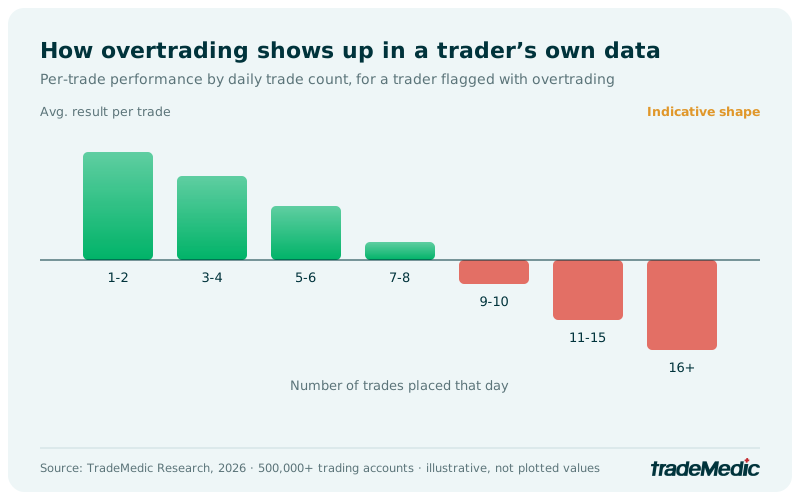
Because the comparison is personal, the same number of trades can be healthy for one trader and costly for another. This is why scalpers are flagged less often despite trading the most, and why a fixed rule like "never more than five trades a day" fits some traders and not others.
The same analysis also detects the opposite pattern. When a trader performs better on days with fewer trades and is profitable overall, TradeMedic AI flags it as a strength called Selective Trades. Selective Trades appears in 56.0% of profitable traders, compared with 34.3% of loss-making traders. More on the methodology behind these figures is on our research page.
With the detection logic in mind, the fixes follow naturally. Each one either reveals your personal limit or makes it harder to cross.
How to stop overtrading
1. Find your personal number. Across all traders, the share of profitable traders drops sharply before the tenth trade of the day and then levels off, as covered in our analysis of how many trades per day to make. But your own limit depends on your strategy and your history. Start by grouping your past trading days by trade count and finding where your average result per trade turns down.
2. Set a daily trade cap before the session starts. Decide the number while you are calm, write it down, and treat reaching it as the end of the trading day. A limit set in the moment tends to move.
3. Write down the reason for every trade before you place it. One line is enough: the setup, the entry level, the exit. If the only reason you can write is that the market is moving, skip the trade. This puts a moment of thinking between the dopamine-driven urge and the click.
4. Build breaks into your day. Stepping away between trades gives the urge to act time to pass. Taking sufficient breaks between trades is one of the strengths that separates consistent traders from the rest.
5. Stop after a big win or a big loss. Both change how the next setup looks to you. A pre-set daily profit and loss limit removes the decision from the moment it is hardest to make.
6. Review your results by trade number, not just by trade. Most traders review individual trades. Looking at how your third, fifth and tenth trades of the day perform on average shows the pattern that single-trade reviews miss.
The right daily limit is personal. TradeMedic AI calculates yours from your own trade history, along with what the trades beyond it have cost you.
The bottom line on overtrading
Overtrading shows up in every second trading account in our dataset, and it costs affected traders an average of $7,248, about a quarter of their losses. It becomes more common the longer traders stay in the market, it is driven by the same reward system that makes any habit hard to break, and the traders it affects are half as likely to be profitable. The fix starts with knowing where your own trading day stops paying.
→ Learn more about TradeMedic AI
Watch How Overtrading Rarely Lead to More Profit
Research behind this article
Barber, B. M., and Odean, T. (2000). Trading Is Hazardous to Your Wealth: The Common Stock Investment Performance of Individual Investors. The Journal of Finance, 55(2), 773 to 806.
Barber, B. M., and Odean, T. (2001). Boys Will Be Boys: Gender, Overconfidence, and Common Stock Investment. The Quarterly Journal of Economics, 116(1), 261 to 292.
Dorn, D., and Sengmueller, P. (2009). Trading as Entertainment? Management Science, 55(4), 591 to 603.
Fenton-O'Creevy, M., Nicholson, N., Soane, E., and Willman, P. (2003). Trading on Illusions: Unrealistic Perceptions of Control and Trading Performance. Journal of Occupational and Organizational Psychology, 76(1), 53 to 68.
Fiorillo, C. D., Tobler, P. N., and Schultz, W. (2003). Discrete Coding of Reward Probability and Uncertainty by Dopamine Neurons. Science, 299(5614), 1898 to 1902.
Gao, X., and Lin, T.-C. (2015). Do Individual Investors Treat Trading as a Fun and Exciting Gambling Activity? Evidence from Repeated Natural Experiments. The Review of Financial Studies, 28(7), 2128 to 2166.
Grinblatt, M., and Keloharju, M. (2009). Sensation Seeking, Overconfidence, and Trading Activity. The Journal of Finance, 64(2), 549 to 578.
Knutson, B., Adams, C. M., Fong, G. W., and Hommer, D. (2001). Anticipation of Increasing Monetary Reward Selectively Recruits Nucleus Accumbens. Journal of Neuroscience, 21(16), RC159.
Schultz, W., Dayan, P., and Montague, P. R. (1997). A Neural Substrate of Prediction and Reward. Science, 275(5306), 1593 to 1599.
Wilson, T. D., et al. (2014). Just Think: The Challenges of the Disengaged Mind. Science, 345(6192), 75 to 77.
TradeMedic Research (2026). Behavioural pattern analysis of 500,000+ retail trading accounts. Source: TradeMedic Research, 2026.
Frequently asked questions
What is overtrading?
Overtrading means taking more trades than your edge can support. It shows up as a drop in performance per trade as the number of trades in a day climbs, until the extra trades start costing money. According to TradeMedic AI data from 500,000+ trading accounts, 49.5% of traders show it.
What does overtrading mean in trading?
In trading, overtrading describes a pattern where the quality of your trades falls as you take more of them. It is defined by what happens to your results, not by a fixed number of trades, so the same volume can be healthy for one trader and costly for another.
How common is overtrading?
Very common. Across 500,000+ trading accounts analysed by TradeMedic AI, overtrading is detected in 49.5% of traders, and 40.3% have it among their five biggest improvement areas. It is the third most common top-five issue in the dataset.
How much does overtrading cost traders?
According to TradeMedic AI data from 500,000+ trading accounts, overtrading causes 25.5% of the losses of the traders who show it, an average of $7,248 per trader. That is two and a half times the share of losses revenge trading causes among the traders who show it.
What are the signs of overtrading?
The main signs are late-day trades that look nothing like your early ones, trading because the market is moving rather than because a setup appeared, restlessness in quiet markets, continuing after a big win or loss, and worse results on days with more trades.
Why do traders overtrade?
Research points to four drivers: dopamine seeking, since the anticipation of an uncertain outcome activates the brain's reward system; trading for entertainment; overconfidence and the illusion of control; and the discomfort of doing nothing. These are ordinary features of how people handle reward and uncertainty, which is why willpower alone rarely fixes it.
Is overtrading linked to dopamine?
Research suggests so. The anticipation of a possible gain activates the brain's dopamine-driven reward system before the outcome is known, and this signal is strongest when the outcome is most uncertain. That makes placing a trade rewarding in itself, whether or not it makes money.
How do I stop overtrading?
Find the daily trade count where your own results start to slip, set a trade cap below it before each session, and write down the reason for every trade before placing it. Breaks between trades and a daily profit and loss limit also help. TradeMedic AI calculates your personal limit from your trade history.
How many trades per day is too many?
There is no universal number. In TradeMedic AI data from 500,000+ trading accounts, the share of profitable traders falls from 33.0% among those averaging fewer than two trades a day to 15.3% at 10 to 15 trades, then levels off. Your own limit depends on your strategy and history.
Is overtrading a beginner mistake?
No. In TradeMedic AI data from 500,000+ trading accounts, overtrading is detected in 15.4% of accounts under 10 days old but in 70.3% of accounts trading for 200 days or more. From 50 days onward, it is the most common issue among traders' five biggest improvement areas.
Do scalpers overtrade more than other traders?
No. In TradeMedic AI data, scalpers trade the most, averaging 47 trades a day, but only 23.9% have overtrading in their top five issues, compared with 41.7% of day traders and 43.3% of swing traders. Overtrading is measured against each trader's own pattern, and high volume is normal for a scalping strategy.
Is overtrading the same as revenge trading?
No. Revenge trading is about re-entering too quickly after a loss, while overtrading is about taking more trades in a day than your edge supports. They are detected separately and can appear independently of each other.
Does overtrading affect forex and day traders?
Yes. Most accounts in the TradeMedic dataset trade forex, gold and indices, and day traders are among the most affected: 41.7% have overtrading among their five biggest improvement areas.
What is the psychology behind overtrading?
Research points to the brain's reward system: the anticipation of an uncertain outcome activates dopamine-driven reward circuits before a trade's result is known, which makes placing trades rewarding in itself. Overconfidence after wins, trading for excitement and the discomfort of doing nothing add to the pull, which is why willpower alone rarely stops it.