Category:
 Author:
 Date:Jun 12, 2026
Trading in Volatile Markets: Are You Actually Profiting?
Most traders assume volatile markets are where the real money gets made. More movement means more opportunity, right? That assumption is worth testing against your own data. For a significant share of traders, the busiest, fastest-moving sessions are quietly the worst-performing ones, and without looking at the numbers, you'd never know.
What does volatility actually mean for traders?
Volatility describes how much and how quickly prices move within a given window. In practice, it tends to spike around news releases, central bank decisions, and macro events that catch the market off-guard. For traders, it's a double-edged condition: bigger swings create the potential for larger gains, but they also compress the time you have to think clearly and act precisely.
A useful analogy is wind and windsurfing. A gentle breeze gives a learner enough to practise safely. A strong gust rewards the experienced surfer who knows how to read and use it. For someone still developing their technique, the same gust just knocks them off the board. Market volatility works much the same way: the conditions don't change, but who benefits from them does.
Why do traders struggle more during high-volatility sessions?
Speed is the core problem. When prices move fast, the window for careful decision-making narrows, and traders default to gut feel rather than a defined process. That shift introduces several compounding issues.
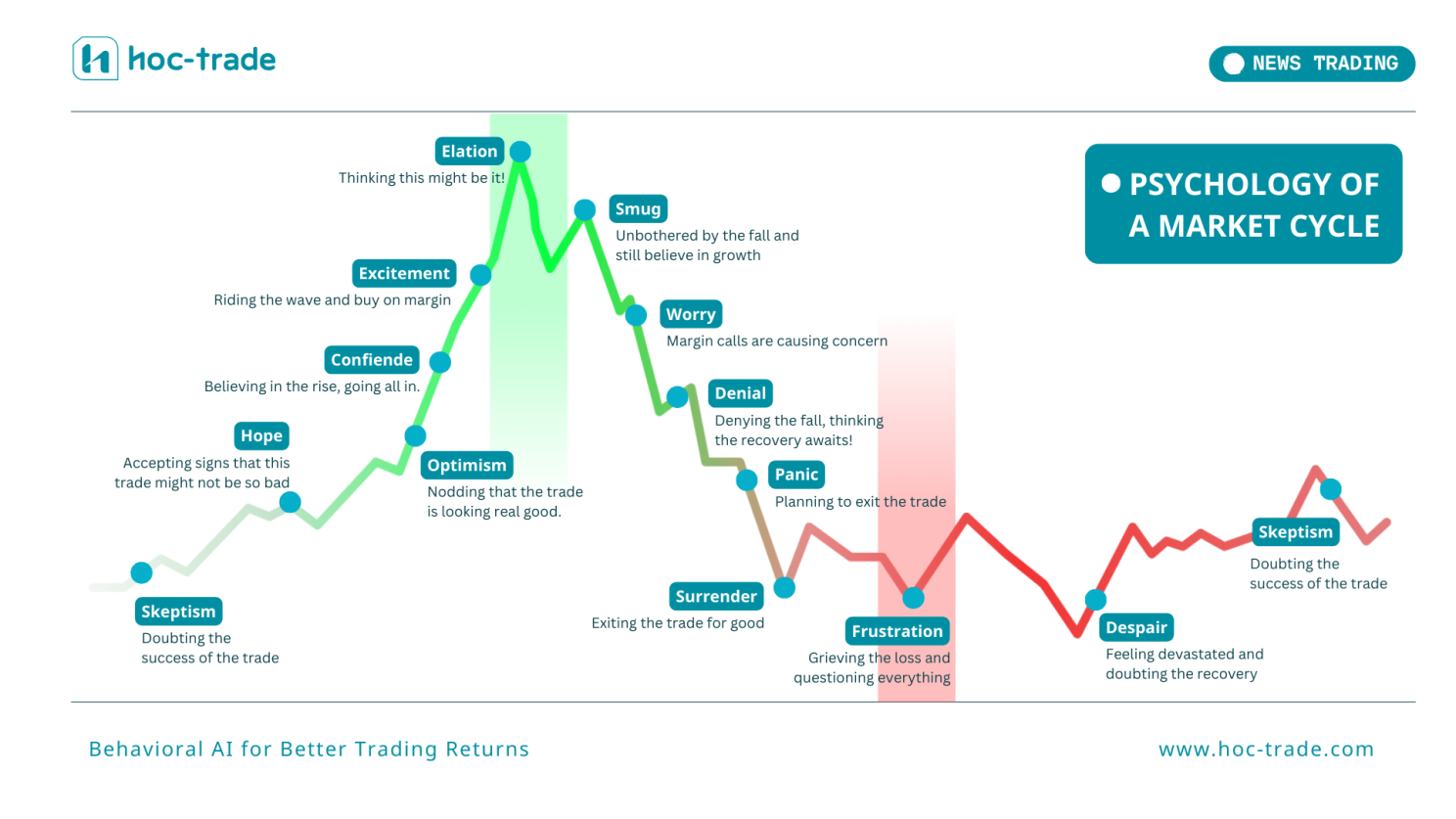
One is intuition-driven entry and exit. Without a clear plan governing exactly when to get in and get out, traders in a fast market tend to hold profitable positions too long (hoping for more) or close them too early (scared of giving it back). Stop-loss orders get moved further out to "give the trade room", which quietly inflates risk without the trader registering it as a deliberate choice.
Another is the FOMO effect. News-driven volatility carries a sense of urgency that is almost designed to trigger impulsive behaviour. Traders who wouldn't normally enter a position find themselves chasing a move because it feels like the window is closing. Often it already has.
There's also the practical matter of slippage and widened spreads. Liquidity providers adjust their pricing during volatile events, which means both entry and exit happen at less favourable prices than you'd expect in a quieter session. Even a trade that looks profitable on paper can be eroded significantly once execution costs are factored in.
How does low-volatility trading compare in performance?
Low-volatility periods don't generate the same excitement, but for many traders they produce far better results. Price movements are more measured, decisions feel less pressured, and the gap between what a strategy is supposed to do and what it actually does tends to be smaller.
The data from TradeMedic's analysis makes this concrete. In one representative example, traders during high-volatility sessions averaged 0.1 pips per trade across 438 trades, producing roughly $440 in total. Across low-volatility sessions, the same cohort averaged 2 pips per trade over 1,062 trades, with total returns exceeding $9,000.
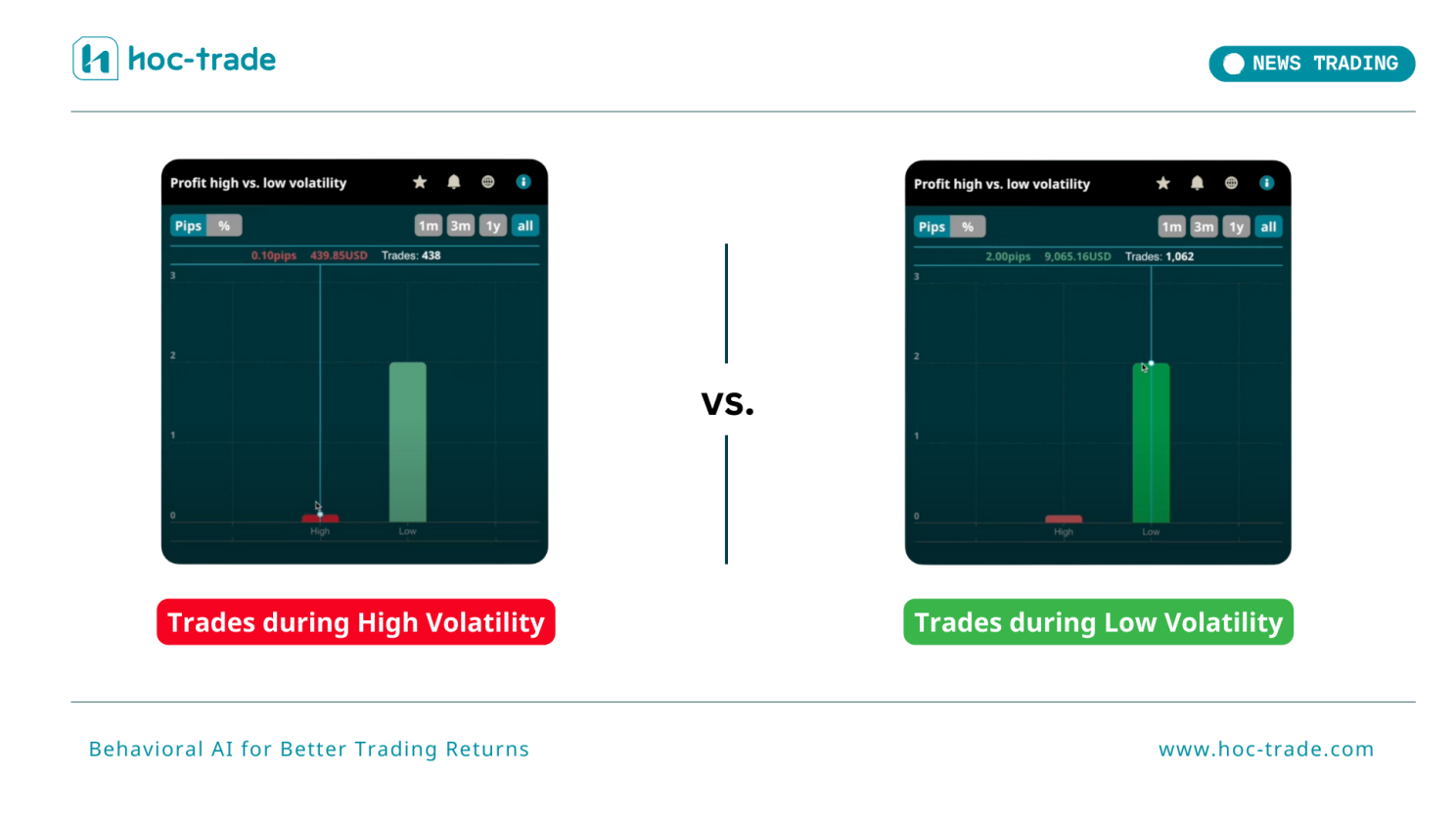
That's not a minor difference. High volatility produced twenty times fewer returns per trade, even though it's where most traders direct their energy and attention. The takeaway isn't that high-volatility trading is inherently bad. It's that traders often overestimate their edge during those sessions, and underestimate the cost of operating without one.
How can traders manage risk more effectively in volatile conditions?
If you know your performance drops during high-volatility sessions, you have options beyond simply staying out of the market. One practical adjustment is reducing lot size during volatile periods. A smaller position allows you to set a wider stop-loss without increasing your overall cash at risk, which gives the trade more breathing room without the exposure that typically accompanies it.
Technical tools can also help you gauge conditions before you enter. Bollinger Bands, for instance, measure how far price is deviating from its recent average. Wide bands signal high volatility; tight bands suggest the market is consolidating. Using them as a pre-entry check, rather than a signal in themselves, gives you a clearer picture of the environment you're trading into.
Stop-loss discipline also matters more in volatile conditions, not less. The instinct to widen a stop-loss when a trade is moving against you is understandable, but it tends to turn manageable losses into significant ones. If your plan requires a tight stop, the answer is usually a smaller position, not a bigger risk tolerance.
What does TradeMedic data show about volatility and trading performance?
TradeMedic's AI analyses volatility exposure across a dataset of 500,000+ trader accounts, classifying each trade based on whether it was opened during high or low volatility using the Bollinger Bands indicator. For each trader, it calculates average return per trade across both conditions and flags any meaningful negative correlation.
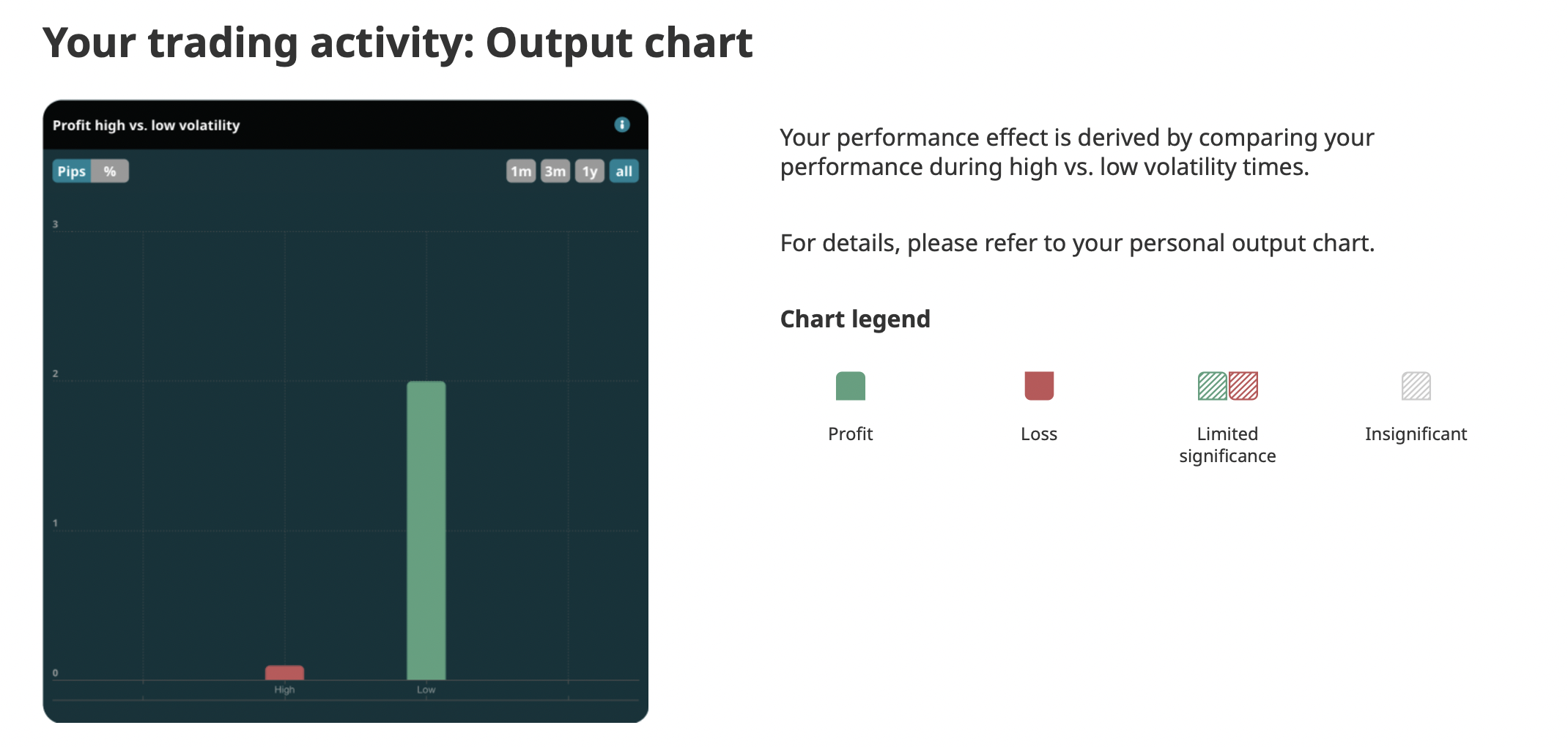
If your trades consistently produce worse outcomes during high-volatility sessions, TradeMedic will identify this as a detected pattern and surface it in your performance overview. The analysis is broken down by volatility level at trade entry, so you can see not just whether you're affected but by how much.
The point isn't to discourage trading around volatile events. It's to make sure the decision to do so is based on your actual performance data, not on the assumption that more market movement equals more opportunity. For traders who do perform well in volatility, the analysis confirms that edge. For those who don't, it gives them something concrete to work with.
Should you trade during high-volatility events?
There's no universal answer. Some traders have genuinely built an edge in fast-moving, news-driven conditions. Many others have convinced themselves they have, because high-volatility sessions are memorable and the wins feel significant even when the overall numbers don't support it.
Connecting your trading account to TradeMedic gives you a clear look at which side of that line you're on. If the data shows you underperform in volatile conditions, that's information you can act on: trade smaller, sit out the event, or work on the specific behaviours (intuition-driven exits, stop-loss adjustments) that tend to surface under pressure. If it shows you outperform, trade with more confidence. Either way, you're working with evidence rather than assumption. You can connect your account and run the analysis for free at hoc-trade.com.
TradeMedic AI analyses over 60 behavioural patterns, including News Trading, across 500,000+ trader accounts. Visit TradeMedic to see how it works and get your own personal analysis.
Watch How News Trading Affects Your Performance
Frequently asked questions
Why do traders perform worse in volatile markets?
Volatile markets compress decision time, pushing traders toward intuition-based choices rather than defined strategies. This often leads to widened stop-losses, premature exits, and chasing momentum. Slippage and widened spreads during news events also erode profitability even on trades that move in the right direction.
What is the difference between high-volatility and low-volatility trading performance?
Analysis from TradeMedic's 500,000+ account dataset shows that many traders average significantly lower returns per trade during high-volatility periods than during calmer sessions. In representative data, traders earned roughly 0.1 pips per trade during volatile periods versus 2 pips per trade in low-volatility conditions, despite taking more trades in quiet sessions overall.
How can I tell if high volatility is hurting my trading performance?
The most reliable method is to review your average return per trade during high-volatility periods versus low-volatility ones. TradeMedic automatically runs this analysis by classifying your historical trades using the Bollinger Bands indicator and flagging any negative correlation between volatility and your results.
What risk management strategies work best in volatile markets?
Reducing position size during high-volatility sessions allows wider stop-loss levels without increasing total capital at risk. Using Bollinger Bands as a volatility gauge before entering a trade helps you understand market conditions. Keeping stop-losses at their planned level rather than widening them under pressure is especially important when price is moving quickly.
Should I avoid trading during major news events?
Not necessarily. Some traders perform well in news-driven conditions. The decision should be based on your own performance data, not general caution. If your data shows consistent underperformance during high-volatility events, sitting them out or trading smaller is rational. If your data shows an edge in those conditions, that's worth knowing too.