Category:
 Author:
 Date:May 21, 2026
How Many Positions Is Too Many? Why Over-Complexity Gets Worse With Experience
You meant to focus on two setups. The session opens, opportunities appear in forex, then indices, then crypto, and by mid-morning you are holding six positions across three markets. Each one needs a thesis, a level to watch, and a reason to stay in or get out. Somewhere in there your attention thinned out, exits started coming late, and a couple of positions began quietly working against each other. The trades did not get worse because your strategy changed. They got worse because there was more open than you could follow.
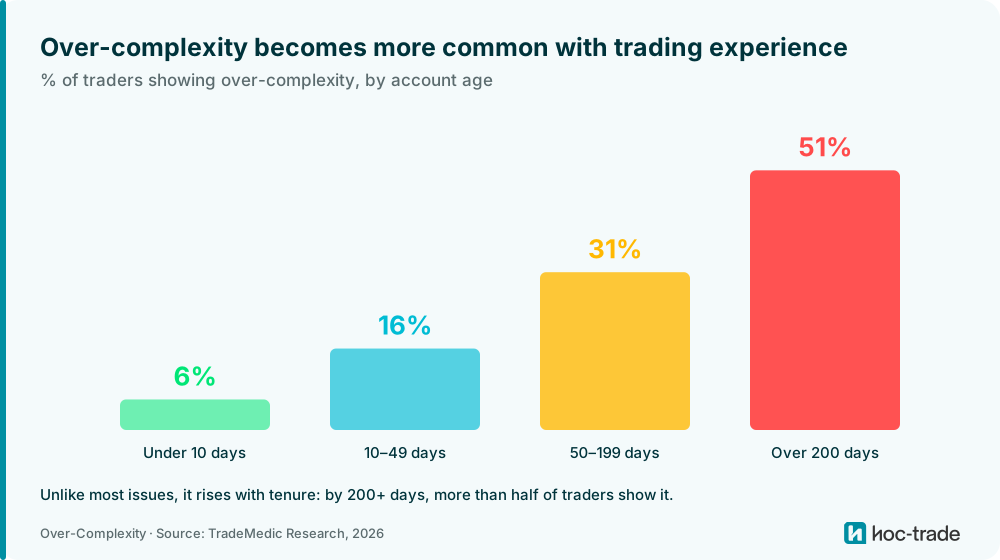
This is over-complexity, and it is one of the more dangerous behavioral patterns in trading. Across more than 500,000 analysed trader accounts it affects only about 20%, so for most people it is not the first thing to worry about. But the behavioral data shows that when it does take hold it is one of the costliest patterns there is, 4th of 23 for cost per affected trader, averaging around $6,937 over the life of an account. And unlike almost every other issue, it gets more common the longer someone trades: from roughly 6% of traders in their first days to more than 50% of those active past 200 days.
What happens when you trade too many positions at once?
Over-complexity is the performance drag that comes from running too many positions across too many markets at the same time. Trading already asks a lot of your attention: analysis, position sizing, monitoring, and keeping your own emotions in check. Past a certain point, adding more open positions pushes the total load beyond what you can process well, and the quality of every decision in the book starts to fall.
The pattern usually builds in four quiet steps. First, you open a few positions that each looked good on their own. Second, you keep adding, because a new setup appears and holding more feels like doing more. Third, attention runs out: there is too much open to monitor properly, so you start reacting on instinct instead of your plan. Fourth, decisions slip. Exits get sloppy, positions you did not realise were correlated start to cancel each other out, and performance fades across the whole account.
How costly is trading too many positions?
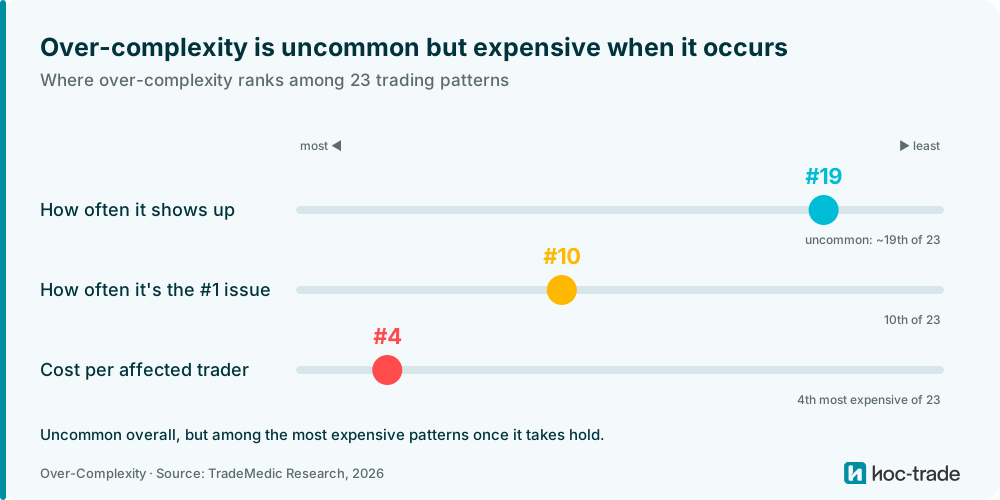
Across more than 500,000 analysed trader accounts, over-complexity shows a measurable negative effect for around 20% of traders. So it is not rare exactly, but it is one of the less common issues. Of the 23 improvement patterns tracked, it ranks about 19th for how often it shows up at all.
The picture flips when you look at cost. Ranked by what it costs the traders who have it, over-complexity jumps to 4th most expensive of all 23 patterns, averaging around $6,937 over the life of an affected account. And ranked by how often it is a trader's single biggest problem, it sits 10th, not 19th. So the shape is unusual: it does not show up for many people, but when it does, it tends to be dominant and costly rather than a minor habit.
Does over-complexity make traders unprofitable?
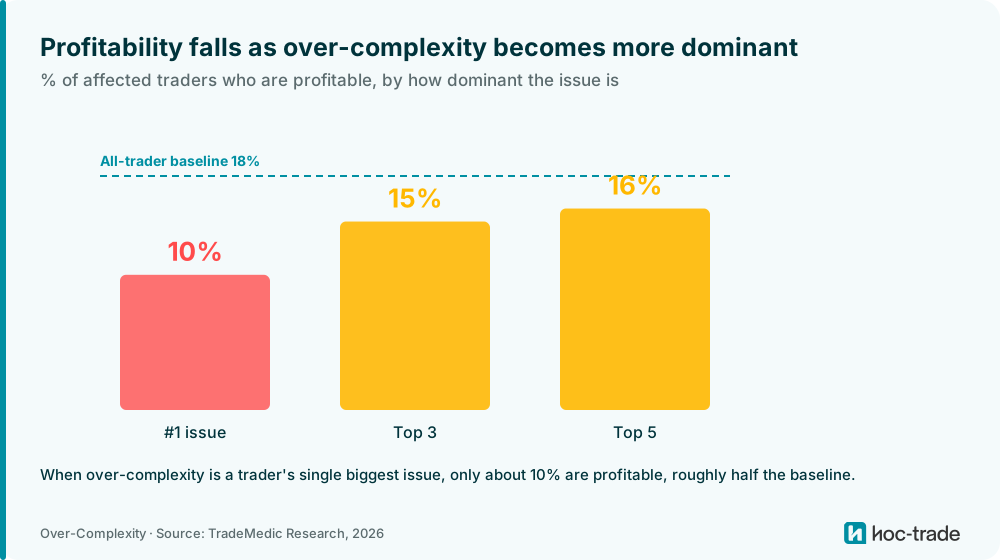
The profitability data points the same way. Across the whole dataset, about 18% of traders are profitable. When over-complexity sits somewhere in a trader's top five issues, that figure is still around 16%. In the top three, about 15%. But when it is a trader's single biggest issue, only about 10% are profitable. In other words, the more over-complexity dominates a trader's profile, the lower their odds, roughly cut in half by the time it is the number one problem.
Who is most affected by over-complexity?
Two groups stand out, and the second is the surprising one.
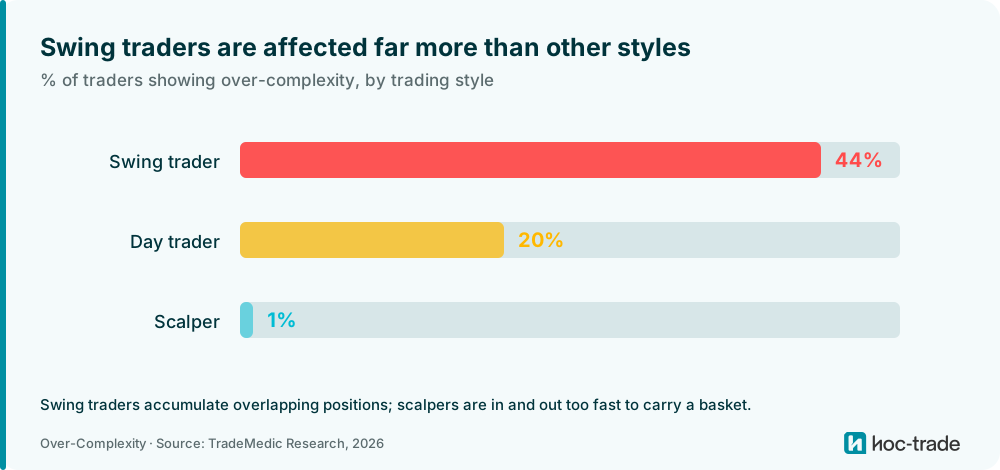
By trading style, this is overwhelmingly a swing trader's problem. Around 44% of swing traders show some effect, against roughly 20% of day traders and only about 1% of scalpers. The reason is mechanical: swing traders hold positions for days and naturally accumulate overlapping trades across markets, so the number open at once builds up. Scalpers are in and out too fast to ever carry a real basket of positions.
By experience, over-complexity runs opposite to almost every other pattern. Most issues fade as traders get more experienced, but this one grows. Among accounts under 10 days old, only about 6% show it. By 50 to 199 days it is around 31%, and past 200 days more than half do, about 51%. As traders gain confidence they tend to widen out into more markets, feel more in control of more things at once, and the position count climbs with them. Nobody decides to over-complicate their trading, but it accrues over time.
Why do traders take on too many positions?
This is often framed purely as a discipline problem. Discipline is part of it, but there is well-studied psychology underneath that explains why the failure is so predictable, and three biases tend to line up here.
Cognitive load: a hard ceiling on attention
Working memory, the mental space you use to actively juggle live information, is surprisingly small. The classic estimate came from George Miller in 1956, the famous "magical number seven, plus or minus two". Later work by Nelson Cowan (2001) revised it down further, to about four chunks once you remove the tricks people use to rehearse and group information. Four. That is roughly how many independent things you can actively hold in mind at the same time before something starts to slip.
A simple way to feel this: try to keep a seven-digit phone number in your head while someone reads you a second one. The first starts dissolving almost immediately. Trading does the same thing, except the "digits" are open positions, each with its own thesis, level, and risk. By the fifth or sixth, you are past the ceiling, and the brain quietly switches mode, from slow, deliberate analysis to fast, automatic gut reactions. The decisions still feel considered, but they are running on far less attention than each one needs.
The flip side of this is the most useful part. Experts do not beat the four-chunk limit by having bigger memory, they beat it by packing more into each chunk. In a well-known 1973 study, Chase and Simon showed that chess masters could glance at a real game position for a few seconds and reconstruct it almost perfectly, while beginners could not, because the master sees a handful of familiar patterns where the beginner sees twenty separate pieces. But on a board of randomly placed pieces, with no familiar patterns to lean on, the master’s advantage almost vanished. The lesson for trading is direct: you cannot expand the number of slots, but deep familiarity with a small set of instruments lets each slot hold more, which is exactly why a focused shortlist beats a sprawling watchlist.
Naive diversification: spreading by reflex
Faced with several plausible options, people tend to spread across all of them by default, treating breadth as inherently safer without weighing each one. Behavioral economists Shlomo Benartzi and Richard Thaler documented a clean version of this, sometimes called the "1/N heuristic": when people were offered a set of retirement funds, many simply split their money evenly across whatever was on the menu, rather than choosing based on what the funds held. The menu shaped the portfolio more than the analysis did.
Trading has the same reflex. The market puts a dozen tempting setups in front of you, and spreading across several feels more prudent than committing to one, even when the extra positions are not better, just more. There is a simpler pull underneath it too: more open positions means more action and bigger swings, which can feel like engagement and progress even when it is not. Either way, you end up holding more than you ever consciously chose to take on.
Illusion of control: more positions, less command
More open positions can feel like more command of the market, as if covering more ground means more control. Psychologist Ellen Langer called this the "illusion of control", the tendency to feel more in charge of an outcome the more actively involved we are, even when our actions do not change the odds. In one of her studies, people who picked their own lottery numbers valued their tickets more highly than people handed random ones, despite the odds being identical. Doing more simply feels like controlling more.
In trading the extra positions mostly add noise, and spreading yourself thin makes it harder to see how your trades interact. The sense of control rises while the actual control falls.
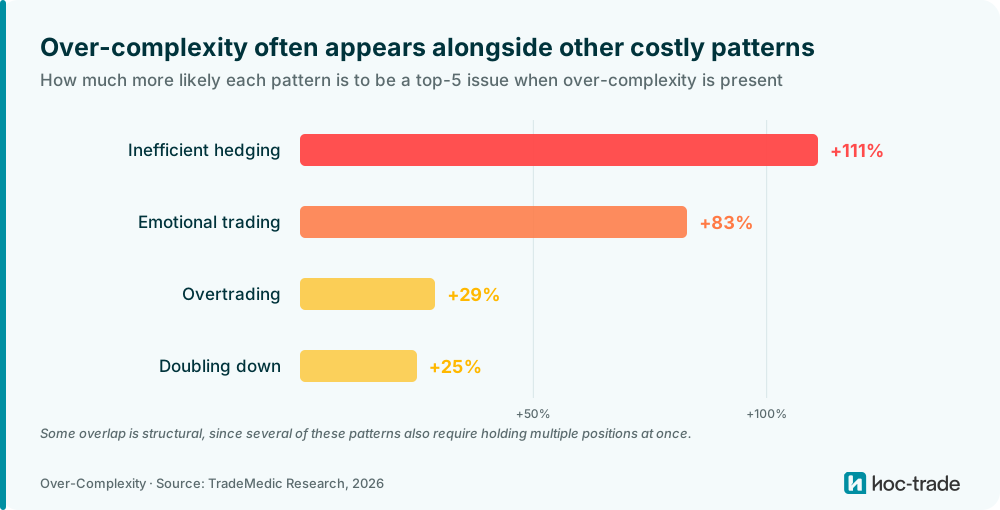
The data hints at the same story through co-occurrence. When a trader shows over-complexity, the patterns most likely to also be among their biggest issues are inefficient hedging, emotional trading, overtrading, and doubling down. The link to inefficient hedging is the strongest, which fits the mechanism almost exactly: when you are tracking many symbols at once, you lose sight of how they correlate and end up half-hedging yourself without meaning to. Some of that overlap is structural, since several of these patterns also require holding multiple positions at once, so the connection is best read as a direction rather than a precise figure.
How does TradeMedic AI detect over-complexity?
TradeMedic AI detects over-complexity by comparison rather than by a fixed rule. For each trader, every trade is grouped by how many other symbols were already open at the moment of entry, and average performance is compared across those groups. If the trades placed while many other positions were open consistently underperform the ones placed with a clear book, over-complexity is flagged. This is assessed on an overall account basis, not trade by trade, so it reveals a genuine pattern rather than one bad session.
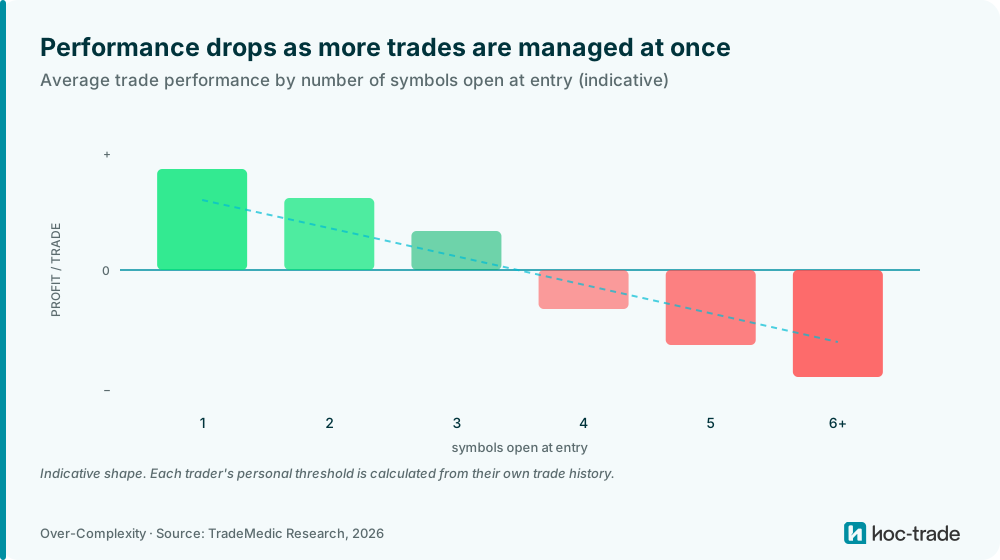
Because the analysis is personal, there is no universal "too many". One trader may stay sharp with five positions open while another loses their edge at two. The threshold falls out of each trader's own history, which is the number that matters.
How to fix over-complexity (and trade fewer positions better)
The standard advice is to trade fewer things, and it is true as far as it goes. But a few approaches work better than willpower alone, because they remove the in-the-moment decision rather than relying on you to make the right call when your attention is already thin.
First, cap your concurrent positions as a rule set in advance. Pick a maximum number of open positions when you are calm and not in a trade, ideally near your personal threshold, and treat it as a hard gate: at the cap, nothing new opens until something closes. Deciding the limit beforehand matters, because the moment you are tempted to add the seventh position is exactly when your judgment is weakest.
Second, cap total exposure across the whole book, not just per trade. Per-trade risk limits do nothing to stop you stacking ten correlated positions into what is effectively one oversized bet. A ceiling on total risk closes that gap.
Third, trade a shortlist you know deeply rather than the whole market. Expertise works by familiarity, not by raising your attention ceiling: a chess master recalls a board not because they have more memory but because they recognise familiar patterns. Depth lets each slot in your head hold more, and the data backs the direction, traders who concentrate their focus are profitable far more often than those who spread thin.
The right threshold is personal. TradeMedic AI calculates yours from your own trade history, the point where adding one more open position starts dragging your average trade down.
The bottom line
Over-complexity is uncommon, affecting around one in five traders, but it is one of the most punishing patterns when it takes hold, and it concentrates in experienced, active traders rather than beginners. The fix is not heroic willpower; it is a position cap, a total-exposure limit, and the discipline to trade a focused shortlist.
One practical note on priorities. Because this pattern is uncommon, it is not the first thing most traders should work on. But if it does show up clearly in your own trading, the data says to treat it as a high priority rather than a minor tidy-up. It sits among the costliest patterns when present, it tends to dominate the profile of the traders who have it, and it gets worse with experience rather than better. In other words, it rarely fixes itself, so when it is yours, it is worth moving to the top of the list.
See if over-complexity appears in your own account. Connect your trading account to TradeMedic AI free.
Watch how Overcomplexity affects your trading
External references
Cited where external research supports the behavioral mechanisms discussed. All trading statistics are from TradeMedic Research, 2026.
Miller, G. A. (1956). The magical number seven, plus or minus two: Some limits on our capacity for processing information. Psychological Review, 63(2), 81-97.
Cowan, N. (2001). The magical number 4 in short-term memory: A reconsideration of mental storage capacity. Behavioral and Brain Sciences, 24(1), 87-114.
Chase, W. G., & Simon, H. A. (1973). Perception in chess. Cognitive Psychology, 4(1), 55-81.
Benartzi, S., & Thaler, R. H. (2001). Naive diversification strategies in defined contribution saving plans. American Economic Review, 91(1), 79-98.
Langer, E. J. (1975). The illusion of control. Journal of Personality and Social Psychology, 32(2), 311-328.
Frequently asked questions
What does it mean to trade too many positions at once?
Trading too many positions at once, a pattern we call over-complexity, is when the number of open trades across different markets pushes the total demand on your attention past what you can handle. Once you cross that personal threshold, decision quality drops and execution gets sloppy across the whole account. It is detected in behavioral data by comparing how a trader performs when few positions are open versus many.
How many positions is too many to trade at once?
There is no universal number. Some traders stay sharp with five open positions while others lose their edge at two, and cognitive research suggests most people can actively track only about four things at once. The threshold that matters is your own, the point where adding one more position starts to lower your average trade performance.
Does trading too many positions lose you money?
The behavioral data says it can be costly when it takes hold. Across 500,000+ accounts, over-complexity ranks 4th of 23 trading patterns for cost per affected trader, averaging around $6,937 over an account's life. When it is a trader's single biggest issue, only about 10% are profitable, against an 18% baseline, roughly half the odds.
Why does trading too many positions get worse with experience?
Unlike most trading issues, over-complexity grows with tenure: it affects about 6% of traders in their first 10 days but more than 50% of those active past 200 days. As traders gain confidence they tend to widen out into more markets and feel more in control, so the number of positions open at once steadily climbs.
Is trading too many positions mainly a swing trading problem?
Largely, yes. Around 44% of swing traders show over-complexity in their data, against about 20% of day traders and only 1% of scalpers. Swing traders hold positions for days and naturally accumulate overlapping trades across markets, so the number open at once builds up. Scalpers move in and out too fast to ever carry a large basket of positions.
How do you stop trading too many positions at once?
Set a cap on concurrent positions in advance and treat it as a hard rule, add a ceiling on total exposure across the whole book rather than just per trade, and trade a focused shortlist of instruments you know well. TradeMedic AI calculates your personal complexity threshold from your own trade history so the cap is based on your real performance.