Category:
 Author:
 Date:May 25, 2026
Anxious Trade Entries: How Hesitation Costs You in Trading
Every trader knows the feeling: you spot a setup, and for a moment you're ready to act. Then doubt creeps in. You wait for one more confirmation. The price moves. By the time you enter, the optimal entry point has passed. That single moment of hesitation doesn't just cost money on one trade, it creates a pattern. Traders who repeatedly delay entries often find themselves chasing the market, facing larger drawdowns, and doubting their own judgment.
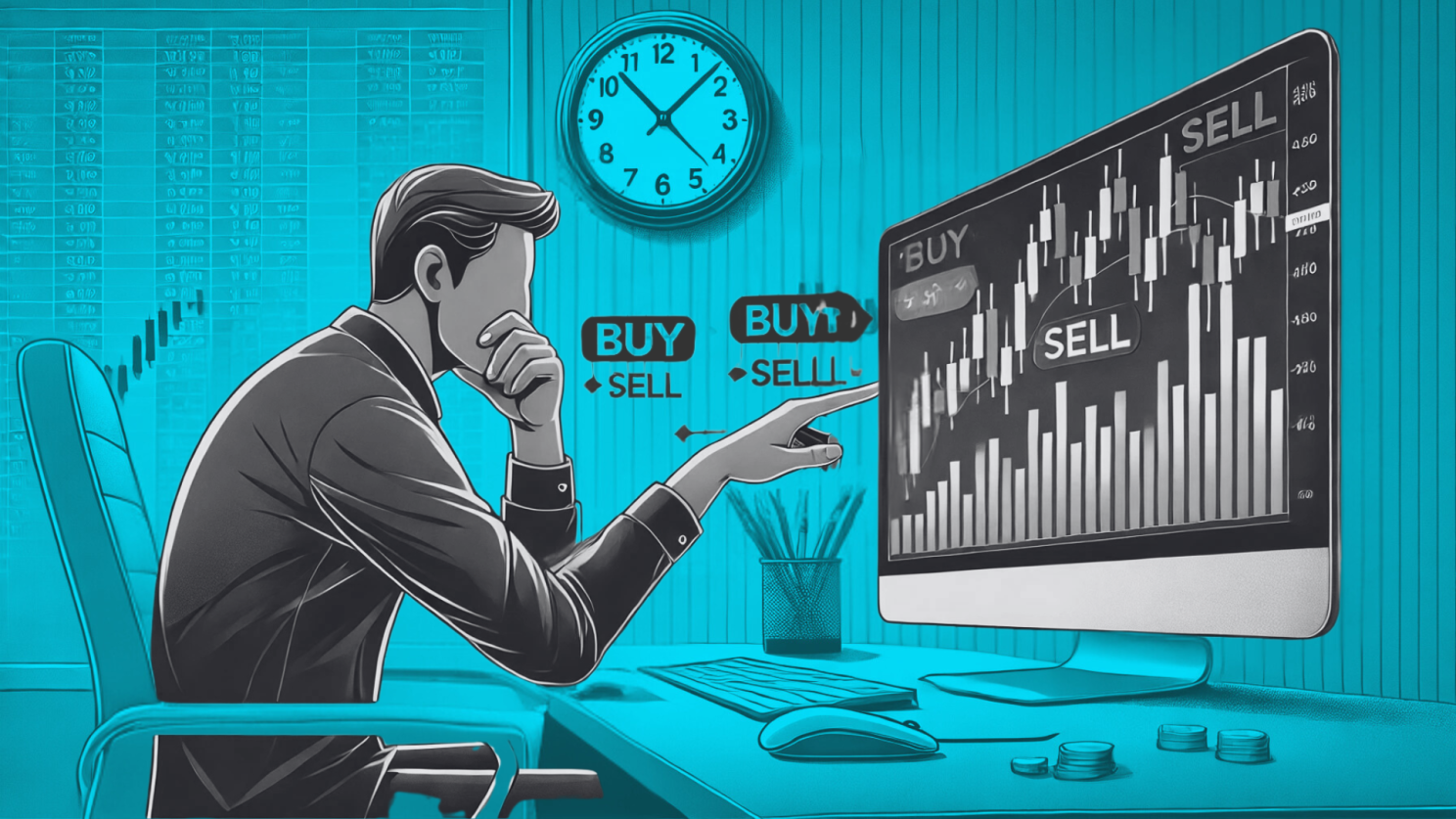
Why do traders enter positions too late?
When traders delay their entry into a trade, it rarely stems from a single cause. The hesitation typically roots itself in fear: fear of being wrong, fear of acting too quickly, or the sense that gathering more evidence will somehow ensure success. The irony is that this caution, intended as protection, often backfires.
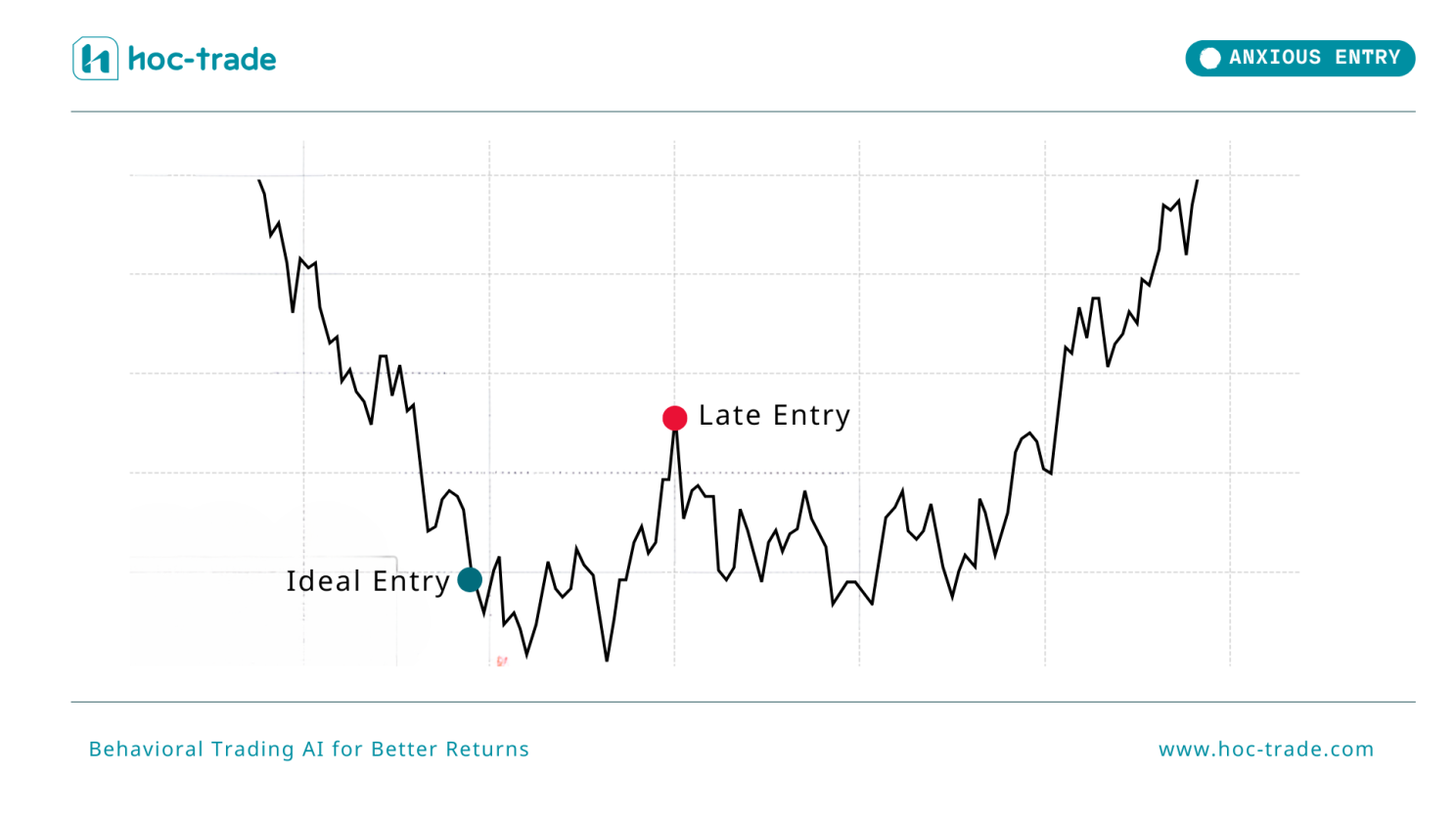
Consider a practical example. A trader identifies a promising setup with clear technical signals. Instead of entering, they wait for another confirmation. They want the price to move a bit more in their favor, or they're looking for feedback from other traders. These delays seem reasonable in the moment. But while they're waiting, the market has already shifted. The risk-reward ratio has deteriorated. The entry that once offered good risk management now exposes the trader to a less favorable outcome.
Over time, this pattern becomes self-reinforcing. Each delayed entry creates frustration. That frustration leads to second-guessing the strategy itself, which triggers even more analysis and hesitation. What began as a single moment of caution transforms into a consistent habit that undermines both profitability and confidence.
What are the consequences of delayed entries?
The impact of anxious entries compounds across multiple dimensions. The most obvious cost is the reduction in profit potential. When traders enter slightly later than optimal, their profit targets become harder to hit, their stop losses sit at less favorable levels, and the overall risk-reward proposition deteriorates.
Beyond the numbers, there's an emotional cost. Traders who consistently lag behind the market often feel reactive rather than proactive. This reactive stance tends to breed poor decision-making: overtrading to make up for missed opportunities, or holding losers too long because they're afraid to act. The behavioral cascade from a simple moment of hesitation can reshape how a trader approaches the entire market.
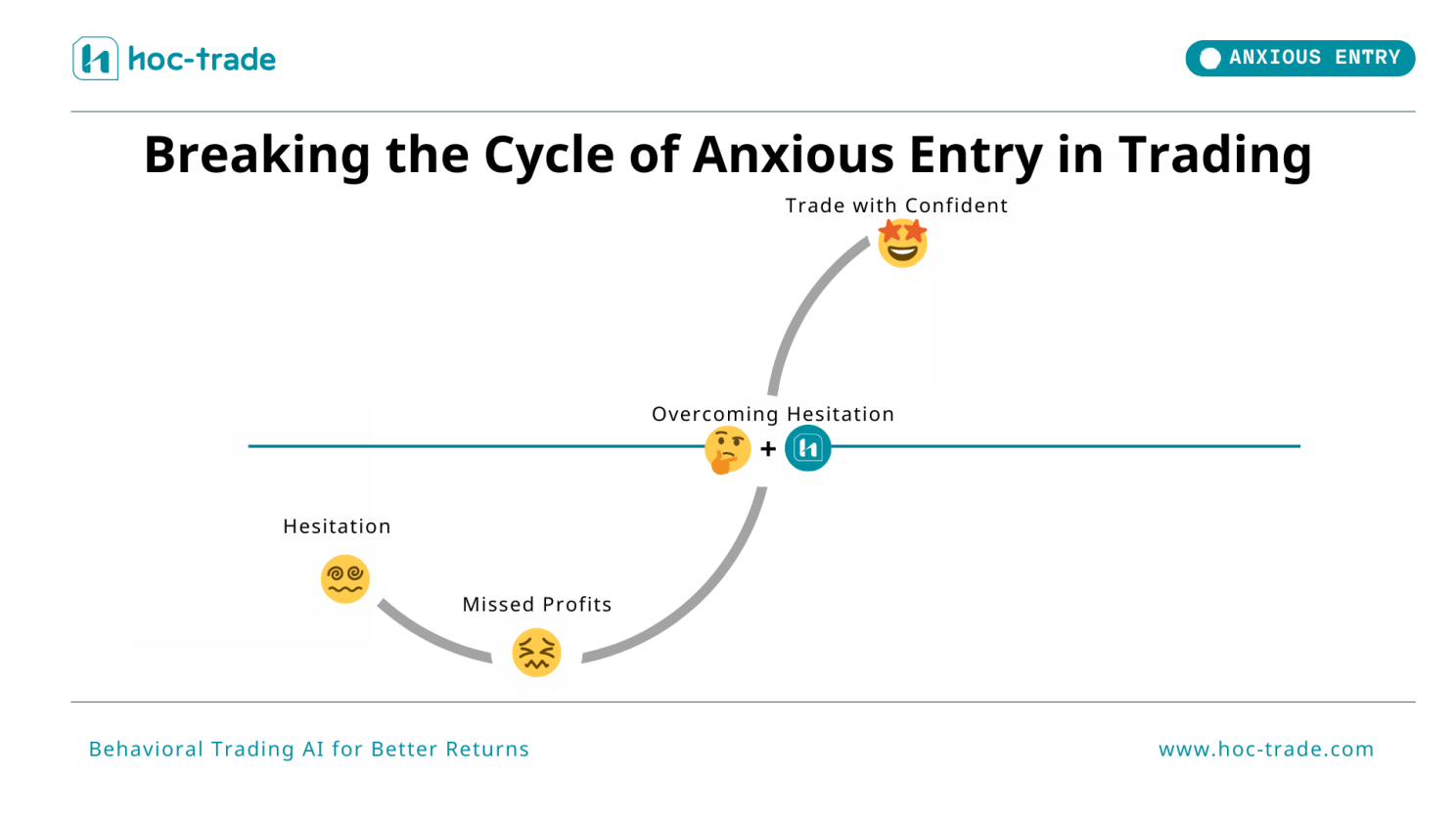
Perhaps most damaging is the erosion of trust in one's own judgment. After repeatedly entering slightly too late, traders begin to doubt their setups, their analysis, and their ability to read the market. This self-doubt opens the door to overcomplicating the strategy, chasing confirmation that never comes, and eventually abandoning approaches that might have worked if executed with conviction.
How can traders build confidence to enter decisively?
Breaking the cycle of hesitation requires addressing its root cause: fear. But fear in trading is not irrational. It's a legitimate response to genuine risk. The goal isn't to eliminate fear, but to act despite it, or better yet, to act in a way that acknowledges fear without being controlled by it.
The first practical step is to simplify your setup. Every additional confirmation filter you add increases the chance of missing the entry. Strip your strategy down to its essentials. If you can articulate the core three or four reasons you enter a trade, you've likely identified what matters. Everything else is noise that creates hesitation.
Another approach is scaling in. Rather than committing your full position size at once, enter with a smaller initial position and add to it as the trade confirms your thesis. This reduces the cost of entries that don't work out, while still capturing most of the move when they do. A trade entered in two or three stages gives you a reason to act earlier, because the risk of being wrong on the first entry is contained.
The third step is deliberate experimentation. Many traders are afraid to test earlier entries because they fear the additional risk. But testing in a demo account or on a small position removes this fear. Begin entering trades a few minutes earlier than usual. Track the results. If earlier entries consistently show better outcomes, you've found evidence that your hesitation is costing you. If they show worse outcomes, your caution was justified.
Finally, focus on the decision itself rather than the outcome. Each trade will either hit your profit target or hit your stop. That's outside your control. What you control is whether you enter with conviction when your setup appears. Shifting focus from outcome to process helps traders act decisively without second-guessing.
What does the data reveal about delayed entries?
TradeMedic's Behavioral AI analyzes patterns across a dataset of 500,000+ trader accounts. Delayed entries, what we call anxious trade entries, rank among the most common behavioral patterns affecting profitability. The AI runs simulations on each trader's account, comparing actual profits with the profits that would have resulted from entering trades a few minutes earlier. This reveals the exact cost of hesitation for each trader.
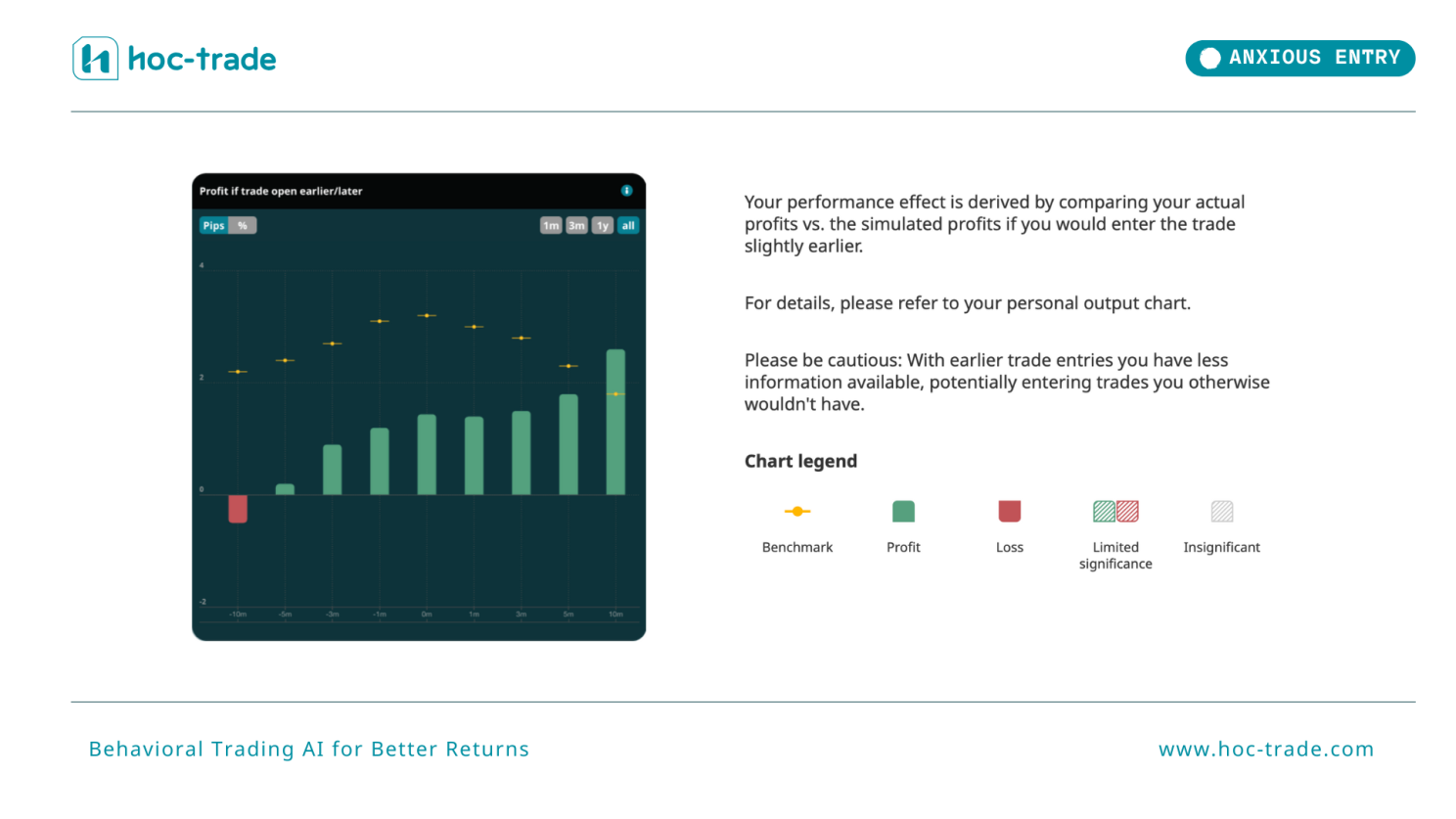
When a trader's data shows that earlier entries consistently yield higher profits, the pattern is flagged in personalized reports with clear visualizations. The trader then has concrete evidence: their hesitation has an identifiable price. That clarity often proves more motivating than general advice about discipline.
Moving from hesitation to decisive action
Hesitation in trading is natural, but when it becomes a habit, it becomes a liability. The traders who improve fastest aren't those with perfect discipline—they're those who identify their behavioral patterns, measure their cost, and adjust. Delayed entries can be overcome, but only if you first see them clearly. With the right data and the right approach to testing, hesitation transforms from an obstacle into an opportunity for measurable improvement.
It's worth noting that anxious entries are arguably harder to correct than the opposite problem of entering too early. Entering earlier means acting on less information, which runs counter to your instinct to gather more confirmation. Progress here is gradual, and traders should expect to feel uncomfortable with the adjustment before it becomes natural. TradeMedic AI analyses over 60 behavioural patterns, including anxious trade entries, across 500,000+ trader accounts. Visit TradeMedic to see how it works and get your own personal analysis.
Frequently asked questions
What are anxious trade entries?
Anxious trade entries occur when traders delay entering a position due to hesitation or fear, resulting in entries at less optimal prices. This behavior often stems from fear of being wrong or the desire for additional confirmation, and it consistently reduces profit potential.
How does hesitation impact trading profitability?
Delayed entries reduce the potential profit margin on each trade and expose traders to worse risk-reward ratios. Over time, this pattern creates frustration and erodes confidence, leading to additional poor decisions that compound the damage to overall performance.
Can traders overcome the habit of delayed entries?
Yes. The most effective approach is to simplify your strategy to its core elements, test earlier entries in a controlled environment like a demo account, and measure the results. When traders see concrete data showing the cost of hesitation, they're often motivated to act more decisively.
How can traders tell if they're entering too late?
One approach is to compare your actual trade entries to your planned entry prices. If you're consistently entering 5-10% past your original target, hesitation is likely at play. More precisely, tools like TradeMedic's AI can analyze your trading data and quantify the exact cost of delayed entries through simulation.
Why does simplifying your trading setup help with hesitation?
A simpler strategy with fewer confirmation filters creates fewer opportunities for second-guessing. When you have three clear entry conditions instead of ten, you spend less time analyzing and more time acting. This reduces the mental space in which hesitation can grow.