Category:
 Author:
 Date:Jun 18, 2026
Catching a Falling Knife: Why Buying Into a Crash So Often Backfires
Catching a falling knife means buying into a sharp price drop in the hope of catching the bottom before the market turns back up. It is one of the most tempting trades in any market: the price looks cheap, the move looks overdone, and a rebound feels close. It is also one of the most expensive habits in trading.
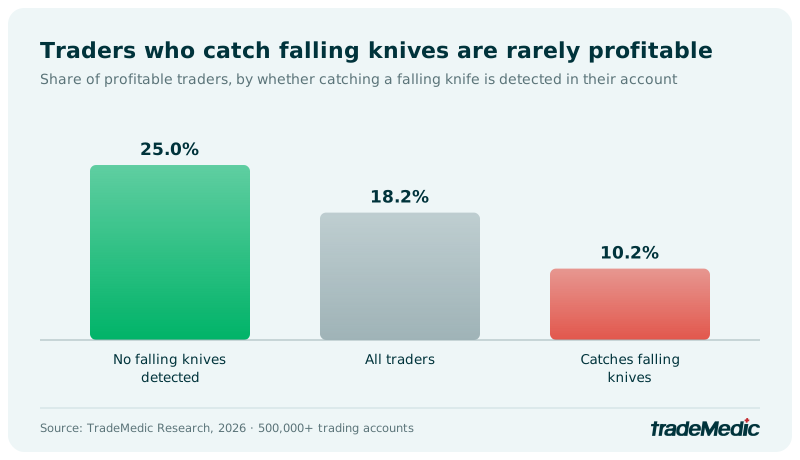
Across more than 500,000 trading accounts analysed by TradeMedic AI, negative impact from catching falling knives is detected in 46.0% of traders. Only 10.2% of those traders are profitable, compared with 25.0% of traders who do not do it. And unlike many trading mistakes, it does not fade with experience: the longer traders trade, the more often they try to catch the knife.
This article explains what catching a falling knife means, how to recognise the pattern, how it differs from buying the dip, what the data shows about its cost, why traders keep doing it, and what works instead.
Let's start with what the phrase means in trading.
What is a falling knife in trading, and what does catching one mean?
The saying comes from an old market warning: never try to catch a falling knife. Grabbing a knife in mid-air is more likely to cut you than to save the knife. In trading, the knife is a price that is dropping fast, and catching it means buying while it is still falling, betting that the drop is about to end.
A falling knife in trading is a market in a sharp, fast decline, usually driven by news, a broken support level or a wave of selling. The trader who catches it is not following a planned setup. They are reacting to how far and how fast the price has fallen, and to the feeling that a reversal must be close.
The same logic applies in the other direction. Shorting into a sharp, fast rally, betting that it has gone too far and must turn, is the mirror image of catching a falling knife, and it tends to end the same way.
Recognising the pattern while it is happening is the first step to avoiding it.
What does a falling knife pattern look like?
A falling knife pattern has a few typical features. The price drops sharply over a short period, often in large candles with little or no pause. Previous support levels break without holding. Volatility rises, and the move is frequently tied to news or a sudden shift in sentiment.
Many traders use the Relative Strength Index (RSI) to spot these moves. When the RSI falls into oversold territory, traditionally below 30, the market has fallen further and faster than usual relative to its recent history. An oversold RSI reading is often treated as a buy signal. But oversold describes a condition, not a turning point. In a strong decline, the RSI can stay oversold for a long time while the price keeps falling, which is exactly the situation in which knives are caught.
This is also how TradeMedic AI detects the pattern: it looks at long trades opened in strongly oversold markets and short trades opened in strongly overbought ones, and checks how those trades perform.
Buying into weakness is not always a mistake, though. The difference between catching a knife and buying a dip matters.
Buying the dip vs catching a falling knife: what is the difference?
Buying the dip means buying after a pullback in a market that is still healthy, expecting the broader move to resume. Catching a falling knife means buying into a sharp decline that has not yet shown any sign of ending. From the outside, the two trades can look identical. The difference is in the context and the timing.
A dip is a pause within a trend or a range: the price pulls back to a level where buyers have stepped in before, the selling slows, and the market stabilises. A falling knife is a move with momentum behind it: the price is breaking levels rather than respecting them, and nothing yet suggests the selling is finished.
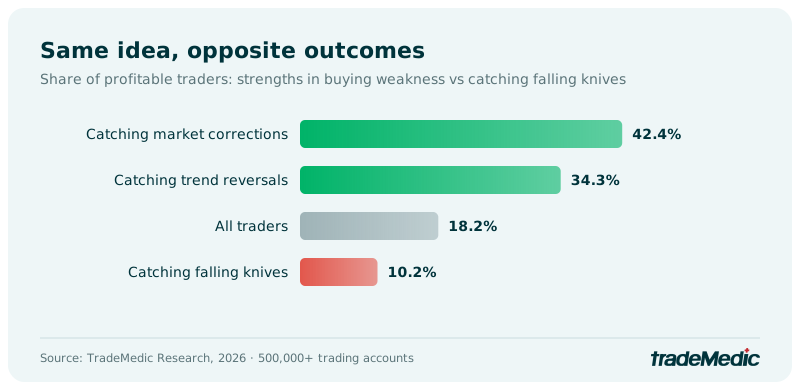
The data shows how much that difference matters. Buying weakness can be a strength. Traders who are good at catching market corrections are profitable 42.4% of the time, and traders who are good at catching trend reversals 34.3% of the time. Traders who catch falling knives are profitable 10.2% of the time. Same idea, opposite outcomes. We come back to what separates them later in this article.
First, a closer look at what catching falling knives costs.
How does catching a falling knife affect trading performance?
Among traders who fail to catch falling knives, the habit causes 16.0% of their losses, an average of $5,346 per trader. Measured across all traders in the dataset, it accounts for 12.3% of all trading losses, ranking eighth of the 23 problem patterns TradeMedic AI tracks.
The link to profitability is clear. Only 10.2% of traders who catch falling knives are profitable, compared with 25.0% of traders where the pattern is not detected, and 18.2% across all traders. The pattern is also much more common among losing traders: it is detected in 50.5% of loss-making traders, compared with 25.8% of profitable ones.
If you want to know whether this pattern shows up in your own trading, and what it is costing you, TradeMedic AI checks your full trade history for it and 60+ other behavioural patterns. Connect your trading account free.
The data also shows who tends to catch falling knives, and the answer may be surprising.
What does the data say about catching falling knives?
Catching falling knives becomes more common the longer traders trade. It is detected in 20.2% of accounts under 10 days old, 41.0% at 10 to 49 days, 65.2% at 50 to 199 days and 75.1% of accounts trading for 200 days or more. Its share among traders' five biggest improvement areas rises too, from 9.6% to 22.6%.
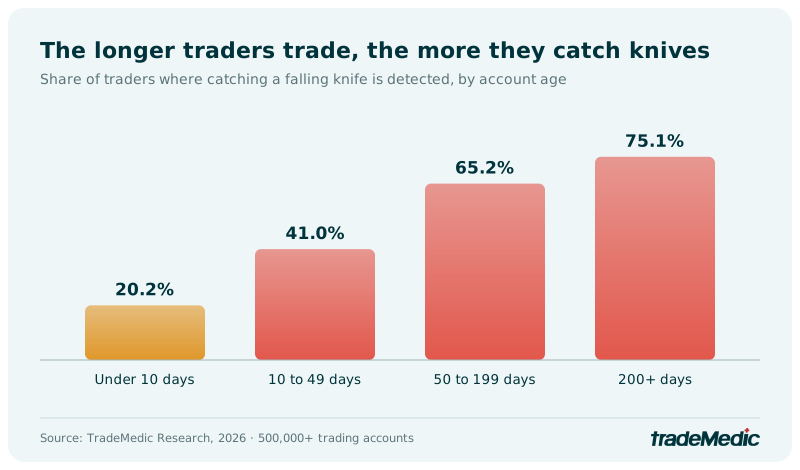
Part of this is mechanical, since a longer history gives the analysis more trades to work with. One plausible reading is that newer traders tend to follow the market, while traders with more experience start to believe they can spot where a move will end. Across trading styles, it is detected in 38.0% of scalpers, 47.1% of day traders and 42.5% of swing traders.
It also rarely comes alone. When the pattern is detected, fighting the trend is 76% more likely to be present as well, appearing in 63.1% of these traders compared with 35.8% of all traders. News trading is 47% more likely (61.0% vs 41.4%), doubling down 37% more likely (63.6% vs 46.5%), and emotional trading 36% more likely (78.0% vs 57.3%).
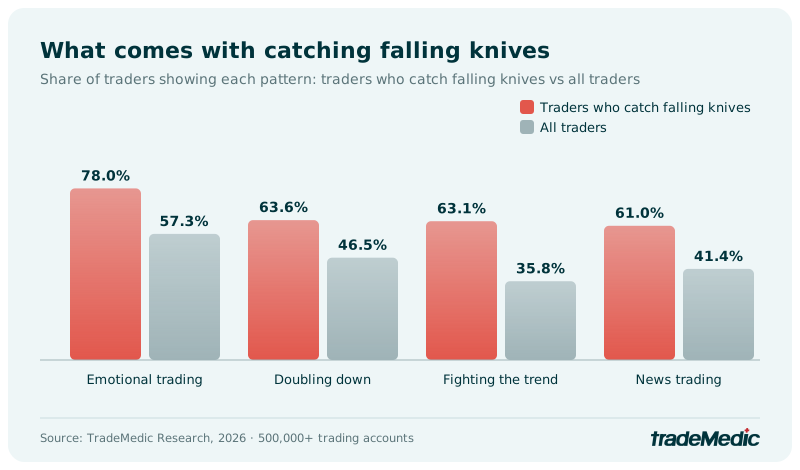
Together they tell a clear story. Fighting the trend is the belief that the move must turn. Trading around news is often where the sharp moves come from. And when the knife keeps falling, doubling down is what many traders do next. One pattern moves the other way: traders who catch falling knives are 13% less likely to show anxious trade entries. These are not hesitant traders. They act quickly and with conviction, often before a setup has formed, much like traders who enter impatiently.
Why would experienced, confident traders keep making a trade that works so rarely? The research offers several answers.
What causes traders to catch falling knives?
The recent high becomes an anchor. In their classic work on judgement, Amos Tversky and Daniel Kahneman showed that people rely heavily on a starting reference point, and adjust too little from it. After a sharp drop, the recent high becomes that reference point. Measured against it, the current price looks cheap, even though the market has not agreed that it is.
Buying after declines comes naturally to individual traders. Research by Ron Kaniel, Gideon Saar and Sheridan Titman found that individual investors tend to buy stocks after they have fallen and sell after they have risen. In their data, stocks that individuals bought heavily went on to earn positive excess returns the following month, which is exactly why the instinct feels right. The problem is that the same instinct does not distinguish between a normal pullback and a market in free fall.
Sharp moves grab attention. Research by Brad Barber and Terrance Odean found that individual investors are much more likely to buy stocks that have caught their attention, such as those with extreme price moves or in the news. Falling knives are, by definition, the most attention-grabbing moves in the market, which fits the strong link between catching falling knives and news trading in our data.
The belief that a reversal is due. After a long fall, many traders feel that the market has dropped so far that it must bounce. That belief is closely related to the gambler's fallacy: the expectation that after a run of one outcome, the opposite is overdue. Markets do not work that way. A price that has fallen sharply is not more likely to rise because it has fallen.
High pressure, fast decisions. Falling knives happen in high-intensity moments. Prices move quickly, the fear of missing the bottom is strong, and trading rules are easily set aside. Once in the trade, many traders feel stuck: the loss widens, and decisions start to be driven by hope rather than a plan.
And even when the idea is right, the timing often is not.
Why do markets stay irrational longer than expected?
"Markets can remain irrational longer than you can remain solvent" is one of the most quoted lines in trading. It is usually credited to the economist John Maynard Keynes, but there is no solid evidence he said it. The earliest known versions come from financial analyst A. Gary Shilling, who used the line in the 1980s and in Forbes in 1993. Whoever said it first, the warning fits falling knives perfectly: even when a sell-off has gone too far, it can keep going far longer than a trader's account can handle.
Research on momentum explains why. In a study of 58 futures and forward markets, including currencies, stock indices, commodities and bonds, Tobias Moskowitz, Yao Hua Ooi and Lasse Pedersen found that past returns predict future returns in the same direction for up to a year, before partially reversing over longer horizons. In other words, strong moves tend to continue before they turn. A trader betting on the turn is betting against one of the most consistent patterns in financial markets.
Even when the market does bounce, the bounce can be a trap.
What is a dead cat bounce?
A dead cat bounce is a short-lived recovery in the middle of a longer decline. The name comes from the grim market joke that even a dead cat will bounce if it falls from a great height. The price rises for a while, drawing in buyers who think the bottom is in, and then resumes its fall.
For a trader who caught the knife, a dead cat bounce is especially dangerous because it feels like confirmation. The position moves into a small profit or a smaller loss, the trader holds or adds, and then the next leg down begins. A dead cat bounce is hard to tell apart from a real reversal while it is happening, which is why the traders who buy weakness successfully wait for more than one up day before calling the bottom.
None of this means that every sharp drop keeps falling. It means that the burden of proof is on the trade, not on the trend. And some traders do manage to buy weakness successfully.
How to catch a falling knife: when buying weakness works
If catching falling knives is so costly, how do some traders profit from buying weakness? The data shows that they exist. Traders with a strength in catching market corrections are profitable 42.4% of the time, and traders with a strength in catching trend reversals 34.3% of the time, compared with 10.2% for traders who catch falling knives.
These strengths are also much rarer. Catching market corrections is detected as a strength in 12.4% of traders compared with 46.0% of traders who catch falling knives. For every trader who is good at catching corrections, almost four get hurt attempting to catch falling knives. And the strengths sit mostly with winners: catching market corrections appears in 29.0% of profitable traders but only 8.8% of loss-making ones.
What separates these traders is not the direction of the trade but how and when they take it. Catching market corrections means buying pullbacks within a larger move, not the move itself. Catching trend reversals means entering once there is evidence that the trend has turned, rather than guessing where it will. In both cases, the trade waits for the market to show its hand.
So the honest answer to how to catch a falling knife is: let it hit the floor first. Wait for the decline to slow, for a level to hold, or for a clear reversal signal, and accept that you will miss the exact bottom. The traders who profit from buying weakness give up the best price in exchange for a much better chance of being right.
That leads directly to the practical rules.
How can traders manage the risk of trading against momentum?
1. Treat oversold as a condition, not a signal. An oversold RSI reading tells you the market has fallen fast, not that it has finished falling. Wait for evidence of a turn, such as a level holding or the momentum slowing, before entering.
2. Define the setup in advance. Decide before the session what a valid reversal setup looks like for you. If a trade does not match it, the speed of the move is not a reason to take it.
3. Reduce position size in high-intensity moves. Sharp moves need wider stops, and wider stops at the same size mean larger losses. If you trade these moves at all, trade them smaller.
4. Set a stop loss before you enter, and never add to the position. If the knife keeps falling, the stop protects the account. Adding to the position, as many traders do, turns a bad entry into the most expensive pattern in trading. Our article on trading without a stop loss explains why this rule matters so much.
5. Be careful around news. Many of the sharpest moves are news-driven, and the strong overlap between catching falling knives and news trading in the data suggests that is where many knives are caught. If that describes you, consider stepping aside until the first reaction has settled.
6. Review your counter-move entries separately. Look at the trades you opened after a sharp move against the market, and compare their results with the rest of your trading. That review shows whether buying weakness is a strength for you or a leak.
The last step is exactly what TradeMedic AI does automatically.
How does TradeMedic detect catching falling knives in real trading data?
TradeMedic AI classifies every trade by the market environment it was opened in, using the RSI indicator and the trade direction. Long trades opened in strongly oversold markets and short trades opened in strongly overbought markets are grouped together, and their performance is compared with the rest of the trader's trades. If those trades perform negatively, the pattern is flagged as catching a falling knife.
The analysis also detects the opposite: traders who buy weakness successfully are flagged with strengths such as catching market corrections or catching trend reversals. That means a trader can see not only whether they catch falling knives, but whether they have the skill to buy weakness well. More on the methodology is on our research page.
The bottom line on falling knives
Catching a falling knife means buying into a sharp decline before it has shown any sign of ending. It is detected in almost half of all traders, it becomes more common the longer traders trade, and only 10.2% of the traders who do it are profitable. The psychology behind it is powerful: anchoring on the recent high, the natural instinct to buy what has fallen, and the belief that a reversal is due. But the data also shows the way out. Traders who wait for the market to show its hand, and buy corrections and confirmed reversals instead of the fall itself, are among the most profitable in the dataset.
→ Learn more about TradeMedic AI
→ Find out if you catch falling knives: connect your trading account to TradeMedic AI free
Watch Why Catching A Falling Knife is Often Backfires
Research behind this article
Tversky, A., and Kahneman, D. (1974). Judgment under Uncertainty: Heuristics and Biases. Science, 185(4157), 1124 to 1131.
Kaniel, R., Saar, G., and Titman, S. (2008). Individual Investor Trading and Stock Returns. The Journal of Finance, 63(1), 273 to 310.
Barber, B. M., and Odean, T. (2008). All That Glitters: The Effect of Attention and News on the Buying Behavior of Individual and Institutional Investors. The Review of Financial Studies, 21(2), 785 to 818.
Moskowitz, T. J., Ooi, Y. H., and Pedersen, L. H. (2012). Time Series Momentum. Journal of Financial Economics, 104(2), 228 to 250.
Quote Investigator (2011). The Market Can Remain Irrational Longer Than You Can Remain Solvent (origin of the saying).
TradeMedic Research (2026). Behavioural pattern analysis of 500,000+ retail trading accounts. Source: TradeMedic Research, 2026.
Frequently asked questions
What does catching a falling knife mean in trading?
Catching a falling knife means buying into a sharp, fast price decline in the hope of catching the bottom before the market turns back up. The phrase comes from the warning that grabbing a knife in mid-air is more likely to cut you than to save the knife. According to TradeMedic AI data from 500,000+ trading accounts, only 10.2% of traders who do it are profitable.
What is a falling knife in trading?
A falling knife is a market in a sharp, fast decline, often driven by news, broken support levels or heavy selling. According to TradeMedic AI data from 500,000+ trading accounts, 46.0% of traders try to catch falling knives, and only 10.2% of them are profitable.
What does a falling knife pattern look like?
A falling knife pattern shows a sharp drop over a short period, large candles with little pause, support levels breaking without holding, and rising volatility. The RSI is often deep in oversold territory, but it can stay there for a long time while the price keeps falling.
Is an oversold RSI a buy signal?
Not on its own. An oversold RSI reading, traditionally below 30, shows that a market has fallen further and faster than usual, not that the fall is over. In strong declines, the RSI can stay oversold while the price keeps dropping, which is exactly when falling knives are caught.
What is the difference between buying the dip and catching a falling knife?
Buying the dip means buying a pullback in a market that is still healthy, where the selling is slowing and levels are holding. Catching a falling knife means buying into a sharp decline that has not yet shown any sign of ending. In TradeMedic AI data, traders with a strength in catching market corrections are profitable 42.4% of the time, against 10.2% for traders who catch falling knives.
How much does catching a falling knife cost traders?
According to TradeMedic AI data from 500,000+ trading accounts, catching falling knives causes 16.0% of the losses of the traders who do it, an average of $5,346 per trader. Only 10.2% of those traders are profitable, compared with 25.0% of traders who do not do it.
Do experienced traders catch falling knives?
Yes, more than beginners. In TradeMedic AI data, the pattern is detected in 20.2% of accounts under 10 days old but in 75.1% of accounts trading for 200 days or more.
How do you catch a falling knife?
The safest way is to let it hit the floor first: wait for the decline to slow, for a level to hold or for a clear reversal signal, and accept missing the exact bottom. Trade smaller than usual, set a stop loss before entering, and never add to the position if the price keeps falling.
What is a dead cat bounce in trading?
A dead cat bounce is a short-lived recovery in the middle of a longer decline. The price rises for a while, drawing in buyers who think the bottom is in, and then resumes its fall. For traders who caught the knife, it often feels like confirmation right before the next leg down.
What is a falling knife stock?
A falling knife stock is a share whose price is dropping sharply and quickly, often after bad news, weak earnings or a broken support level. Buying it during the fall is catching a falling knife: the price looks cheap compared with where it was, but nothing yet shows that the selling has ended.
Is buying the dip a good strategy?
It can be, when the dip is a pullback in a healthy market rather than a sharp decline still in motion. In TradeMedic AI data from 500,000+ trading accounts, traders with a strength in catching market corrections are profitable 42.4% of the time, but only 12.4% of traders have that strength, while 46.0% catch falling knives and only 10.2% of them are profitable.
Is counter-trend trading the same as catching a falling knife?
No. Counter-trend trading is a planned approach that trades against the prevailing direction with defined entries, exits and risk, often at the end of a correction. Catching a falling knife is an unplanned reaction to a sharp move that has not yet shown any sign of ending.
Is catching a falling knife the same as mean reversion trading?
No. Mean reversion trading is a strategy that expects prices to return towards an average, with defined rules for entries and exits. Catching a falling knife is an unplanned reaction to a sharp move. Mean reversion strategies can work in ranging markets, but applied to a market in a strong trend, they turn into falling-knife trades.