Category:
 Author:
 Date:Jun 15, 2026
Entering Trades Too Early: The Mistake 77% of Traders Make (and Why It Is Not the Problem You Think)

Entering before a setup has confirmed is one of the most common patterns in trading. In an analysis of more than 500,000 trading accounts, TradeMedic found that entering too early shows a measurable effect for around 77% of traders, making it the second most common improvement area in the data. Yet the same analysis found it is rarely the thing actually holding a trader back, and that the traders who show it most are disproportionately the profitable ones. It is widespread, it is misunderstood, and for most traders it is more an opportunity to tighten than a problem to fear.
What does entering too early mean?
Entering too early, sometimes called impatient entries, means opening a position before the setup has fully confirmed. The level has not quite been reached, or the signal has not quite completed, but the urge to act wins and the trade goes on a little ahead of the plan. It is distinct from chasing or FOMO, which push a trader to enter late, after a move is already underway. Impatience pushes in the other direction: in before the move has started.
The typical sequence is familiar to most traders. A setup is forming and price is approaching the level being watched. Waiting starts to feel like inaction, and the fear of missing the move builds. The trade gets opened before the level is genuinely reached or the signal confirms. A slightly later entry would have caught a more favourable price.
One point matters before looking at the numbers: this is not a realised loss. The detection compares each actual entry against the same trade entered slightly later. When the later entry would have performed better on average, the difference is forfeited upside, a better price that was available, not money lost on the trade itself.
In short, it is measured by re-running every trade in an account with a slightly later entry and checking whether that later entry would on average have produced a better result. A trader is flagged only when the pattern is consistent across their trades, not when they are occasionally early. The fuller detection method is described later in this article.
How common is entering too early, and what does it cost?
Across the 500,000+ accounts analysed, entering too early shows a measurable effect for around 77% of traders. That makes it the second most common improvement area detected in the data, more common than its late-entry counterpart. The figures here are drawn from accounts with enough trade history to establish a reliable pattern rather than a one-off, so they reflect persistent behaviour, not occasional early entries.
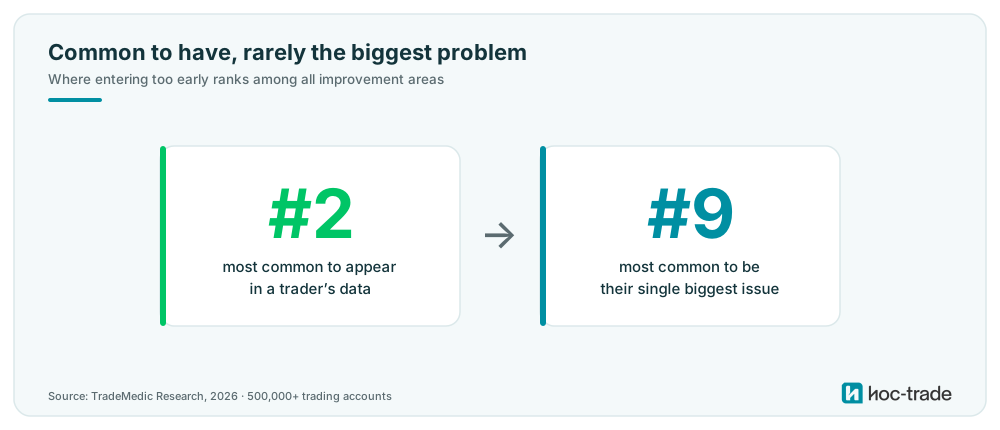
The more revealing finding is the gap between how often it appears and how often it matters. Entering too early is the 2nd most common pattern to appear in a trader's data, but only around the 9th most common to be their single biggest issue. It is widespread but rarely dominant: a common habit, not usually the thing actually holding a trader back.
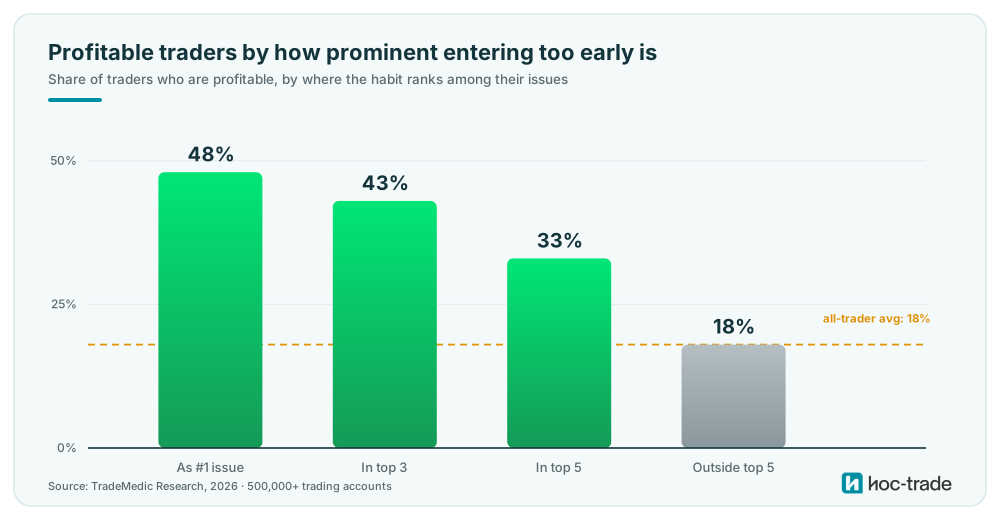
There is also a counterintuitive link to profitability. In TradeMedic's analysis, traders whose single biggest issue is entering too early are around two and a half times more likely to be profitable than the average trader in the dataset. The effect scales with how central the habit is: about 48% of traders are profitable when it is their number one issue, 43% when it is in their top three, and 33% when it is in their top five, against a baseline of roughly 18% across all traders. Once it falls outside the top five, profitability returns to that 18% baseline. This does not mean being early makes money, a clean entry is always better. It appears instead to be a marker of an active, decisive trader who is taking their setups, rather than one frozen on the sidelines. It also tends to mean the more damaging patterns, such as overtrading or doubling down, are not that trader's dominant problem.
On cost, the forfeited upside averages around $1,786 per affected trader over the life of an account, equivalent to roughly 10 to 14% of that trader's total losses. That proportion stays remarkably stable across deposit sizes, from accounts of a few hundred dollars to tens of thousands. Larger accounts leave more on the table in absolute terms, but only because they trade larger size, not because they are proportionally more impatient.
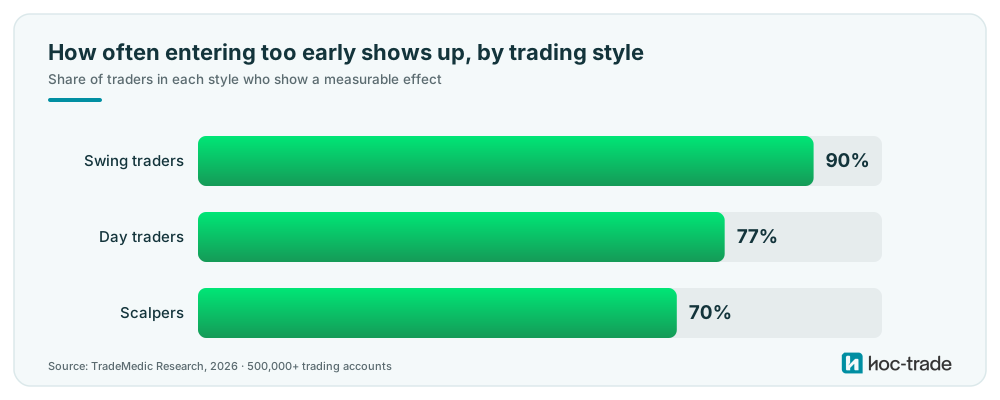
The pattern is most pronounced for swing traders, 90% of whom show some effect, because a slower setup leaves more room to enter before the level is genuinely reached. Day traders sit at about 77% and scalpers at about 70%, since faster trading leaves less room for the gap to open.
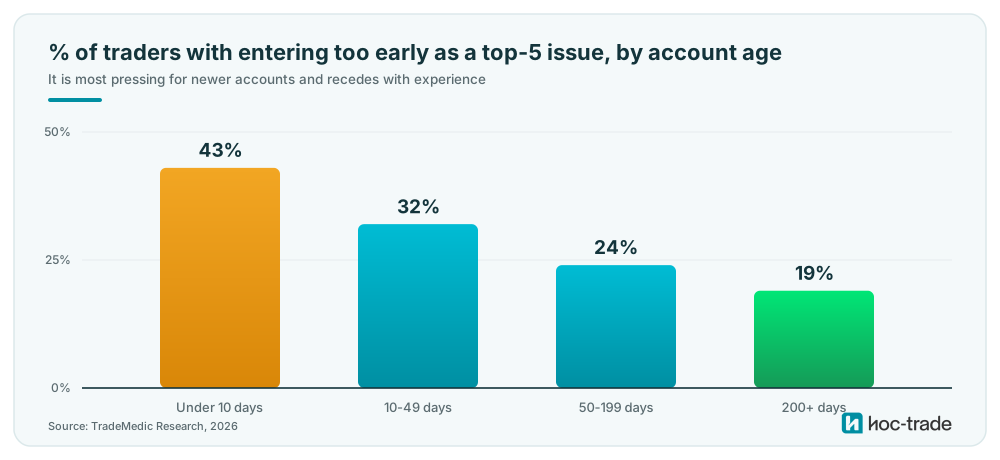
It is also most pressing for newer accounts: it is a top-five issue for about 43% of accounts under ten trading days, falling to roughly 24% by 50 to 200 days and 19% beyond that. Most traders improve at waiting over time, without ever fully eliminating it.
Why do traders enter too early? The psychology
Entering too early is not purely a discipline problem, though discipline plays a part. Several well-studied behavioural tendencies sit underneath it, and understanding them tends to make the behaviour easier to change than willpower alone.
Action bias
Action bias is the pull to do something rather than wait, because acting feels like progress and control even when waiting is the better choice. A well-known study of penalty kicks in football by Bar-Eli and colleagues (2007) found that goalkeepers dive left or right around 94% of the time, staying in the centre only about 7%, even though nearly 29% of kicks go straight down the middle and standing still saves more of them. Diving feels like doing the job; standing still feels like failing to act. Watching a setup form without clicking triggers the same discomfort, so the trader acts early even when doing nothing is correct.
Impatience with delay
People tend to prefer a smaller reward now over a slightly larger reward shortly later, a tendency behavioural economists call delay discounting, studied in classic work by Thaler (1981) and reviewed by Frederick, Loewenstein and O'Donoghue (2002). In the textbook version, many people will take $20 today over $25 in a month even though waiting is clearly the better deal. In trading, the better entry that needs another couple of minutes quietly loses out to the trade that can be taken immediately, and the worse but instant option wins.
It is the opposite of FOMO
Entering too early is frequently confused with FOMO, but the two are opposites. FOMO is the fear of missing a move that is already running, which makes a trader late, chasing price that has already moved. Impatience makes a trader early, in before the move has begun. They belong to the same emotional family but produce opposite timing errors, and the appropriate fix differs depending on which one a trader actually has. The late-entry side, anxious or hesitant entries, is a separate pattern worth its own treatment.
What entering too early tends to travel with
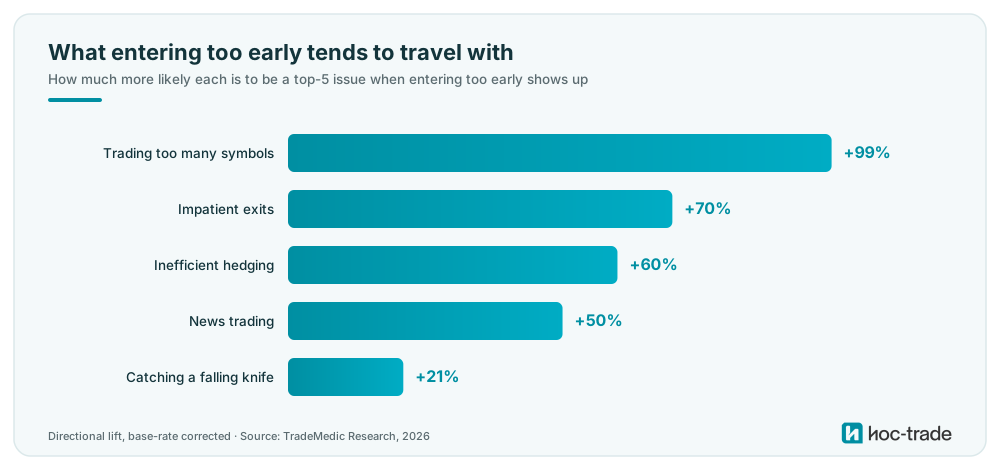
Looking at which other patterns become more prominent when entering too early is present points to a shared root of impulsiveness. When it shows up, impatient exits are about 70% more likely to also be a leading issue, the clearest signal that the same impatience is showing up at both ends of the trade. Trading too many symbols at once is around 99% more likely, news trading about 50% more likely, jumping onto a sharp move such as catching a falling knife about 21% more likely, and inefficient hedging about 60% more likely. These are indicative connections rather than proof of a single cause, but the through-line of impulsiveness is hard to miss, and it suggests that working on the underlying impatience can help more than addressing any one habit in isolation.
How TradeMedic AI detects entering too early
TradeMedic™ AI re-simulates each of a trader's trades with a slightly later entry, holding everything else constant, and checks whether the later entry would on average have produced a better result. If later entries would consistently have improved performance, the pattern is flagged and its dollar impact calculated. The detection looks for a persistent pattern across all of a trader's trades, not occasional early entries, and it tends to be most exposed on reversal setups, where the move has not yet fully developed. Entering too early is one of more than 60 behavioural patterns the system analyses per trader.
How to stop entering trades too early
The standard advice, wait for confirmation, use a checklist, be patient, is true but rarely specific enough to act on. A few concrete approaches tend to help more:
Treat your entries like your exits. Most traders enforce exits with clear rules and resting stop-loss and take-profit orders, but decide entries on feel in the moment. Giving the entry the same structure, a defined trigger rather than a sense that it looks right, is the single most effective change.
Define the confirmation trigger in advance. Decide exactly what counts as confirmed before the moment arrives: a level genuinely touched, a candle closed, a specific volume behind the move. A written rule turns the entry into a mechanical step rather than a contest with the urge.
Use a resting limit order at the confirmed level. When the urge to enter is strong, willpower is unreliable. A limit order placed at the price the criteria actually call for removes the in-the-moment decision. The one caveat is to place it at the confirmed level, not the early price impatience wants.
Give the setup one more candle. When the pull to enter hits, a single fixed pause before acting is small enough to actually follow, and since the better price is often only a few minutes away, it is frequently enough
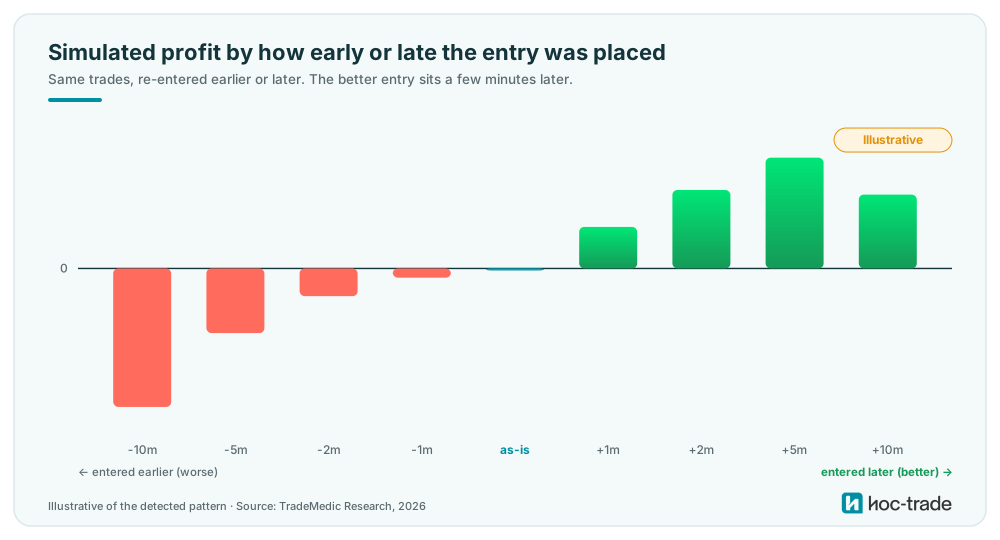
The right amount of patience is personal. Across accounts, the point at which a later entry would have been better most commonly lands somewhere in the two to ten minute range, but the individual number varies widely. TradeMedic™ AI calculates a trader's own timing from their own trade history, showing whether their entries land early and by how much, which turns "be more patient" into a specific, measurable target.
The bottom line
Entering too early is one of the most common habits in trading and one of the least dangerous. It is forfeited upside rather than a loss, it shows up more in active and profitable traders than struggling ones, and the better entry is usually only a short wait away. It is worth tidying up, but rarely worth losing sleep over.
See if entering too early appears in your own trading: connect your trading account to TradeMedic™ AI free.
Watch: How to Overcome Impatient Entries in Trading
Research behind this article
Action bias in goalkeepers: Bar-Eli, M., Azar, O. H., Ritov, I., Keidar-Levin, Y., & Schein, G. (2007). Action bias among elite soccer goalkeepers: The case of penalty kicks. Journal of Economic Psychology, 28(5), 606-621. Kick-direction distribution from related work by Bar-Eli & Azar (2009).
Delay discounting and preference for smaller-sooner rewards: foundational work in behavioural economics on temporal discounting (e.g. Thaler, 1981; Frederick, Loewenstein & O'Donoghue, 2002).
All trading statistics: TradeMedic Research, 2026, based on a dataset of more than 500,000 trading accounts.
Frequently asked questions
What does entering too early mean in trading?
Entering too early, also called impatient entries, means opening a position before the setup has fully confirmed, ahead of the planned level or signal. It is the opposite of FOMO or chasing, which cause late entries. It is measured as forfeited upside, a better price that was available, rather than a loss on the trade.
How common is entering too early among traders?
Across more than 500,000 trading accounts analysed by TradeMedic, entering too early shows a measurable effect for about 77% of traders, making it the second most common improvement area detected. However, it is rarely a trader's single biggest issue, ranking only around ninth on that measure: very common to have, rarely the main problem.
How much does entering too early cost traders?
For affected traders, the forfeited upside averages around $1,786 over the life of an account, equivalent to roughly 10 to 14% of their total losses. This proportion stays fairly stable across account sizes. It is forfeited upside, the gap to a better available entry on the same trade, rather than money lost outright.
Why do I keep entering trades too early?
It is mostly wiring rather than a discipline failure. Two tendencies drive it: action bias, the pull to act because doing something feels like progress even when waiting is better, and impatience with delay, the preference for acting now over a slightly better outcome a few minutes later. Understanding these makes the behaviour easier to change than willpower alone.
Does entering too early make traders unprofitable?
Not necessarily. Among traders whose biggest issue is entering too early, about 48% are profitable, compared with roughly 18% across the dataset. It does not make money on its own, a clean entry is always better, but it tends to mark an active, decisive trader rather than a struggling one.
Is entering too early the same as FOMO?
No, they are opposites. FOMO is the fear of missing a move already underway, which makes traders enter late. Impatience makes traders enter early, before the move has started. They share an emotional root but produce opposite timing errors and need different fixes.
How do I stop entering trades too early?
Treat entries with the same structure as exits: define an exact confirmation trigger in advance and enforce it, ideally with a resting limit order at the confirmed level rather than relying on willpower. A single fixed pause of one more candle also helps, since the better entry is often only a few minutes away.