Category:
 Author:
 Date:May 20, 2026
Impatient Exits: Why Do Traders Exit Early
Your setup was sound. Price moved in your direction. Everything was working exactly as planned. Then, moments before hitting your profit target, you closed the position. Not because your rules told you to. But because something inside whispered: lock it in now.
This impulse—to exit early—is one of the most common behaviors that silently damage trading performance. It's not born from poor entry logic or flawed strategy design. It emerges from emotion and psychology. The frustrating truth is that most traders don't recognize it's happening until the damage is already done.
What triggers early exits?
Early exits rarely announce themselves. They sneak in during moments of doubt. A modest price pullback just before your target can spark concern, even when the setup remains intact. A market that's grinding sideways might feel ominous, creating a sense of danger that wasn't there an hour earlier. Sometimes it's simply the weight of an unrealized profit sitting on your screen—the discomfort of seeing money that hasn't been 'locked down' yet.
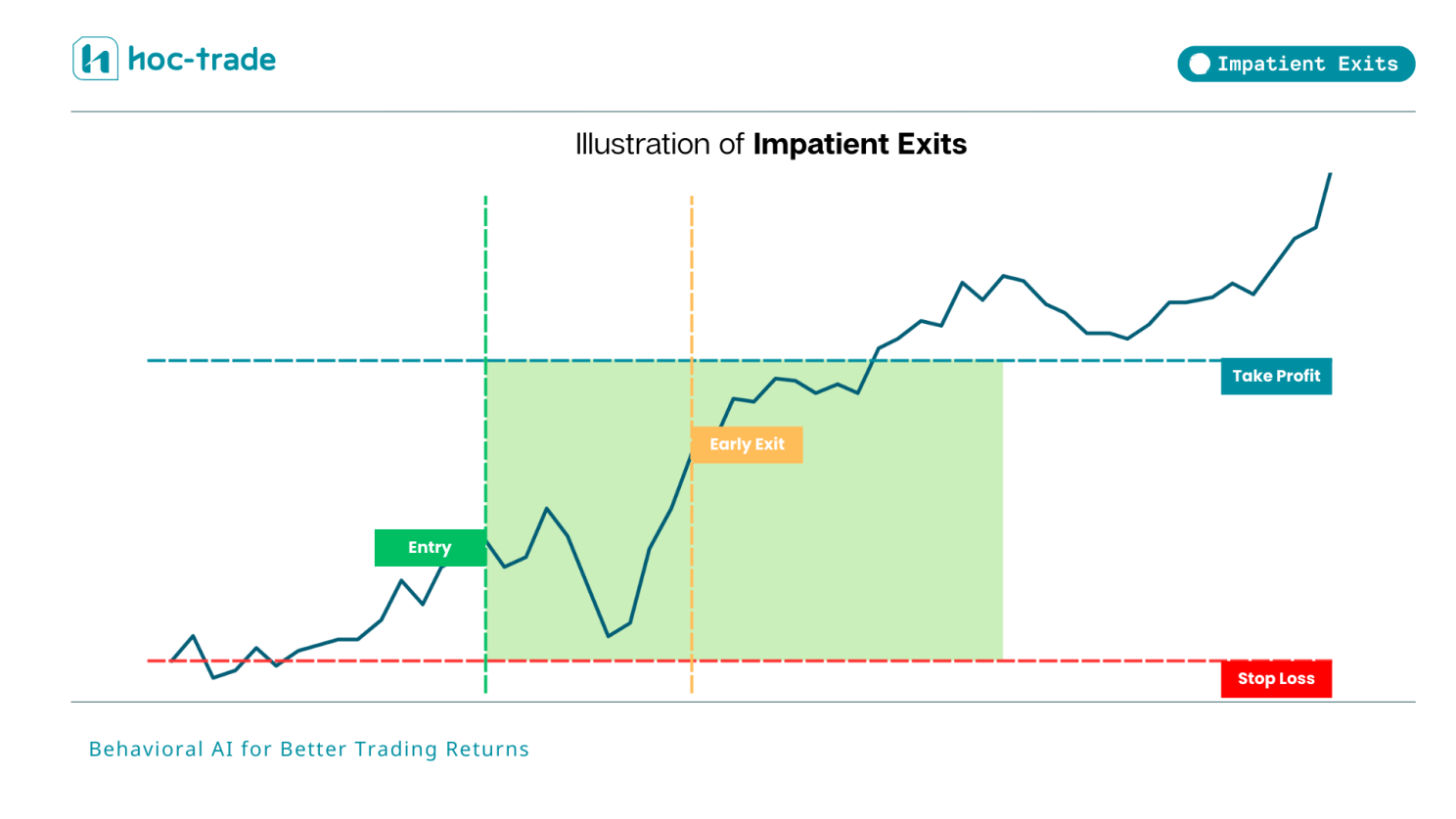
These moments create a kind of internal pressure. The mind seeks resolution. For many traders, the quickest way to resolve that pressure is to close the trade, regardless of what the original plan says. In every case, the position is still alive and moving in the right direction. But psychologically, the trader has already exited.
There's also the tension that builds when price approaches your stop-loss, even if it's well within reasonable risk parameters. The proximity alone can trigger the illusion of imminent danger. Rather than waiting for an actual signal, the trader takes action to escape the discomfort. The result is a closed trade based on fear, not evidence.
How do impatient exits affect trading performance?
On first glance, exiting a winner early looks like responsible risk management. There's even an old trading saying: 'Nobody ever went broke taking a profit.' But this logic ignores what happens across dozens, hundreds, or thousands of trades.
When exits are trimmed consistently and losses are taken in full, the math shifts. Your reward-to-risk ratio deteriorates. The strategy that works brilliantly on paper—the one with a solid theoretical edge—now underperforms its own projections. Not because the strategy is broken. But because execution itself is broken.
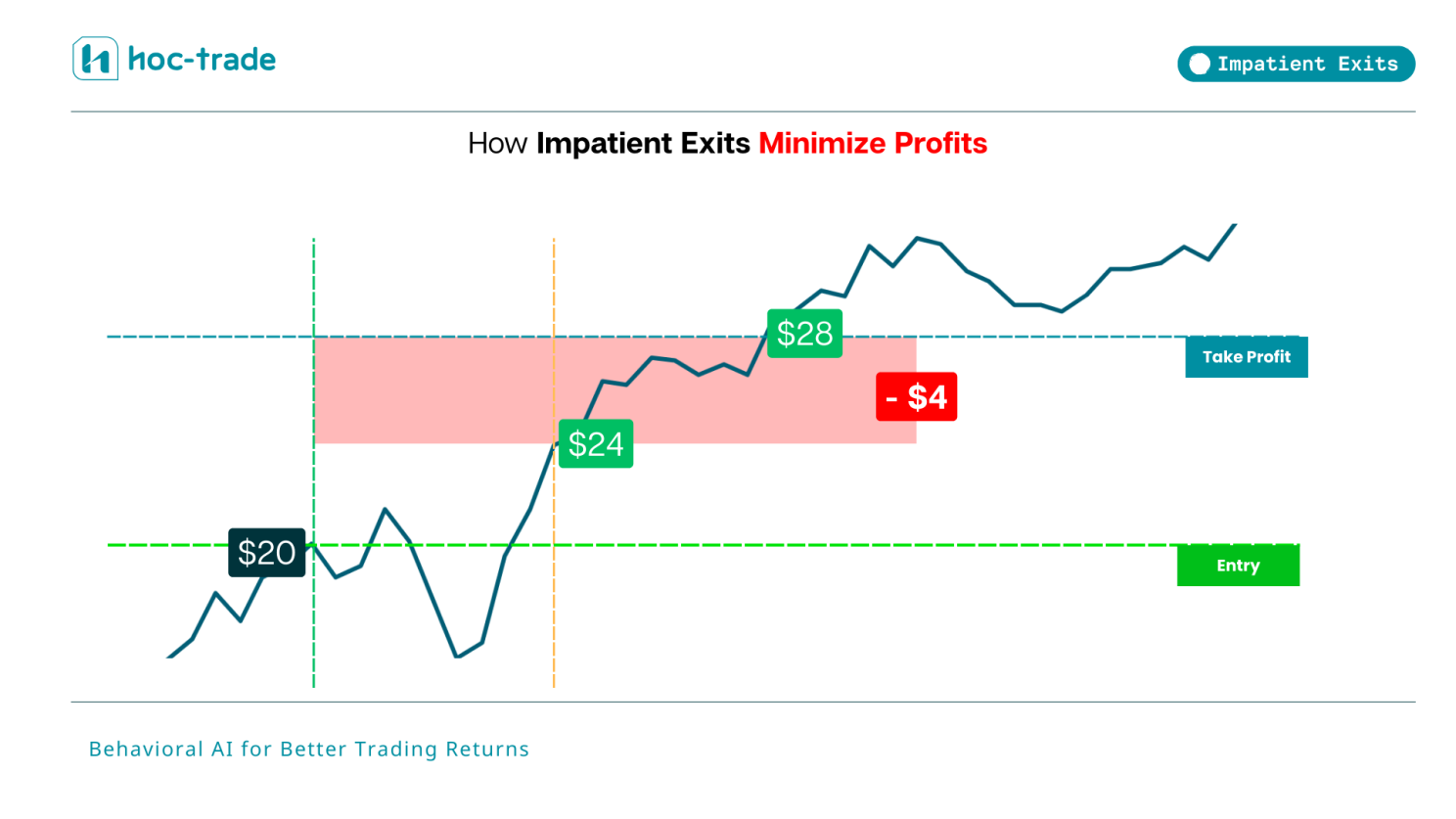
Many traders find themselves in a peculiar position: they win frequently, but never seem to accumulate real profits. They might close 65% of their trades as winners. Yet at the end of the month or quarter, the account barely moved. The edge exists. It's just being slowly dismantled by behavior.
What psychological factors cause impatient exits?
Early exits aren't technical errors. They're expressions of deep psychological patterns that economists and behavioral scientists have documented for decades.
Loss aversion is primary. Daniel Kahneman and Amos Tversky's research on behavioral economics revealed something fundamental: humans feel the pain of losing $1 far more intensely than the pleasure of gaining $1. In trading, this manifests as an almost visceral need to protect profits the moment they appear on screen. That unrealized gain feels like it could evaporate, and the discomfort drives the trader to 'secure' it immediately, even though closing early means missing the larger move that was always part of the plan.
Regret aversion amplifies this. Traders dread the specific pain of watching a winner turn into a loser. They imagine the emotional sting of that reversal and decide in advance to avoid it by exiting early. They choose the certainty of a small win over the possibility of a larger win, because the latter carries the risk of regret.
There's also the discomfort that trading inherently demands. Markets create periods of genuine ambiguity. Price moves in the right direction, then stalls. Or it pulls back even though the setup is still valid. Sitting through this requires patience and trust in your process. For many traders, this discomfort becomes intolerable. The urge to 'do something'—anything—overwhelms the discipline to wait. Exiting feels like control, even though it's actually the opposite.
Understanding these drivers isn't a sign of weakness. It's the first step toward changing behavior.
How common is impatient exit behavior in real trading data?
TradeMedic™ AI detects impatient exits across a dataset of 500,000+ trader accounts and identifies it as one of the most frequently occurring behavioral improvement opportunities. This behavior appears consistently across different markets, timeframes, and trading styles, suggesting it's a nearly universal challenge.
What's more revealing is the performance impact. In our dataset, traders who frequently exit early show measurable drag on returns compared to their own theoretical edge. A detailed analysis comparing actual exit points to optimal exit points reveals the cumulative cost of this pattern. The data breakdowns are available in our dedicated impatient exits analysis.
How can traders identify this pattern in their own trading?
Recognizing the pattern is harder than it should be. Most traders feel the impulse to exit early—they remember the discomfort, the tension, the urge to 'do something.' But they don't connect this pattern to performance degradation. They assume each early exit was probably justified.
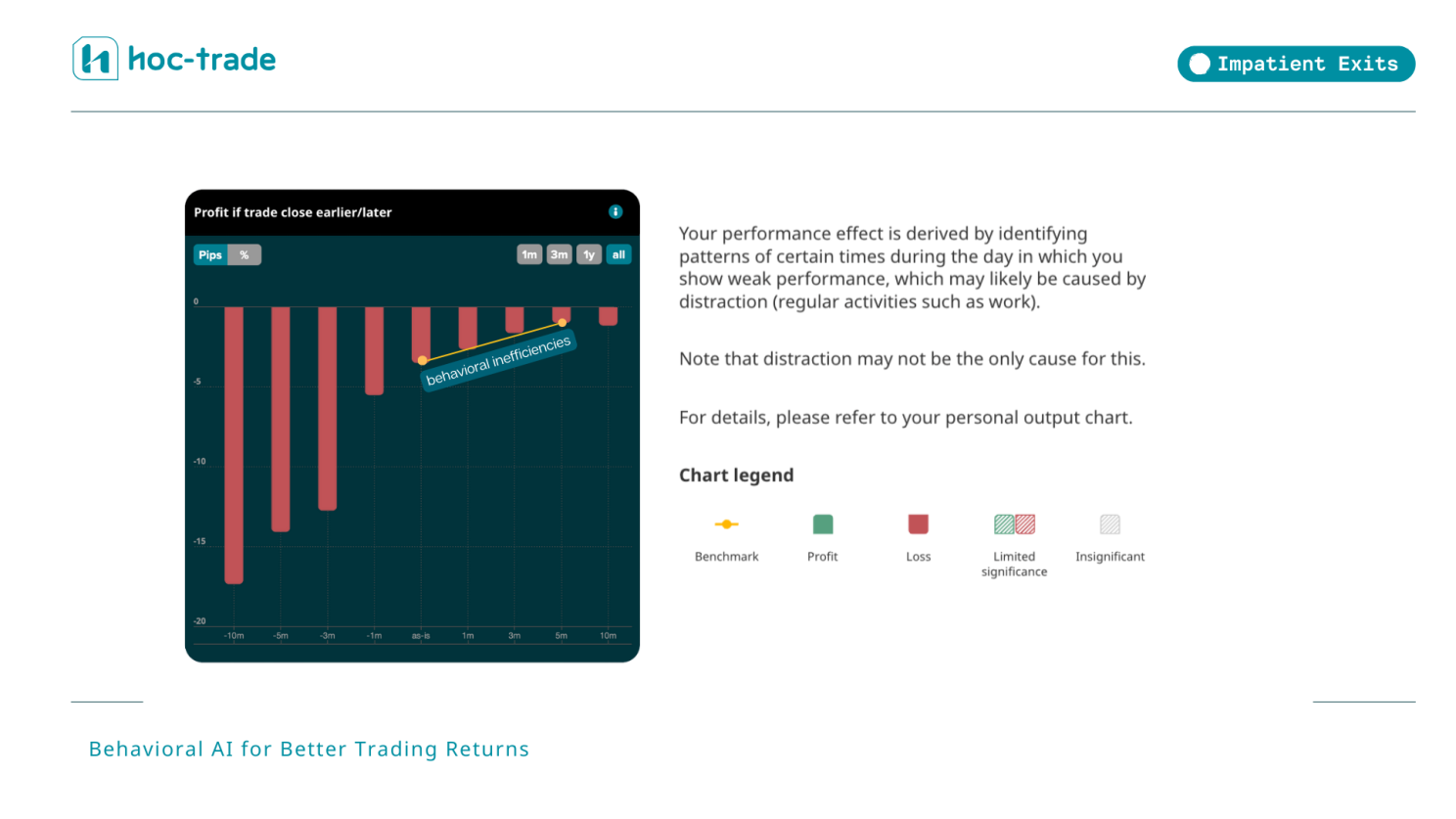
This is where behavioral analytics becomes essential. Modern tools can move beyond surface-level performance metrics to examine the actual mechanics of individual trades. TradeMedic's detection process works by running simulated delayed exits. For each closed trade, the system recreates what would have happened if the trader had held the position slightly longer—hours longer, sometimes minutes.
If there's a consistent, statistically positive relationship between holding longer and better outcomes, the behavior is flagged as impatient exit. This detection doesn't rely on subjective judgment or hindsight bias. It's grounded in data analysis of the actual trade lifecycle and simulated alternative scenarios.
The result isn't just a score. It's a behavioral mirror—a concrete representation of the cost of early exits, which invites the trader to course-correct based on tangible evidence rather than intuition or shame.
How can you change this behavior?
Impatient exits don't happen because traders are reckless or undisciplined. Often they emerge from hypervigilance—an overreaction to every price tick, every moment of uncertainty. But success in trading doesn't reward constant vigilance. It rewards the ability to sit with discomfort, trust your process, and let probability play out.
The good news is that this behavior can be changed. New habits can be built. Whether it takes 21 days or longer, the process begins with understanding the behavior and honestly assessing its impact. From there, three elements become critical: behavioral awareness (knowing when the urge to exit early is building), data-backed feedback (seeing the concrete cost in your own trading), and a mindset shift (recognizing that holding on is sometimes the bravest thing you can do).
Often the edge traders are looking for isn't hiding in a new entry setup or a refined technical signal. It's already there, in the trades they're already taking. They just need to hold on to it long enough to let it work.
TradeMedic AI analyses over 60 behavioural patterns, including impatient exists, across 500,000+ trader accounts. Visit TradeMedic to see how it works and get your personal analysis.
Watch how Impatient Exists affect your trading
Frequently asked questions
What is an impatient exit?
An impatient exit occurs when a trader closes a trade before reaching their predetermined profit target, typically driven by emotion or discomfort rather than a signal from their trading plan. This behavior undermines the full profit potential of trades that remain in the trader's favor.
Why do traders close winning trades too early?
Loss aversion, regret aversion, and discomfort with market ambiguity drive early exits. Traders fear losing an unrealized profit or watching a winner turn into a loss, so they exit prematurely to resolve the emotional tension. This is a psychological pattern, not a technical mistake.
How do impatient exits damage trading performance?
When exits are consistently trimmed but losses are taken in full, the reward-to-risk ratio collapses. A trader may win 65% of trades but see minimal account growth. The strategy's edge exists, but behavior prevents it from fully expressing itself in net returns.
How can traders recognize this pattern?
TradeMedic AI detects impatient exits by simulating what would have happened if you hadn't closed manually, then measuring the difference across your trade history.. If holding longer consistently produced better results, the pattern is flagged. This data-driven approach removes subjective judgment and shows the concrete cost of early exits.
Can traders change this behavior?
Yes. Changing impatient exit behavior requires behavioral awareness, data-backed evidence of its impact, and a mindset shift that recognizes patience as a strength. Building new habits takes time, but the process begins with understanding the pattern and its cost.