Category:
 Author:
 Date:Jun 12, 2026
Why Cutting Profits Early Is Costing Your Trading Strategy
Picture this: you close a trade in profit, relieved to bank the gain. A few hours later you check the chart and the position kept running, well past where you exited. That feeling is familiar to most active traders, and it's not just bad luck. Exiting winning trades too early is one of the most reliably documented patterns in trader behaviour, and it's one that compounds quietly over hundreds of trades before most people notice it in their numbers.
What does cutting profits early actually cost?
The direct cost is obvious in hindsight: you secured a portion of a trade's potential, not the full return. If your take profit was set at 15% but you exited at 5%, you left 10% on the table. Do that across dozens of trades a month and the gap between actual performance and potential performance becomes a meaningful number.
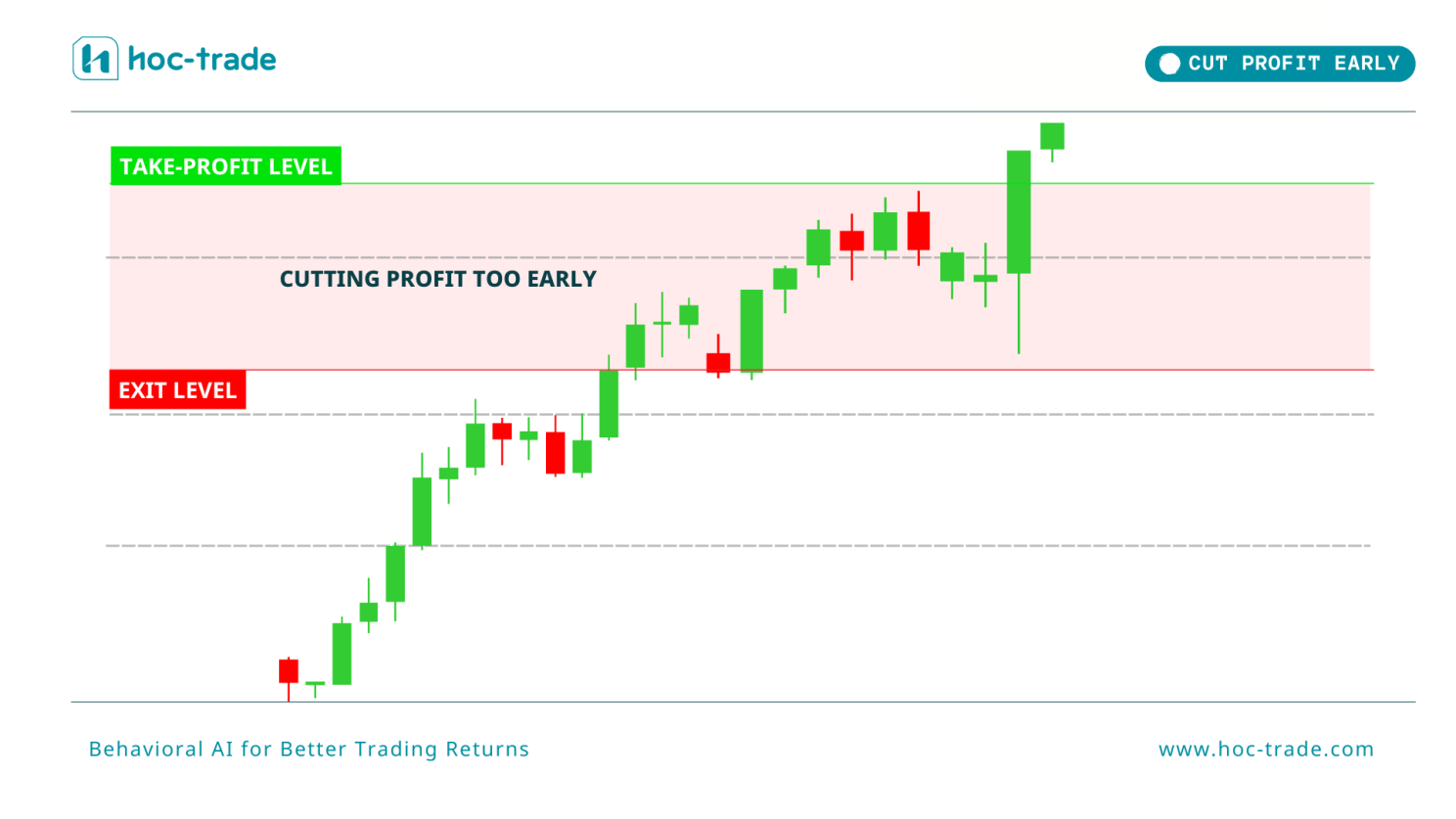
The less obvious cost is what it does to your reward-to-risk ratio. A sound trading strategy depends on that ratio staying favourable over time, either through a strong win rate or through wins that are meaningfully larger than losses. When you consistently clip your winning trades short while still absorbing the full weight of your losing trades, you compress the reward side of the equation without touching the risk side. A few large losses can wipe out the cumulative gains from many smaller wins, and the math stops working in your favour.
Why do traders close winning trades too soon?
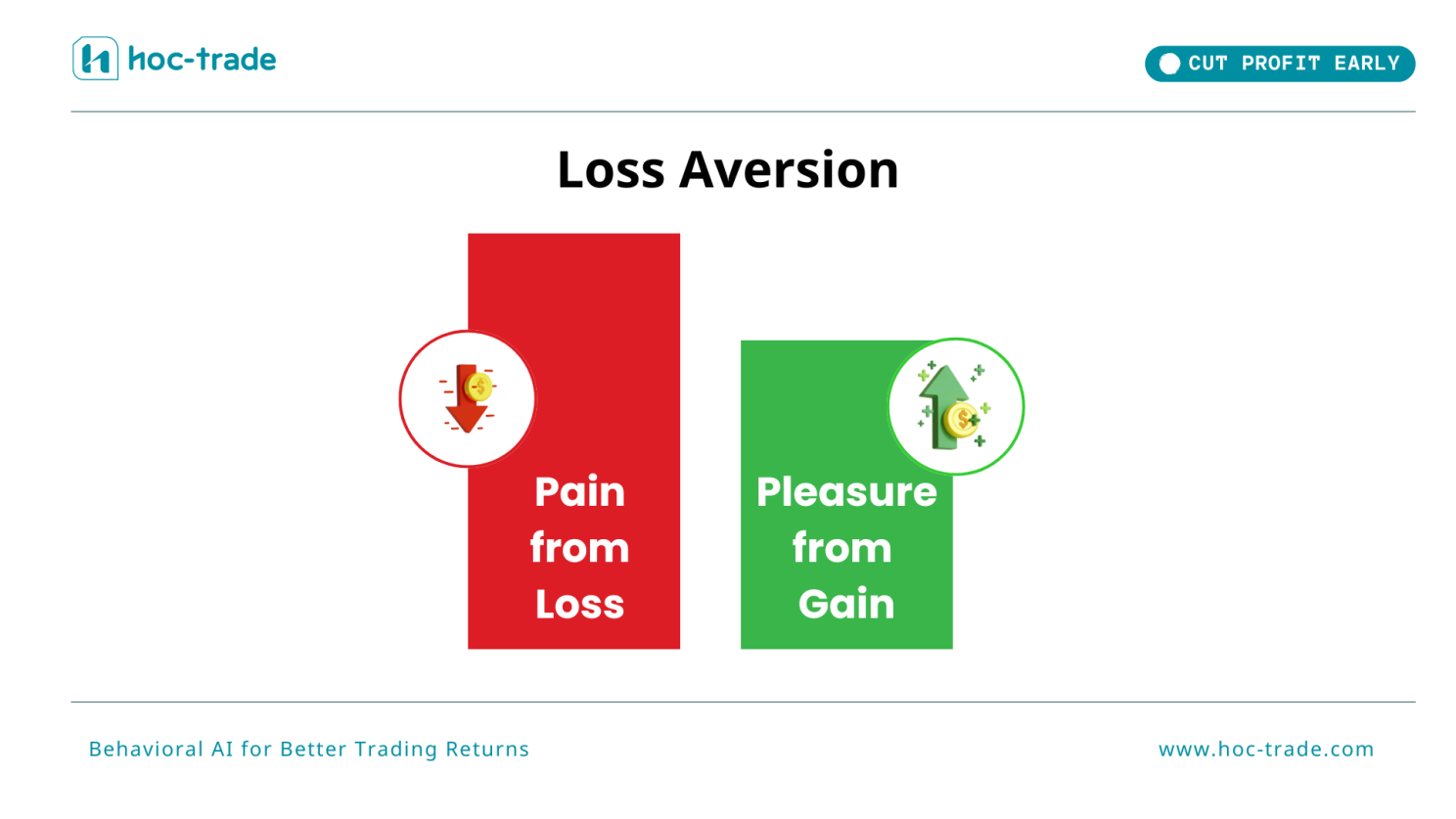
The short answer is loss aversion. It's a well-established principle in behavioural finance, central to Prospect Theory, which was developed by Nobel Prize winners Daniel Kahneman and Amos Tversky. Their research found that people feel the pain of a loss roughly 2.5 to 3 times more acutely than the pleasure from an equivalent gain.
In a trading context, this shows up as a specific anxiety: the unrealised profit sitting in an open trade feels fragile. The possibility that it turns into a loss registers more strongly than the possibility that the trade continues to run. So traders exit, even when the original logic for staying in the trade hasn't changed.
The cruel irony is that this behaviour tends to combine with the opposite pattern on the loss side. Traders who cut profits quickly often let losing trades run, hoping for a reversal. Wins get cut small; losses get cut large. That's a structural problem, not a bad-luck problem. It shows up in the data.
How does TradeMedic detect this pattern in trading data?
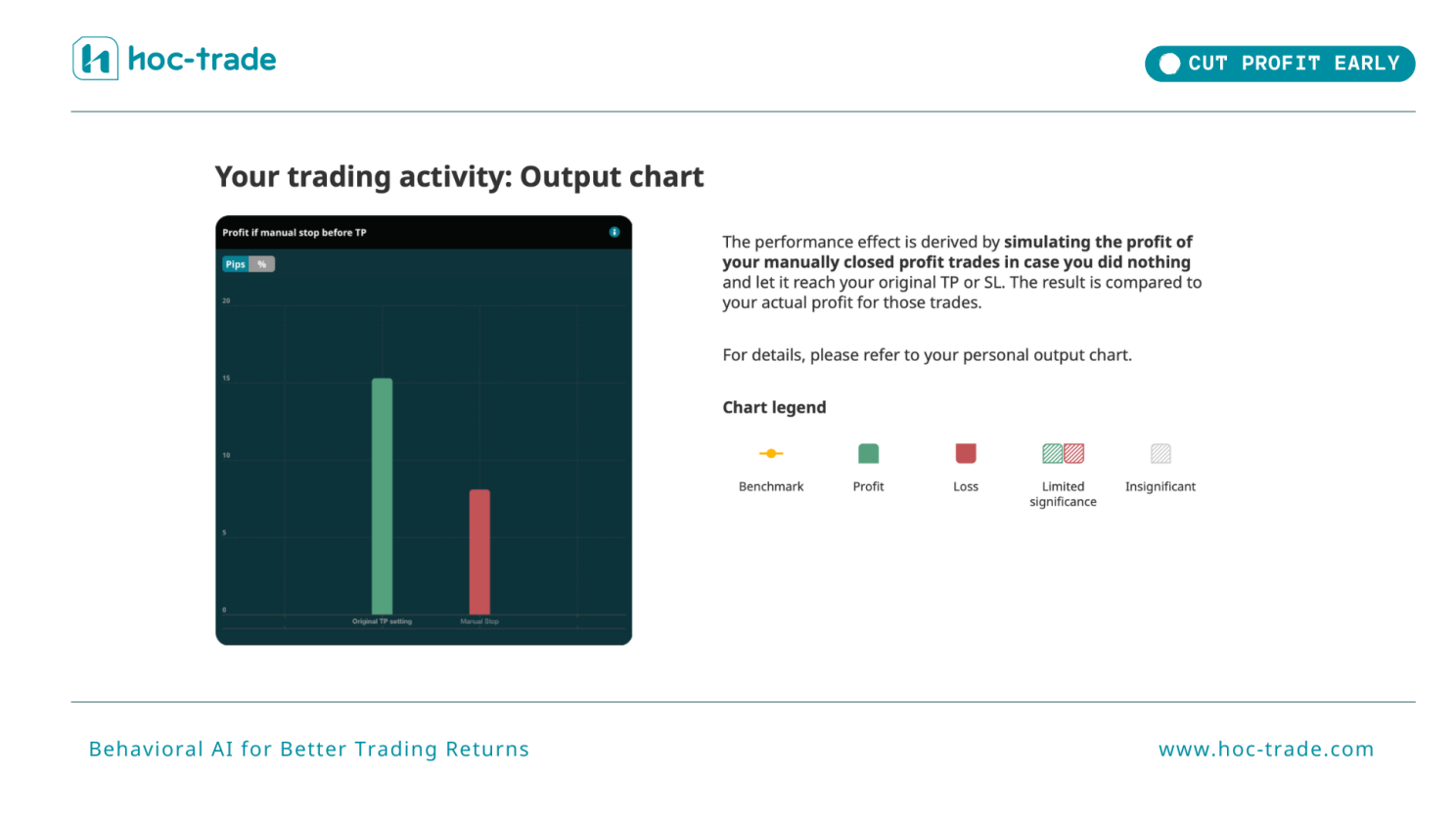
TradeMedic's algorithms are built specifically to surface patterns like this one. For any trade that was manually closed while in profit, the system simulates how that trade would have performed if it had remained open, projecting forward to either the original take profit or stop loss level.
If the simulated outcome would have been better than the actual outcome, the trade is classified as an instance of cutting profits early. The aggregate effect of those trades is surfaced in the TradeMedic report as an improvement potential: a concrete number showing what the pattern is costing, in real performance terms.
This matters because patterns like this are almost impossible to self-diagnose from memory. Traders tend to remember the times the early exit saved them from a reversal far more than the times staying in would have paid off. The data doesn't have that memory bias.
How common is cutting profits early in real trading data?
TradeMedic detects cutting profits early across a dataset of 500,000+ trader accounts, calculating each trader's personal risk profile for this behaviour. Across the dataset, it ranks among the most frequently identified improvement opportunities, appearing consistently across different trading styles, instruments, and experience levels.
A detailed statistical breakdown is being prepared as part of TradeMedic's pattern analysis series.
How can traders stop exiting winning positions too early?
The first step is simply recognising that the urge to exit is a bias response, not a rational one. Loss aversion is a feature of human psychology, not a character flaw, but it operates below conscious reasoning. Naming it in the moment gives you a fraction of distance from the impulse.
Beyond awareness, there are practical approaches worth building into your process. Setting explicit take profit and stop loss levels before a trade opens, and committing to them, removes the decision from the moment of peak emotional exposure. If your trade setup has a defined target, the question of when to exit has already been answered.
Tracking your reward-to-risk ratios consistently across your trades is another lever. When you can see the ratio degrading over time because wins are being cut smaller than losses, the data makes the pattern harder to ignore or rationalise away.
If the anxiety of holding an open winning trade feels too uncomfortable, there are ways to reduce exposure without closing the position entirely. Moving your stop loss to break-even locks in a floor while keeping the upside open. Partially closing the position reduces size and psychological pressure without sacrificing the full opportunity. Traders who struggle with loss aversion often find these approaches easier to sustain than trying to simply override the feeling through willpower. You can read more about managing trade risk and emotional exposure in our article on initial trade setup behaviour.
What does disciplined trade management actually look like?
Discipline in trading is often framed as willpower: holding firm when your instincts say exit. And discipline is part of it. But there's more going on. Most of the traders who consistently hit their take profit targets aren't suppressing a strong emotional pull in the moment. They've reduced the number of real-time decisions they need to make by front-loading the work into their pre-trade process.
Clear entry and exit rules, defined before the trade opens, mean the emotional load during the trade is lower. When the setup says stay in, you stay in, not because you're ignoring your instincts, but because the decision was already made from a clearer mental state.
TradeMedic's analysis helps identify where the gap between planned and actual trade management is largest, giving traders a precise starting point for improvement rather than a general sense that something isn't working. If cutting profits early is showing up in your data as an improvement potential, that's not a verdict on your trading. It's a specific, fixable pattern, and the data shows you exactly where it's happening.
TradeMedic AI analyses over 60 behavioural patterns, including Cutting Profit Early, across 500,000+ trader accounts. Visit TradeMedic to see how it works and get your own personal analysis.
Watch How Cutting Profits Early is Costing Your Trading Performance
Frequently asked questions
What does cutting profits early mean in trading?
Cutting profits early refers to closing a winning trade before it reaches its predefined take profit level. Traders do this to lock in a smaller, certain gain rather than risk a reversal. Over time, this habit compresses the reward side of a trading strategy's reward-to-risk ratio and can significantly reduce overall profitability.
Why do traders cut their profits short?
The primary driver is loss aversion, a psychological bias described in Prospect Theory by Daniel Kahneman and Amos Tversky. People feel the pain of losing unrealised gains more strongly than the pleasure of additional gains, so they exit early to protect what they have. This instinct is natural, but it consistently works against long-term trading performance.
How does loss aversion affect trading performance?
Loss aversion causes traders to exit winning positions too soon while often holding losing positions for too long. This creates an asymmetry where wins are small and losses are large, which undermines even a high win rate. Over hundreds of trades, this pattern erodes the edge that a trading strategy would otherwise produce.
How does TradeMedic identify cutting profits early in trading data?
TradeMedic's algorithms analyse trades that were manually closed while in profit and simulate what would have happened if those trades had remained open to their original take profit or stop loss level. If the simulated outcome outperforms the actual outcome, the trade is flagged as an instance of cutting profits early. The cumulative impact is displayed as an improvement potential in the trader's report.
What's the most effective way to stop cutting profits early?
The most effective approach is to set explicit take profit and stop loss levels before opening a trade, and to treat them as binding. This moves the exit decision out of the emotional window of an open trade. For traders who find holding a winning position too uncomfortable, moving the stop loss to break-even or partially closing the position can reduce pressure without eliminating the upside.