Category:
 Author:
 Date:Jun 18, 2026
Doubling Down Is the Most Expensive Habit in Trading. Here's the Data
A trade goes against you. Instead of closing it, you add to it. The average entry price improves, the break-even point moves closer, and a small bounce would now get you out without a loss. It feels like a smart adjustment. In most trading accounts, it is the single most expensive habit a trader can have.
Across more than 500,000 trading accounts analysed by TradeMedic AI, doubling down shows up in almost half of all traders (46.5%). Among the traders who show it, doubling down causes 32.5% of their losses, an average of $9,988 per trader. That is the largest share of any of the 23 problem patterns TradeMedic AI detects. And only 7.2% of the traders who double down are profitable.
This article covers what doubling down means in trading, how it relates to the martingale strategy, what the data shows about its cost and who is most affected, the psychology that makes it so hard to resist, and how to stop.
Let's start with what doubling down means in trading.
What does doubling down mean in trading?
Doubling down means adding to a position that is already losing money. A trader buys, the price falls, and instead of closing the trade or waiting, the trader buys more at the lower price. The same applies in reverse to short positions. The term comes from the idea of doubling the position, but in practice any addition to a losing trade counts, whether it doubles the size or adds a fraction of it.
In trading, doubling down is also called averaging down. The name describes what it does to the numbers: the average entry price of the whole position moves closer to the current price, so a smaller move back is needed to break even. That is the appeal. The catch is that the position is now larger, and if the price keeps moving against it, the loss grows faster than before.
A simple example shows the trade-off. A trader buys one standard lot of EURUSD at 1.1000, where each pip is worth about $10. The price drops to 1.0950, an open loss of $500. The trader buys a second lot. The average entry is now 1.0975, so a recovery of 25 pips instead of 50 would get them out without a loss. But if the price falls another 50 pips to 1.0900 instead, the loss is $1,500: $1,000 on the first lot and $500 on the second. With one lot, it would have been $1,000. From the moment the second lot is added, every further pip against the position costs $20 instead of $10. Doubling down halves the distance to break even, and doubles the cost of every pip if the trade keeps going wrong.
A related idea comes up often in forex, especially in automated trading, and it has a name of its own.
Is doubling down the same as the martingale strategy?
They are closely related, but not the same. The martingale strategy originally comes from betting: after every loss, the stake is doubled, so that a single win recovers all previous losses plus the original stake. In trading, martingale usually means doubling the position size after each losing trade, or at each new level against an open position. Many grid and recovery robots in forex work this way.
Doubling down is the broader behaviour. Any addition to a losing position counts, whether or not the size doubles and whether or not it follows a fixed system. A martingale is a strict, mechanical version of doubling down.
Both share the same weakness, and the maths makes it clear. If each addition doubles the size, the position after six losses in a row is 64 times the original. After ten, it is 1,024 times. Both approaches depend on the market turning before the account, or the margin, runs out. Often the market does turn, which is why these approaches can look reliable for months. When it does not, a single run of losses can take the account with it.
So how often does this happen in real trading accounts, and what does it cost? The data gives a clear answer.
How common is doubling down, and what does it cost?
Doubling down is detected in 46.5% of the traders in our dataset. For 20.5% it is one of their five biggest improvement areas, and for 1.6% it is the single biggest issue. That makes it common, but not the pattern that most often tops a trader's list.
What sets it apart is the cost. Among traders who show doubling down, it causes 32.5% of their losses, an average of $9,988 per trader. No other pattern takes a larger share. For comparison, inefficient hedging takes 29.0%, anxious trade entries 27.0% and overtrading 25.5% of the losses of the traders who show them. Revenge trading, the pattern traders are warned about most, takes 10.0%. For the traders affected, doubling down takes a share more than three times as large. Measured across all traders in the dataset, it accounts for 23.2% of all trading losses, also the largest share of any pattern.
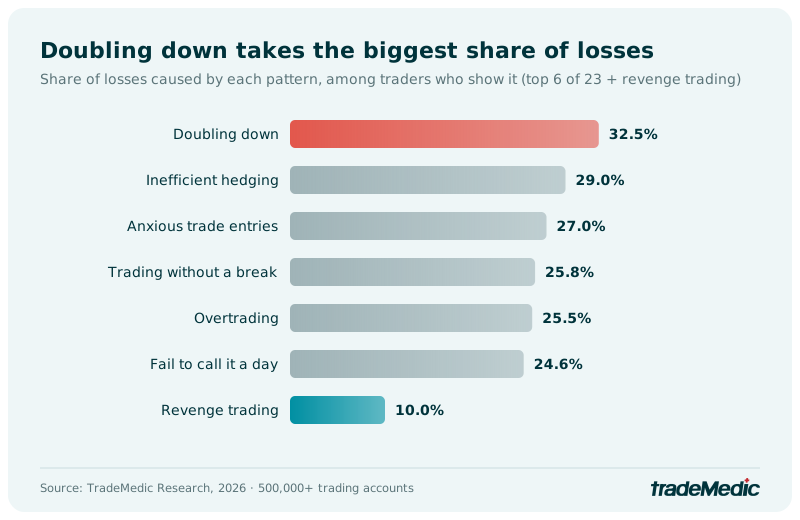
Most traders show several of these patterns at once, and each one takes its own share. If you want to see which of them show up in your own trading, and what each one is costing you, connect your trading account to TradeMedic AI. It checks your full trade history for doubling down and 60+ other behavioural patterns, and shows you the result in dollars. Connect your account free.
The link to profitability is even starker. Only 7.2% of traders who double down are profitable, compared with 27.7% of traders where it is not detected, almost four times the rate. When doubling down is among a trader's five biggest issues, 5.7% are profitable, and when it is the single biggest issue, 5.3%. Across all traders, the rate is 18.2%.
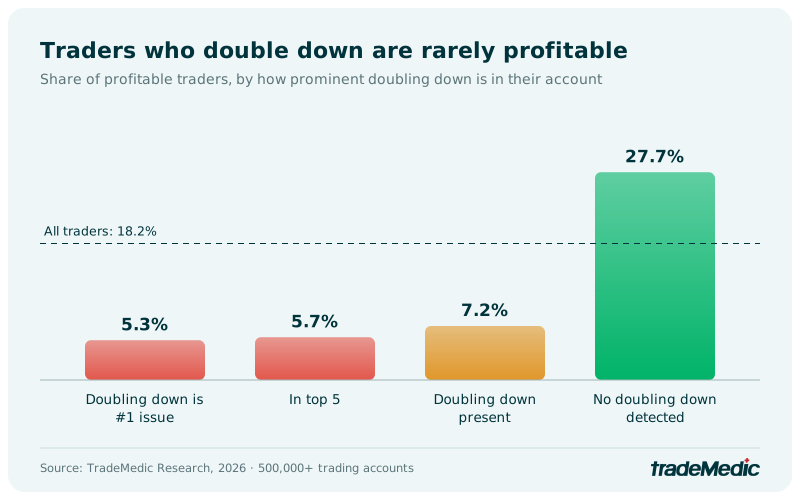
23.6% of loss-making traders have doubling down in their top five, compared with 6.4% of profitable traders. That is a ratio of almost four to one.
Knowing that doubling down is the most expensive pattern in the dataset, the next question is who is most likely to show it.
Who doubles down the most?
Account size tells an unusual story. Among traders who double down, the share of losses it causes is highest at both ends of the scale. For accounts under $250, doubling down causes 33.1% of affected traders' losses. For accounts over $10,000, it causes 34.7%, with an average cost of $48,703 per affected trader. In between, from $250 to $10,000, the share sits between 17.3% and 18.6%.
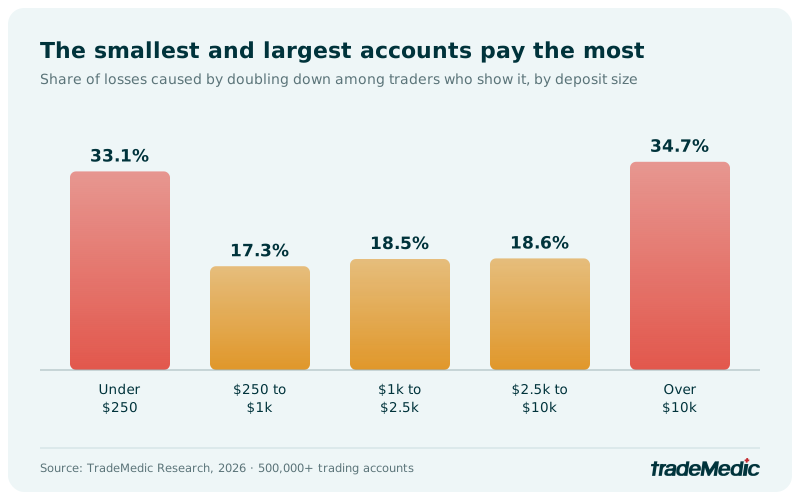
The data cannot say why both ends are hit hardest, but the pattern fits two different situations. Very small accounts have little room for losing trades, so adding to one quickly becomes a large part of the balance. Large accounts can afford to keep adding for much longer before margin runs out, which lets a losing position grow far beyond what a smaller account would allow.
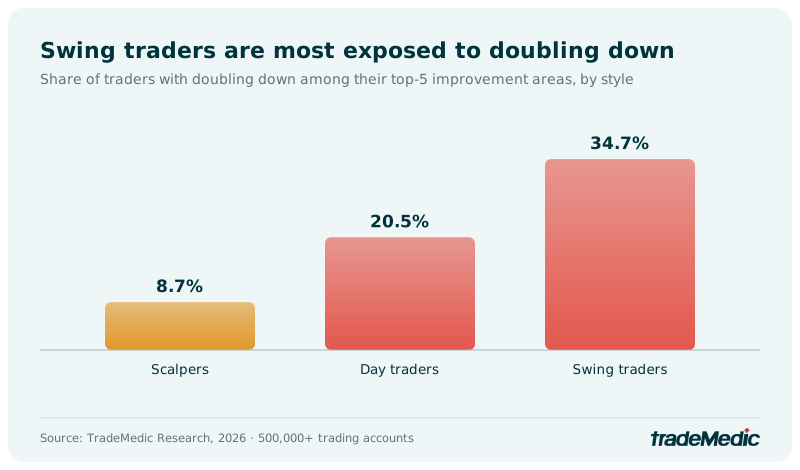
Trading style matters too. Doubling down is among the top five improvement areas for 34.7% of swing traders, compared with 20.5% of day traders and 8.7% of scalpers. Longer holding periods leave more time for a position to move against the trader, and more opportunities to add to it. Our comparison of day trading and swing trading covers how the two styles differ more broadly.
Experience does not protect against it either. Doubling down is detected in 36.6% of accounts under 10 days old, rising to 54.8% at 50 to 199 days and 59.9% of accounts trading for 200 days or more. Part of this is mechanical, since a longer history gives the analysis more trades to work with. But it is clear that doubling down does not fade the longer traders stay in the market.
If experience does not cure it, the reasons must run deeper than a lack of knowledge. That is where the psychology comes in.
Why do traders double down? The psychology of doubling down
Almost every trader knows that adding to a losing position is risky. Many do it anyway. Decades of research on how people handle losses explain why, and five mechanisms stand out.
Losses make people take more risk. In their work on prospect theory, Daniel Kahneman and Amos Tversky showed that people behave very differently with gains and losses. Faced with a sure gain, most people avoid risk. Faced with a sure loss, most people become risk seeking: they prefer a gamble that might avoid the loss, even at the risk of losing more. A losing trade puts a trader in exactly that position. Closing it turns the loss into a certainty. Adding to it keeps alive the chance of getting out without one. Our article on loss aversion covers this bias in more depth.
Breaking even becomes the goal. In real-money experiments, Richard Thaler and Eric Johnson found what they called the break-even effect: after a loss, options that offer a chance to get back to zero become especially attractive. Averaging down is built for exactly that. It moves the break-even price closer, so the goal quietly shifts from making a good trade to getting back to where you started.
Losers are held, winners are sold. Hersh Shefrin and Meir Statman named this the disposition effect: the tendency to sell winners too early and ride losers too long. When Terrance Odean analysed the trading records of 10,000 brokerage accounts, he found a strong preference for selling winners rather than losers, one that could not be explained by rebalancing or trading costs, and was not justified by how the investments performed afterwards. Doubling down is the active version of this tendency: instead of simply holding the loser, the trader adds to it.
The more you are responsible, the more you commit. In a classic 1976 study, Barry Staw asked 240 business students to make investment decisions in a simulated company. Those who were personally responsible for an earlier decision that had gone badly committed the most money to it afterwards. Psychologists call this escalation of commitment. In trading, the trader chose the entry, and the trade going wrong is felt as a verdict on that choice. Adding to it is a way of standing by the decision.
Sometimes it works, and that is the problem. Many losing positions recover at least part of the way, so doubling down often ends well. Each time it does, the habit is reinforced, even though the decision was risky. This is outcome bias, judging a decision by its result rather than its quality, and it is covered in detail in our article on outcome bias in trading. The trades that do not recover are rare, but they are the ones that cause the losses in the data above.
The most famous example of these mechanisms working together is Nick Leeson at Barings Bank. Leeson hid growing losses in a secret account numbered 88888. When the Kobe earthquake sent the Nikkei falling in January 1995, he doubled his bets on a recovery rather than closing his positions. The losses reached roughly £830 million, more than the bank could absorb. Barings, founded in 1762, collapsed and was sold for £1. Few traders operate at that scale, but the logic is the same one that plays out in individual accounts every day.
None of this makes doubling down a character flaw. These are ordinary features of how people handle losses. The practical consequence is that relying on judgement in the moment rarely works, because the pull to add is strongest exactly when the position is losing most.
The same psychology also shows up in the other patterns that tend to appear alongside doubling down.
Which patterns appear alongside doubling down?
When doubling down is detected in an account, three other patterns become much more likely to be present, and they all point in the same direction: trading against the market. Fighting the trend appears in 50.2% of traders who double down, compared with 35.8% across all traders, a 40% increase. Emotional trading is 38% more likely, and catching a falling knife 37% more likely.
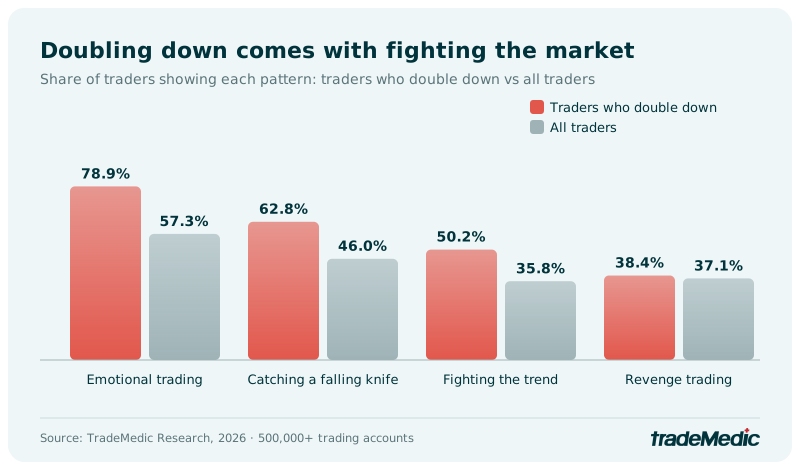
Together they describe a clear profile: a trader who takes a position, refuses to accept that the market has turned, and adds to it on the way down. Fighting the trend is the belief, catching a falling knife is the entry, and doubling down is what happens when both go wrong.
One pattern is almost missing from the list. Revenge trading is only 3.5% more likely among traders who double down, barely more than chance. The two are often confused, but they are different behaviours. Revenge trading is about re-entering quickly after a trade has been closed at a loss. Doubling down is about refusing to close it in the first place.
That raises a fair question: if adding to a position is so costly, is it ever the right thing to do?
Is averaging down ever a good strategy?
Sometimes, but only when it is not really doubling down at all. There is an important difference between planned scaling and adding to a loser.
A planned scale-in is decided before the first trade. The trader defines the total position size, the levels at which to add, and a single stop loss for the whole position, so the maximum loss is known in advance and does not grow when the trade goes wrong. Some long-term investors and some systematic strategies work this way.
Doubling down, as it shows up in most accounts, is different. The addition is decided after the trade has moved against the trader, the total risk grows with every addition, and the stop loss, if there is one, is often moved or removed to make room. That is when averaging down becomes a problem.
The data reflects this distinction. TradeMedic AI only flags doubling down when the trades added to losing positions perform worse than the trader's other trades. Traders whose additions work as planned are not flagged. The 46.5% who are flagged are traders for whom adding to losers is measurably costing money.
For most traders, the practical answer to whether averaging down is a good strategy is simple: if you did not plan it before you entered, it is not a strategy.
The way TradeMedic AI measures this is worth looking at more closely.
How TradeMedic AI detects doubling down
TradeMedic AI looks at every trade that was opened while the trader already held a losing position in the same instrument. Those trades are grouped by how many losing positions were already open at the time: one, two, three or more. The analysis then compares how those additions performed against the rest of the trader's trades.
If the added trades perform worse, and the effect becomes consistently negative from a certain number of additions onward, doubling down is flagged. The report shows how many additions it takes before the trader's results turn negative, and the dollar impact of the trades added beyond that point. Because the analysis is based on each trader's own history, it separates traders whose scaling works from traders whose additions are costing them money. More on the methodology is on our research page.
Knowing where the problem starts in your own trading makes the fixes much more concrete.
How to stop doubling down
1. Decide your maximum position before you enter. Define the total size you are willing to hold in a trade, including any additions, before the first order. If a trade is at its maximum size, there is nothing left to add, however tempting the price.
2. Set one stop loss for the whole position, and do not move it. A stop loss that moves every time you add is not a stop loss. Our articles on trading without a stop loss and on failing to cut losses cover why this single rule matters so much.
3. Ask whether you would open this trade fresh. Before adding, ask: if I had no position, would I open a new trade here, at this size? If the answer is no, the addition is about the old trade, not a new opportunity.
4. Only add to positions that are working. If you scale into trades at all, add to winners as planned, not to losers as they fall. That way, your largest positions are the ones the market is confirming, not the ones it is rejecting.
5. Keep risk per trade small. The smaller each trade, the less pressure there is to rescue it. Across all traders in the dataset, traders whose losing trades cost them less than 0.5% of their balance on average are profitable 24.5% of the time, compared with 15.0% for traders averaging more than 2%. Our guide on how much to risk per trade covers the full analysis.
6. Review your additions separately. Look at every trade you opened while already holding a loser in the same instrument, and compare its results with the rest of your trading. That single review shows whether doubling down is helping or hurting you.
The sixth step is the one TradeMedic AI does automatically, across your full trade history.
The bottom line on doubling down
Doubling down is the most expensive habit in trading. It shows up in almost half of all traders, it causes 32.5% of the losses of the traders who show it, and only 7.2% of them are profitable. It is driven by some of the most robust findings in behavioural research: people take more risk to avoid a certain loss, chase the chance to break even, and commit more to decisions they feel responsible for. The fix is not more willpower in the moment. It is deciding your maximum size and your stop before you enter, and treating a losing trade as information rather than something to rescue.
→ Learn more about TradeMedic AI
→ See if doubling down is costing you: connect your trading account to TradeMedic AI free
Watch How Doubling Down is A Dangerous Trap
Research behind this article
Kahneman, D., and Tversky, A. (1979). Prospect Theory: An Analysis of Decision under Risk. Econometrica, 47(2), 263 to 291.
Thaler, R. H., and Johnson, E. J. (1990). Gambling with the House Money and Trying to Break Even: The Effects of Prior Outcomes on Risky Choice. Management Science, 36(6), 643 to 660.
Shefrin, H., and Statman, M. (1985). The Disposition to Sell Winners Too Early and Ride Losers Too Long: Theory and Evidence. The Journal of Finance, 40(3), 777 to 790.
Odean, T. (1998). Are Investors Reluctant to Realize Their Losses? The Journal of Finance, 53(5), 1775 to 1798.
Staw, B. M. (1976). Knee-Deep in the Big Muddy: A Study of Escalating Commitment to a Chosen Course of Action. Organizational Behavior and Human Performance, 16, 27 to 44.
Encyclopaedia Britannica. Bankruptcy of Barings Bank (1995).
TradeMedic Research (2026). Behavioural pattern analysis of 500,000+ retail trading accounts. Source: TradeMedic Research, 2026.
Frequently asked questions
What does doubling down mean in trading?
Doubling down means adding to a position that is already losing money, usually to improve the average entry price and bring the break-even point closer. Any addition to a losing trade counts, whether or not it doubles the position size. According to TradeMedic AI data from 500,000+ trading accounts, 46.5% of traders do it.
What is averaging down?
Averaging down is another name for doubling down. Buying more of a losing position lowers the average entry price, so a smaller recovery is needed to break even, but the larger position also loses faster if the price keeps moving against it.
Is doubling down the same as the martingale strategy?
They are related but not the same. The martingale strategy doubles the position size after every loss, following a fixed system. Doubling down is the broader behaviour of adding to any losing position. Both depend on the market turning before the account or margin runs out.
How common is doubling down?
Across 500,000+ trading accounts analysed by TradeMedic AI, doubling down is detected in 46.5% of traders, and 20.5% have it among their five biggest improvement areas.
How much does doubling down cost traders?
Among traders who show it, doubling down causes 32.5% of their losses, an average of $9,988 per trader. That is the largest share of any of the 23 problem patterns TradeMedic AI detects, and more than three times the share caused by revenge trading.
Are traders who double down profitable?
Rarely. According to TradeMedic AI data from 500,000+ trading accounts, only 7.2% of traders who double down are profitable, compared with 27.7% of traders where it is not detected. When doubling down is a trader's single biggest issue, only 5.3% are profitable.
Why do traders double down?
Research points to several mechanisms: people become risk seeking when facing a certain loss, a chance to break even becomes especially attractive after a loss, investors tend to hold losers and sell winners, and people commit more to decisions they feel responsible for. When doubling down works out, outcome bias reinforces the habit.
Is averaging down a good strategy?
Only when it is planned before the first trade, with a defined total position size and a single stop loss for the whole position. Adding to a losing trade after it has moved against you, with growing total risk, is doubling down, and it is the most costly pattern in the TradeMedic dataset.
Why is averaging down bad?
Averaging down increases the position size exactly when the market is proving the original trade wrong. Often the price recovers enough to get out, which makes the habit feel safe, but the times it does not recover can cause losses far larger than the original trade.
Does doubling down work in forex?
It can appear to work for long periods, because many currency pairs recover part of their moves. But the risk grows with every addition, and a sustained move against the position can wipe out many small wins at once. Most accounts in the TradeMedic dataset trade forex, gold and indices, and doubling down is the most costly pattern among them.
Is doubling down the same as revenge trading?
No. Revenge trading means re-entering quickly after closing a losing trade. Doubling down means adding to a losing trade instead of closing it. In the TradeMedic data, revenge trading is barely more common among traders who double down than among all traders.
How can I stop doubling down?
Decide your maximum position size and a single stop loss before you enter, and do not move the stop. Before adding, ask whether you would open the trade fresh at that price and size. Keep risk per trade small, and review the trades you added to losing positions separately. TradeMedic AI does this review automatically across your trade history.
What is the martingale strategy in trading?
The martingale strategy doubles the position size after every losing trade, so that one winning trade recovers all previous losses. The exposure grows fast: after six losses in a row, the position is 64 times its original size, and after ten, 1,024 times. It can look reliable for months, until a single run of losses is longer than the account can survive.
Does the martingale strategy work in forex?
It can appear to work in forex for long periods, because many currency pairs recover part of their moves, which is why martingale grid robots are popular. But the exposure doubles with every loss, so one sustained move against the position can wipe out months of small gains. TradeMedic Research found that doubling down, the broader form of this behaviour, causes 32.5% of the losses of the traders who show it.