Category:
 Author:
 Date:May 22, 2026
How Failed De-Risking Costs You Profits in Trading
Stop-loss management separates profitable traders from those who give back gains. Yet many traders struggle with the timing: securing positions too early leaves money on the table, while holding too long turns winning trades into losses. This tension between protecting profits and capturing upside isn't a willpower problem—it's a timing problem. The right de-risking strategy, backed by data about your own trading patterns, can transform how you manage risk and preserve capital.
Why Most Traders Get De-Risking Wrong
Traders typically fall into one of two patterns when adjusting stop-losses. The first group moves stops to breakeven far too early, locking in minimal gains but exposing themselves to frequent stop-outs on normal market pullbacks. A small 2-3% correction wipes out positions that could have doubled. The frustration compounds: you see the trade recover and climb higher—after you've been stopped out.
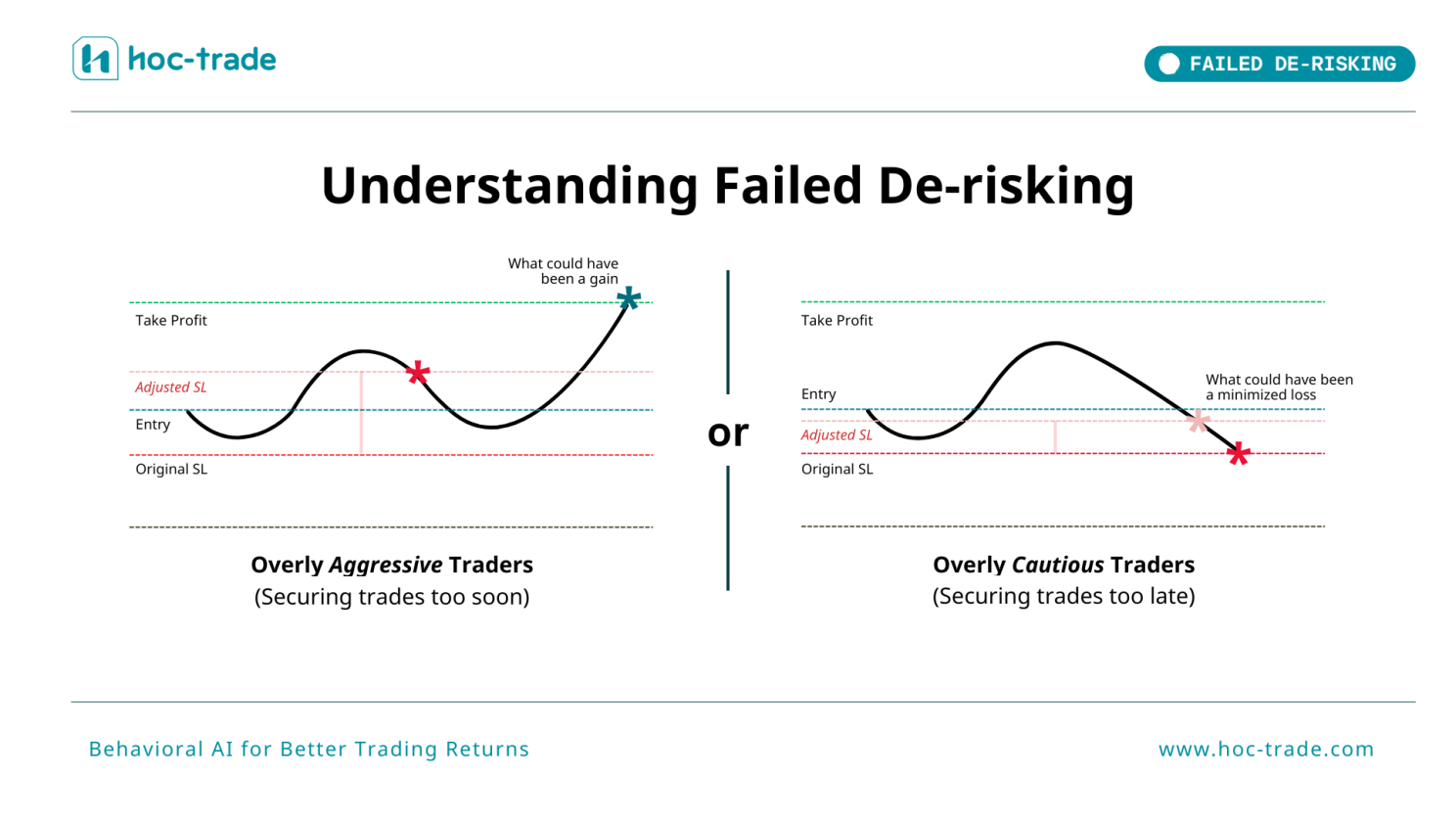
The second group waits too long or skips de-risking altogether. These traders hold positions through sharp reversals, convinced the market will turn in their favor. Sometimes it does. But when it doesn't, profitable trades become catastrophic losses. What started as a 50% gain evaporates into a -20% drawdown. Both patterns feel rational in the moment. Both cost money.
The Real Cost of Poor De-Risking on Your Trading Psychology
The damage from failed de-risking extends beyond the account balance. Traders who experience repeated stop-outs or sudden reversals often develop emotional patterns that shape all future decisions. After watching a position stopped out near its eventual highs, traders may become gun-shy, closing winners prematurely for months afterward. After losing what felt like certain profits, they may avoid de-risking altogether on the next trade—setting up an even larger loss.
This cycle erodes long-term results. Traders begin overtrading to compensate, taking excessive risk, or abandoning their risk management systems entirely. The initial de-risking mistake becomes a psychological anchor that undermines dozens of future decisions. The account suffers, but so does confidence.
Identifying De-Risking Patterns in Your Trade Data
The first step toward better de-risking is seeing your own patterns clearly. Most traders don't know whether they secure profits too early or hold too long—they only know they feel unhappy with the results. TradeMedic's analytical approach isolates exactly where de-risking goes wrong by running simulations against your trade history.
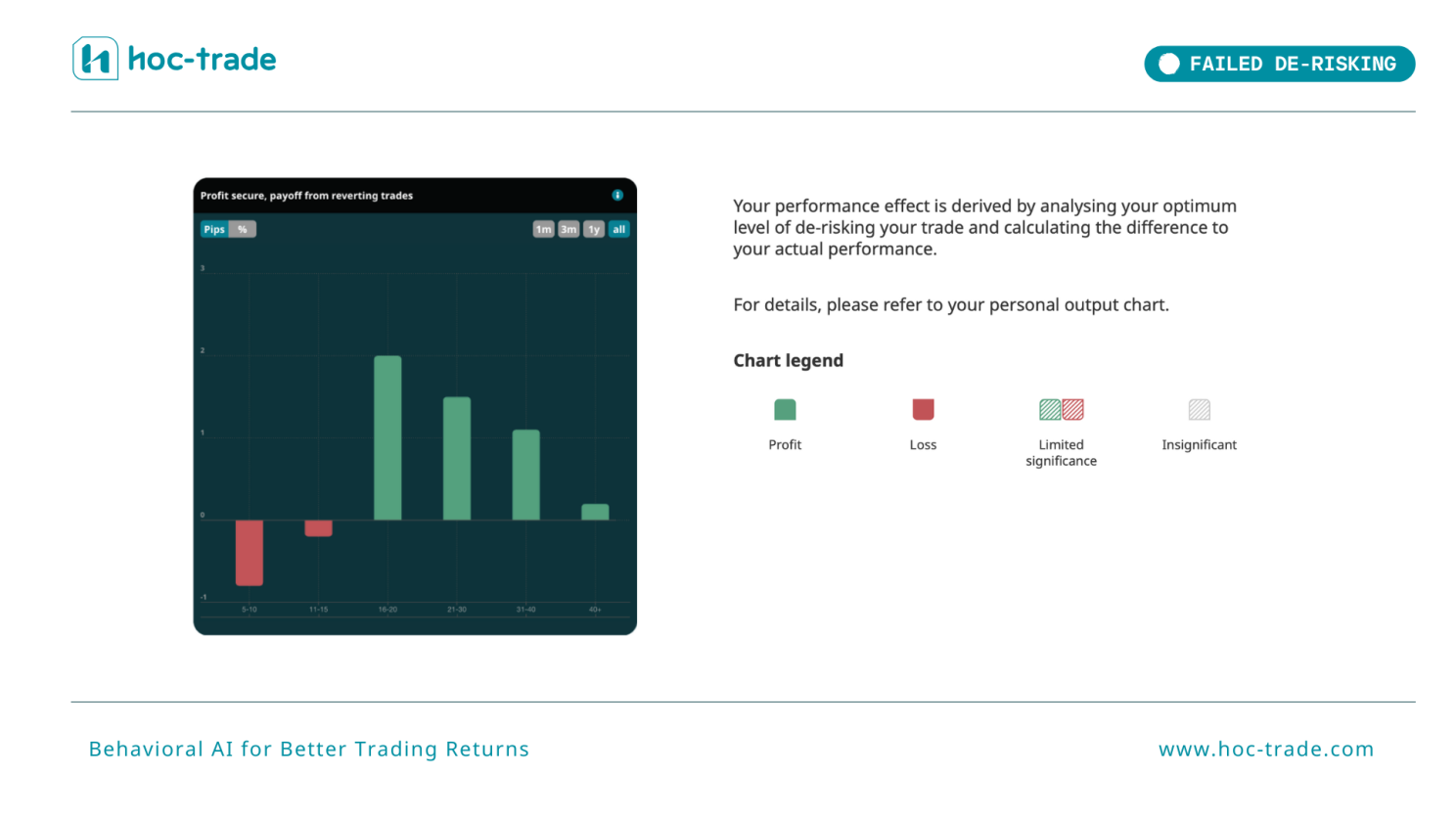
The system analyzes correlations between the timing of your stop-loss adjustments and the profits you actually captured. By simulating different de-risking points—moving stops at 10% profit, 20% profit, 30% profit, and so on—the data reveals whether you'd have improved by tightening sooner or backing off longer. If you consistently lock in at 5% profit but the trade could have safely run to 15%, the data makes that visible. If you hold past a key resistance level and give back 30%, the analysis shows you where the exit signal was clearest.
De-Risking Strategies That Actually Work
Balance is the foundation of effective de-risking. You need enough room to let profits grow, but active protection once you're ahead. Several frameworks help achieve that balance.
Trailing stop-losses work well because they adjust automatically as price moves in your favor, maintaining a fixed distance without forcing a premature decision. Instead of moving stops to breakeven at +2% and gambling on luck, a trailing stop at -5% from the most recent high gives the trade room to develop while protecting against reversals.
Identifying key resistance and support levels ahead of time provides another anchor. If a trade reaches a significant technical level—support from a prior pullback, a round number, a moving average—that's often a logical point to reassess. Prices pull back from resistance; they don't just keep climbing. Knowing where reversals historically occur in your market helps you time de-risking to market structure, not emotion.
Reviewing your past trades with structured analysis reveals personal patterns. Did you lock in winners at specific profit percentages? Do certain market conditions tend to precede your stop-outs? Your trading journal or a tool like TradeMedic's simulation function can show you exactly which de-risking rules would have improved performance without requiring you to second-guess yourself on each new trade.
Finally, establishing clear rules before you enter a position removes emotional decision-making from the execution. Decide in advance: if this trade hits +20% profit and stays above support level X, move stops to breakeven. If it breaks below Y on volume, exit. When the moment comes, you follow the plan instead of agonizing.
What Does the Data Say About De-Risking?
TradeMedic™ AI detects de-risking patterns across a dataset of 500,000+ trader accounts and analyzes how timing decisions impact profitability. De-risking exits rank among the most common opportunities for improvement, affecting not just the account balance but the psychological resilience of the trader. Detailed breakdowns of de-risking behavior, optimal timing thresholds, and trader-specific improvement opportunities are available in TradeMedic's full analysis when you upload your trading data.
Profitable trading demands discipline in three areas: position entry, risk management, and exit timing. De-risking sits at the intersection of all three. By analyzing your patterns, removing emotion from the decision, and following market structure instead of hope, you can dramatically improve how you protect gains. The cost of failed de-risking is high, but the solution is available to anyone willing to look at their data honestly.
TradeMedic AI analyses over 60 behavioural patterns, including failed de-risking, across 500,000+ trader accounts. Visit TradeMedic to see how it works and get your own personal analysis.
Watch How Failed De-Risking Costs You Profits in Trading
Frequently asked questions
What is failed de-risking?
Failed de-risking occurs when traders move stop-losses at the wrong time—either too early, locking in small gains and exposing positions to normal pullbacks, or too late, allowing winning trades to become losses. Both timing mistakes leave money on the table.
Why do traders struggle with de-risking timing?
Traders face competing impulses: protect early to avoid disappointment, or hold longer to capture bigger gains. Without a data-driven framework tied to market structure, the decision feels emotional and uncertain. Most traders don't see how their timing affects overall profitability until they analyze past trades.
How can I tell if I'm de-risking too early or too late?
Review your past trades and note the stop-loss level you chose relative to where price moved afterward. If most stops trigger on minor pullbacks before the trade recovers, you're likely moving them too soon. If you're giving back 30%+ of gains, you're waiting too long. Tools like TradeMedic's simulation function can quantify the exact pattern.
What's the best de-risking strategy?
There's no one-size-fits-all rule, but trailing stop-losses, identifying key support and resistance levels, and establishing preset rules based on your personal trading patterns tend to work better than emotional decisions in the moment. The key is having a rule and following it.
How does de-risking affect trading psychology?
Failed de-risking creates anchoring effects that damage confidence in future trades. Traders who are stopped out near highs often become overly cautious for months; those who lose profits to reversals may avoid de-risking altogether. These patterns compound, eroding long-term results beyond the initial loss.