Category:
 Author:
 Date:May 21, 2026
When to Stop Trading: Emotional Spillover Costs of Failed To Call It A Day
Every trader knows that entering and exiting at the right moments matters. But there's another skill that deserves equal attention: recognizing when to stop trading entirely. Many traders fall into a pattern where emotions from their best or worst trades of the day bleed into their next decisions. This spillover effect isn't superstition or weakness. It's a measurable shift in decision-making that often leads to measurable drops in performance.
Why Do Traders Keep Trading After Big Wins or Losses?
When a day begins with a large profit, overconfidence can take over. Position sizes grow. Risk tolerance expands. The setups that earned the initial win no longer feel quite as crucial because the early success creates a sense of invincibility.
The reverse happens after a sharp loss. The desire to recover what was lost can override rational judgment. Revenge trading emerges: trades that ignore your normal entry criteria in favor of speed and hope.
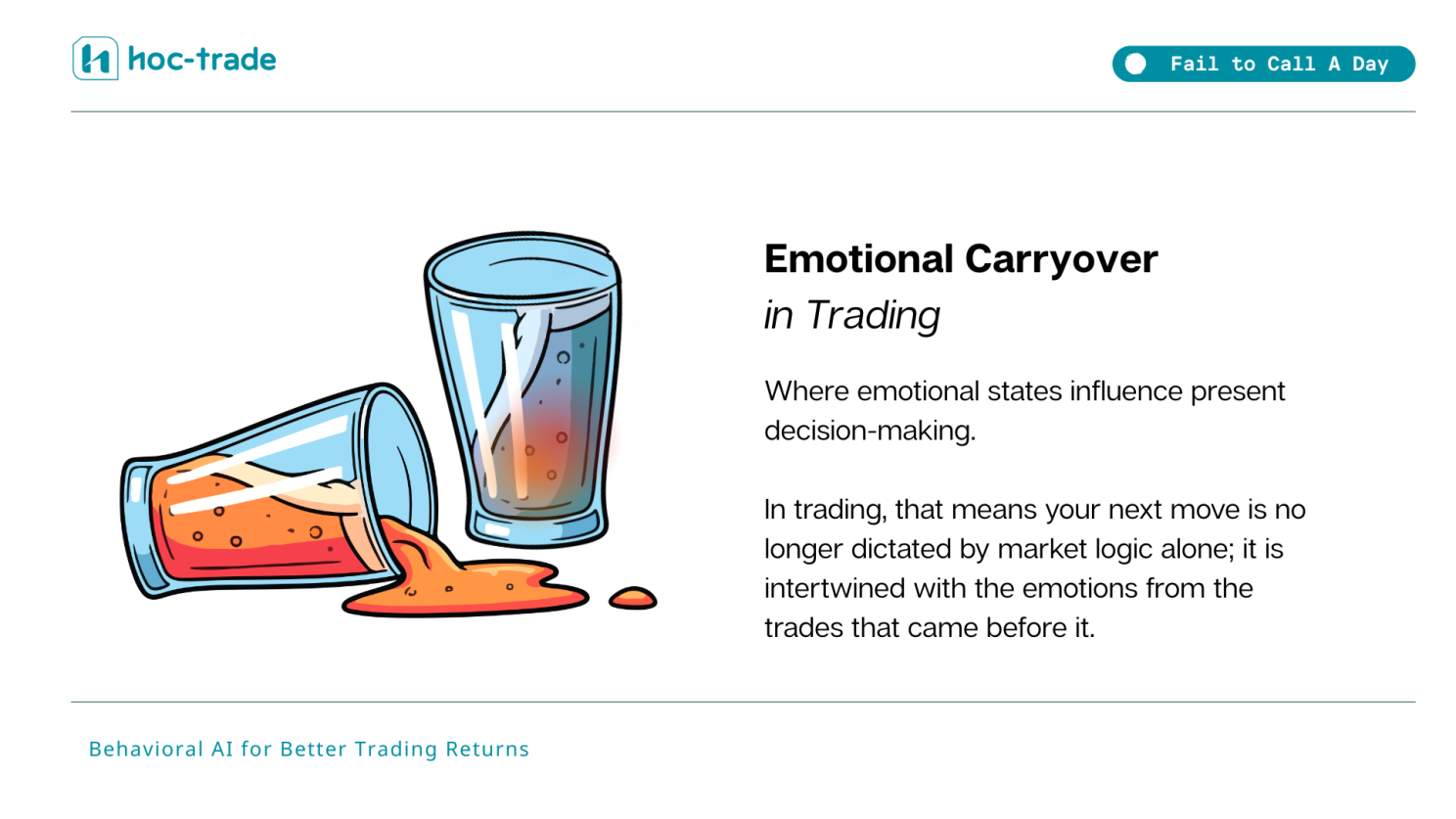
This shift is called emotional carryover. Prior emotional states influence current decision-making, so your next move is no longer guided purely by market structure or your tested edge. Instead, it's tangled with the feelings from the trades before it. For day traders and scalpers in fast-moving markets like Forex and crypto, where every tick can feel like opportunity or threat, this effect compounds quickly.
How Does Mental Accounting Affect Your Trading Risk?
Behavioral economists have identified a pattern called mental accounting, first described in detail by economist Richard Thaler. The core insight: people treat money differently depending on how they obtained it, even though every dollar has identical purchasing power.
In trading, this shows up in how traders perceive profit. A trader who begins the day flat and quickly books a 10,000 dollar gain doesn't see that profit as part of the capital base. Instead, it becomes "extra money" in the trader's mind. The psychology shifts dramatically. Position sizes creep upward. Entry criteria soften. The trader thinks, "This is profit money. I can afford to take bigger swings because I'm only risking gains, not my starting capital."
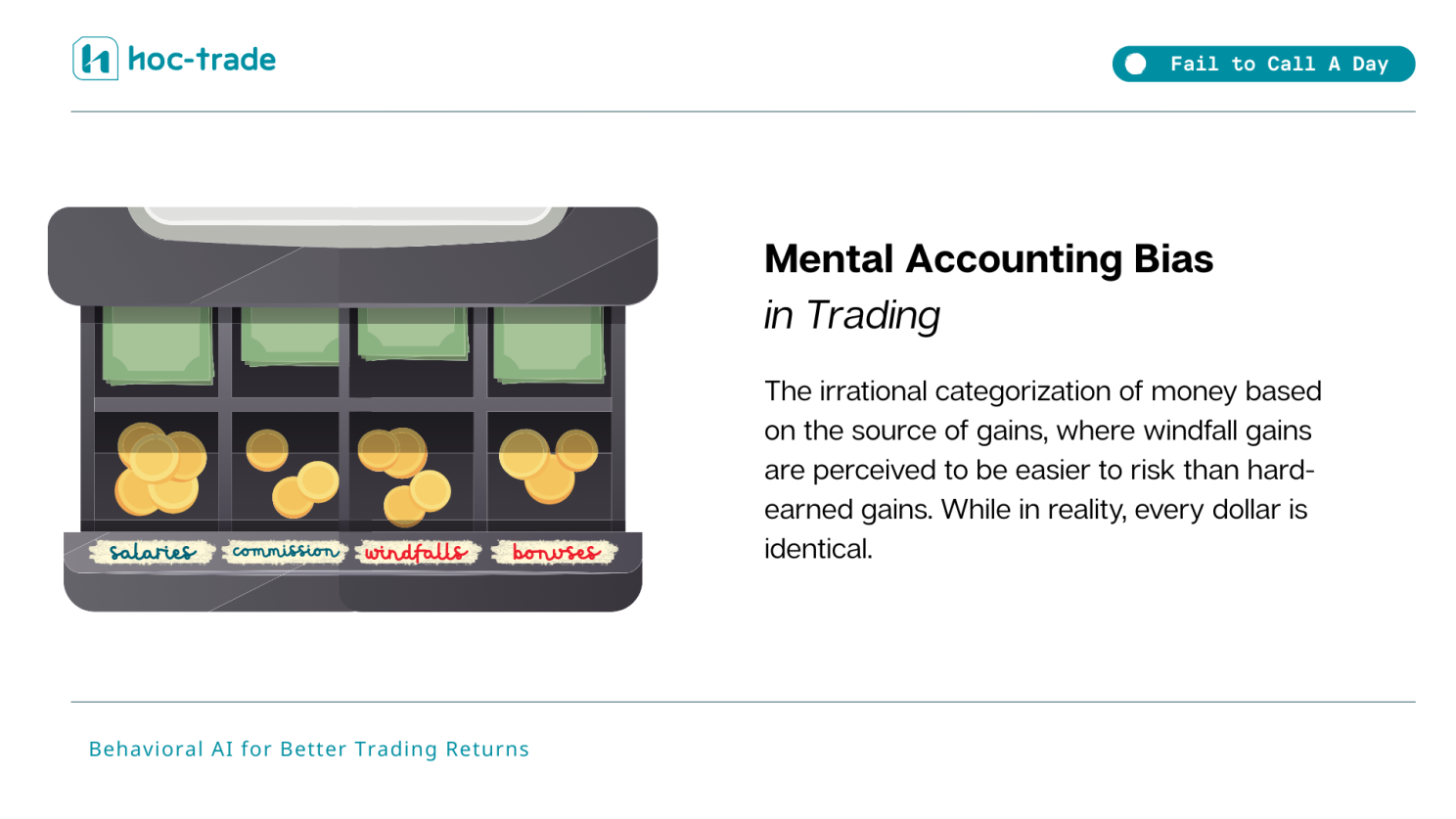
That distinction creates an illusion. Capital is fungible. A dollar earned as profit has the same value and the same impact on risk as a dollar in your opening account. But mental accounting makes them feel different, distorting risk perception and pushing traders toward decisions they would never make if their original stake were on the line. What started as careful discipline transforms into opportunism, and the edge that created the win in the first place begins to erode.
What Are the Performance Costs of Trading Past Your Limits?
Continuing to trade after crossing emotional thresholds isn't just psychologically risky. It's statistically damaging. The costs are measurable across several dimensions.
Profit erosion is the first cost. Gains earned earlier in the session are gradually chipped away, sometimes completely reversed. Drawdown amplification follows. As traders try to recover from mounting losses, each subsequent loss compounds the previous one. Lower-quality setups become the norm. Impulse replaces analysis. Decision fatigue sets in. As mental energy depletes, discipline collapses and tolerance for poor risk-reward ratios increases.
What makes this particularly damaging is that traders often don't see the pattern until reviewing their results at day's end. By then, the damage is already done, and the habit is reinforced for the next trading session.
What Does the Data Say About Emotional Spillover?
This behavior is not theoretical. TradeMedic's AI detects emotional spillover patterns across 500,000+ trader accounts by measuring the correlation between daily profit or loss and the performance of subsequent trades. When a trader's trades after crossing a certain daily threshold consistently underperform compared to their baseline, the system flags the pattern. In our dataset, traders show a measurable and statistically significant degradation in trade quality following high-emotion days—both wins and losses trigger the same effect.
How Can You Identify When Emotions Are Affecting Your Trades?
The first step is measurement. Track not just your daily profit and loss, but also the quality of your trades following emotional highs or lows. Compare your setup accuracy, risk-reward ratios, and average loss sizes on the days when you trade past your edge versus your baseline.
Set clear daily limits: a profit target, a loss limit, or a fixed number of trades. When you hit the limit, stop. Not because of superstition, but because the data shows your decisions degrade. Over time, these limits become your protection mechanism, not a limitation on your potential.
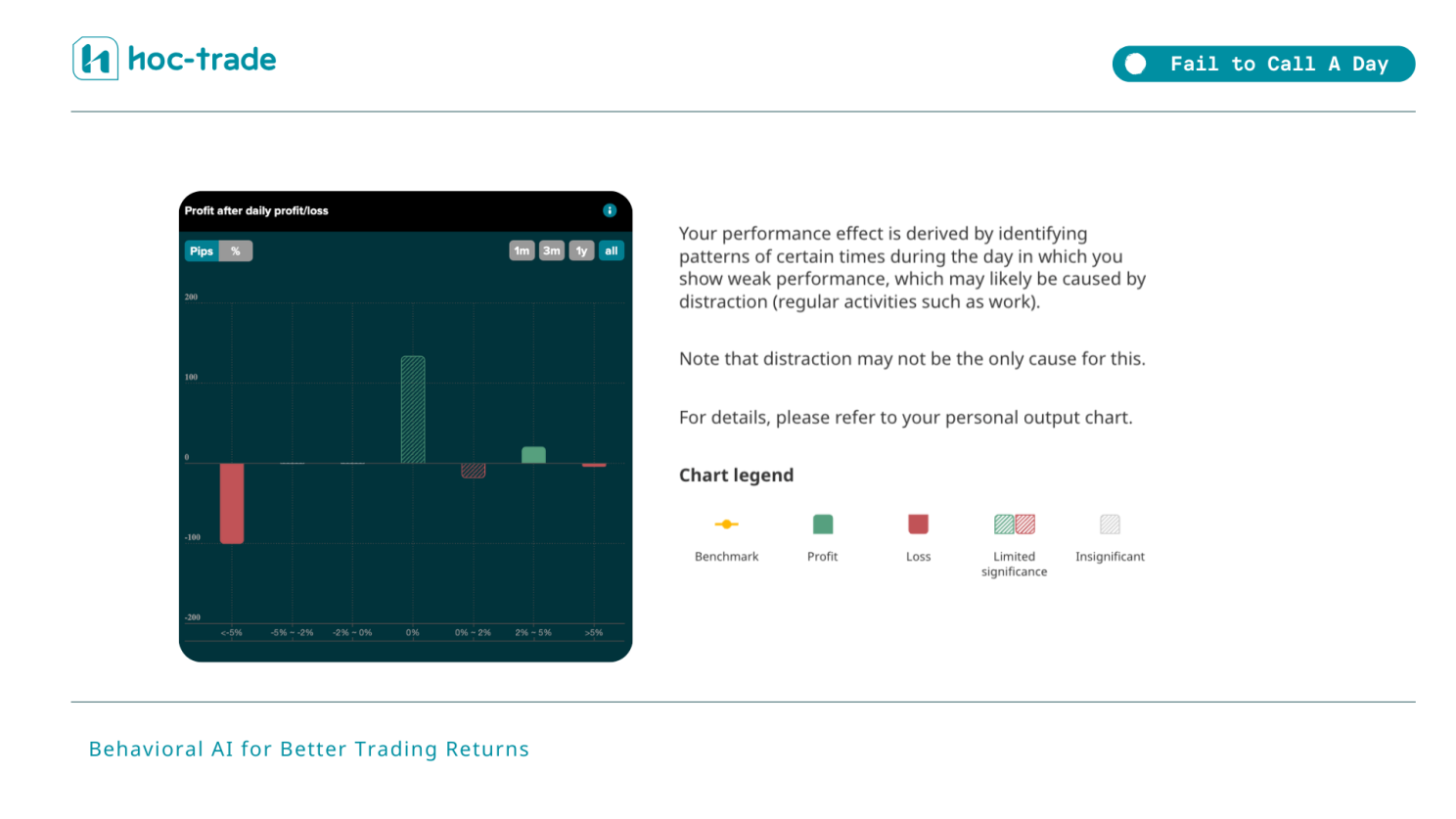
Tools like behavioral analytics can make this pattern visible. By analyzing how your post-threshold trades perform compared to your baseline, you can pinpoint exactly when your decision-making begins to slip and adjust your stop conditions accordingly.
The edge you build through careful setups and disciplined execution is only as strong as your ability to recognize when to stop. Taking a break after an emotional day becomes a performance strategy, not a defensive move. It protects your gains, contains your losses, and preserves the consistency that builds long-term profitability. In trading, knowing when to walk away is just as important as knowing when to trade.
TradeMedic AI analyses over 60 behavioural patterns, including failing to call it a day, across 500,000+ trader accounts. Visit TradeMedic to see how it works and get your personal analysis.
Watch: Why knowing when to stop trading matters
Frequently asked questions
What is emotional spillover in trading?
Emotional spillover occurs when the feelings from your best or worst trades of the day influence your next trading decisions. After a big win, you might feel invincible and take larger positions. After a sharp loss, you might chase recovery through revenge trading. Either way, your next decisions are no longer purely based on your edge; they're tangled with the emotions from before.
Why does mental accounting bias affect traders differently?
Mental accounting bias makes traders perceive profit money as separate from capital money, even though they're fungible. After an early win, traders tell themselves they can "afford to loosen rules" because they're only risking profits. This false distinction distorts risk perception and leads to larger positions and softer entry criteria than they normally use.
How much do performance costs matter for day traders?
The costs are measurable. Traders show profit erosion, amplified drawdowns, lower-quality setups, and degraded decision-making after crossing emotional thresholds. Because these trades happen after the initial emotion, traders often don't recognize the pattern until reviewing their day. By then, consistent gains are already eroded.
What's the best way to manage trading after a big win or loss?
Set clear daily limits: a profit target, a loss cap, or a fixed trade count. When you hit the limit, stop trading for the day. This isn't arbitrary. The data shows that trades after these thresholds underperform your baseline. Stopping becomes a protection mechanism that preserves your edge rather than a limitation on potential.
How can tools like TradeMedic help identify this pattern?
Behavioral AI systems analyze the correlation between your daily profit/loss and subsequent trade performance. When your post-threshold trades consistently underperform, the system flags it. This makes the pattern visible so you can adjust your daily limits and protect your gains before they erode.