Category:
 Author:
 Date:May 10, 2026
The Gambler’s Fallacy in Trading: Why Your Next Trade Doesn’t Care About the Last One
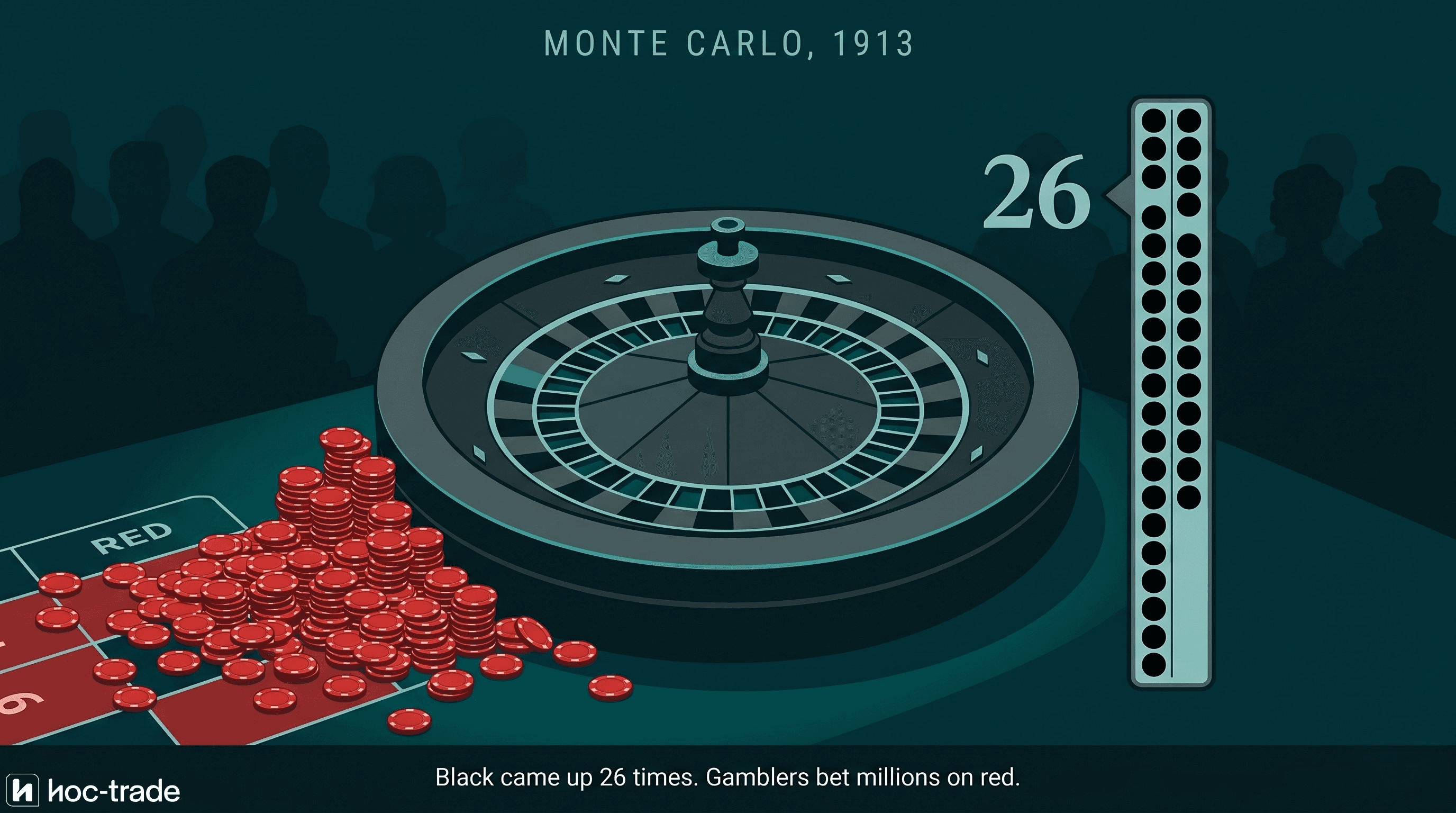
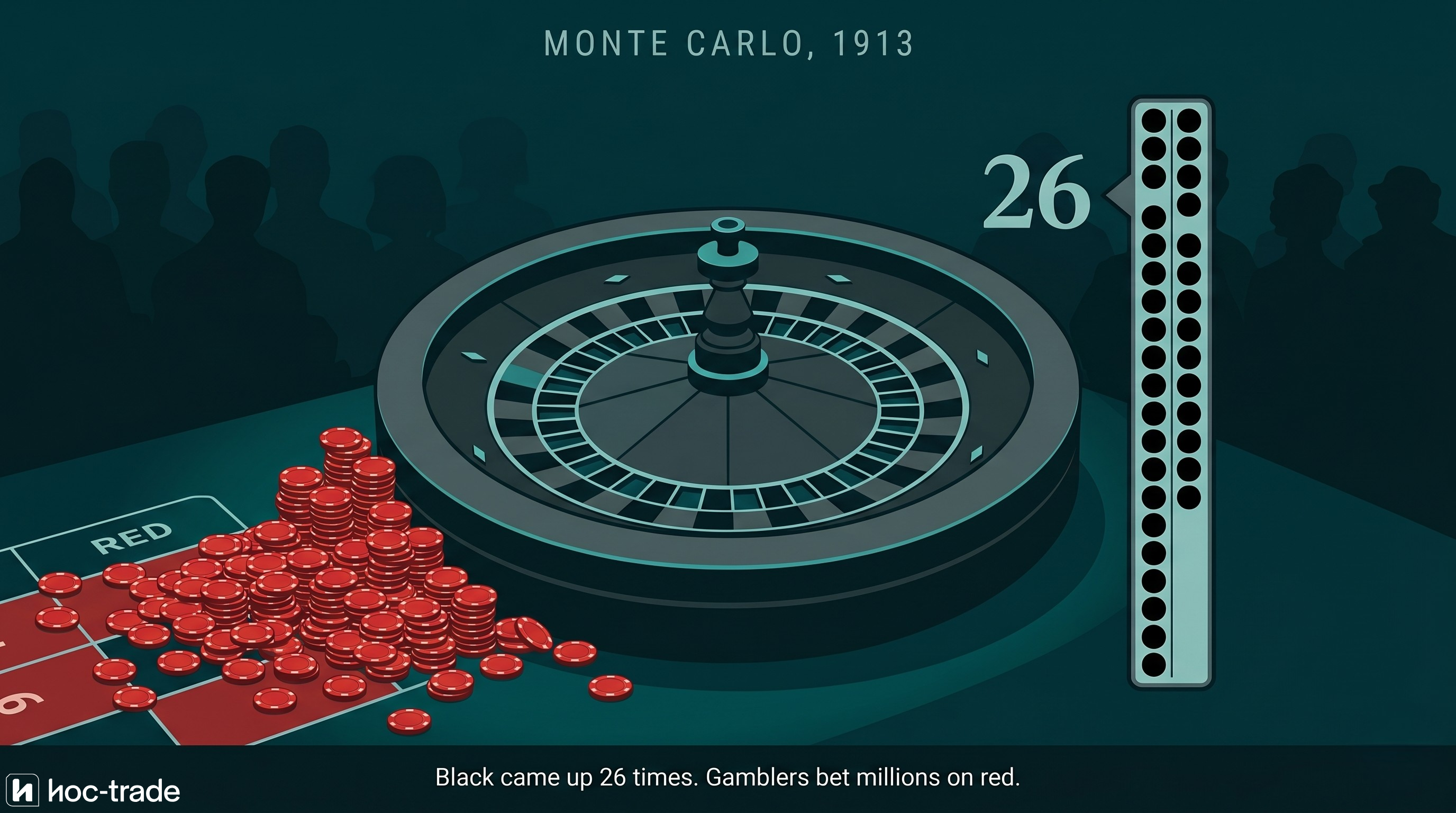
On the evening of August 18, 1913, something remarkable happened at the Monte Carlo Casino. The roulette ball landed on black. And then black again. And again. By the time the streak reached fifteen, gamblers at the table were convinced that red was overdue. They started pushing increasingly large bets onto red. Black kept coming. Twenty times. Twenty-five times. Bets reportedly worth millions of francs piled onto red with every spin, the crowd growing more certain with each result that the streak simply had to end. When the ball finally landed on red after the 26th consecutive black, the casino had already collected a fortune from players who were sure the universe owed them a correction.
This is the gambler’s fallacy in its purest form. And traders fall for it every day, usually without realising it.
What is the gambler’s fallacy?
The gambler’s fallacy is the belief that past outcomes influence future probabilities in independent random events. After a series of one outcome, people expect the opposite outcome to become more likely. A coin has landed on heads five times in a row, so tails must be due. A stock has risen for seven consecutive days, so a decline must be coming. A trader has lost four trades in a row, so the next one is more likely to be a winner.
The fallacy sits on a fundamental misunderstanding of probability. Each event in a genuinely independent sequence carries the same odds regardless of what happened before. The coin does not remember its previous flips. The roulette wheel does not track its history. Your eleventh trade does not know about the ten that preceded it.
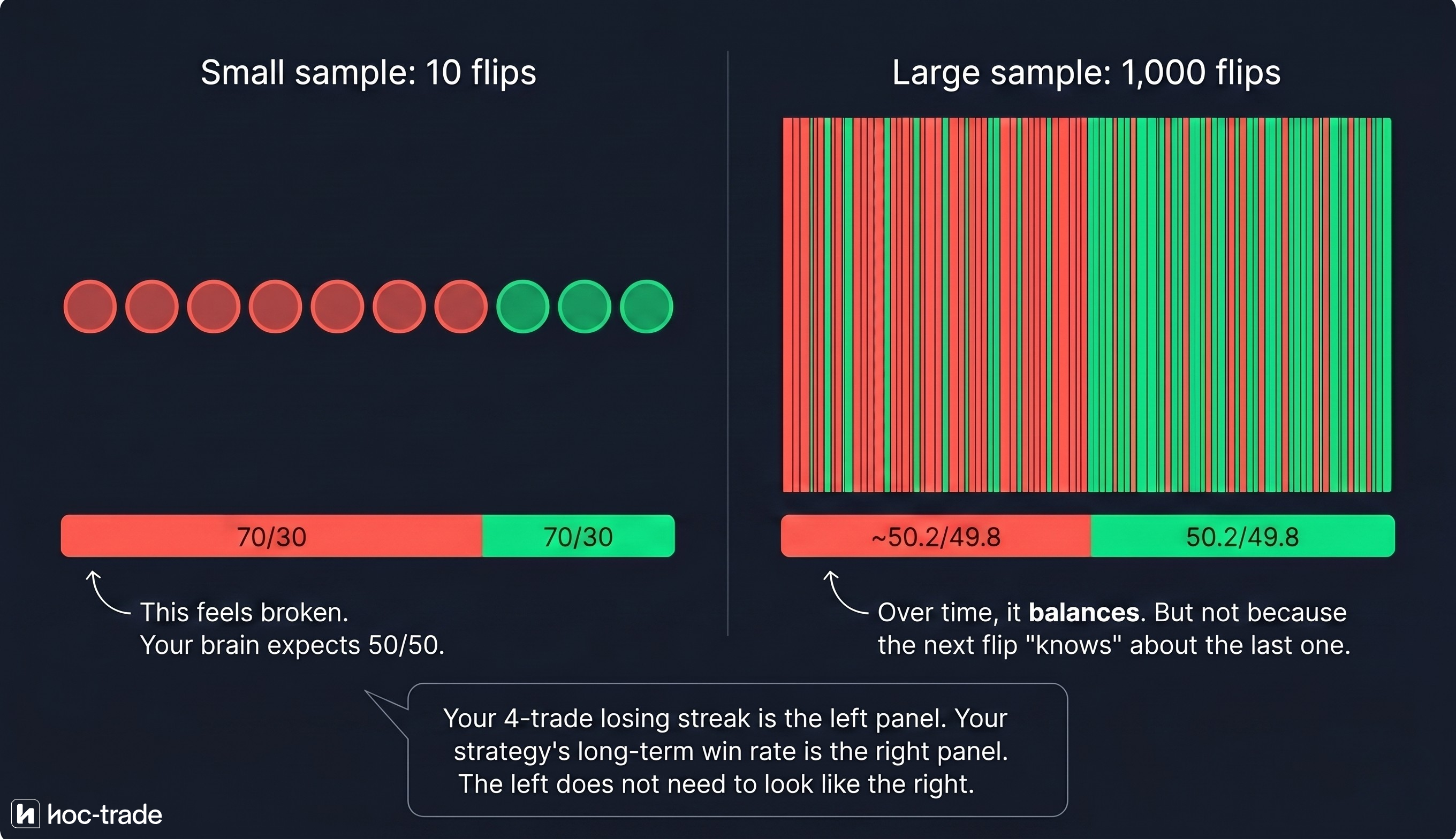
The mechanism behind the gambler’s fallacy was explained through the work of Amos Tversky and Daniel Kahneman, who identified what they called the “law of small numbers” and the representativeness heuristic. People intuitively expect small samples to look like the overall distribution. If a fair coin should produce 50% heads over thousands of flips, the brain expects even a sequence of five flips to approximate that ratio. When it does not, it feels like the world is out of balance, and a correction is coming.
The night Monte Carlo proved the fallacy
The 1913 Monte Carlo incident is more than a historical curiosity. It is the clearest illustration of how the fallacy operates under pressure. The probability of 26 consecutive blacks on a single-zero roulette wheel is approximately 1 in 68.4 million. An extraordinarily unlikely event. But that probability applies to any pre-specified sequence of 26 outcomes. Once the streak was underway, each new spin still carried the same roughly 48.6% chance of landing on black, completely independent of what came before.
The gamblers who reportedly lost millions that night were not unintelligent. They understood roulette. They understood probability in the abstract. What they could not override was the gut-level conviction that the universe owed them a correction. This is the same conviction that leads traders to increase their position size after a losing streak, convinced that their system is “due” for a win.
Why your brain falls for it: the law of small numbers
Tversky and Kahneman’s “belief in the law of small numbers” explains why the fallacy is so persistent. Humans are pattern-detection machines. We evolved to find structure in our environment, to predict what comes next based on what came before. In most of life, this serves us well. Seasonal patterns, social cues, cause-and-effect relationships all reward pattern recognition.
The problem arrives when we apply this same pattern-detection instinct to genuinely random sequences. Our brains unconsciously expect small samples to be “representative” of the larger distribution. Five consecutive losses feels like too many for a strategy that wins 55% of the time, so the brain concludes that a win must be imminent to restore the expected ratio. The technical term for this is “representativeness heuristic.” It is fast, intuitive, and wrong.
A 2016 study published in the Quarterly Journal of Economics by Chen, Moskowitz, and Shue found that behaviour consistent with the gambler’s fallacy extends well beyond casinos. They examined decision-making across three high-stakes professional domains: asylum court decisions, loan application reviews, and Major League Baseball umpire pitch calls. In each setting, they found significant negative autocorrelation in sequential decisions, meaning that after making several decisions in one direction, professionals were more likely to decide the opposite way, unrelated to the merits of the case. The effect was stronger with less experienced decision-makers and following longer streaks.
The implication for trading is direct. Professional experience does not eliminate the fallacy. Trained decision-makers in high-stakes environments still fall for it.
How the gambler’s fallacy shows up in trading
The fallacy manifests in trading in several distinct ways, most of which feel rational from the inside.
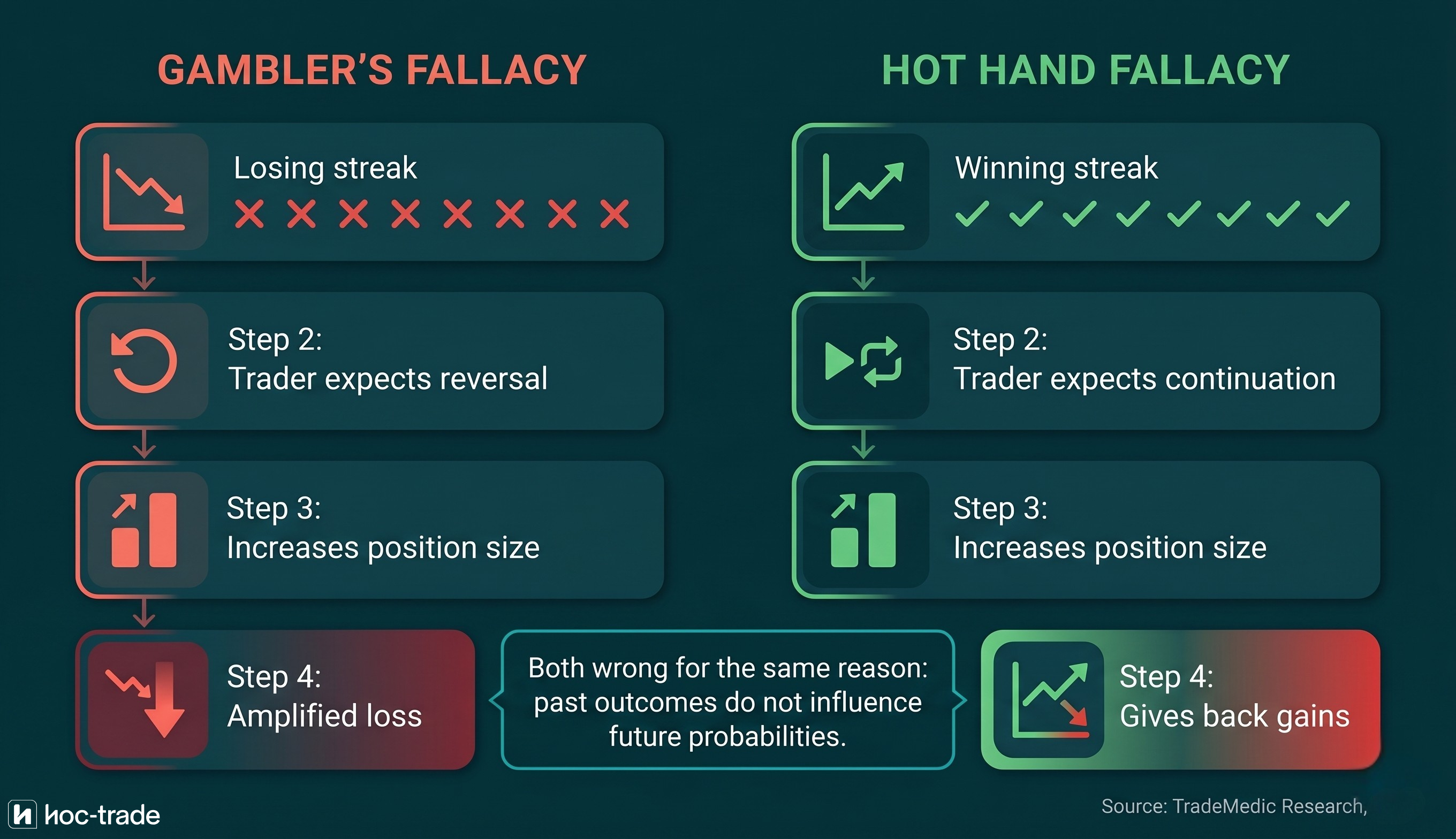
Position sizing after losses. This is the most direct and dangerous form. After a series of losing trades, a trader increases their position size because they believe a win is statistically overdue. The reasoning feels compelling: the strategy has a positive expectancy, the losses are just variance, so a larger bet on the “inevitable” correction makes sense. In reality, the next trade carries the same probability as any other trade. The larger position only means that if the loss continues, the damage is amplified.
Calling reversals on streaking assets. A stock has risen for eight consecutive sessions. A currency pair has been declining all week. Traders influenced by the gambler’s fallacy start positioning for a reversal, not because of any change in the fundamentals or technical picture, but because the streak itself feels unsustainable. Research on short sellers supports this: Blau, Griffith, and Whitby found that short-selling activity is abnormally high after three to five consecutive days of positive stock returns, suggesting that even sophisticated traders may be influenced by the fallacy rather than acting purely on fundamental analysis. Even when a reversal does eventually come, a streak can extend far longer than a trader’s capital or risk tolerance can withstand. Being eventually right about direction is meaningless if the position is liquidated before the turn arrives.
Abandoning working strategies during drawdowns. A systematic strategy goes through a natural drawdown period. The trader, influenced by the gambler’s fallacy in reverse, starts to believe the strategy is broken rather than experiencing normal variance. They abandon it, switch to something else, or override the signals. The irony is that the drawdown may end shortly after, but the trader has already moved on. This is closely related to outcome bias — the tendency to judge a decision by its result rather than by the quality of the reasoning behind it. A strategy that loses four trades in a row may still be a sound strategy experiencing normal variance. Outcome bias makes the losses feel like proof that the system is broken, when they are actually just noise.
Emotional escalation during losing streaks. The gambler’s fallacy does not operate alone. After multiple losses, the trader’s emotional state deteriorates. Anger, frustration, and the desire to “get even” combine with the cognitive distortion that a win is overdue. This toxic combination is one of the primary drivers of revenge trading — re-entering the market too quickly after a loss with an oversized position, chasing the recovery that feels inevitable but is not.
Gambler’s fallacy examples in trading
Example 1: The forex scalper and the losing streak. A scalper running a strategy with a 60% win rate hits seven consecutive losses. Statistically, a run of seven losses is expected to occur roughly once every 600 trades for a 60% win rate strategy. It is unusual but not rare. The scalper, however, feels that the eighth trade is almost certain to be a winner. They double their lot size. The eighth trade is another loss. The account is now down significantly more than the strategy’s normal drawdown because the position sizing decision was driven by the fallacy, not by the strategy’s rules.
Example 2: Shorting the rally. A trader watches a stock climb for five consecutive days on strong volume and solid earnings. No technical reversal signals are present. But the trader shorts it because “it can’t keep going up forever.” The stock does keep going up. The trader’s conviction that the streak must end prevents them from cutting the loss early, because the reversal is always “about to happen.”
Example 3: The contrarian trap. A crypto trader sees Bitcoin decline for three consecutive weeks. They go long, reasoning that three weeks of selling must mean buyers are about to step in. No analysis of support levels, no assessment of macro conditions, just the gut feeling that three red weeks demands a green one. Bitcoin drops for two more weeks before finding a floor. The entry was premature and the position sized for conviction, not probability.
Example 4: Abandoning a strategy at the worst time. A swing trader following a trend-following system hits a choppy market. The system generates four consecutive losing trades over two months. The trader decides the system is broken and switches to mean-reversion. The trend-following system’s next three signals are all winners. The trader missed the recovery because they treated a normal drawdown as evidence that the system’s edge had disappeared.
The hot hand fallacy: the mirror image traders also miss
The gambler’s fallacy has a twin that operates in the opposite direction. The hot hand fallacy is the belief that a winning streak will continue, that success breeds more success in random sequences. Where the gambler’s fallacy expects streaks to reverse, the hot hand fallacy expects them to persist.
Research using retail investor trading data found an interesting dynamic: traders tend to exhibit the gambler’s fallacy after shorter streaks of consecutive outcomes in one direction, but switch to the hot hand fallacy after longer streaks. After a few losses a trader expects a reversal, but after a sustained winning run they start to believe they have a “hot hand” and take increasingly aggressive positions.
Both fallacies stem from the same root problem: the inability to accept that independent events do not influence each other. In one large-scale study of 565,915 online sports bets, researchers found that gamblers who lost chose riskier odds on their next bet (consistent with the gambler’s fallacy, chasing a reversal), while those who won chose safer odds (expecting their luck to run out). Paradoxically, this behaviour pattern meant winners kept winning and losers kept losing, not because of luck but because of the position sizing changes the fallacies drove.
For traders, the practical lesson is this: both your losing streaks and your winning streaks should trigger the same response. Check the data. Stick to your sizing rules. Do not let the length of a streak dictate your risk.
Why smart traders are not immune
Some research suggests that higher cognitive ability does not eliminate the gambler’s fallacy and may even reinforce the pattern-seeking tendencies that drive it. A study published in PLOS ONE found that susceptibility to the fallacy was positively correlated with general intelligence and executive function in their sample, with the researchers attributing this to a stronger pattern-detection capacity: the more powerful your analytical mind, the harder it works to find structure, even in randomness. While the relationship between intelligence and bias susceptibility is not settled across all studies, the finding aligns with a broader pattern: being analytically capable does not automatically protect you from cognitive biases.
The Chen, Moskowitz, and Shue study reinforced this finding in professional settings. Asylum judges, loan officers, and MLB umpires are all trained professionals making high-stakes decisions, and all showed the fallacy in their sequential decisions. The effect was stronger with less experienced professionals, but it never disappeared entirely regardless of experience level. For traders, this means that neither intelligence nor years of screen time will make you immune. The fallacy operates below the level of conscious reasoning, in the same intuitive pattern-detection systems that make you a good trader in other respects. The only reliable counter is external structure: rules, data, and systems that do not share your brain’s bias toward expecting balance in small samples. This connects directly to the blind spot bias — the tendency to believe your own reasoning is less biased than others’, which prevents many traders from even recognising they are subject to the gambler’s fallacy in the first place.
The important nuance: markets are not roulette wheels
Every article about the gambler’s fallacy in trading makes the comparison to roulette or coin flips. The comparison is useful for explaining the core concept, but it oversimplifies something important: markets are not purely random.
A roulette wheel has no memory. Each spin is perfectly independent. Markets, by contrast, do exhibit trends, momentum, mean reversion, and serial correlation. A stock that has been rising may continue rising because the underlying business is improving. A currency pair that has been declining may keep declining because interest rate differentials are widening. These are not random events.
So where does the gambler’s fallacy actually apply in trading? It applies to your trade outcomes, not to market behaviour itself. Your personal win rate on the next trade is not influenced by whether your last three trades were winners or losers, assuming your strategy and execution remain consistent. The market does not owe you a win because you have had several losses. Your edge plays out over large samples, not through some cosmic balancing mechanism that forces good trades after bad ones.
This distinction matters because it prevents a different mistake: concluding that the gambler’s fallacy means you should ignore streaks entirely. Price streaks can be meaningful. Trading outcome streaks are not. A stock rallying for five days may be responding to genuine information flow. Your personal five-trade losing streak is noise within your strategy’s expected distribution. Confusing the two leads to errors in both directions.
How to protect yourself from the gambler’s fallacy
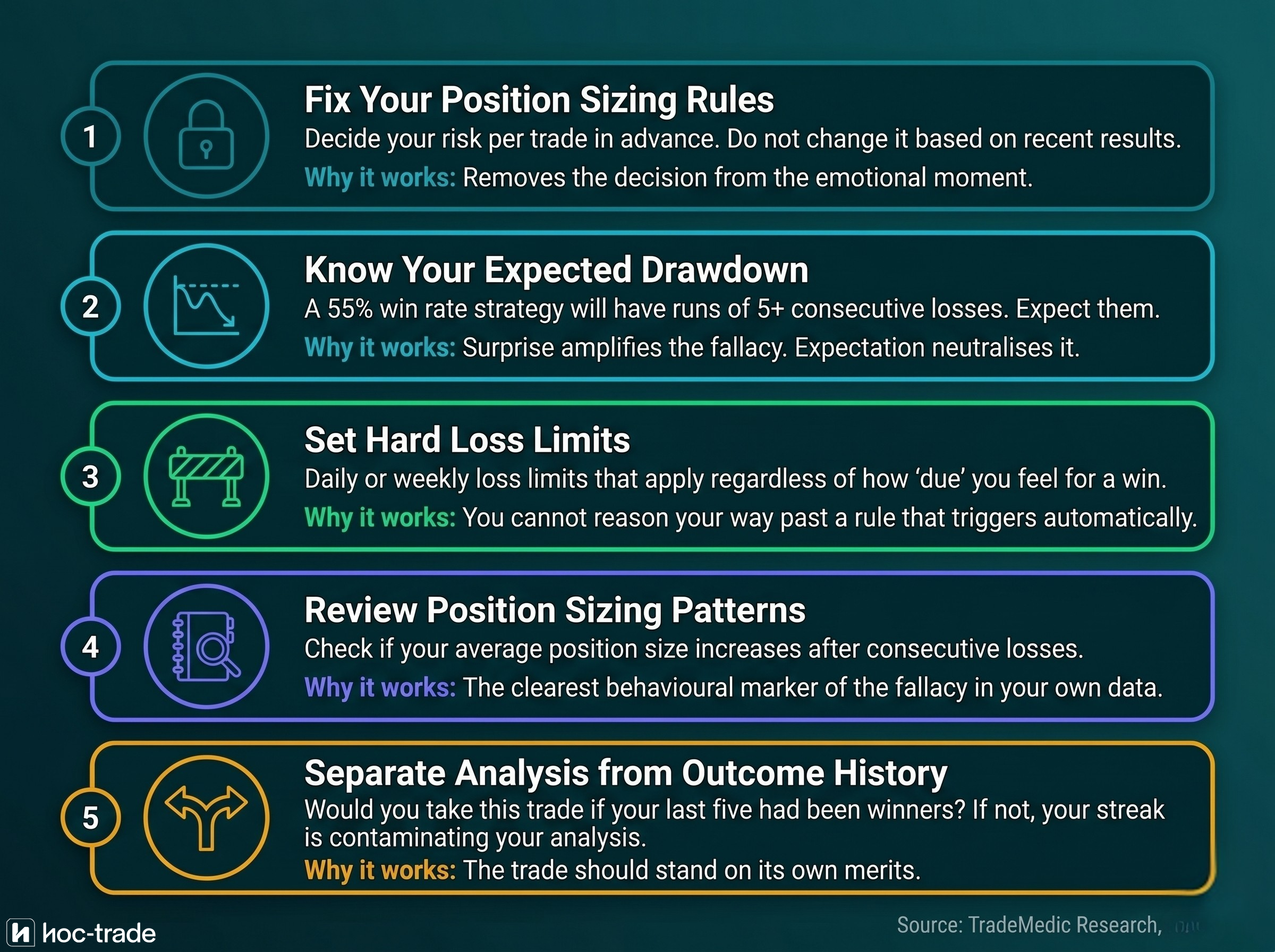
Fix your position sizing rules and do not deviate. The most direct defence against the gambler’s fallacy is mechanical position sizing. Decide in advance how much you will risk per trade, and do not change it based on recent results. If your rule is 1% of capital per trade, it is 1% after a winning streak and 1% after a losing streak. The moment you adjust your position size because you “feel” that a win is coming, the fallacy is operating.
Know your strategy’s expected drawdown profile. Every strategy has losing streaks. A system with a 55% win rate will experience runs of five or more consecutive losses regularly over a year of trading. If you know this in advance from backtesting or historical performance data, a five-trade losing streak does not feel like a signal that something is broken. It feels like a normal part of the process. Surprise amplifies the fallacy. Expectation neutralises it.
Set a maximum daily or weekly loss limit. A hard loss limit removes the decision from the emotional moment. When you hit your limit, you stop. You do not get to reason that the next trade will surely be the one that turns things around. The limit is set when your mind is clear, and it applies regardless of how “due” you feel for a winner.
Review your trade journal for position sizing patterns. Look specifically at whether your position sizes increase after losses. This is the clearest behavioural marker of the gambler’s fallacy in action. If your average position after three consecutive losses is larger than your average position after three consecutive wins, the fallacy is influencing your trading whether you recognise it or not.
Separate market analysis from outcome history. Before entering a trade, ask yourself: would I take this trade if my last five trades had been winners instead of losers? If the answer is no, or if you would be taking a smaller position, then your recent outcomes are contaminating your analysis. The trade should stand on its own merits, independent of your personal streak.
What does the data say?
TradeMedic™ AI analyses trading behaviour across a dataset of 500,000+ trader accounts, identifying over 60 distinct behavioural patterns. Several of these patterns relate directly to the gambler’s fallacy and its downstream effects. The platform measures how individual traders adjust their risk after losses, whether their performance deteriorates during and after losing streaks, and how their behaviour changes when they deviate from their historical risk levels.
For traders who receive their TradeMedic report, the data makes the gambler’s fallacy visible in their own numbers. You can see, quantified in dollar terms, whether you tend to increase your position size after consecutive losses, and what that behaviour costs you. This is the kind of evidence that overrides the intuitive feeling that a win is overdue, because the numbers do not care about your feelings. They show what actually happens when you bet bigger after a streak.
The gambler’s fallacy is one of the most well-documented cognitive biases in psychology. Its presence in trading data is equally well-documented. The gap between knowing about it and actually preventing it from affecting your trading is where tools and data make the difference.
The fallacy that costs traders the most at the worst time
The gambler’s fallacy is particularly destructive because it strikes hardest when you can least afford it. After a losing streak, when your account is already down and your emotional resilience is depleted, the fallacy convinces you to increase your risk. It takes an already difficult situation and makes it worse by encouraging exactly the wrong response.
Understanding the fallacy intellectually is a start, but as the research shows, knowledge alone does not eliminate it. Professional judges, loan officers, and baseball umpires all demonstrate the bias in their sequential decisions despite extensive training. The counter is not more willpower. It is structure: fixed position sizing, pre-set loss limits, and objective data about your own behaviour that shows you when the fallacy is operating in your trading.
The roulette wheel at Monte Carlo did not owe those gamblers a red. Your next trade does not owe you a win. The sooner that becomes not just an idea you understand but a rule you trade by, the sooner the fallacy stops costing you money.
Source: TradeMedic Research, 2026
Frequently asked questions
What is the gambler’s fallacy?
The gambler’s fallacy is the mistaken belief that past outcomes influence future probabilities in independent random events. After a series of one outcome, people expect the opposite to become more likely. In trading, this leads traders to increase position sizes after losing streaks because they believe a win is overdue, when in reality each trade carries the same probability regardless of previous results.
Why is it called the Monte Carlo fallacy?
The alternative name comes from a famous incident at the Monte Carlo Casino on August 18, 1913, when a roulette wheel landed on black 26 times consecutively. Gamblers lost millions of francs betting on red, convinced the streak had to end. The probability of each individual spin remained unchanged, but the gamblers could not override their intuition that the universe owed them a correction.
How does the gambler’s fallacy affect traders?
The fallacy primarily affects position sizing and risk management. Traders who have experienced consecutive losses tend to increase their position size on the next trade, believing a win is statistically overdue. This amplifies losses at the worst possible time. The fallacy also leads traders to call reversals on streaking assets without fundamental or technical justification, and to abandon working strategies during normal drawdown periods.
What is the difference between the gambler’s fallacy and the hot hand fallacy?
The gambler’s fallacy expects streaks to reverse: after losses, a win must be coming. The hot hand fallacy expects streaks to continue: after wins, more wins must follow. Both are wrong for the same reason. Independent events do not influence each other. Research shows traders tend to exhibit the gambler’s fallacy after short streaks and the hot hand fallacy after longer streaks.
Can experienced or intelligent traders avoid the gambler’s fallacy?
Not automatically. Research shows the fallacy is positively correlated with general intelligence, meaning smarter individuals may actually be more susceptible. A landmark 2016 study found the fallacy operating in decisions made by professional judges, loan officers, and baseball umpires. The most effective counter is not willpower but structure: fixed position sizing rules, pre-set loss limits, and objective data about your own trading behaviour.