Category:
 Author:
 Date:May 16, 2026
AI Trading Coach: What Actually Helps Traders Improve and What Just Tracks Your Losses
The trading tool market in 2026 is full of products calling themselves AI trading coaches, AI mentors, and AI-powered journals. Some of them are genuinely useful. Many of them are a chatbot with a trading prompt pasted in front of it. And the difference between the two is not obvious from a landing page.
The question is not whether AI can help traders improve. It can. Data from one broker integration shows that traders who engaged with an AI-powered behavioural analytics report at least four times within their first 60 days saw an average improvement of 12% in return per trade. That is an average across a diverse group: some profitable traders became more profitable, some loss-making traders reached profitability, and some remained unprofitable but reduced their losses. Not every trader improved, and the results varied significantly by individual. But the aggregate direction was clear and measurable.
The question is what kind of AI actually produces that result. And the answer depends entirely on what the tool is doing under the surface.
What is an AI trading coach?
An AI trading coach is any tool that uses artificial intelligence to help a trader improve their performance. That definition is broad enough to include almost anything, which is part of the problem. A tool that tells you "consider reviewing your risk management" after a losing streak is technically AI coaching. A tool that detects that you consistently double down after losses, calculates that this specific pattern has cost you 14% of your returns over the past six months, and shows you exactly which trades triggered it is also AI coaching. But the gap between those two is enormous.
What a trader actually needs from a coach is what any athlete needs from a coach: someone who can see the patterns the performer cannot see in themselves. In trading, that means analysing behaviour across hundreds or thousands of trades, not commenting on individual trades in isolation. A basketball coach does not evaluate a player based on one missed shot. They evaluate shooting form, decision-making tendencies, performance under pressure, and how those things change across situations and over time. The same principle applies to trading.
This is where blind spot bias becomes relevant. Research shows that over 85% of people believe they are less biased than average. Traders are no exception. Most traders believe they understand their own weaknesses. They do not. A genuine AI coaching tool needs to surface what the trader cannot see, not confirm what they already believe.
What types of AI trading tools exist?
The current market breaks down into four distinct categories, each with fundamentally different approaches to helping traders improve.
Chatbot coaches. These tools wrap a large language model (like GPT) with a trading-focused system prompt and let the trader ask questions about their trades. The AI can offer generic advice, explain concepts, and sometimes comment on individual trades if the trader provides the details. The limitation is that chatbots have no persistent view of your trading history. They respond to what you tell them in the moment. They cannot detect patterns across hundreds of trades because they do not have access to that data. A chatbot that says "you might be revenge trading" because you described entering a trade after a loss is not detecting a pattern. It is matching a keyword to a concept.
Replay-based coaches. These tools let traders replay past market conditions and re-execute their trades in simulation. The value is genuine: reliving a trade slows the experience down and forces reflection on entry, exit, and management decisions. The AI component typically analyses performance during replay sessions and suggests improvements. The limitation is that replay is backward-looking and time-intensive. A trader who needs to review 500 trades to find a pattern will not do it through replay. And replay tools cannot detect behavioural patterns that only emerge across large sample sizes, such as how your performance changes after a losing streak or whether you systematically take profits too early.
Journal-based analytics. These tools import your trades (from your broker or manually) and generate analytics: win rate, profit factor, performance by day of week, average hold time, and similar metrics. More advanced versions include tagging systems where traders label trades with emotions or strategy types and then filter analytics by those tags. The value is that the trader can see aggregate performance data they would never calculate manually. The limitation is that the analysis depends heavily on what the trader tags and records. If a trader does not tag a trade as "revenge trade," the journal will never identify it as one. The system relies on the trader's self-awareness, which is precisely what is compromised by the biases the tool is supposed to help with.
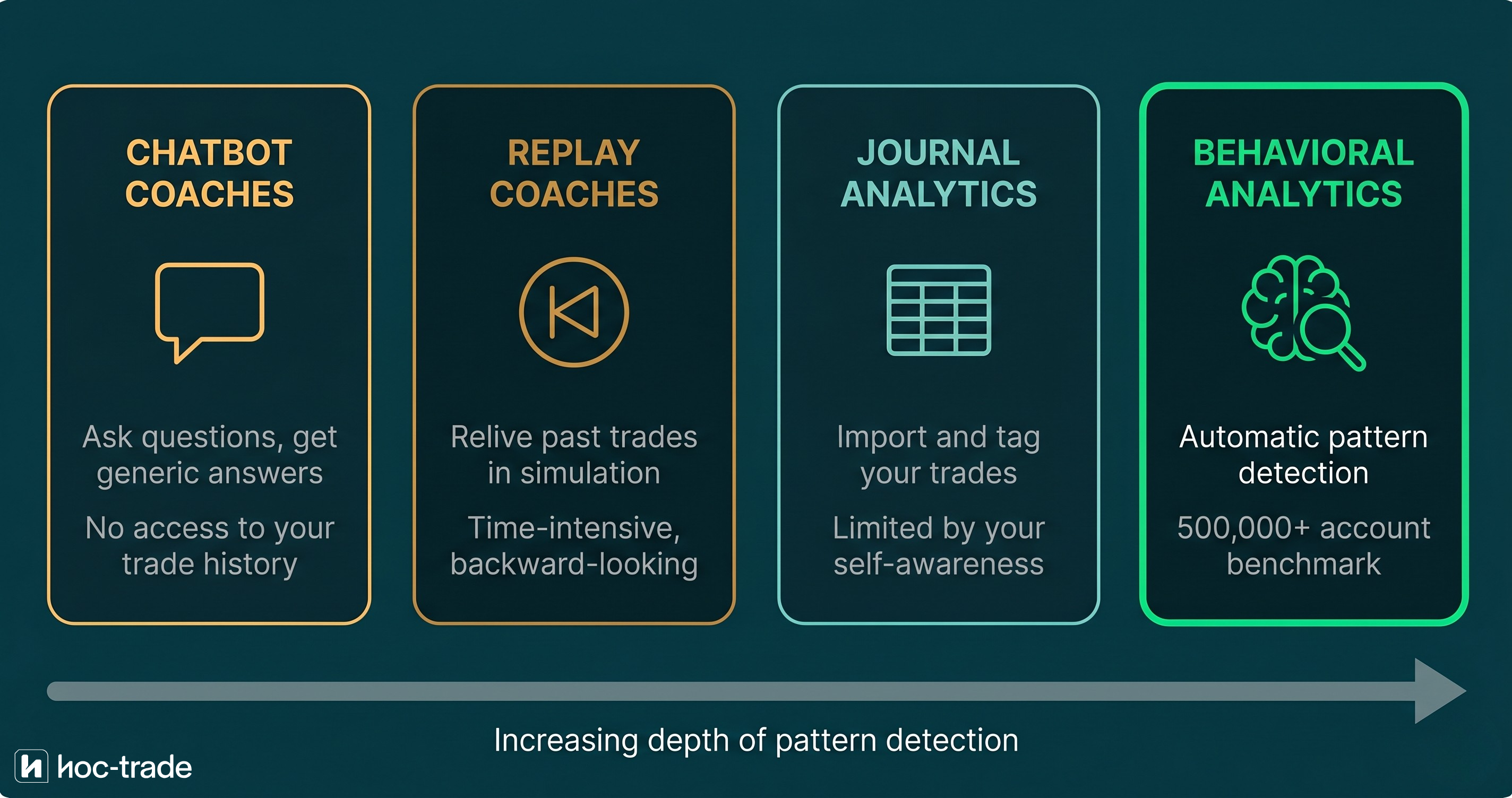
Behavioural analytics. These tools ingest the trader's full trade history automatically (no manual entry, no tagging) and run pattern detection algorithms across the entire dataset. They do not wait for the trader to ask a question or label a trade. They detect patterns the trader does not know exist. The analysis compares the trader's behaviour against a reference dataset of other traders to identify whether detected patterns are normal or abnormal, and it quantifies the financial impact of each pattern in the trader's specific account. This is where TradeMedic operates: 60+ behavioural patterns detected automatically across a dataset of 500,000+ trader accounts, with each trader receiving a personalised report showing their specific strengths and improvement areas with quantified performance impact.
There is another dimension that separates behavioural analytics from other approaches: the system learns across its entire user base, not just from a single trader's history. Every trader's data refines the detection models. With 500,000+ accounts processed, the system has identified which patterns tend to appear together (traders who show revenge trading are far more likely to also show overtrading), how specific patterns behave differently across trading styles (scalpers versus swing traders show the same bias in different ways), and what distinguishes profitable traders' behaviour from the rest. A chatbot draws on general knowledge. A journal draws on one trader's data. A behavioural analytics platform draws on every trader it has ever analysed.
What should an AI trading mentor actually do?
The word "mentor" implies a relationship that develops over time. A mentor learns about you, identifies your specific weaknesses, and gives advice that is relevant to your situation, not generic advice that applies to everyone. By that standard, most tools calling themselves AI trading mentors fall short.
A genuine AI trading mentor should do five things. First, it should detect patterns without requiring the trader to identify them. If the tool only finds what the trader already suspects, it is a confirmation engine, not a mentor. The most valuable insights are the ones the trader did not know to look for. Second, it should quantify impact. Telling a trader they "might be overtrading" is less useful than telling them that overtrading has cost them 8,400 USD across their trading history. The number makes the abstract concrete and creates motivation to change. Third, it should personalise. Two traders can both show revenge trading, but one might have a dangerous window of 5 minutes after a loss and the other might have a window of 45 minutes. A generic recommendation to "take a break after a loss" is less useful than knowing your specific window. Fourth, it should track progress over time. A one-time assessment tells you where you stand. Ongoing monitoring tells you whether you are actually improving, which patterns have responded to your efforts and which have not, and what should be the priority to work on next. Without this, a trader has no way to know whether their changes are working or whether they have simply shifted the problem from one pattern to another. Fifth, it should identify strengths, not just weaknesses. Most tools focus exclusively on what is going wrong. But knowing what you are already doing well is equally valuable. A trader who discovers their performance in calm market conditions is significantly above average has a clear direction: trade more in those conditions, lean into that edge. A tool that only gives you a list of problems to fix without showing you what to double down on is telling half the story.
The tools that come closest to genuine mentoring are the ones that combine automated detection, quantified impact, personalised thresholds, progress tracking, and strength identification. They do not just surface what is wrong. They show the full picture: what to fix, what to lean into, and whether your changes are working.
What makes an AI trading analysis tool effective?
There are several dimensions that separate a useful AI trading analysis tool from one that just presents numbers.
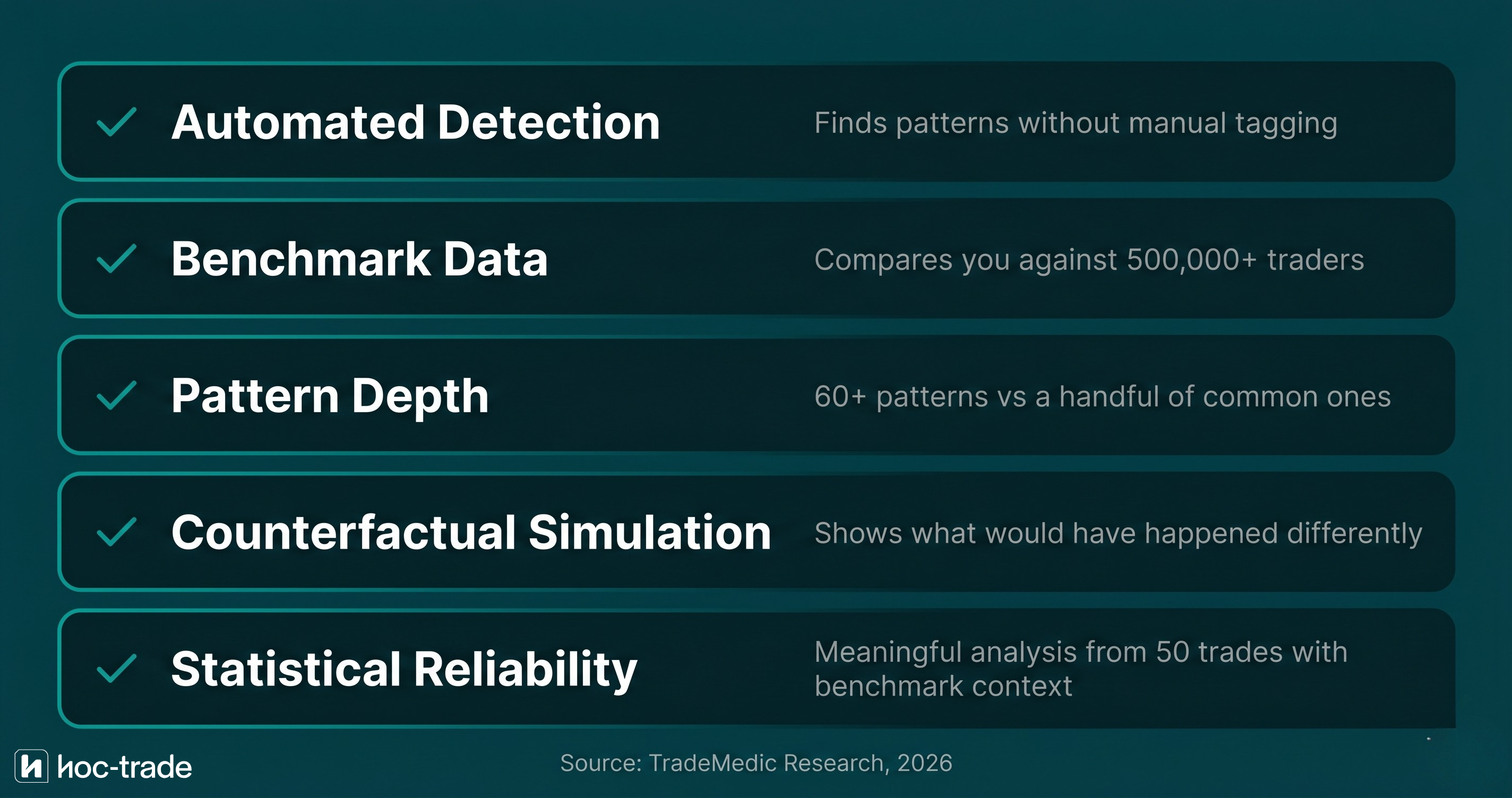
Automated detection versus manual tagging. If the tool requires the trader to tag trades with emotions, strategy labels, or setup types before it can generate insights, the quality of the analysis is limited by the trader's own self-awareness. A trader experiencing revenge trading is unlikely to label the trade as "revenge trade" in the moment. They believe they are taking a legitimate setup. The most effective tools detect patterns from the raw trade data without any manual input.
Benchmark data. Knowing that your win rate is 48% is meaningless without context. Is that good or bad for your instrument, timeframe, and style? Tools that analyse your data in isolation can only compare you to yourself over time. Tools that have access to a large reference dataset can tell you how your patterns compare to hundreds of thousands of other traders. That benchmark is what turns raw analytics into actionable insight.
Pattern depth versus pattern breadth. Some tools detect a handful of common patterns: overtrading, revenge trading, and maybe a few more. Others detect dozens. The breadth matters because trading behaviour is complex. A trader might not show any of the obvious patterns but still have a measurable issue with impatient entries or too-wide stop losses that is costing them money. Narrow detection misses these less obvious patterns entirely.
Simulation and counterfactual analysis. The most powerful form of trading analysis is not just showing what happened, but simulating what would have happened under different conditions. What if you had not manually closed your profitable trades? What if your stops had been tighter? What if you had waited 15 minutes after a loss before entering the next trade? Counterfactual simulation turns observation into specific, actionable recommendations.
Statistical reliability. Any tool can find a pattern in 20 trades. The question is whether that pattern is real or just noise. Tools that analyse a trader's data in isolation need hundreds of trades before patterns become statistically meaningful. But tools with access to a large reference dataset can draw reliable comparisons much sooner, because the benchmark provides the statistical context that a small individual sample cannot. TradeMedic begins producing meaningful analysis from as few as 50 trades, precisely because the 500,000+ account benchmark allows individual patterns to be compared against established distributions rather than evaluated in a vacuum. More trades always improve precision, but a strong benchmark lowers the threshold for useful insight significantly.
How does behavioural trading analytics differ from AI coaching?
The distinction matters because it sets the right expectation for what the tool does and does not do.
An AI coaching tool implies conversation. You ask it questions, it gives you answers. The experience feels like talking to a knowledgeable person. The strength of this approach is accessibility: it meets the trader where they are and answers in natural language. The weakness is that a conversational interface is limited by the questions the trader thinks to ask. If you do not know you have a pattern of setting stops too wide, you will never ask about it.
Behavioural trading analytics works differently. It does not wait for questions. It analyses the full trade history, runs detection algorithms across every trade, and produces a comprehensive report of everything it finds. The trader receives a personalised assessment covering 60+ patterns with quantified performance impact for each one. The experience is closer to getting a medical diagnostic report than having a conversation with a doctor.
Some in the industry describe this approach as trading diagnostics. The term is useful because it sets the right expectation. A diagnostic identifies what is happening and how severe it is. But unlike a simple blood test, the best trading diagnostics go further: they calculate personalised action thresholds for each trader. TradeMedic, for example, does not just tell a trader they show revenge trading. It calculates their specific recovery window after a loss, in minutes. It does not just flag impatient entries. It shows how much later the entry would have needed to be for performance to improve, and by how much. It does not just detect early profit-taking. It calculates the exact profit level at which that specific trader would benefit most from securing their trade at breakeven. Each pattern comes with an explanation video covering what it is, why it happens, and specific mitigation actions. The name is not accidental. It is a diagnostic that comes with personalised treatment recommendations built into the report.
Neither approach is inherently better. The conversational approach is better for traders who know what they want to explore and need guidance thinking it through. The diagnostic approach is better for traders who do not know what they do not know, which, given the research on blind spot bias, is most traders. The ideal is a tool that provides the comprehensive diagnostic first and then supports exploration of the findings.
What does the data show about traders who use performance analytics?
The evidence for whether AI tools improve trading performance is still emerging. Most tools in this space are too new to have longitudinal data, and the ones that do exist have obvious incentives to present their results favourably.
There is also reason for scepticism. A 2026 survey by Traders Union found that while 58% of retail traders report using AI tools, only 21% confirmed a measurable improvement in profitability. Nearly half experienced no change, and 30% saw worse results. Those numbers are sobering, but they describe AI trading tools as a category, which includes signal generators, trading bots, and chatbots alongside analytical tools. The question is not whether AI in general helps traders. It is whether a specific type of AI, applied to a specific problem, produces measurable results. The data below addresses that narrower question.
That said, early data from one broker integration of a behavioural analytics platform is encouraging. Among traders who engaged with the report regularly (four or more sessions) within the first 60 days, average return per trade improved by 12% compared to their baseline. This is an average across a diverse group: some profitable traders became more profitable, some loss-making traders reached profitability, and some remained unprofitable but reduced their losses. Not every trader improved, and the results varied significantly by individual. But the aggregate direction was clear and measurable.
What the data does not yet show is whether this improvement persists over longer time periods, and whether traders who engage less frequently (fewer than four sessions in 60 days) see any measurable benefit. These are open questions that will be answered as more data accumulates.
A separate study addressed a different question: can an AI actually detect which trades are affected by behavioural issues? The analysis classified 2.75 million trades at the point of entry into two categories: trades exhibiting behavioural issues and trades that did not. The classification was made at trade entry, with no knowledge of how the trade would turn out. The result: trades classified as free from behavioural issues showed 63% better performance per trade on average than those flagged with issues. Trades with issues averaged -1.15% per trade, while trades without issues averaged -0.43% per trade. Both figures are negative, which is consistent with the fact that over 90% of retail traders lose money overall. But the gap between the two groups demonstrates that the detection is identifying real behavioural patterns with measurable performance consequences.
The broader academic evidence on journaling and self-review in trading is more established. Research on structured reflection suggests that traders who systematically review their performance make better decisions over time compared to traders who do not. The trading journal article on this site covers why most traders abandon journaling and what automated approaches add on top of manual reflection. The key insight is that self-reported data is inherently limited by the biases of the person reporting it. Automated analysis removes that limitation.
What an AI trading tool cannot do
No AI trading tool, regardless of how sophisticated it is, can do the following:
It is not a trading bot. This is worth stating clearly because the term "AI trading" covers a wide range of tools. Some AI tools do analyse markets, generate signals, or build and execute automated strategies on the trader's behalf. Those tools exist and serve a different purpose. An AI trading coach analyses your behaviour in the context of market conditions. It does not tell you what to trade or when. It tells you how you trade and where your patterns are costing you money. That includes how your behaviour changes across different market environments: whether you perform differently in high versus low volatility, trending versus ranging conditions, or during specific market sessions. The market is part of the analysis, but the focus is on your response to it, not on predicting where price goes next. If you are looking for a tool that executes trades for you, that is a different category entirely and should be evaluated on different criteria. This article is about tools that make you a better trader, not tools that replace you as the trader.
It cannot replace discipline. A tool can show you that you revenge trade and quantify how much it costs you. It cannot stop you from doing it. The same Traders Union survey found that 61% of traders override their AI tool's decisions, and 48% stop using AI entirely after a string of losses. The gap between knowing and doing is where the real work of trading improvement happens, and that work is done by the trader, not the tool. What the tool can do is make the problem visible, specific, and quantified, which is a necessary precondition for change but not a sufficient one.
It cannot guarantee profitability. Any tool that claims to make you profitable is making a claim it cannot support. Trading is a probabilistic activity with inherent uncertainty. The best any tool can do is identify patterns that are costing you money and show you where your behaviour diverges from what the data suggests is optimal. Whether you act on that information, and whether the markets cooperate, is outside the tool's control.
The right question is not which tool is best
The right question is what you need the tool to do. If you want to talk through your trading decisions with an AI that responds in real time, a chatbot-based coach will work for you. If you want to replay and re-experience past trades, a replay tool is the right choice. If you want to track your trades and filter by custom tags, a journal with analytics will serve that purpose.
But if what you need is to see the patterns you cannot see in yourself, to quantify how much your behaviour is costing you across hundreds of trades, and to understand how your performance compares to half a million other traders, that requires a different kind of tool. It requires one that does not wait for you to ask the right question because the whole point is that you do not know what the right question is yet.
This is especially relevant for prop firm traders preparing for funded challenges, where a single day of behavioural mistakes can end a challenge that took weeks to build. Knowing your patterns before you risk the challenge fee is a fundamentally different proposition than discovering them after you have already failed.
TradeMedic runs this kind of diagnostic across 60+ behavioural patterns, benchmarked against 500,000+ trader accounts. You can see what it finds in your trading data at here.
Frequently asked questions
What is an AI trading coach?
An AI trading coach is any tool that uses artificial intelligence to help traders improve their performance. These range from simple chatbots that answer trading questions, to replay tools that simulate past market conditions, to behavioural analytics platforms that automatically detect patterns across hundreds or thousands of trades and quantify their financial impact.
Can an AI trading coach make me profitable?
No tool can guarantee profitability. Trading is a probabilistic activity with inherent uncertainty. What an effective AI trading tool can do is identify behavioural patterns that are costing you money, quantify their impact, and show you where your behaviour diverges from what the data suggests is optimal. Early data from one broker integration shows traders who engaged regularly with a behavioural analytics tool saw a 12% average improvement in return per trade within 60 days.
What is the difference between an AI trading coach and a trading bot?
An AI trading coach analyses your behaviour and helps you improve your decision-making. A trading bot analyses markets and executes trades on your behalf. They are fundamentally different categories of product. A coach helps you become a better trader. A bot replaces you as the trader.
What is an AI trading mentor?
An AI trading mentor is a tool that provides personalised trading guidance based on your specific trading data and patterns. A genuine mentor detects patterns without requiring the trader to identify them, quantifies their financial impact, and personalises recommendations to the trader's specific behaviour rather than giving generic advice.
What is the best AI trading analysis tool?
The best AI trading analysis tool depends on what you need. For conversational coaching, chatbot-based tools work well. For replaying past trades, replay-based tools are effective. For comprehensive behavioural pattern detection across large trade histories with quantified impact and benchmark comparisons against hundreds of thousands of other traders, behavioural analytics platforms offer the deepest analysis.