Category:
 Author:
 Date:May 13, 2026
Riding the Mid-Term Trend: Why the Hold Matters More Than the Entry
Price rarely moves in a straight line. Even when a market is travelling with real conviction over several days, the intraday path can look like doubt: sharp pullbacks, choppy rotations, and brief countermoves that feel like a reversal long before one actually arrives. In those moments, the biggest threat to a good position usually isn't a missed entry. It's mistaking ordinary friction for a change in regime, and treating a short-term wobble as if it cancels out the larger move.
What does it mean to ride a mid-term trend in trading?
Riding a mid-term trend is the ability to stay aligned with the medium-term direction of a market even when the short-term picture at the moment of entry looks unsupportive. It means reading the prevailing mid-term structure correctly, understanding that short-term corrections are often just part of that structure rather than a break from it, and having the patience to let the move play out. A second, less obvious layer sits underneath this: knowing when to close the position and bank the gain before a genuine reversal arrives.
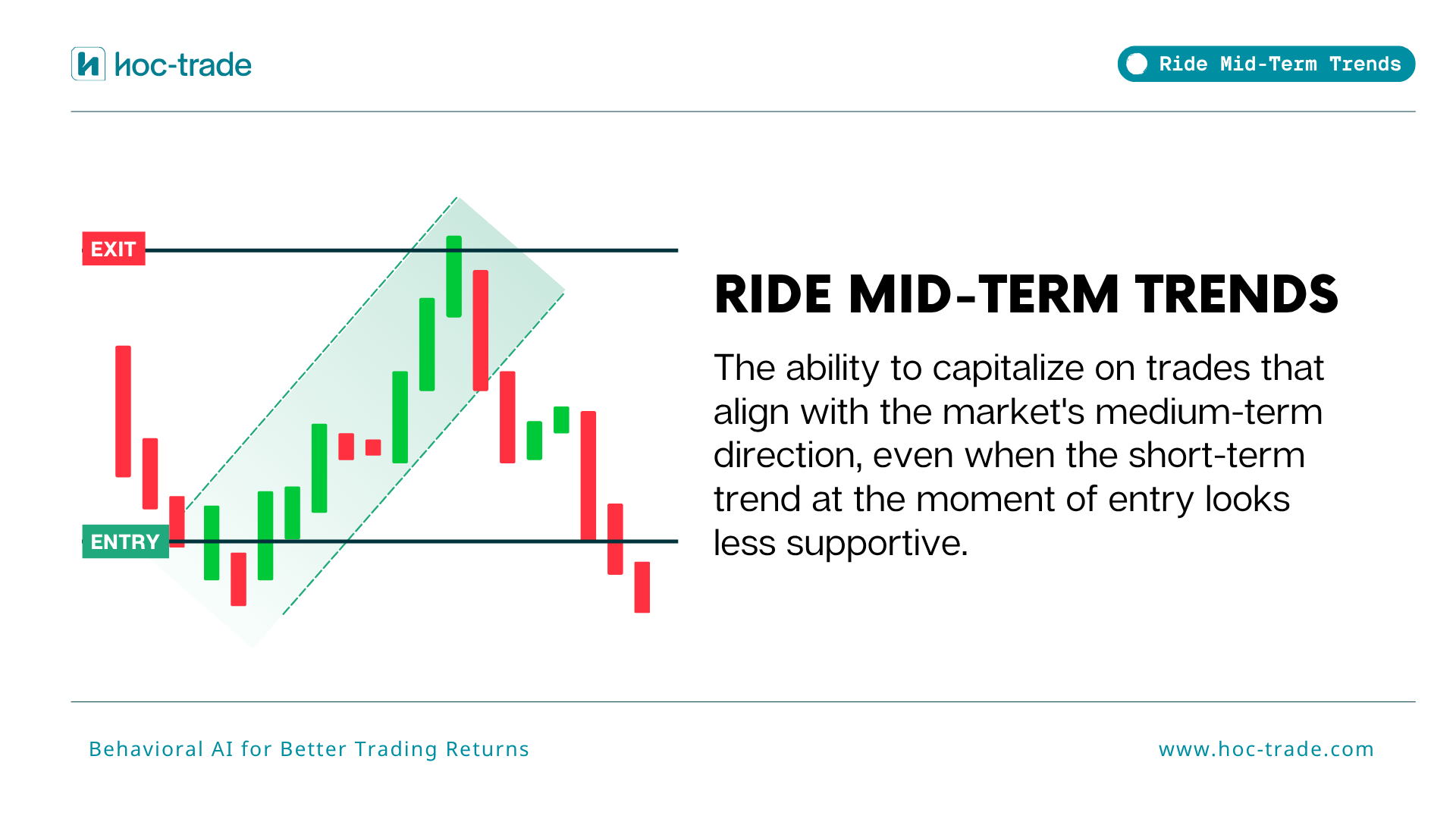
This isn't really about predicting where price goes next. It's about alignment. The trader isn't trying to call every small swing correctly. They're expressing a view on the medium-term environment and choosing moments inside that environment where the price gives them a workable way in.
What does ride mid-term trends look like in real trading behaviour?
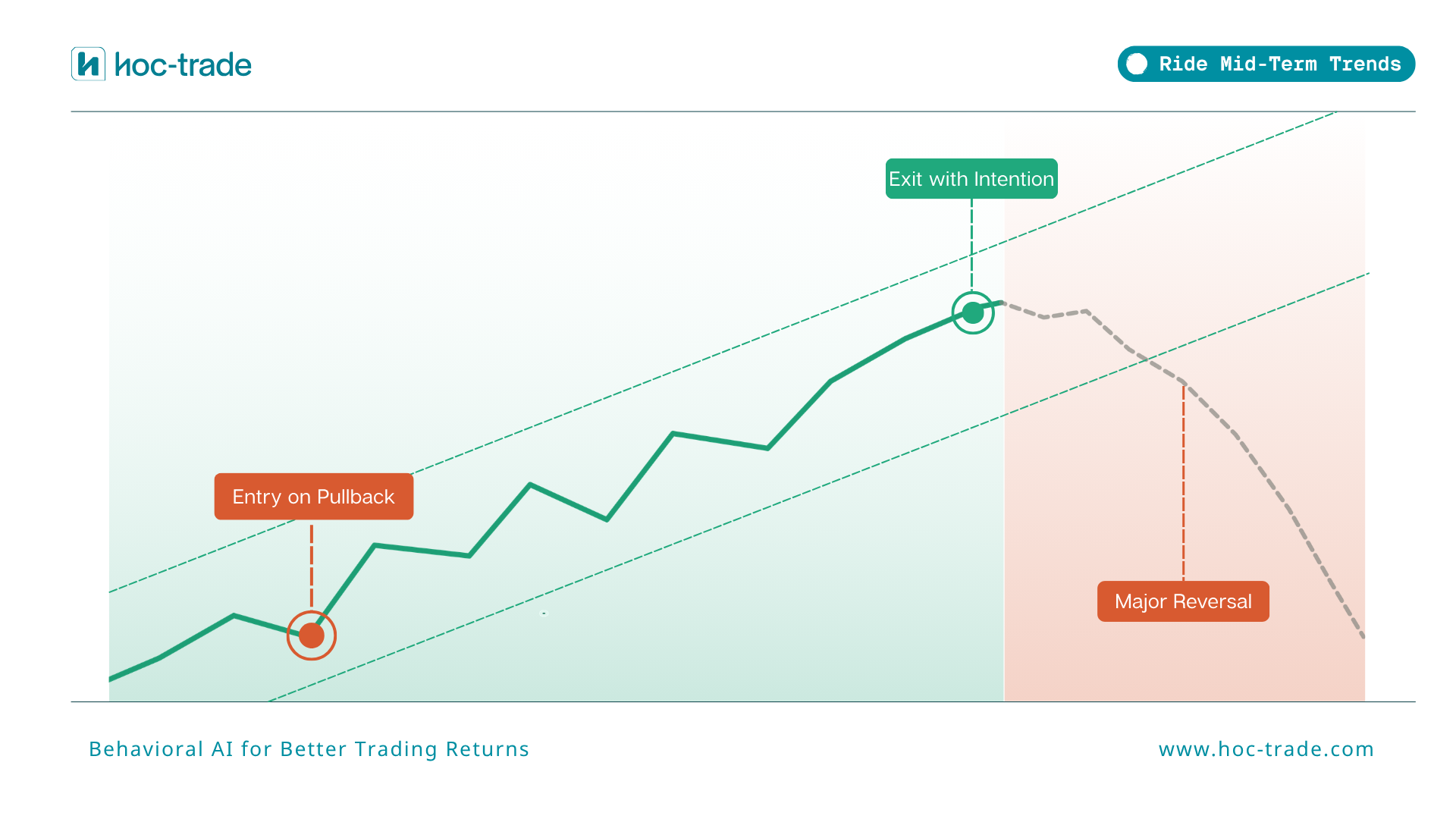
In practice, this strength often produces entries that look premature if you only look at the short-term chart. A trader might buy into a correction, a pullback, or a brief counter-trend swing, because the mid-term structure is still pointing the same way it always was. Nothing about this is impulsive. It's contextual: the entry answers to the mid-term trend, not to whatever noise happens to be triggering it.
Picture the NASDAQ grinding higher on the daily chart, then dropping 1.5% intraday after a hawkish comment from the Fed. Looked at in isolation, that looks like a warning sign. Most traders react by tightening stops or closing out altogether, protecting whatever gain they already have. A trader oriented to the mid-term trend reads the same drop as noise inside a larger move and holds through it. By the end of the week, the trend has reasserted itself and the position is sitting at new highs. The gap between those two outcomes isn't a different entry. It's a different relationship with discomfort.
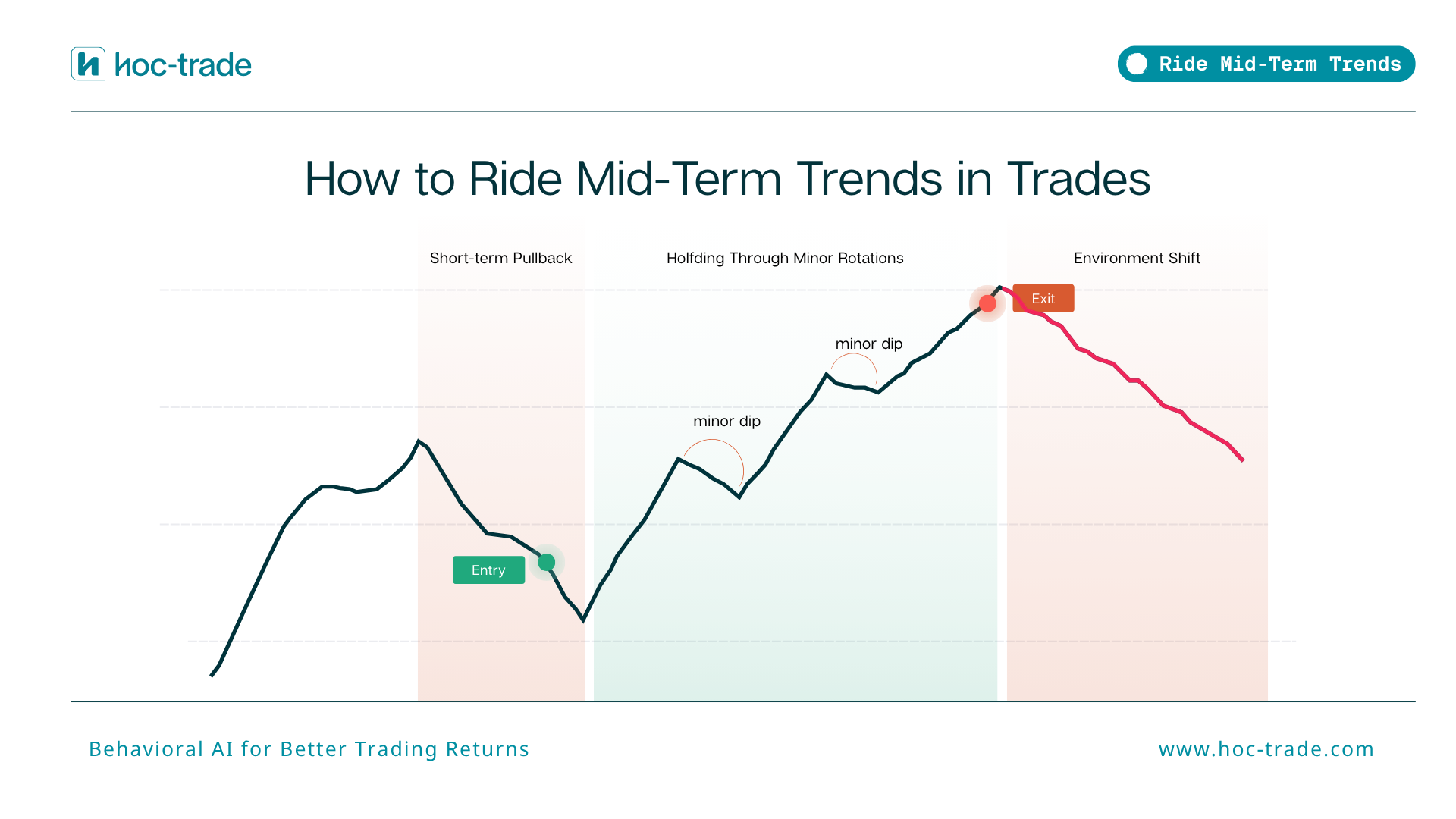
Trade management under this pattern tends to aim at capturing the larger move rather than banking small, frequent wins. Positions stay open long enough for the mid-term swing to express itself, even through minor pullbacks that a more reactive trader would treat as an emergency exit signal. Where many traders quietly cap their own results by closing too soon, this shows up as resistance to that instinct: staying with the position until it reaches a genuine point of completion rather than an arbitrary one.
Exits carry their own signature too. Rather than letting the position drift until the market forces a decision, the trader locks in gains ahead of a major reversal, which points to a structured approach to realising profit: gains are harvested as the move matures, not only when there's no choice left.
Why is holding through a mid-term trend a trading edge?
The edge here is consistency of alignment. When a genuine medium-term trend exists, direction carries real statistical and behavioural weight: momentum, positioning, and follow-through tend to feed each other. A trader who stays oriented to that backdrop depends less on perfect timing and more on reading the context correctly.
This also reshapes the distribution of outcomes over time. Capturing a larger share of a sustained move can matter more across a trading history than stacking up many small wins, because a handful of well-held trades can end up contributing a disproportionate share of overall results. The strength doesn't apply everywhere, since some conditions make trends genuinely hard to read. But when the market does offer a clear mid-term direction, the ability to stay in without being shaken loose by short-term countermoves becomes a durable advantage.
Why does the hold matter more than the entry?
Most traders already know how to get into a trend. The tools for that are well understood: moving averages, pullback entries, breakout confirmation. Staying in is a different skill entirely, and it's the one that separates traders who capture the full move from traders who take a slice off the top and watch the rest happen without them.
The pressure to exit early has a specific driver: fear of giving back an unrealised gain. The instant a position turns green, the question in a trader's head shifts from 'am I right about the direction?' to 'should I protect what I already have?' That reframing is where most of the value gets left on the table. A good entry into a strong trend can still deliver an average result if it's cut short at the first sign of friction. Held with discipline through ordinary pullbacks, that same entry produces a meaningfully different outcome. The entry is the easy part. The hold is the edge.
What does the data say about riding mid-term trends?
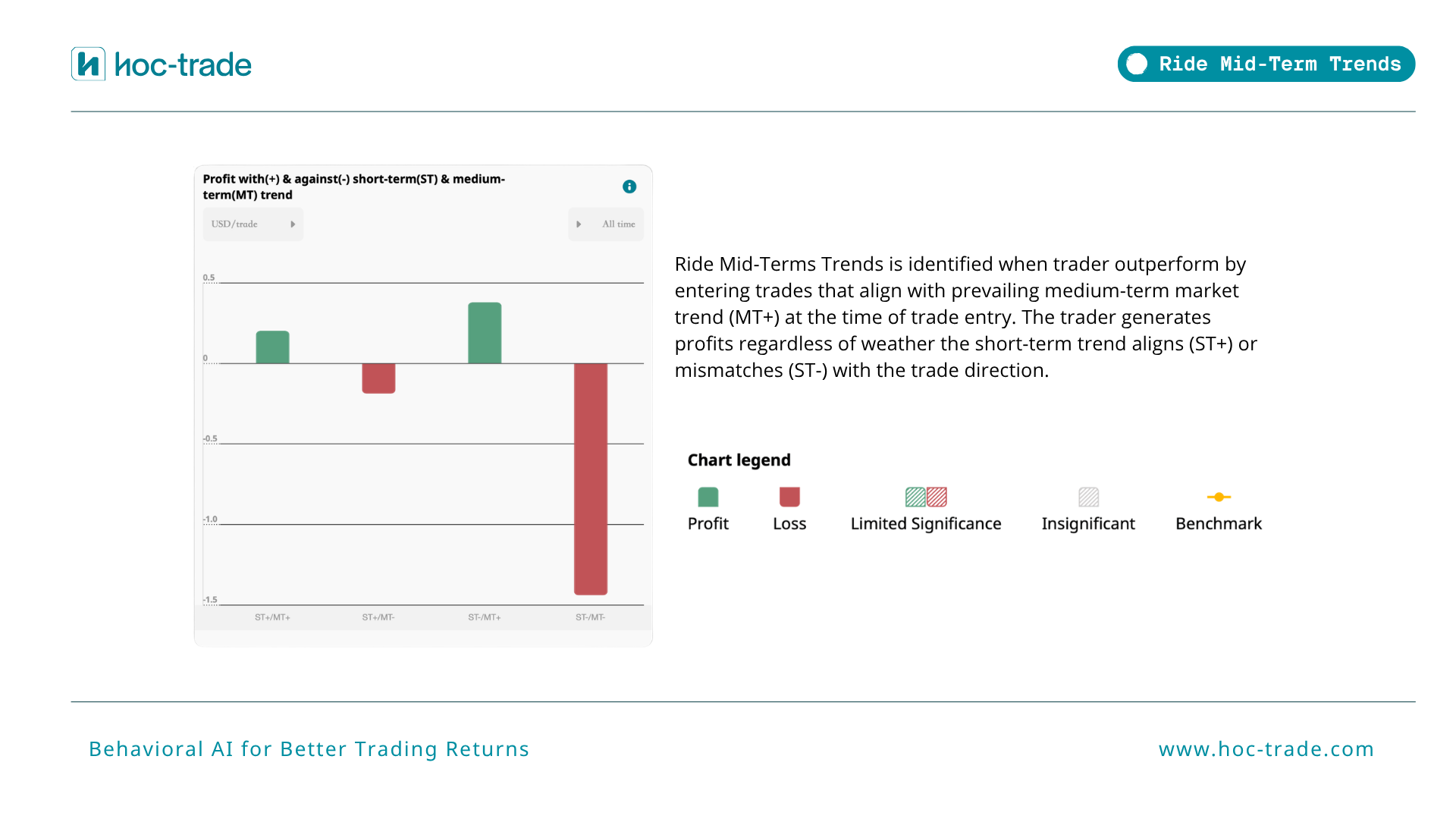
TradeMedic™ AI examines whether performance improves when trades are taken in the direction of the prevailing medium-term trend, classifying market structure using short- and medium-term moving averages across M15 and H4 timeframes, alongside each trade's direction. Across a dataset of 500,000+ trader accounts, TradeMedic looks for consistent outperformance in trades aligned with the mid-term trend regardless of the short-term picture at entry, which is what marks Ride Mid-Term Trends as a repeatable execution capability rather than a one-off result. Traders working on this pattern can compare their own hold behavior against these benchmarks through the TradeMedic platform, alongside related strengths like calm recovery and consistent risk management.
How can traders build on this strength?
The pattern is fairly clear across the data: larger moves get captured when an entry can tolerate a short-term correction, and when the position is held long enough for the trend to develop in full. What separates this from a lucky trade is repetition, the recurring ability to treat minor pullbacks as part of the trend's path while still recognizing the point where the market is genuinely approaching a reversal that changes the picture.
This is often framed as a discipline problem, and discipline is part of it. But there's more going on: it's also a question of context reading, of correctly separating a trend's normal texture from an actual shift in regime. Traders who struggle here often show up alongside patterns like impatient exits or premature profit taking, since the same discomfort with unrealised gains tends to drive both.
Over time, this strength tends to get more refined in how it balances patience against decisiveness, staying with a move without letting conviction slide into stubbornness. Once it shows up clearly in execution data, it stops being a story about 'being a trend trader' and becomes something more concrete: a demonstrated tendency to extract value from a medium-term direction, even when the short-term picture is arguing the opposite. Explore more behavioral patterns on the TradeMedic research page.
TradeMedic AI analyses over 60 behavioral patterns, including Ride Mid-Term Trends as a trading strength, across 500,000+ trader accounts. Visit TradeMedic to see how it works.
Watch How Initial Trade Setup is A Trading Edge
Frequently asked questions
What does it mean to ride a mid-term trend in trading?
Riding a mid-term trend means staying aligned with a market's medium-term direction even when the short-term picture at entry looks unsupportive. It involves recognising short-term corrections as part of the larger structure and holding with enough patience to let the trend develop, then exiting before a genuine reversal.
Why do traders exit winning trades too early?
The moment a position turns green, the psychological question shifts from whether the direction is correct to whether the gain needs protecting. That shift drives many traders to close positions at the first sign of short-term friction, even when the mid-term trend is still intact.
How does TradeMedic detect Ride Mid-Term Trends in trading data?
TradeMedic classifies market structure using short- and medium-term moving averages on M15 and H4 timeframes, then checks whether trades aligned with the medium-term trend outperform, regardless of the short-term trend at entry, across a dataset of 500,000+ trader accounts.
Is holding through a pullback the same as ignoring risk?
No. Riding a mid-term trend still involves a structured approach to exits, closing the position before a major reversal rather than letting the market force the decision. The pattern is about tolerating normal trend texture, not ignoring genuine warning signs.
Why does the hold matter more than the entry point?
Entry techniques like pullback entries and breakout confirmation are widely understood. Staying in a trade through normal short-term noise is a separate skill, and it's usually what determines whether a trader captures a full mid-term move or only a small piece of it.