Category:
 Author:
 Date:Sep 24, 2026
Range Trading: Why Trading Sideways Markets Separates Winners From Losers
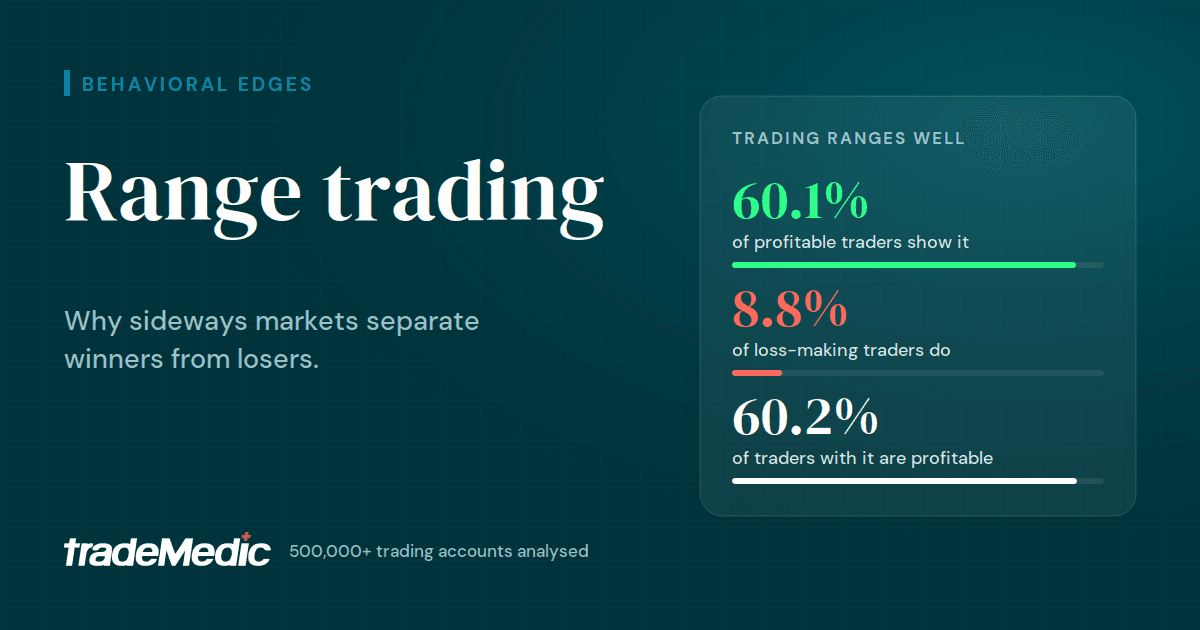
Across more than 500,000 trading accounts analysed by TradeMedic AI, the ability to make money in ranging markets is the single strongest habit we can detect. It appears in 60.1% of profitable traders and just 8.8% of loss-making ones, and 60.2% of the traders who have it are profitable, against 18.2% of all traders. No other strength separates the two groups as sharply.
Range trading means trading a market that is moving sideways: buying near the bottom of a price range, selling near the top, and treating the boundaries as the edges of the trade rather than signals to follow a trend. Most trading content treats ranges as dead time between trends. The data says the opposite.
This article explains what a ranging market is, how to recognise one, what the data says about traders who handle ranges well, what the research says about why ranges can be traded, and the mistakes that turn range trading into a losing strategy.
Let's start with what a ranging market is.
What is a ranging market?
A ranging market is one that moves sideways between a recognisable high and low, without clear upward or downward momentum. Price bounces between a ceiling, where sellers keep taking control, and a floor, where buyers keep stepping in. It is sometimes called a sideways market, a consolidation, or a range-bound market.
A ranging market is not the same as a calm one. Ranging describes direction: the market is going sideways. Calm describes volatility: the moves are small. A market can range violently, with large swings between the boundaries, and it can be calm while drifting slowly in one direction. TradeMedic AI measures both separately, and they often go together: 65.0% of traders who handle ranges well also perform well in calm markets, against 20.2% of all traders.
TradeMedic AI classifies every trade by the market environment it was placed in, including whether the market was trending or ranging at the time, and then measures how a trader performs in each. Trading ranging markets well is flagged as a strength when a trader consistently makes money in sideways, low momentum conditions.
Recognising a range while it is happening is the harder part.
How to identify a ranging market
Ranges have a few recognisable features. The price makes highs at a similar level and lows at a similar level, so support and resistance hold rather than break. Candles overlap heavily instead of stacking in one direction. Volatility falls compared with the preceding move. And on many indicators, the readings hover in the middle of their scale rather than showing sustained strength, or oscillate between overbought and oversold without the price making progress.
Two practical tests help. First, mark the last obvious high and low: if the price has crossed that band several times without closing beyond it, you are probably in a range. Second, ask whether a breakout has held. Ranges usually end with a decisive close outside the band, followed by continuation. Until that happens, the boundaries are still valid.
The mirror image is just as important: in a range, the moves that look like breakouts are often the ones that fail. Traders who read those as trends end up fighting the trend in one direction or catching falling knives in the other, and both are linked to the weakest results in the dataset.
So how much difference does handling ranges well make?
How profitable is range trading?
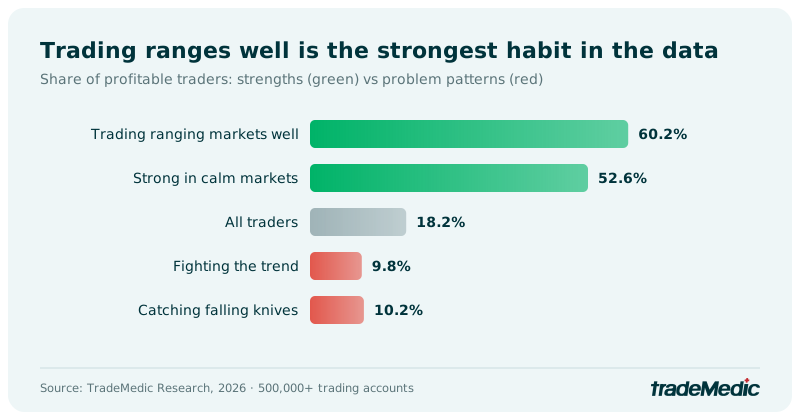
Among traders who trade ranging markets well, 60.2% are profitable. That is the highest share of any of the 20+ strengths TradeMedic AI detects, and more than three times the 18.2% average. For comparison, traders who perform well in calm, low-volatility markets are profitable 52.6% of the time, while traders who suffer from fighting the trend are profitable 9.8% of the time and those who suffer from catching falling knives 10.2%.
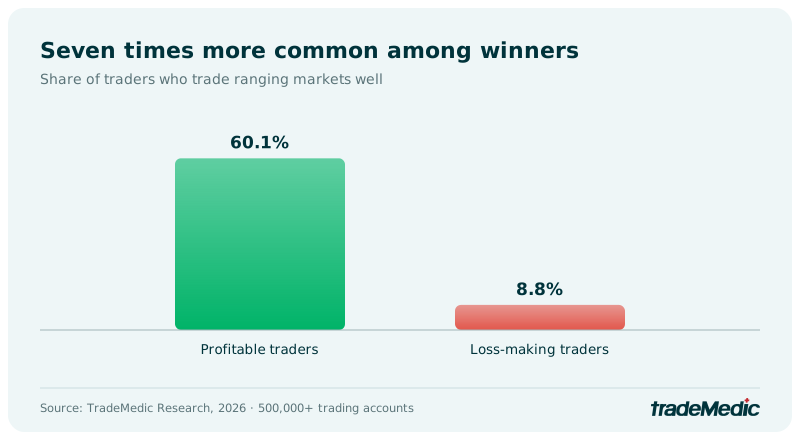
The gap between winners and losers is just as stark. The strength appears in 60.1% of profitable traders and 8.8% of loss-making traders, a ratio of almost seven to one, the widest of any habit we measure.
It is not rare, either: the strength is detected in 18.2% of all traders, and it becomes more common with experience, rising from 9.1% of accounts under 10 days old to 17.1% of accounts trading for more than 200 days.
If you want to know whether ranges are one of your strengths, TradeMedic AI checks your trade history for this and 20+ other strengths, alongside the patterns that cost you money. Connect your trading account free.
Style matters too.
Which traders trade ranges best?
Swing traders are the most likely to have this strength among their five biggest, at 20.2%, compared with 12.0% of day traders and 10.7% of scalpers.
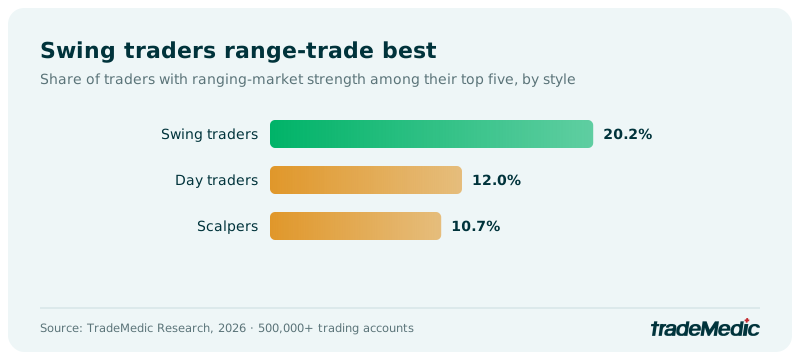
That fits the mechanics of the strategy. A range gives a defined entry, a defined invalidation point just beyond the boundary and a target at the other side, which suits traders who are willing to wait for price to come to them. Swing traders are also the most profitable group overall, at 27.5%.
It also fits what we see by instrument: traders whose main pair is AUDCAD, a slow and often range-bound pair, are profitable 42.2% of the time, more than twice the average, as covered in our analysis of the best forex pair to trade.
Numbers aside, it is worth saying what this strength means in practice.
What it means if range trading is one of your strengths
If TradeMedic AI flags trading ranging markets as one of your strengths, it means something specific: you make money in the conditions most traders wait through. That is a valuable place to have an edge, for three reasons.
You are not dependent on a trend appearing. Trends are the conditions every trader is watching for, and they are the minority of the time in most instruments. A trader whose edge is in ranges has more days that suit them, and less pressure to force trades while waiting.
Ranges give you cleaner risk. A range gives a defined entry near a boundary, a defined invalidation just beyond it and a target on the other side. That structure is what makes the good range trades repeatable, and it is why range traders in our data are also far more likely to stick to their initial trade setup.
It is a rare edge. Being good at following trends is common: trend following appears in 36.6% of profitable traders and 35.4% of loss-making ones. Being good at ranges is not: 60.1% against 8.8%. If it is your strength, you have something most traders in the dataset do not.
The practical consequence is to lean into it rather than trade around it. Traders who know ranges are their strength tend to do better by choosing range-friendly instruments and sessions, sizing their best setups within their normal risk rules, and stepping aside when the market starts trending, instead of trying to trade every condition equally well. And if ranges are not your strength, the same logic applies in reverse: the point of measuring is to find which conditions pay you, and to spend more of your time there.
There is a wider lesson in this, and it is not a comfortable one.
Why the boring skills are the ones that separate traders
Set the strengths side by side and a pattern appears. The habits that separate profitable traders from losing ones are the quiet ones. Trading ranging markets is 6.8 times more common among profitable traders than among loss-making ones. Performing well in calm, low-volatility markets is 5.0 times more common. Recovering calmly after a loss, 4.2 times.
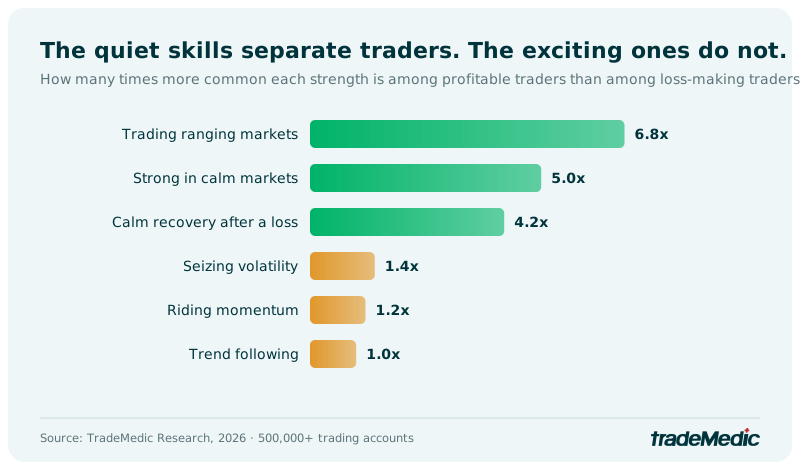
The exciting ones separate almost nobody. Seizing volatility is 1.4 times more common among profitable traders, riding momentum 1.2 times, and trend following 1.0 times, which is to say not at all. Catching a breakout on a fast market is the skill most traders want. It is also the skill that tells you least about whether a trader makes money.
This is worth sitting with, because it runs against how trading is usually taught and sold. The content that gets attention is about big moves, news events and breakouts. The behaviour that shows up in profitable accounts is the opposite: waiting through quiet conditions, trading a market that is going nowhere, taking a defined trade between two levels and being unremarkable about it.
If you are choosing what to get good at, this is the answer the data gives. Learning to handle ranging and calm markets is slower and less interesting than learning to catch the next big move, and it is what separates the two groups most clearly. Our article on trading in low-volatility markets covers the other half of the same lesson.
The habits that come with it are just as revealing.
What else do range traders do well?
Comparing strengths against each other shows a clear profile. Traders who handle ranging markets well are far more likely to also perform well in calm markets (65.0%, against 20.2% of all traders), to recover calmly after a loss (37.7% against 16.0%), to stick to their initial trade setup (20.8% against 9.3%) and to focus on a small number of instruments (24.7% against 11.5%). They are also more selective, with 58.6% showing the Selective Trades strength against 38.3% of all traders.
What is missing from that list matters just as much. Trend following is no more common among range traders than among everyone else (35.8% against 35.7%), and seizing volatility is slightly less common (20.3% against 23.3%). Range traders are not traders with an extra skill in trends. They are patient, selective traders who have found conditions that suit them and mostly stay there.
Why should trading a range work at all?
Why does range trading work? What the research says
Prices tend to reverse over short horizons. Studies of short-horizon returns by Narasimhan Jegadeesh and by Bruce Lehmann found that stocks which rose in the past week or month tended to fall back in the next one, and vice versa, so contrarian strategies produced positive returns over those horizons. Later work argued that part of these gains reflects delayed price reactions and trading frictions rather than pure overreaction, and that costs eat into them, which is a fair warning for anyone trading ranges with high frequency.
Trends persist over months, then partly reverse. In a study of 58 futures and forward markets, including currencies, indices and commodities, Tobias Moskowitz, Yao Hua Ooi and Lasse Pedersen found that returns continue in the same direction for up to about a year, before partially reversing over longer horizons. Between those horizons, markets spend long stretches going nowhere, which is where range trading lives.
Buying weakness is often rewarded, at the right horizon. Research by Ron Kaniel, Gideon Saar and Sheridan Titman found that individual investors tend to buy after prices fall, and that stocks they bought heavily earned positive excess returns over the following month. The instinct to buy dips is not wrong in itself. It becomes wrong when the market is not ranging.
Put together: mean reversion is real at short horizons and trends are real at medium ones. Range trading works when a trader correctly identifies which of the two they are in, which is exactly what the strength measures.
One caveat belongs here, before the numbers above get over-read. The strength is detected from results: a trader is flagged as handling ranges well when their trades in sideways conditions consistently make money. So the link between the strength and profitability is partly built into how it is measured, and the figures do not prove that switching to range trading makes a trader profitable. What they do show is where profitable traders earn their money. Many traders make theirs in trends instead, and the point of measuring both is to find out which one describes you.
That also explains where range trading goes wrong.
Why range trading fails: the most common mistakes
Trading a range that has already ended. The most expensive version is buying into a market that has broken down, which our data records as catching a falling knife: 46.0% of traders do it, and only 10.2% of them are profitable.
Refusing to accept the breakout. Once the range breaks, holding the old view leads to fighting the trend, which appears in 35.8% of traders, of whom 9.8% are profitable.
Adding to the losing side of the range. If price pushes through the boundary, averaging down turns a small loss into the most expensive pattern in the dataset. Doubling down causes 32.5% of the losses of the traders who show it.
Trading every small swing inside the range. Ranges tempt traders into frequent entries, which raises costs and pulls in overtrading. Relative to the daily range, costs are highest in exactly the markets many range traders prefer, as our analysis of trading fees by instrument shows.
No invalidation level. A range trade without a stop just beyond the boundary has no definition of being wrong, and that is where range trading turns into hoping.
The fixes follow directly from the mistakes.
How to trade ranging markets
The steps below are common practice among range traders rather than findings from our data, but each one addresses a failure mode the data does show.
1. Mark the boundaries before you trade, not during. Define the high and the low of the range in advance, and place limit orders at your level instead of chasing price inside the band.
2. Put the stop just beyond the boundary. The range is your thesis; a decisive close outside it is your evidence that the thesis is wrong.
3. Take profit at the other side, not at the exact extreme. Targets set slightly inside the opposite boundary fill more often than targets at the edge.
4. Trade fewer swings, not every swing. One or two well-placed trades per range beat a dozen small ones once costs are counted. This fits the data: 58.6% of traders who handle ranges well also show the Selective Trades strength.
5. Have a rule for the breakout. Decide in advance what you will do if the range breaks: stand aside, or trade the breakout in the new direction. Anything else becomes fighting the trend.
6. Know whether ranges are your strength. Some traders make money in ranges and lose it in trends, and some the other way around. TradeMedic AI measures your results by market environment, so you can see which conditions suit you rather than guessing.
The bottom line on range trading
Range trading is not the quiet part between the real moves. In TradeMedic AI data it is the habit that separates profitable traders from losing ones more sharply than any other: it appears in 60.1% of profitable accounts against 8.8% of losing ones, and 60.2% of the traders who have it are profitable. The research explains why it can work, with short-horizon reversals on one side and medium-term trends on the other. And the failures are behavioural rather than technical: trading a range that has already broken, refusing to accept the breakout, adding to the losing side, and trading every swing inside the band. The wider lesson is the uncomfortable one: the quiet skills, ranges and calm markets, separate winners from losers many times more sharply than the exciting ones such as momentum and breakouts, which barely separate them at all.
→ Learn more about TradeMedic AI
Research behind this article
Jegadeesh, N. (1990). Evidence of Predictable Behavior of Security Returns. The Journal of Finance, 45(3), 881 to 898.
Lehmann, B. N. (1990). Fads, Martingales, and Market Efficiency. The Quarterly Journal of Economics, 105(1), 1 to 28.
Moskowitz, T. J., Ooi, Y. H., and Pedersen, L. H. (2012). Time Series Momentum. Journal of Financial Economics, 104(2), 228 to 250.
Kaniel, R., Saar, G., and Titman, S. (2008). Individual Investor Trading and Stock Returns. The Journal of Finance, 63(1), 273 to 310.
TradeMedic Research (2026). Behavioural pattern analysis of 500,000+ retail trading accounts. Source: TradeMedic Research, 2026.
Frequently asked questions
What is range trading?
Range trading means trading a market that moves sideways between a recognisable high and low: buying near the floor, selling near the ceiling, and using a decisive close outside the band as the signal to stop. In TradeMedic AI data from 500,000+ trading accounts, 60.2% of traders who handle ranging markets well are profitable, against 18.2% of all traders.
How do I identify a ranging market?
Look for highs at a similar level and lows at a similar level, heavy overlap between candles instead of directional progress, and falling volatility compared with the preceding move. A practical test: mark the last clear high and low, and treat the market as ranging until price closes decisively outside that band.
What is the best strategy for a range-bound market?
Define the range boundaries before trading, enter with limit orders near the edges rather than chasing price, place the stop just beyond the boundary, target the opposite side slightly inside the extreme, and decide in advance what to do if the range breaks.
Is range trading the same as mean reversion?
They overlap. Mean reversion is the broader idea that prices tend to return towards an average; range trading applies it between two defined boundaries. Research on short-horizon returns found that prices which rose in the past week or month tended to fall back in the next, which is the effect both rely on.
Is range trading better than trend trading?
In TradeMedic AI data they separate traders very differently. Trend following appears in 36.6% of profitable traders and 35.4% of loss-making ones, so it barely distinguishes the two groups, while handling ranging markets well appears in 60.1% of profitable traders and 8.8% of loss-makers. That does not make ranges better for every trader, but being good at trends is common, while being good at ranges is rare.
Which trading style suits range trading best?
Swing traders. In TradeMedic AI data, 20.2% of swing traders have the ranging-market strength among their five biggest, compared with 12.0% of day traders and 10.7% of scalpers. Swing traders are also the most profitable group overall at 27.5%.
How do I trade support and resistance in a range?
Treat the range boundaries as zones rather than exact prices: place entries slightly inside them, stops beyond them, and wait for price to come to you instead of entering mid-range. The decisive close outside the zone is what invalidates the trade.