Category:
 Author:
 Date:Apr 9, 2026
Sufficient Breaks: Why the Pause Between Trades Protects Your Edge
There is a habit that rarely gets discussed in trading psychology, and it has nothing to do with entries or exits. It is the gap you leave between closing one position and opening the next. Traders who protect this gap consistently show steadier decision making, and Hoc-trade's behavioural data ties it directly to stronger long-term outcomes.
What is the Sufficient Breaks pattern in trading?
Sufficient Breaks describes a trader's tendency to build real pauses into their trading day rather than moving straight from one position into another. It is not about trading less. It is about the space between decisions, and whether that space is long enough for the previous outcome to stop influencing the next one.
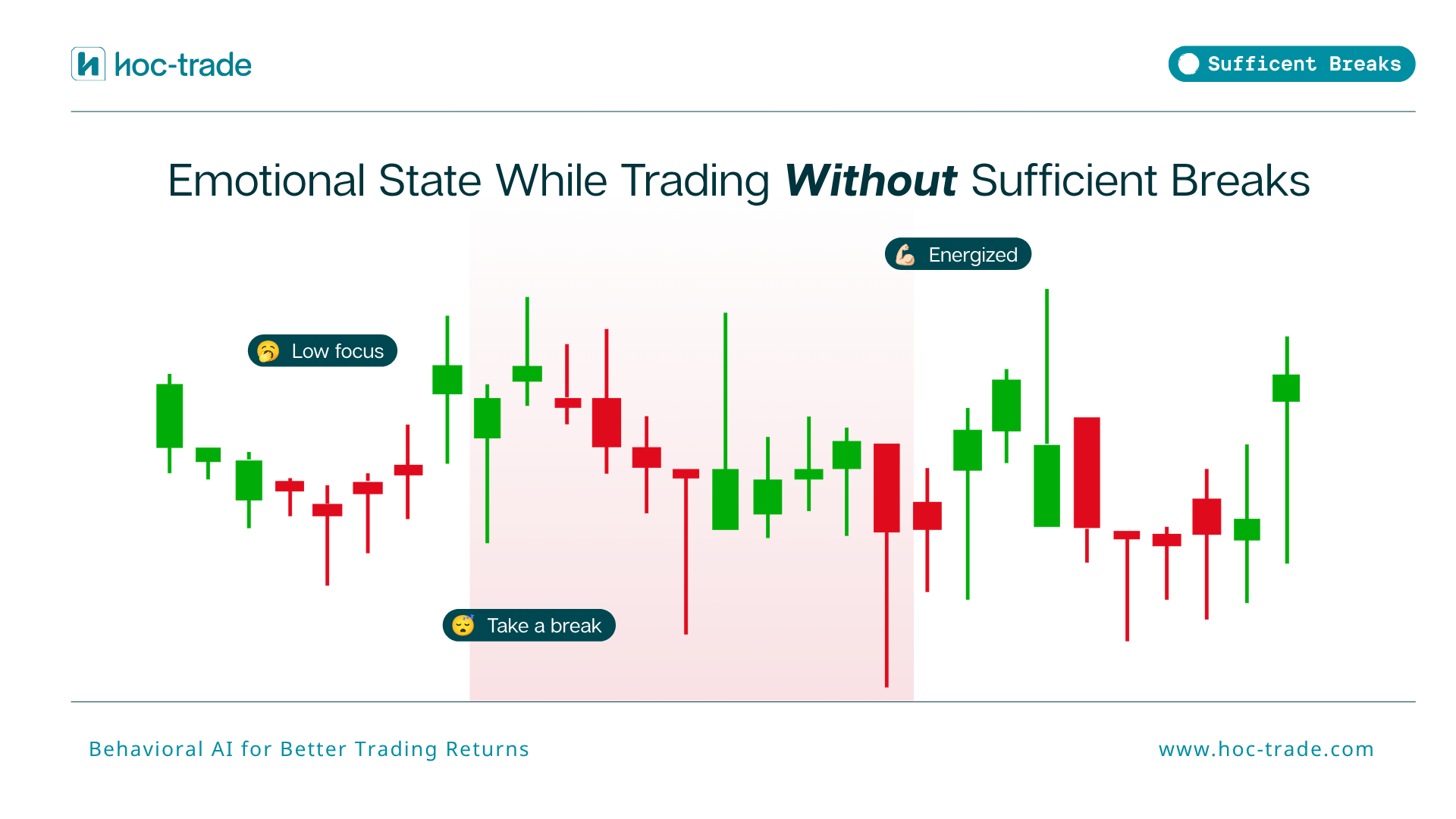
A trader with strong Sufficient Breaks steps away deliberately at key moments. The next decision then comes from a settled state of mind rather than as a reaction to what just happened. This distinction, between deciding and reacting, is what separates a repeatable process from a string of impulses.
Why does taking a break after a loss prevent revenge trading?
After a loss, urgency tends to override evaluation. The instinct is to get back into the market immediately and recover what was lost, and that instinct is exactly what revenge trading feeds on. A deliberate pause interrupts that slide before it starts.
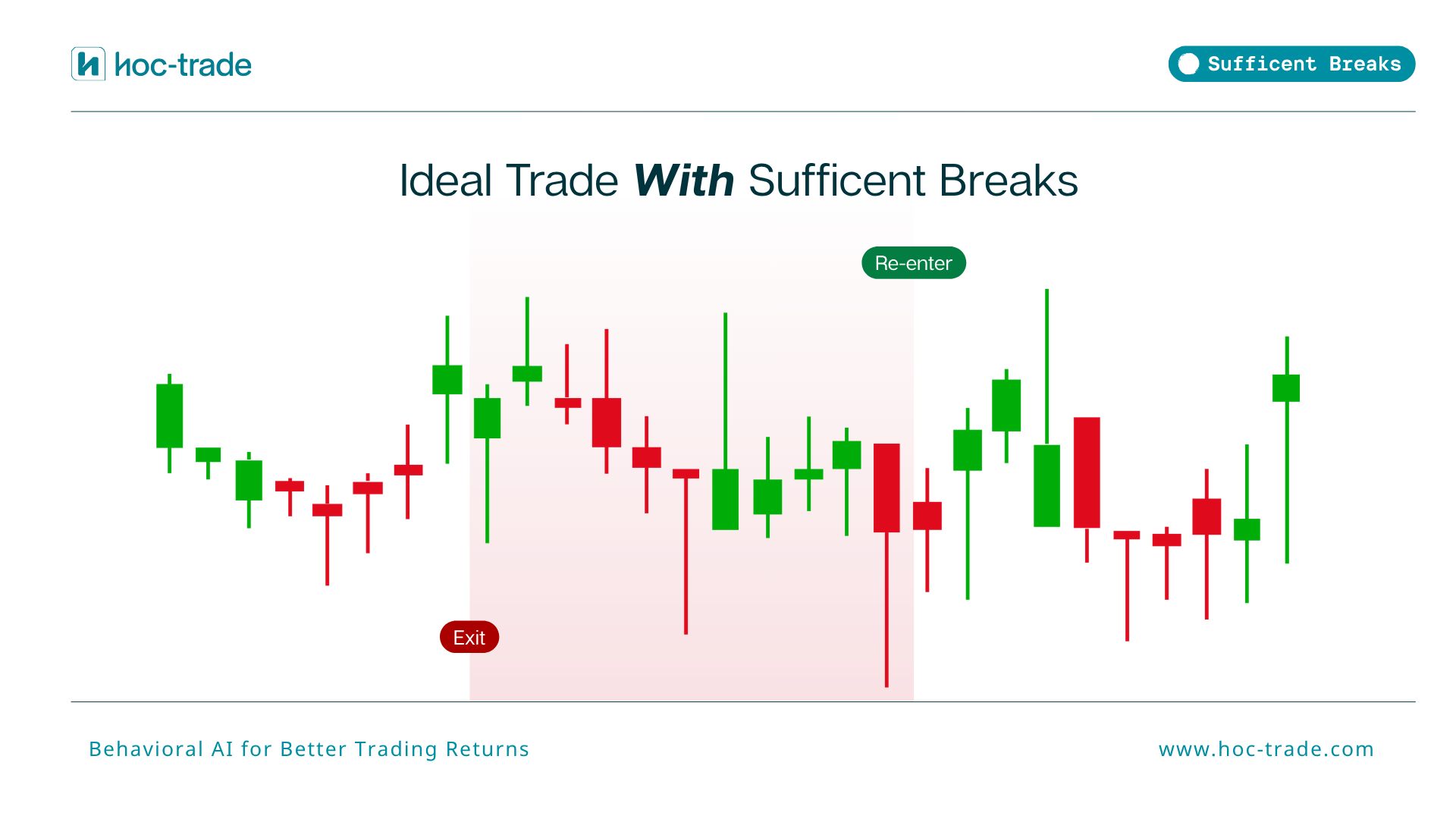
This is often framed as a discipline problem, and discipline is part of it. But there's more going on. The break itself is a mechanism, not just willpower. Stepping away creates the physical and mental distance needed to review what happened without spiralling into over-analysis, and to return with a wider read on market conditions instead of a narrow focus on the last candle.
This is closely related to the pattern behind revenge trading, where the gap between trades often collapses to almost nothing right after a loss.
Does a break matter after a winning trade too?
Breaks are not only a loss-side tool. After a win, the temptation runs in the opposite direction: sizing up because momentum feels good, or entering the next trade faster because confidence is high. Without a pause, that drift toward overconfidence rarely gets checked before it shows up in the next position.
The same gap that protects a trader after a loss also protects them after a win. It gives the brief window needed to ask whether the next trade is justified by conditions, or simply by the feeling of the last one.
How does spacing out trades improve long-term performance?
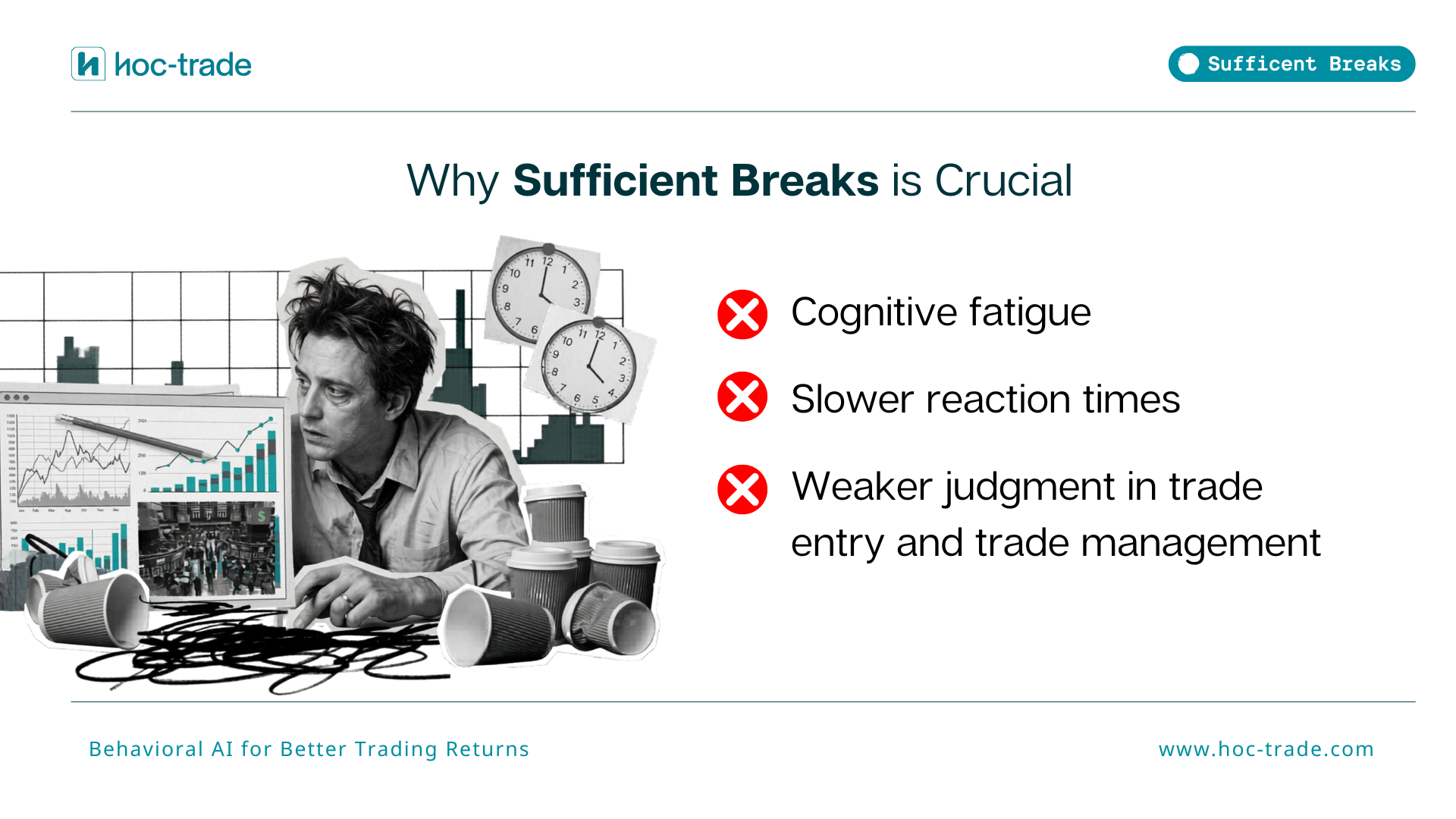
Prolonged intensity has a cost. Reaction times slow, judgement narrows, and both entries and trade management start to suffer under sustained cognitive fatigue. Traders who space their decisions out consistently protect execution quality across a much larger number of trades than those who don't.
Over time, the effect compounds. Fewer trades get taken purely to chase a feeling, and more get taken with clear intent and stable attention. Performance starts to depend less on hot streaks and more on a repeatable process, which is the foundation TradeMedic looks for when assessing a trader's long-term profile through TradeMedic.
Traders working on overtrading often find that rebuilding the gap between trades is the first change that moves the needle, before any adjustment to entries or exits.
What does the data say about breaks between trades?
TradeMedic™ AI detects Sufficient Breaks by measuring the time between the close of one trade and the opening of the next, across a dataset of 500,000+ trader accounts. The model then checks whether longer pauses correlate with stronger subsequent trade performance for that individual trader.
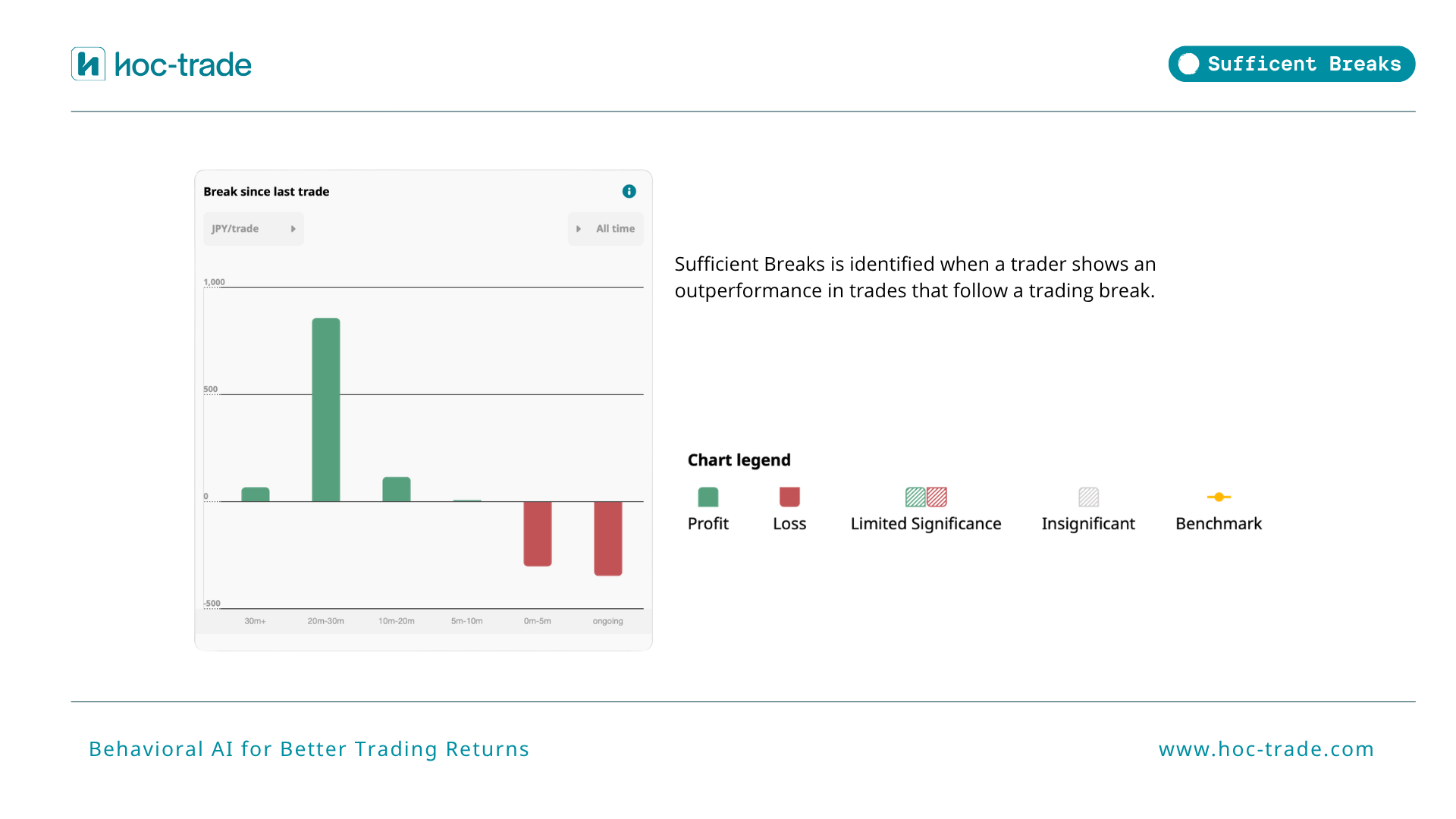
Where the data confirms that trades taken after longer breaks consistently outperform, Hoc-trade surfaces that spacing pattern as a validated strength rather than treating it as a personal habit. A fuller breakdown of break-length thresholds and their effect on performance is available on our research page.
Building sufficient breaks into a trading routine is one of the simplest structural changes available, and one of the most consistently underrated. The gap after a trade is not dead time. It is where the next good decision actually gets made.
TradeMedic AI analyses over 60 behavioural patterns, including Sufficient Breaks as a trading strength, across 500,000+ trader accounts. Visit TradeMedic to see how it works.
Watch Why Sufficient Breaks are Crucial
Frequently asked questions
What is the Sufficient Breaks pattern in trading?
Sufficient Breaks is a trader's tendency to build a real pause between closing one trade and opening the next. It matters because it stops the previous outcome, win or loss, from directly shaping the next decision.
Why does a pause after a loss reduce revenge trading?
After a loss, urgency tends to replace evaluation, which is what drives revenge trading. A deliberate break interrupts that urgency and gives a trader room to review the loss calmly before acting again.
Does taking a break after a winning trade matter?
Yes. Wins can push traders toward overconfidence and larger position sizes simply because momentum feels good. A break after a win creates space to check whether the next trade is justified by conditions rather than by the last result.
How does Hoc-trade measure Sufficient Breaks?
TradeMedic™ AI measures the time between the close of one trade and the opening of the next across a dataset of 500,000+ accounts, then checks whether longer breaks correlate with stronger subsequent performance for that trader.
How long should a break be between trades?
There is no single fixed length that works for every trader. What matters is whether the gap is long enough for the trader's own data to show a clear performance improvement, which is why Hoc-trade calculates this per account rather than applying one rule to everyone.