Category:
 Author:
 Date:Feb 6, 2026
Symbol Focus: Why Narrowing Your Symbol List Can Sharpen Trading Decisions
A trading session rarely announces itself as chaotic. It just starts to feel that way: three charts moving at once, a headline landing mid trade, attention snapping from one instrument to the next before a single idea gets finished. On days like that, the constraint most traders run into usually isn't a shortage of setups. It's a shortage of attention. As the number of moving parts goes up, the quality of a trader's decisions depends less on finding opportunity and more on whether they can stay deliberate instead of reactive.
What is Symbol Focus in trading?
Symbol Focus describes a trader's capacity to protect mental clarity when conditions get fast and demanding. It's built around a simple structural habit: pausing between decisions rather than moving straight from one trade into the next. Those pauses do real work. They lower stress, keep reactions closer to rational, and give a trader's concentration somewhere to reset before the next call has to be made.
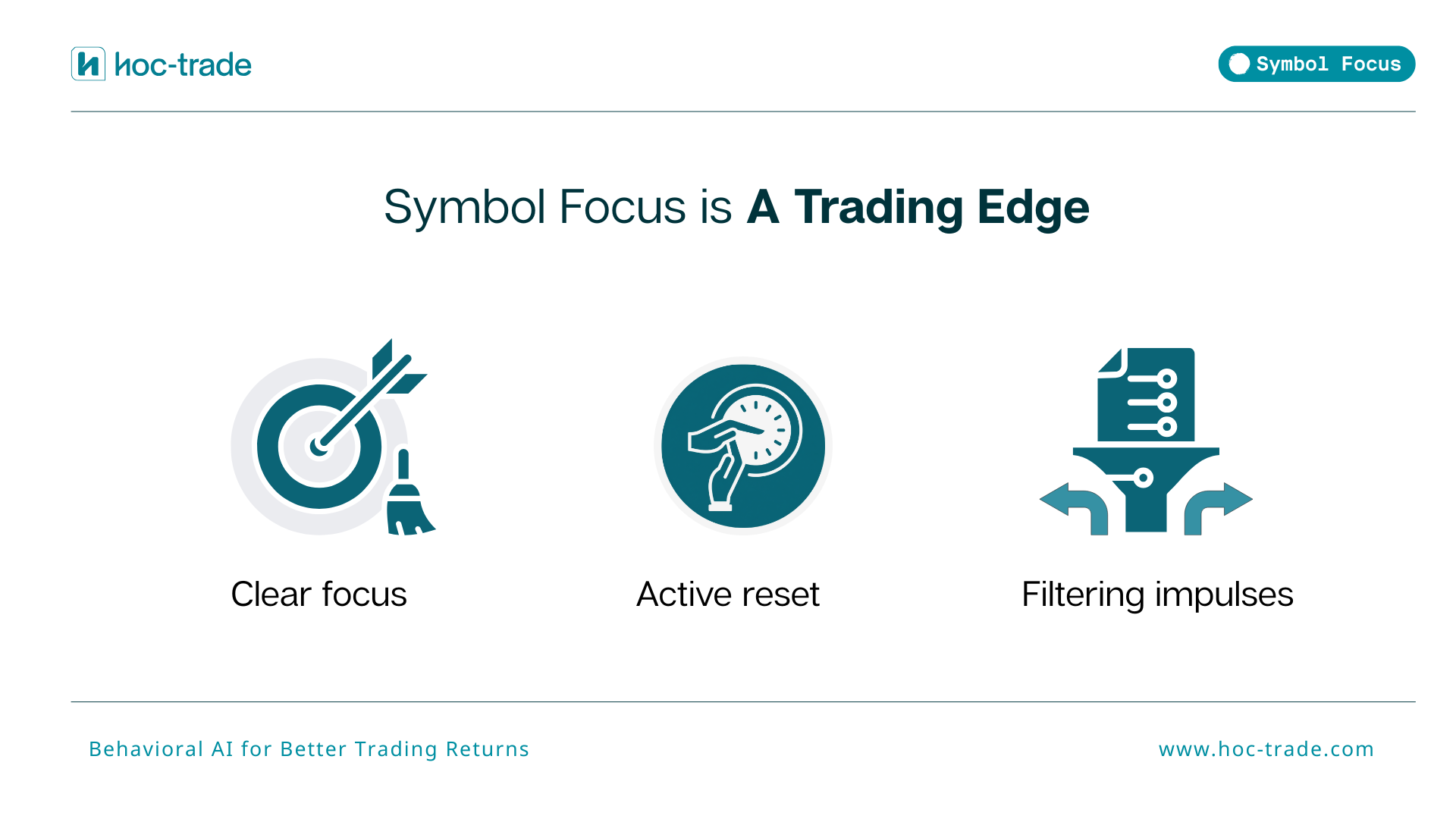
Trading with this rhythm doesn't guarantee anything on its own, but it does something more durable: it filters out the impulses that tend to hijack judgment right after a big swing. A loss creates pressure to make it back immediately, which can distort both timing and selection. A win creates the opposite pressure, confidence that nudges a trader into risk they wouldn't normally take. The pause in between gives space to review what actually happened before re-entering, and it doubles as a kind of zoom out, pulling attention away from the immediate flicker of price and back toward the wider picture.
How does trading fewer symbols at once protect decision quality?
In practice, Symbol Focus tends to show up as a narrower battlefield rather than a longer pause. Traders who exhibit it are often working a limited set of symbols at any given moment, not because they lack opportunities elsewhere, but because fewer simultaneous instruments means less competing for attention. With that smaller universe, it becomes easier to separate a genuinely strong setup from a mediocre one, to manage open positions with more precision, and to stay on top of the news that's actually relevant instead of skimming headlines for everything at once.
What does Symbol Focus look like in real trading behavior?
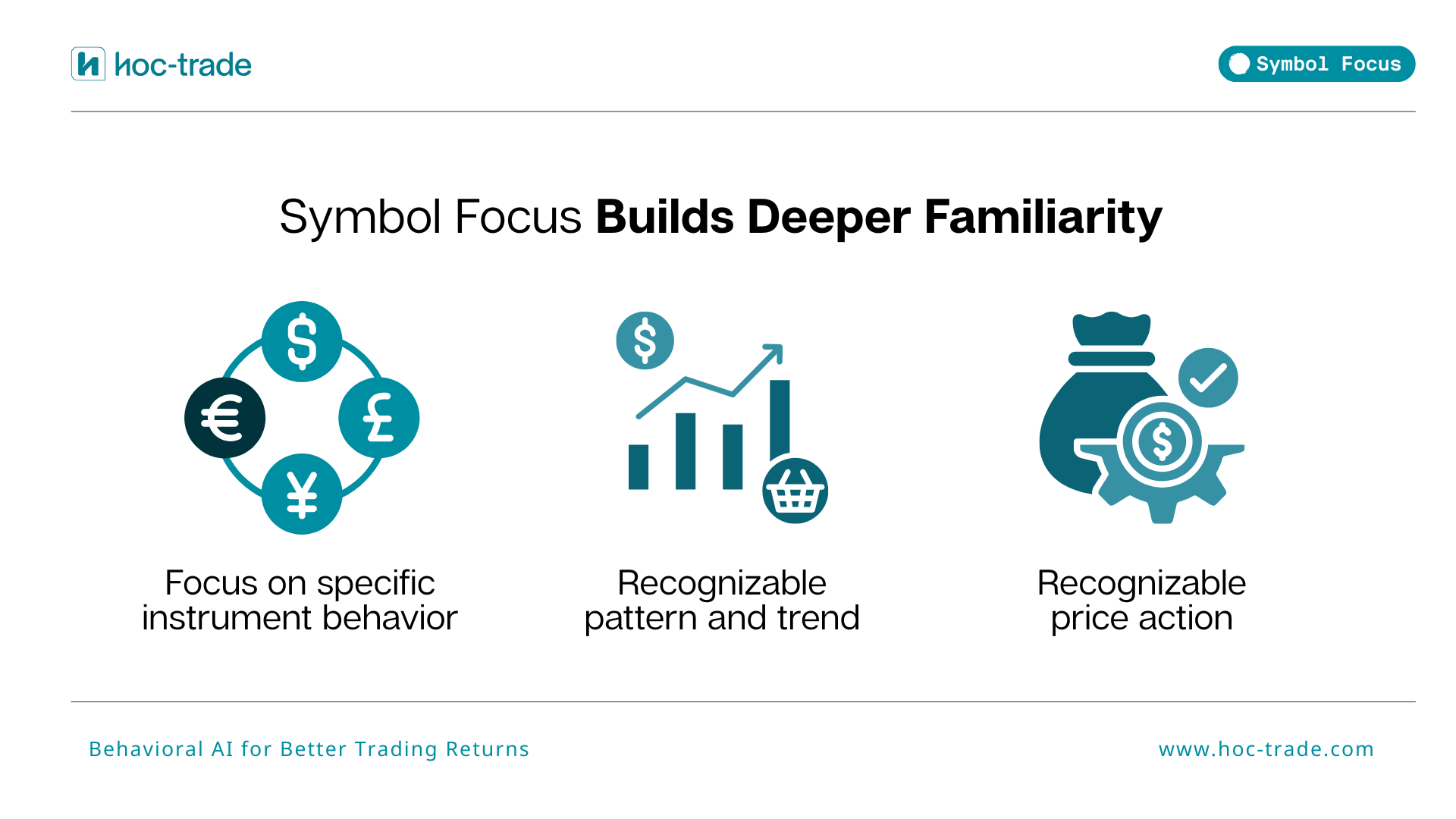
Over time, working the same small set of instruments builds a kind of fluency that's hard to shortcut. Patterns, tendencies, and the particular rhythm of how a given symbol tends to move become recognizable in a way they never do when attention is split across a dozen unrelated markets. None of this shows up as intensity or nonstop activity, quite the opposite: it reads as cleaner trade selection, steadier monitoring, and calmer management, simply because there are fewer open positions demanding attention at the same moment.
The same narrowing also shows up as restraint. When a trader intentionally keeps their symbol universe small, there's less pull toward chasing whatever happens to be moving that day. Execution starts to feel less like reacting to stimulus and more like operating inside familiar territory, where entries, exits, and timing can be handled with a level of confidence that's difficult to fake.
Why is Symbol Focus considered a trading edge?
The edge here comes from repeatability rather than any single well timed trade. When attention stays concentrated, both selection and management lean less on adrenaline in the moment and more on conditions the trader has actually seen before. Markets can still move violently, and a focused trader's process is still exposed to volatility, it's just less likely to buckle under several signals arriving simultaneously.
This is also a fit between trader and environment. In sessions where a lot of instruments are competing for attention at once, the ability to narrow scope and hold onto clarity tends to preserve execution quality across a much larger sample of trades. That's the real payoff, not one good trade, but a decision making process that stays coherent even when the market is offering more than any one person can reasonably process.
How does Hoc-trade detect Symbol Focus in trading data?
Hoc-trade surfaces Symbol Focus by looking directly at the relationship between symbol load and trading outcomes. The question it's answering is whether performance improves as the number of concurrently open symbols goes down, and whether stronger overall profitability tends to show up specifically under conditions of fewer simultaneous positions. When that relationship holds, limiting concurrent symbols correlates with stronger results, and Symbol Focus is flagged as present.
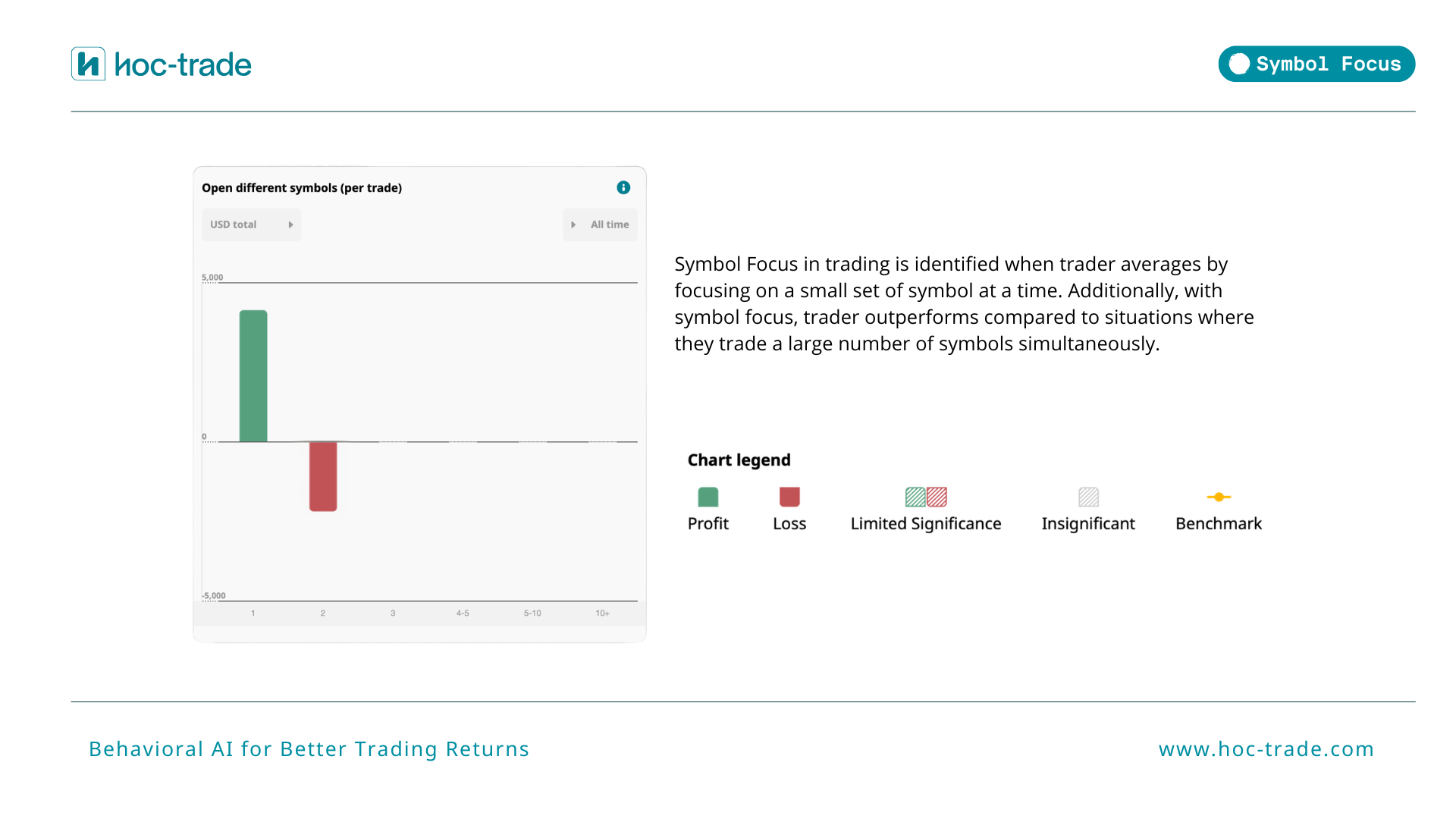
To confirm the pattern rather than assume it, Hoc-trade classifies each trade by how many other symbols were open at the moment of entry. Comparing performance across those classifications is what separates a genuine execution advantage from a trader simply preferring to keep things simple.
What does the data say about Symbol Focus?
TradeMedic AI tracks Symbol Focus across a dataset of 500,000+ trader accounts, comparing outcomes at different levels of concurrent symbol load for each individual trader. Because the relationship between focus and performance can look different from one trader to the next, TradeMedic calculates a personal read on how much this pattern is actually shaping someone's results, rather than applying a single blanket rule. Traders working through related patterns like overtrading or distracted trading often see Symbol Focus surface as part of the same underlying picture.
Read as a whole, Symbol Focus looks less like a single skill and more like a compounding habit. A smaller working set of symbols builds real familiarity with how specific instruments behave, and it makes it easier to stay current on the information that actually matters for timing. The same structure, pauses, review, and periodic zoom outs, also tends to dampen the pull toward chasing whatever's moving.
Over a longer stretch, this pattern is really about sustaining decision quality once pressure enters the picture. It has nothing to do with how much a trader is doing and everything to do with how cleanly their attention gets allocated when the market makes distraction feel like participation. Hoc-trade's visibility into symbol load, paired with tools like TradeMedic, makes it possible to recognize this as a repeatable capability worth building on, not just a lucky day. For traders curious how their own symbol load lines up with outcomes, the research hub has more on how these patterns get measured.
TradeMedic AI analyses over 60 behavioral patterns, including Symbol Focus as a trading strength, across 500,000+ trader accounts. Visit TradeMedic to see how it works.
Watch Why Symbol Focus Can Sharpen Trading Decisions
Frequently asked questions
What is Symbol Focus in trading?
Symbol Focus is a behavioral strength that reflects a trader's ability to protect mental clarity by working a limited set of symbols and pausing between decisions. It shows up as steadier concentration, less reactive behavior after wins and losses, and a clearer read on overall market conditions.
Why does trading fewer symbols at once improve performance?
A: Fewer simultaneous symbols means less competing for attention, which makes it easier to spot high quality setups, manage open positions carefully, and track relevant news without constant context switching. Over time, this also builds deeper familiarity with how specific instruments tend to behave.
How does Hoc-trade detect Symbol Focus in trading data?
Hoc-trade examines whether trading performance improves as the number of concurrently open symbols decreases. Trades are classified by how many other symbols were open at entry, and performance is compared across those groups to confirm whether focus is a measurable edge rather than just a preference.
Is Symbol Focus the same thing as discipline?
Not exactly. Symbol Focus is more about how attention gets allocated across the market at a given moment than about willpower on its own. A trader can be disciplined in other ways and still spread themselves across too many symbols, which is why Hoc-trade tracks it as its own distinct pattern.
How does TradeMedic use Symbol Focus in a trader's profile?
TradeMedic AI tracks Symbol Focus across a dataset of 500,000+ trader accounts and calculates a personalized read on how concurrent symbol load affects each trader's own results. That personal profile helps highlight whether narrowing focus is likely to improve a specific trader's outcomes.