Category:
 Author:
 Date:May 22, 2026
How Inefficient Hedging Is Silently Eroding Your Trading Returns
Hedging is meant to be insurance. A way to reduce the sting of market moves that go against you. But for many traders, hedging has become the opposite. It's a way they unknowingly multiply costs while making their portfolios worse, not better.
This happens because traders don't see what they've actually built. They see separate trades on their screen. Technical analysis told them to go long here, short there. But when you step back, those positions overlap in ways that create redundant exposure at unnecessary cost.
The problem isn't the idea of hedging. It's that many traders hedge inefficiently, neutralizing risk while bleeding capital to spreads, commissions, and funding fees that quietly stack up over time.
What counts as inefficient hedging?
Inefficient hedging happens when you build positions that eliminate risk but do it in a roundabout way. Instead of taking one direct trade, you take multiple trades that offset each other while costing you three times as much to execute.
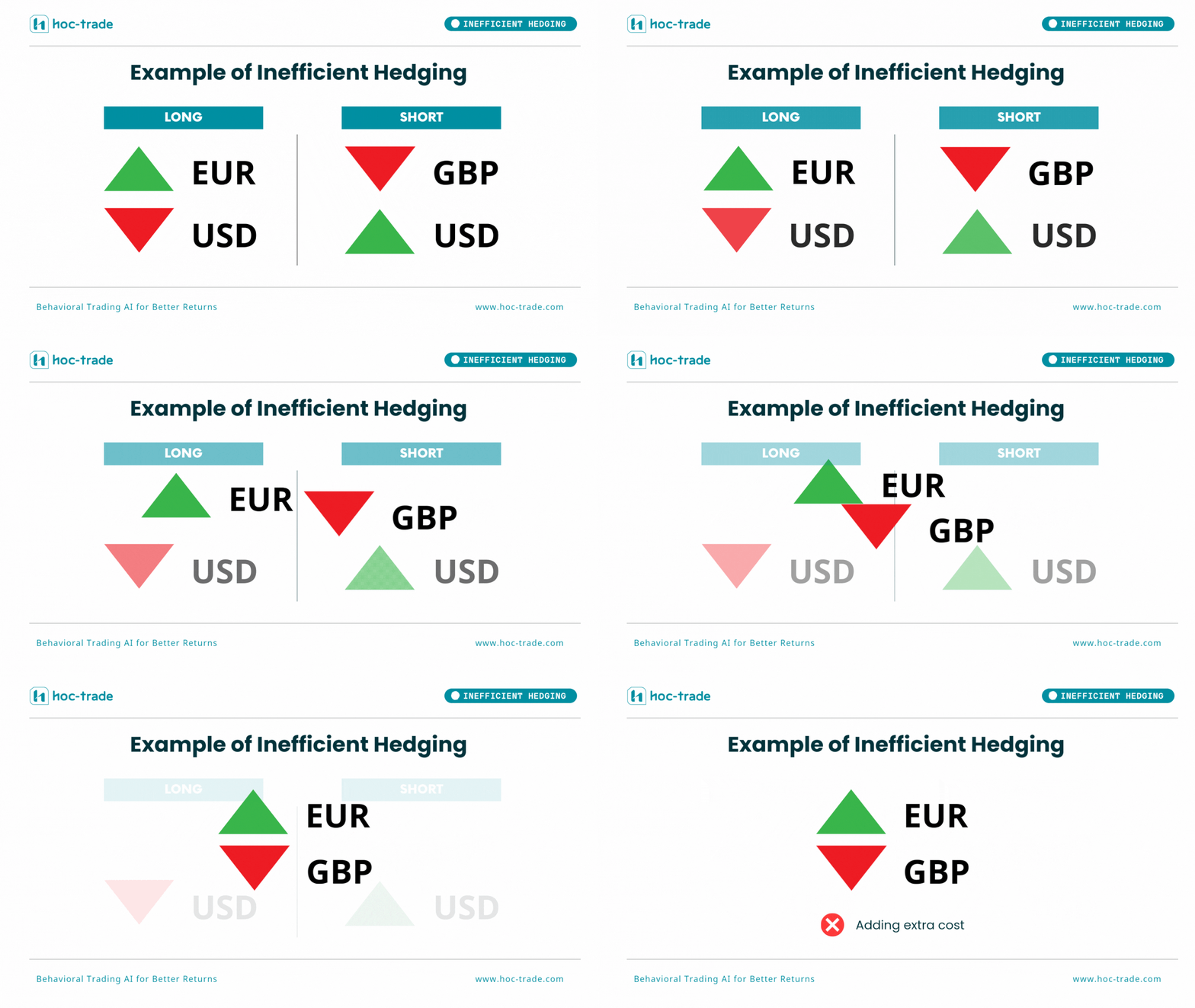
A trader goes long EUR/USD and short GBP/USD with matching position sizes. On the surface, these look like separate bets based on different technical signals. But what's actually happening? You've hedged out your USD exposure and created a long EUR/GBP position. You've done it, though, at double the cost. Two spreads. Two sets of commissions. Twice the margin tied up.
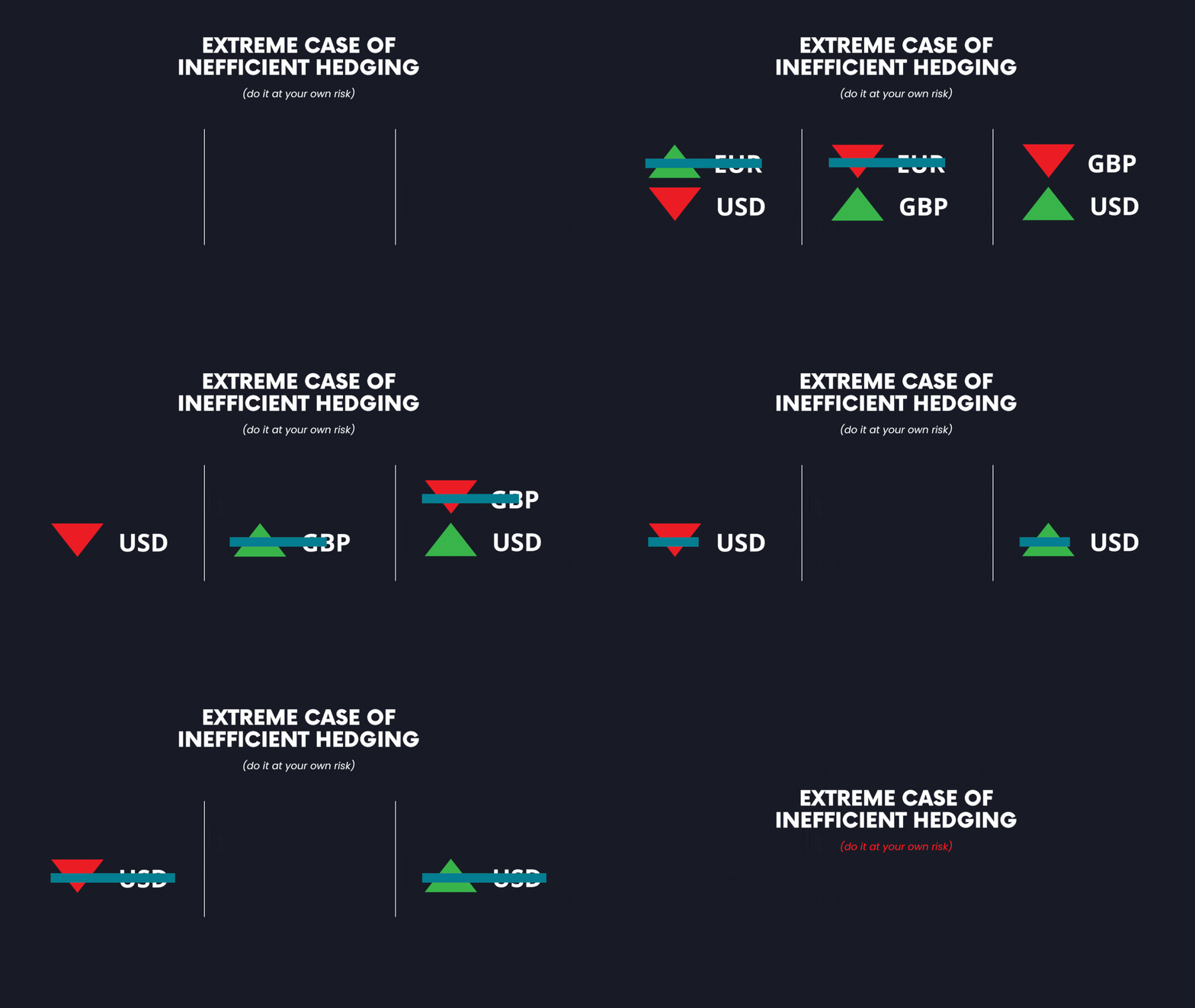
The extreme version is worse. A trader opens a long EUR/USD, shorts EUR/GBP, and shorts GBP/USD. Three separate positions driven by three different chart setups. But the math reveals something simple: net exposure is zero. That trader has paid three times the costs to end up right where they started.
The tragedy is that none of this was intentional. The trader wasn't sitting down planning to hedge. They just took trades as they saw them.
Why traders unknowingly build these redundant positions
The root cause isn't poor judgment. It's that most traders look at trades in isolation. Technical analysis says 'buy this pair' without asking how it affects what they already own. They're focused on the chart, not the portfolio.
Some traders actively choose hedging as a way to sidestep reality. A position is underwater. Rather than close it and face the loss, they hedge it. This feels like risk management. It feels safer. But now they're paying fees on two positions instead of one, and they're still exposed to the original problem.
Indecision plays a role too. Unsure which way the market will move, a trader hedges instead of committing to a clear direction. This creates two positions when one would have been better. The cost isn't just the fees. It's the complexity. Both positions have to be managed. Both tie up mental energy.
Then there's the invisible tax. Most traders know spreads exist. Commissions get attention. But funding fees quietly accrue every night you hold a position. Margin requirements stack. When you're holding redundant positions, these costs multiply without ever appearing as a line item on a P&L statement until months later when you realize your overall returns are surprisingly weak.
The combination of these factors—isolated thinking, loss aversion, directional indecision, and underestimating costs—creates a trap that most traders fall into without ever realizing they're in it.
What does the data say about inefficient hedging?
TradeMedic's AI detects patterns across a dataset of 500,000+ trader accounts. Inefficient hedging ranks consistently among the most impactful patterns identified. When traders eliminate redundant positions and optimize their hedging approach, the difference to profitability is measurable. A detailed data breakdown with specific statistics is available in our forthcoming inefficient hedging analysis. Far fewer traders show smart hedging, which actually benefits them
This pattern is so widespread because it's invisible to manual analysis. Your trading software doesn't warn you. Your charts don't flag it. You have to know to look for it.
How to identify and eliminate inefficient hedges
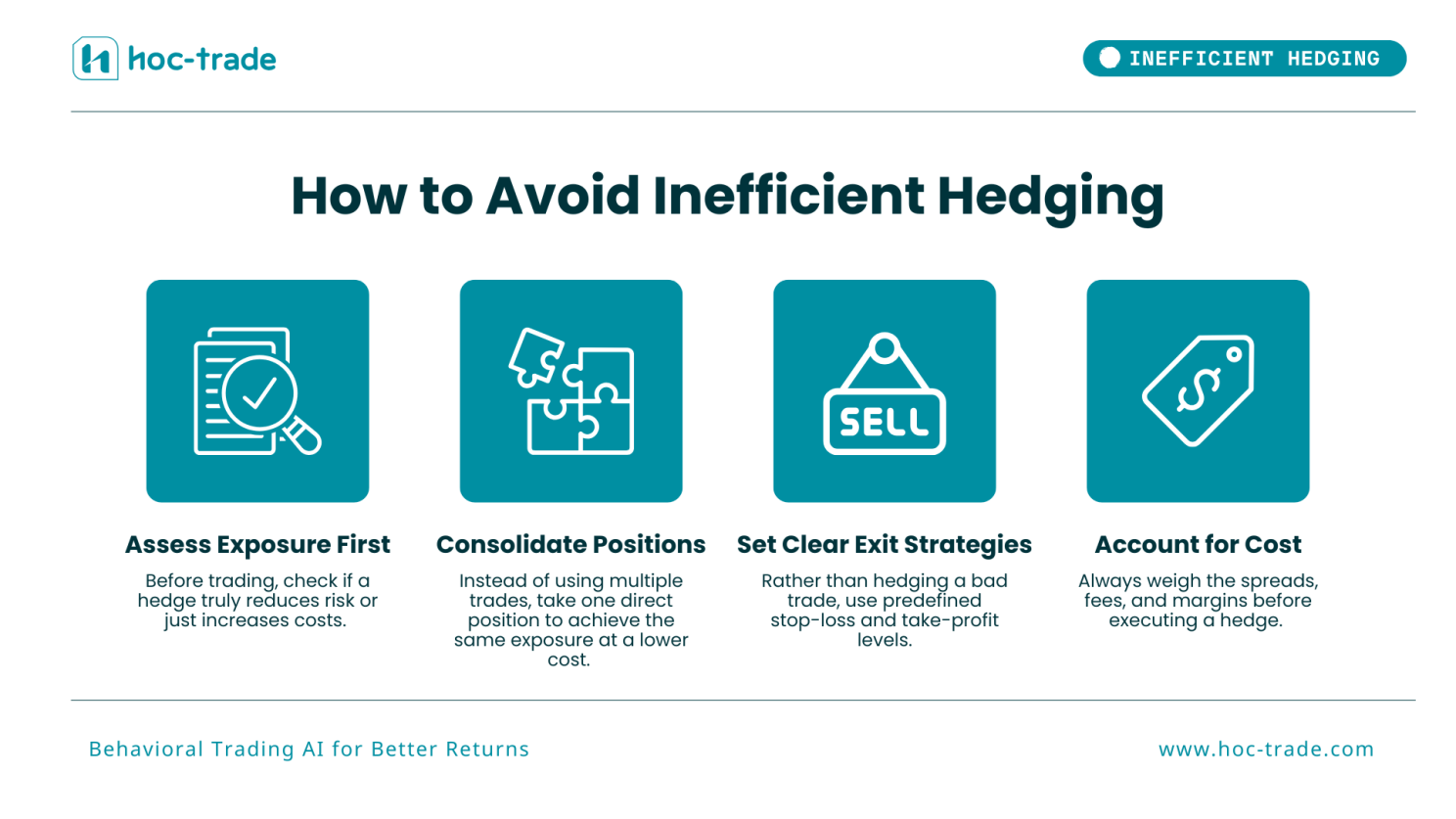
Start by mapping your actual exposure. Not the trades you think you have, but the exposure you actually carry. If you hold long EUR/USD and short GBP/USD, you have net long EUR exposure and net short GBP exposure. The USD exposure cancels out. Understanding this forces clarity.
Next, quantify the cost of each position. Most platforms show spreads and commissions. Fewer show the cumulative cost of funding fees over a month. Add them up. Compare the total cost to the risk you're actually managing. If you're paying $500 a month in fees to hedge a position that moved $300 last month, the math is off.
The hard part is discipline. If you're holding a losing trade and hedge it, you're avoiding the emotional pain of closing it. Closing it is often the better move. The fee you pay to close—usually a fraction of your hedging costs—is a worthwhile price for simplification and clarity.
When you're tempted to hedge because you're unsure of direction, ask yourself if you should be trading at all in that moment. No trade is better than a hedged trade that costs you money to hold.
Inefficient hedging is dangerous because it hides in plain sight. It looks like sophisticated risk management. It feels protective. But over a year of trading, it compounds into a significant drag on your bottom line. Many traders discover this only when they finally sit down with their statements and realize where their edge has gone.
By understanding why inefficient hedging happens, you're already halfway to avoiding it. The next step is seeing your portfolio clearly. Tools like TradeMedic make this possible by automatically flagging conflicting exposures, quantifying hidden costs, and showing you which hedges are actually working. Once you see it, you can fix it.
TradeMedic AI analyses over 60 behavioural patterns, including inefficient hedging, across 500,000+ trader accounts. Visit TradeMedic to see how it works and get your own personal analysis.
Watch How Inefficient Hedging is Silently Eroding Your Performance
Frequently asked questions
What is inefficient hedging?
Inefficient hedging occurs when traders take multiple positions that offset each other's exposure but at higher total cost than necessary. Rather than using one direct trade, they take multiple trades across different currency pairs or assets, incurring redundant spreads, commissions, and funding fees.
How much does inefficient hedging typically cost a trader?
The cost varies by position size and market conditions, but traders often pay 2-3x the necessary fees by using inefficient hedges instead of direct trades. Over months, these accumulated costs—spreads, commissions, and funding fees—significantly erode profitability without improving risk management.
Why don't traders realize they're hedging inefficiently?
Most traders analyze trades individually based on technical signals rather than looking at total portfolio exposure. They see separate trading opportunities without recognizing that multiple positions offset each other. Costs also accumulate invisibly over time, making the damage hard to spot.
Can a trader avoid all hedging, or is some hedging necessary?
Hedging itself isn't bad. The problem is how most traders execute it. Efficient hedging uses the minimum number of positions to achieve a specific exposure goal. Most traders instead layer multiple positions that create redundancy. The key is being intentional about risk reduction, not defensive about losses.
How does TradeMedic help identify inefficient hedging?
TradeMedic's AI analyzes your portfolio to detect negative correlations where hedging consistently reduces profitability. It tags positions with conflicting exposures, quantifies the hidden costs of each hedge, and shows you the difference between hedged and non-hedged scenarios so you can make informed adjustments.