Category:
 Author:
 Date:May 11, 2026
Blind Spot Bias in Trading: The #1 Bias You Need to Address First
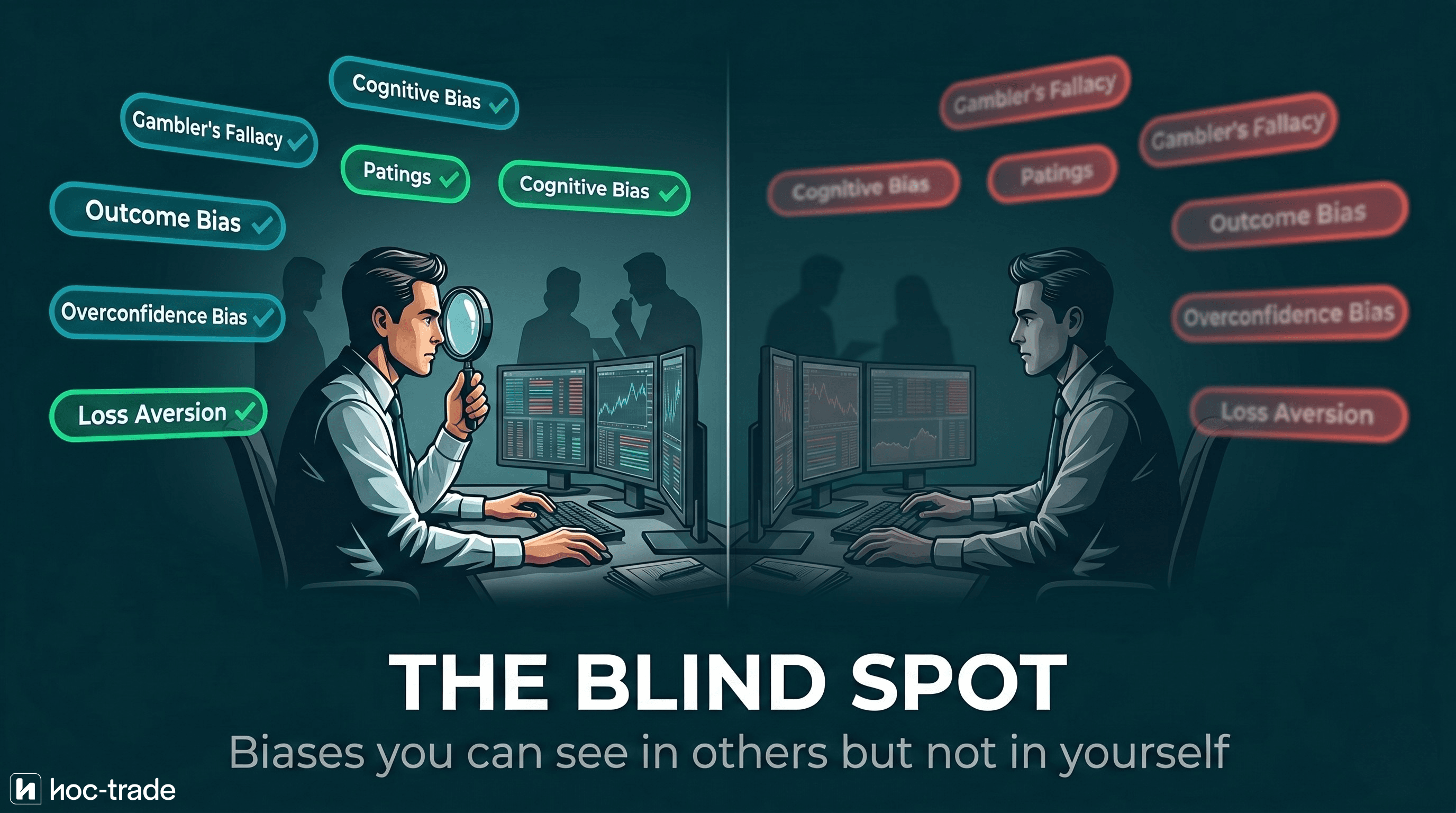
Most traders know that psychology matters. They have read about loss aversion, overconfidence, maybe even the disposition effect. They can spot these patterns in other people with impressive clarity. The friend who revenge trades after a loss. The forum poster who doubles down on a sinking position because they are convinced the market will turn.
And yet, when it comes to their own trading, the picture looks different. Their decisions feel rational. Their reasoning feels sound. When things go wrong, there are explanations that make sense: the market was unpredictable, the data was misleading, the timing was unlucky.
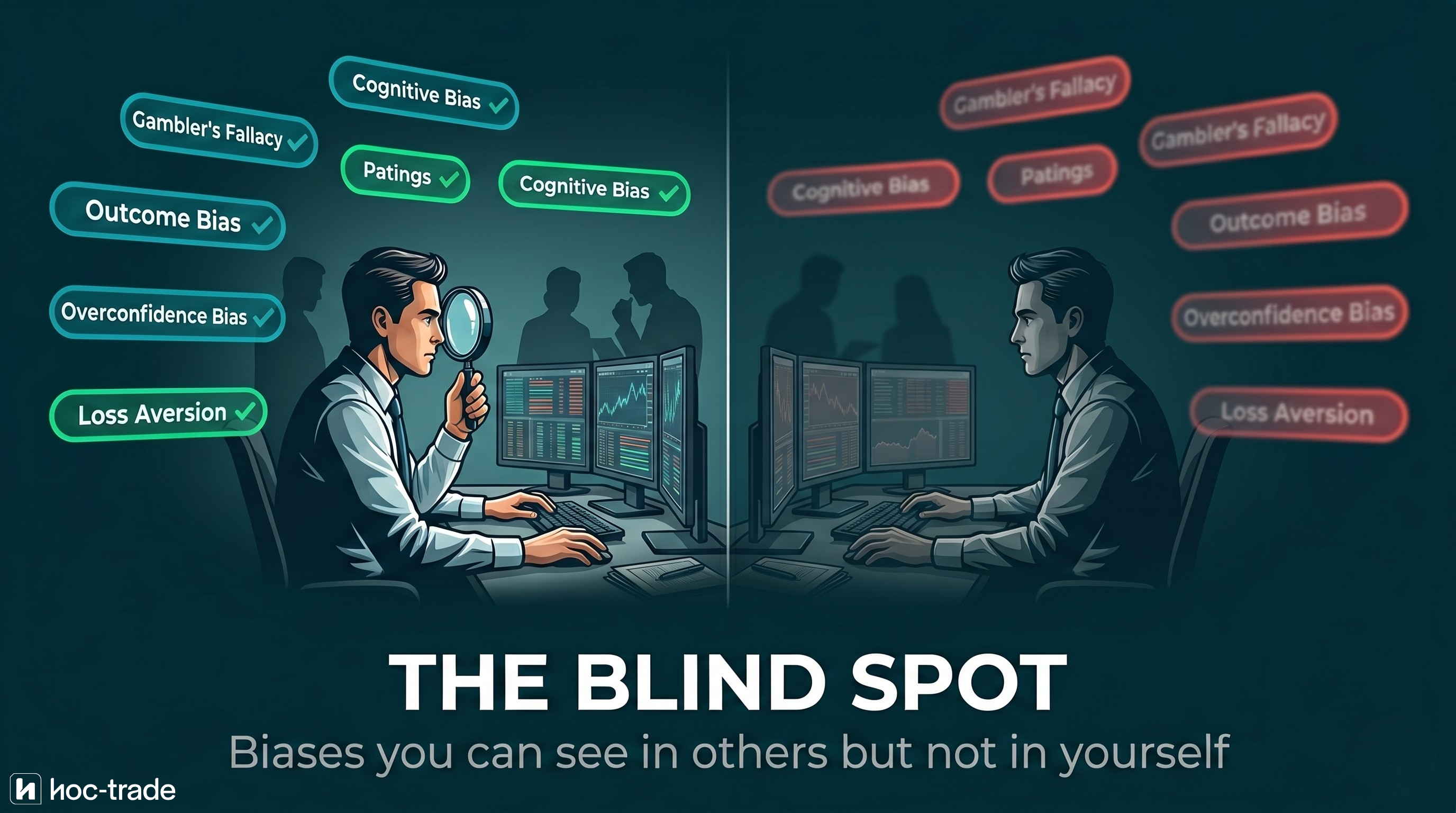
This gap between how clearly we see bias in others and how poorly we detect it in ourselves has a name. Psychologists call it the blind spot bias. And for traders, it is arguably the single most important bias to understand, because it is the one that prevents you from working on all the others.
What is blind spot bias?
Blind spot bias is the tendency to believe that you are less affected by cognitive biases than the people around you. You might fully accept that biases exist, that they influence decision-making in predictable ways, and that most people fall victim to them. The catch is that you are far less likely to believe those same biases are operating in your own thinking.
The term was introduced in 2002 by Stanford psychologist Emily Pronin and her colleagues Daniel Lin and Lee Ross. Across three studies, they found a consistent pattern: people rated themselves as significantly less susceptible to various biases compared to the average person, their classmates, and even fellow travelers at an airport. In a sample of more than 600 US residents, over 85% believed they were less biased than the average American. Only a single participant in the entire sample rated themselves as more biased than average.
This is not a small effect limited to one lab. A 2024 replication study conducted in Brazil confirmed the finding with a large effect size. The pattern holds across cultures, age groups, and professions. It shows up in medicine, law, HR, investing, and forensics. Pronin’s later work with Matthew Kugler showed something even more striking: even after participants were told about the blind spot bias and shown how it could affect them, they still insisted their own judgments were accurate and unbiased.
What causes blind spot bias?
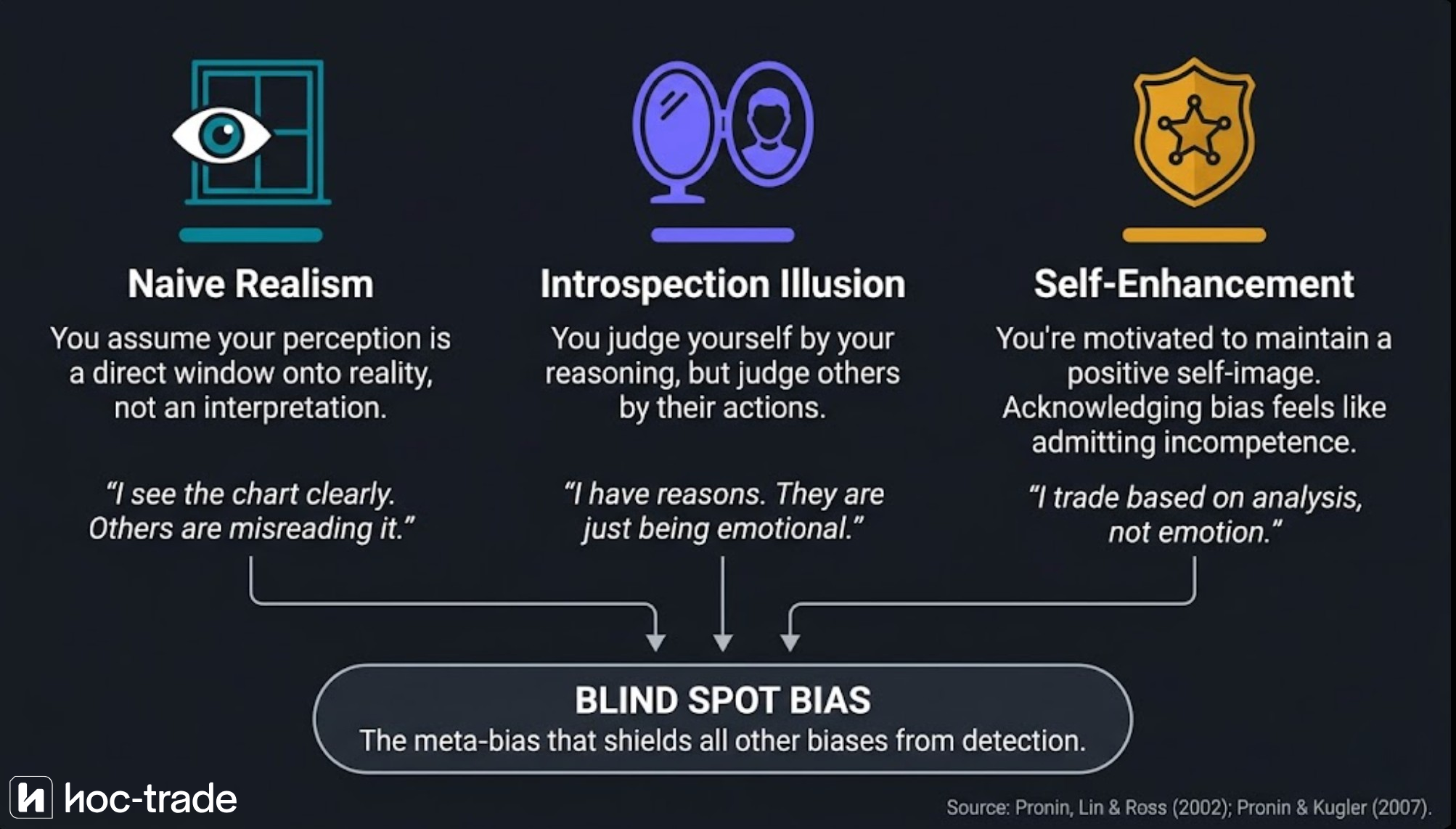
Three psychological mechanisms work together to create this effect. Understanding them matters because each one maps directly onto common trading mistakes.
Naive realism. This is the default assumption that you see the world as it actually is. Your perception feels like a direct window onto reality, not an interpretation filtered through experience, emotion, and expectation. When you look at a chart and form a view on where the price is headed, that view feels like an observation, not a hypothesis. When someone else reaches a different conclusion from the same chart, it is tempting to assume they are the one misreading it.
The introspection illusion. When you evaluate your own thinking, you have access to your internal reasoning. You can trace the logic, recall the factors you considered, and it all feels coherent. When you evaluate someone else, you can only observe their behavior and outcomes. This creates an asymmetry: you judge yourself by your intentions and reasoning process, but you judge others by their visible actions. A trader who holds a losing position can construct an internally consistent narrative about why they are staying in the trade. Watching another trader do the same thing, all you see is someone refusing to cut their losses.
Self-enhancement motivation. People are motivated to see themselves in a positive light. Biases are generally considered undesirable, so acknowledging that your own decisions are influenced by them threatens your self-image as a rational, competent trader. This is not vanity. It is a basic cognitive protection mechanism that operates largely outside conscious awareness.
How does blind spot bias affect traders?
The blind spot bias does not cause bad trades directly. What it does is far more insidious: it blocks the feedback loop that would otherwise help you improve. If you cannot see that a bias is influencing your decisions, you will never take steps to address it. The destructive pattern continues, and it continues unexamined.
Consider how many traders struggle with revenge trading. After a loss, they jump back into the market too quickly, often with a larger position, trying to recover what they lost. Most traders can identify this behavior in others. They will point it out on forums, in group chats, in post-trade reviews. But recognizing revenge trading in your own behavior is harder. The next trade feels justified. The setup looks good. You are not trading emotionally, you are capitalizing on an opportunity.
The same dynamic plays out across virtually every behavioral pattern that hurts trading performance. Traders who fight the trend believe they are reading the market correctly while others are chasing momentum. Traders who fail to cut losses believe they are being patient and disciplined while others are panicking. Traders who overtrade believe they are active and engaged while others are sitting on their hands. In each case, the blind spot bias reframes a potentially harmful behavior as a rational choice.
There is also a social dimension. The blind spot bias makes traders less receptive to feedback. Research by Scopelliti and colleagues, published in Management Science in 2015, found that people with stronger blind spots placed less weight on advice from others and were less likely to benefit from debiasing training. For traders, this means the very people who most need feedback on their behavior are the ones least likely to seek it or take it seriously when offered.
Blind spot bias examples in trading
These scenarios illustrate how blind spot bias operates in practice. None of them involve obviously reckless behavior. That is the point. Blind spot bias is most dangerous precisely when your decisions feel reasonable.
The selective memory trader. You remember the trades where your analysis was right and the market confirmed your thesis. The trades where you were wrong fade into the background. Research published in PNAS in 2021 found that investors exhibit a positive memory bias for past performance: when asked to recall their returns from memory rather than looking them up, they consistently overestimated how well they had done. This inflated self-assessment feeds overconfidence, which the blind spot bias then prevents you from recognizing.
The attribution asymmetry trader. After a winning trade, you credit your analysis, your discipline, your edge. After a losing trade, you point to market volatility, unexpected news, broker execution. This pattern is so common it has its own name in psychology: the self-serving attribution bias. Traders exhibiting this pattern can easily spot it in others while remaining convinced their own attributions are accurate.
The confirmation-seeking trader. You enter a long position and then spend time reading analysis that supports your bullish view. You scroll past bearish arguments. You interpret ambiguous data as supportive. When someone in your trading group suggests the opposite direction, you think they are the ones with a bias, not you. The blind spot makes confirmation bias invisible from the inside.
The rules-for-others trader. You have a clear set of trading rules. You know your maximum position size, your stop loss placement criteria, your conditions for entry. And most of the time, you follow them. But occasionally, a setup just feels different. The opportunity is too good. The conviction is too strong. You make an exception. It is not a rules violation, it is an informed judgment call. When a friend tells you they did the same thing and lost money, your first thought is: they should have stuck to their rules.
Why being smart does not protect you from blind spot bias
One of the most counterintuitive findings in the research is that cognitive ability does not reduce the blind spot bias. You might expect that smarter, more analytically minded people would be better at detecting their own biases. They are not.
West, Meserve, and Stanovich published a study in the Journal of Personality and Social Psychology in 2012 showing that participants who scored higher on measures of cognitive sophistication actually had larger blind spots, not smaller ones. The Scopelliti 2015 study found that bias blind spot scores did not correlate with intelligence, decision-making ability, or personality traits like conscientiousness or self-esteem.
This finding is directly relevant to trading. Markets attract analytical, intelligent people. Many traders pride themselves on their ability to think critically, process data, and make rational decisions under pressure. The research suggests this self-image may actually amplify the blind spot rather than reduce it. If you believe you are more rational than average, you are less likely to consider that your own reasoning might be distorted.
Experience does not solve the problem either. The bias shows up across professions where people have extensive training and high-stakes decision-making responsibility. Forensic examiners, medical professionals, judges, and financial analysts all exhibit the blind spot. The 2023 review by Pronin and Hazel confirmed its presence specifically in investing contexts. Years of market experience can make you a better trader in many ways, but they do not automatically make you better at seeing your own biases.
How to reduce blind spot bias in your trading
The research is clear that simply knowing about the blind spot bias is not enough to fix it. Pronin’s own studies showed that awareness alone did not change self-assessments. So what does help?
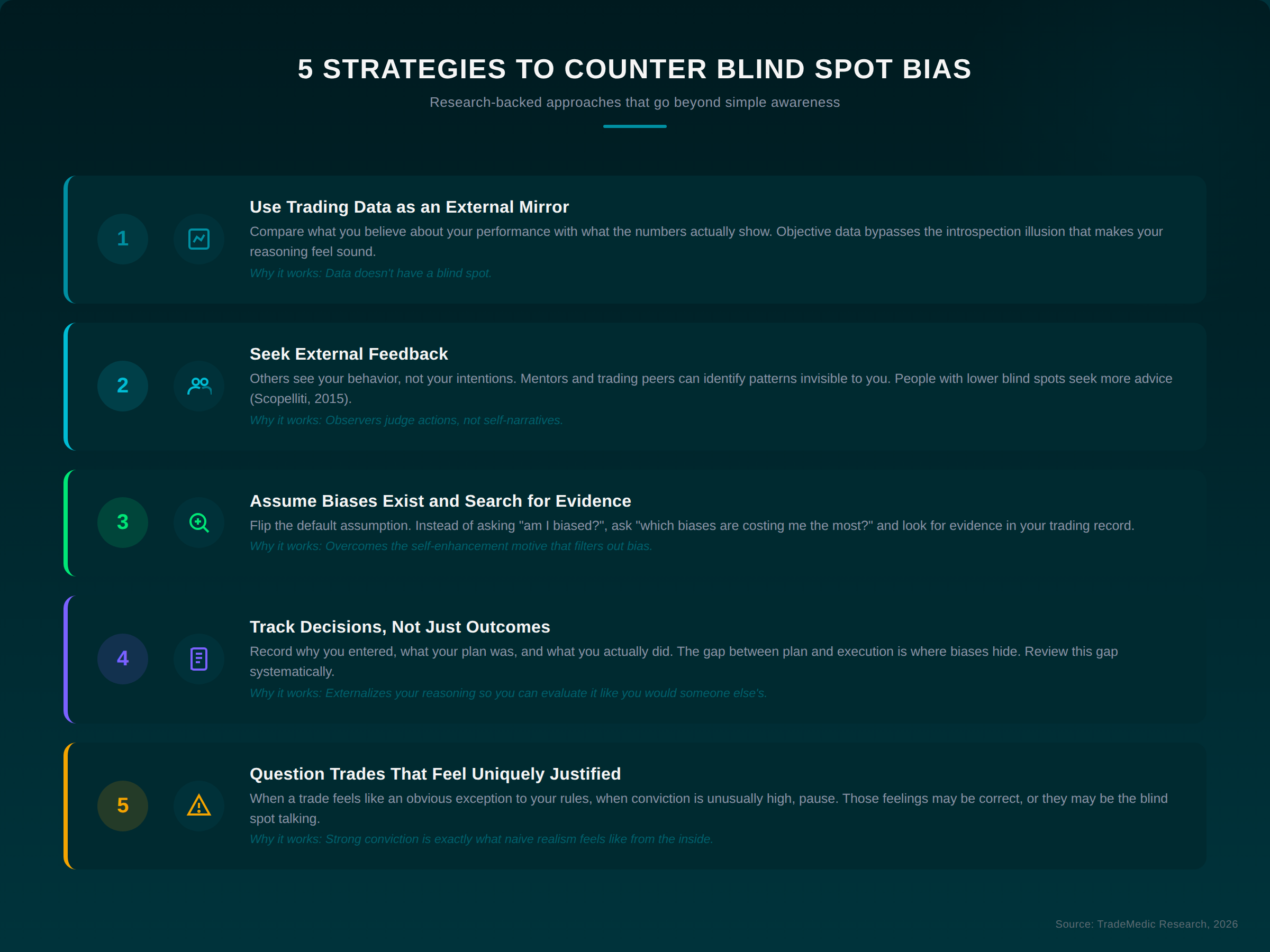
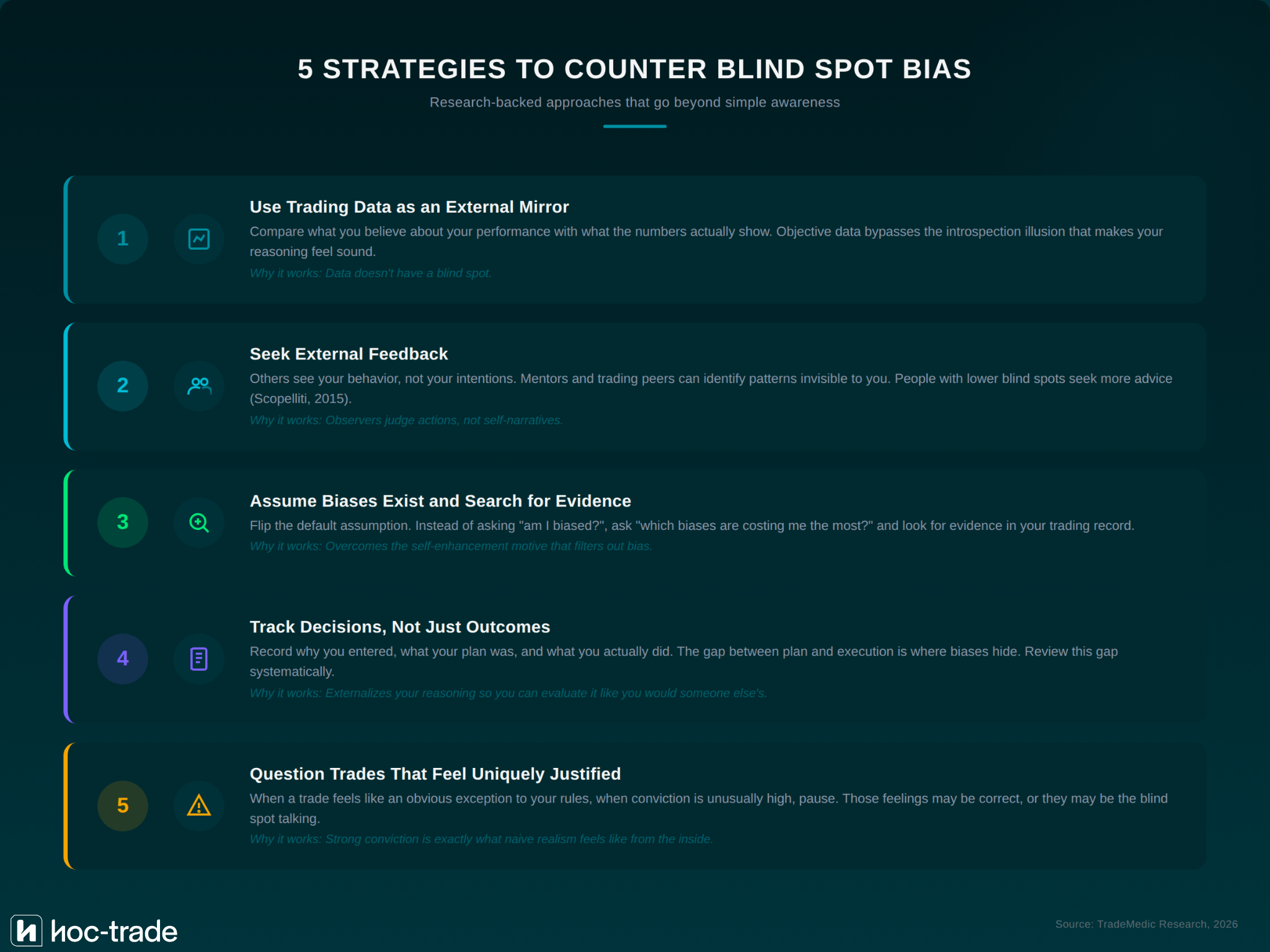
Use your trading data as an external mirror. The single most effective counter to the blind spot is objective data about your own behavior. Not your memory of how you traded. Not your internal narrative about your decision-making process. The actual numbers. How often do you cut losses at your predetermined level versus moving your stop? How does your performance differ between your first trade of the day and your fifth? What happens to your win rate after a losing streak? These are questions that data can answer honestly, even when introspection cannot.
Seek feedback from people who see your behavior, not your intentions. The Scopelliti research found that people with lower blind spot scores placed more weight on external advice. Trading communities, mentors, and accountability partners can see patterns in your behavior that are invisible to you. The key is to actually listen when they point something out, rather than dismissing their observations as applying to other traders but not to you.
Assume you have biases and look for evidence. Instead of asking whether you have a particular bias, start from the assumption that you do and look for evidence in your trading record. This is a fundamental shift in framing. You are not trying to prove you are unbiased. You are trying to find out which biases are costing you the most money so you can address them.
Track decisions, not just outcomes. A trade journal that only records what you bought, when, and whether it made money misses the point. Record why you entered, what you expected, what your plan was, and critically, what you actually did versus what the plan said. The gap between plan and execution is where biases live. Reviewing this gap systematically over time makes blind spots visible.
Be suspicious of trades that feel uniquely justified. The blind spot bias makes your own reasoning feel more legitimate than it might be. When a trade feels like an obvious exception to your rules, when you are unusually confident, when you are sure this time is different, those feelings are worth questioning. They might be correct. They might also be the bias talking. The point is not to second-guess every decision but to treat strong conviction with the same scrutiny you would apply to someone else’s strong conviction.
What does the data say about blind spot bias in trading?
Blind spot bias is different from most of the behavioral patterns that TradeMedic™ AI detects. Patterns like revenge trading, failing to cut losses, or fighting the trend leave measurable traces in trading data. They can be identified, quantified, and tracked over time. Blind spot bias does not work that way. It is a meta-bias that sits above all the others, influencing whether a trader will even acknowledge and address the patterns that are costing them money.
TradeMedic™ AI analyzes trading behavior across a dataset of 500,000+ trader accounts, identifying over 60 distinct behavioral patterns that correlate with trading performance. For traders who receive their TradeMedic report, the data itself serves as one of the most powerful tools against the blind spot bias. When you can see, in your own numbers, that your trades after losses show a specific pattern, or that your performance drops when you deviate from your stop loss strategy, the internal narrative of rationality meets an external reality check.
The academic research is unambiguous: awareness alone does not eliminate the blind spot. But data-driven self-confrontation comes closer than anything else. It moves the conversation from subjective self-assessment to objective behavioral measurement. That shift is exactly what the blind spot bias is designed to resist, and exactly what makes it effective.
Why blind spot bias is your starting point
Every other bias article, every trading psychology book, every piece of advice about improving your decision-making assumes one thing: that you are willing to consider the possibility that your own thinking might be flawed. The blind spot bias is the barrier to that willingness.
It is why traders can read about loss aversion and think it applies to other people. It is why they can learn about revenge trading and not see it in their own post-loss behavior. It is why they can study confirmation bias and still scroll past analysis that contradicts their position.
You cannot work on biases you do not believe you have. That makes the blind spot bias your starting point. Not because it is the most damaging bias in isolation, but because it is the one that keeps all the others in place.
The research tells us that intelligence will not save you, experience will not save you, and simply reading this article will not save you either. What helps is a deliberate, ongoing practice of checking your own behavior against objective evidence, seeking external feedback, and resisting the comfortable assumption that your reasoning is uniquely sound.
Source: TradeMedic Research, 2026
Frequently asked questions
What is blind spot bias in trading?
Blind spot bias is the tendency to recognize cognitive biases in other traders while failing to detect the same biases in your own decision-making. Research shows over 85% of people believe they are less biased than average. In trading, this prevents you from identifying and correcting the behavioral patterns that hurt your performance.
Why is blind spot bias considered the #1 bias in trading?
Blind spot bias acts as a meta-bias that shields all other biases from detection. You cannot work on patterns like revenge trading, overconfidence, or loss aversion if you do not believe they apply to you. Addressing the blind spot first opens the door to improving every other aspect of your trading psychology.
Does being an experienced or intelligent trader reduce blind spot bias?
No. Research published in the Journal of Personality and Social Psychology found that higher cognitive sophistication was associated with larger blind spots, not smaller ones. A separate 2015 study in Management Science confirmed that bias blind spot scores do not correlate with intelligence, decision-making ability, or personality traits like self-esteem. Experience and intelligence can improve many aspects of trading, but they do not automatically make you better at seeing your own biases.
How can traders reduce blind spot bias?
The most effective strategies involve creating external checks on your self-assessment. Use objective trading data to compare what you believe about your performance with what actually happened. Seek feedback from mentors or trading peers who observe your behavior. Keep a detailed decision journal that tracks not just outcomes but the reasoning behind each trade. Start from the assumption that biases are present and look for evidence, rather than assuming objectivity.
Can trading data help overcome blind spot bias?
Yes. Behavioral analytics tools like TradeMedic™ AI analyze trading data across 500,000+ accounts to identify over 60 behavioral patterns. For individual traders, this kind of objective analysis serves as a powerful counter to the blind spot because it reveals patterns in your behavior that introspection alone cannot detect. Data-driven self-confrontation is more effective than awareness alone.