Category:
 Author:
 Date:Jul 26, 2026
Best Timeframe to Trade Gold? What 500,000+ Accounts Show About XAUUSD

Search for the best timeframe to trade gold and you will find near-total agreement. Use M1 or M5 for scalping, M15 to H1 for day trading, H4 or daily for swing trading, and concentrate on the London and New York overlap. None of those guides tells you whether any of it works.
We measured it. Across 500,000+ trading accounts, 65.9% have XAUUSD as their most-traded instrument, which makes gold the largest single trading population available to study. Gold swing traders finish net profitable at 21.0%, gold scalpers at 20.2%, and gold day traders at 17.3%, against an all-trader baseline of 18.2%. Those numbers look unremarkable until you set them against how each trading style performs across the whole dataset, at which point gold turns out to be doing something no other instrument does.
What is the best timeframe to trade gold?
Measured by the share of accounts finishing net profitable, swing trading gold edges it at 21.0%, scalping follows closely at 20.2%, and day trading finishes last at 17.3%.
The order alone is unusual. Gold is the only instrument we measured where scalpers outperform day traders. But the more revealing comparison is against the population.
Across the full dataset, independent of what anyone trades, swing traders finish net profitable at 27.5%, scalpers at 19.3%, and day traders at 17.3%. We covered that finding in detail in our analysis of day trading versus swing trading.
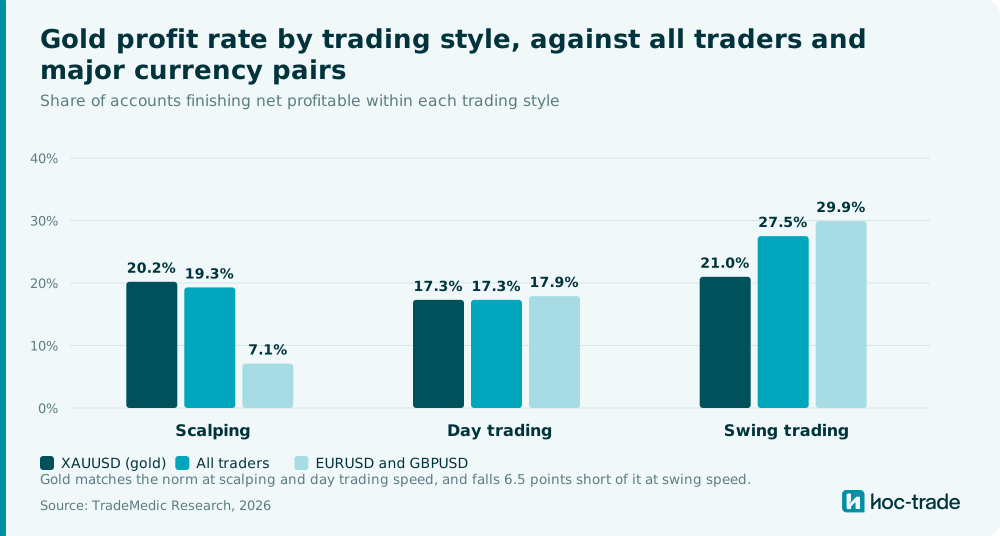
Line the two sets up and gold's real problem appears. Gold scalpers at 20.2% sit almost exactly at the scalper norm of 19.3%. Gold day traders at 17.3% sit exactly at the day trader norm of 17.3%. But gold swing traders at 21.0% fall 6.5 points short of the 27.5% swing traders achieve elsewhere.
Gold is not especially good at any speed. It is average at two of them and clearly below average at the third. And the third is the one that pays best everywhere else.
Is gold good for scalping?
Gold is good for scalping relative to other instruments: gold scalpers finish net profitable at 20.2%, against just 7.1% for scalpers on EURUSD and GBPUSD combined. It is better than the alternatives, though not for the reason it first appears.
Gold scalpers finish net profitable at 20.2%. Scalpers on EURUSD and GBPUSD combined finish at 7.1%. That is close to three times the rate on the same behavior in a different instrument, and it is the widest gap in the whole study.
The honest reading is that gold does not make scalpers exceptional. At 20.2% against a scalper norm of 19.3%, gold scalpers are performing about as well as scalpers in general. What gold does is avoid destroying them. Major currency pairs punish scalping severely, and gold does not.
The mechanism is volatility relative to spread. A scalper closes dozens of small positions a session, and each one has to cover the spread before it shows a profit. Gold's average daily range is roughly four times that of a major pair, while its spread is nowhere near four times wider. On EURUSD the intraday movement a scalper is working with is small next to the cost of getting in and out. On gold there is far more movement per unit of that same cost, so the math works out better. Fine a detailed analysis of the impact of spreads on traders (including gold traders) here.
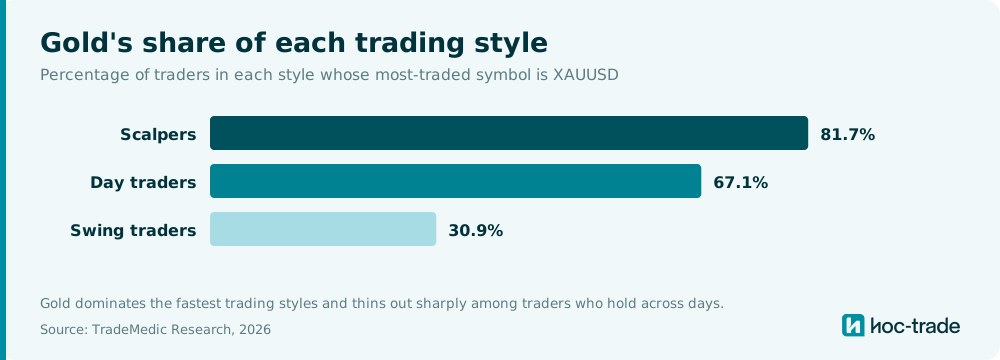
Traders appear to have found this without articulating it. Gold is the main instrument for 81.7% of scalpers, against 67.1% of day traders and 30.9% of swing traders. The faster the style, the more it concentrates in gold.
None of this makes scalping a good idea in general. Scalpers finish net profitable at 19.3% against 27.5% for swing traders. The finding is narrower: if you are going to scalp, gold is where it has the best chance of working.
Is gold good for day trading?
Gold day traders finish net profitable at 17.3%, below the 18.2% all-trader baseline, and exactly level with the 17.3% day traders achieve across every instrument. Against major currency pairs, gold day traders are marginally behind, with EURUSD and GBPUSD day traders combining at 17.9%.
So day trading gold is neither better nor worse than day trading anything else. It is simply the weakest of the three speeds, and it is what most gold traders do. Two thirds of all day traders in the dataset have gold as their main instrument.
Day trading gold appears to fall between two stools. It is not fast enough to exploit the intraday range the way scalping does, and it is not slow enough to ride the directional moves that reward swing traders elsewhere. Positions are held long enough to accumulate exposure to gold's volatility without being held long enough for a thesis to resolve.
Is gold good for swing trading?
This is where gold underperforms, and it is the most useful finding in the article. Gold swing traders finish net profitable at 21.0%, gold's best result in absolute terms and above the 18.2% baseline, which is why it looks fine in isolation.
Set against the 27.5% swing traders achieve across the dataset, and the 29.9% achieved by swing traders on EURUSD and GBPUSD, that 21.0% is a clear shortfall.
Slowing down is the single most reliable improvement available to a retail trader. It works on almost every instrument. On NAS100 it roughly doubles the profit rate. On EURUSD it lifts it by around three quarters. On gold it adds about a fifth, the smallest gain of any instrument with a usable trader population.
Traders have adapted to this, whether or not they know why. Gold makes up 81.7% of scalpers and 67.1% of day traders, but only 30.9% of swing traders. Traders who hold across days migrate away from gold toward currency pairs, and the numbers suggest they are right to.
XAUUSD average daily range and why it matters
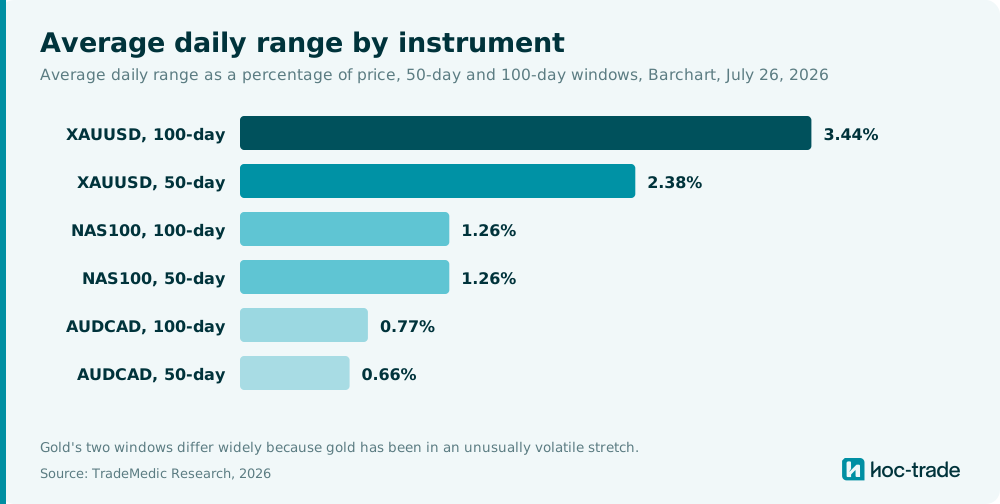
Gold's average daily range runs about 2.38% of price on a 50-day window and 3.44% on a 100-day window, measured on Barchart as of July 26, 2026. NAS100 sits at 1.26% on both windows. AUDCAD sits at 0.66% on the 50-day and 0.77% on the 100-day.
The two gold windows differ widely because gold has been in an unusually volatile stretch, which is worth knowing before treating either figure as a permanent property of the market. Its annualized historic volatility tells the same story, at 19.94% over 50 days and 33.65% over 100.
That single number explains most of what appears above. A large daily range is what makes scalping viable, because it provides enough movement to clear the spread many times a session. The same large range is what makes day trading gold punishing, because a position held for hours is exposed to the full swing without either a very tight stop or a multi-day thesis to justify it.
A second feature matters for longer holds. Gold's annualized volatility is comparable to NAS100's, but its daily range is close to double, so gold concentrates more of its movement inside the session. It also trends over long horizons, driven by rates, the dollar, and risk sentiment, and those moves can run against a position for weeks. A range-bound cross forgives a badly timed entry if you wait. Gold does not forgive in the same way, which is why being early and being wrong can look identical on a gold chart for a long time.
XAUUSD vs EURUSD: which is easier to trade profitably?
It depends entirely on how fast you trade, which is the point of this article.
Overall, gold traders finish net profitable at 17.7% and EURUSD traders at 19.2%. That modest edge conceals a much larger divergence underneath. A gold scalper is at 20.2% while a EURUSD scalper is at 4.9%. A EURUSD swing trader is at 30.8% while a gold swing trader is at 21.0%.
There is no general answer to which is easier. There is only an answer for a given holding period, and the two instruments swap places depending on which one you pick.
Forex vs gold trading: which produces better outcomes?
Taken as a whole, currency pairs outperform gold. Major pairs sit at 19.2% and 20.4% against gold's 17.7%, and one cross, AUDCAD, reaches 42.2%. Our full ranking appears in the analysis of the best forex pair to trade.
The comparison only becomes useful once holding period is specified. If you scalp, gold is the better market by a wide margin. If you hold across days, currency pairs are better by a wide margin. If you day trade, the two are close enough that other factors dominate.
Why do most traders trade gold?
Gold is chosen as the main instrument by 65.9% of traders. The next most popular single instrument, EURUSD, accounts for 8.6%.
Three reasons, all defensible. Gold moves, which matters for a trader with a small account seeking meaningful movement without excessive leverage. Gold is liquid and cheap relative to the range it offers. And gold is legible, with a story attached at all times, whether that story is inflation, rates, the dollar, or geopolitics.
What the popularity does not produce is above-average results. Gold's overall profit rate of 17.7% sits marginally below the 18.2% baseline. The tables above suggest where the advantage goes: most gold traders are day trading it, and gold offers no benefit at that speed while withholding most of the benefit that patience delivers elsewhere.
How TradeMedic™ AI analyzes gold trading performance
Population figures describe traders in aggregate. They cannot tell you which timeframe suits you.
TradeMedic™ AI connects to your MT4 or MT5 account and analyzes your real trade history across 60+ behavioral patterns, quantifying each in dollars against your own results. For a gold trader, two things matter most.
The report identifies your best-performing holding period from your own trade history rather than from a population average. Given how sharply gold outcomes shift between scalping, day trading, and swing trading, that is a more useful number than anything in this article.
Symbol Expert tests whether you consistently outperform on gold specifically, rather than simply trading it most. Trading one instrument for years is not the same as having an edge in it, and familiarity feels like skill from the inside. Our analysis of how many pairs you should trade covers how concentration and per-symbol edge show up in the data.
Because gold attracts fast trading, it also amplifies what fast trading produces. Position sizing carried over from a currency pair is aggressive on a 2.38% daily range, and our data on how much to risk per trade shows accounts risking under 0.5% per trade finishing profitable at roughly double the rate of those risking 2% to 5%.
The bottom line
Gold swing traders finish net profitable at 21.0%, gold scalpers at 20.2%, and gold day traders at 17.3%, against an all-trader baseline of 18.2%. Gold is the only instrument we measured where scalpers outperform day traders.
Set against the population norms for each style, though, gold is average at scalping and day trading and 6.5 points below par at swing trading. Slowing down is the most reliable improvement available to a retail trader, and gold is the instrument where it delivers least.
The reason sits in the daily range. At roughly 2.38% of price, gold provides enough intraday movement to make very short holding periods viable, while its tendency to trend over longer horizons makes it a weaker choice than currency pairs for anyone holding across days.
Most gold traders day trade, which is the one speed at which gold offers no advantage at all. If you trade gold, the question worth asking is not whether gold is a good instrument. It is whether the speed at which you trade it matches what gold offers.
Learn more about TradeMedic™ AI
Connect your trading account to TradeMedic™ AI free
Methodology
Traders are grouped by their most-traded instrument, defined as the single symbol in which the account placed the highest number of trades. No minimum concentration threshold is applied. Profit rate means the share of accounts in a group that finished net profitable across their analyzed history. Trading style is derived from observed holding periods and trade frequency rather than self-reported preference. Average daily range and annualized historic volatility figures are drawn from Barchart as of July 26, 2026, reported for both the 50-day and 100-day windows. Groups representing very small trader populations are excluded from published comparisons.
Source: TradeMedic Research, 2026
Frequently asked questions
What is the best timeframe to trade gold?
Across 500,000+ trading accounts, gold swing traders finish net profitable at 21.0%, gold scalpers at 20.2% and gold day traders at 17.3%, against an all-trader baseline of 18.2%. Day trading is the most common approach to gold and the weakest performing one.
Is gold good for scalping?
Gold is the only instrument in this study where scalpers outperform day traders, at 20.2% against 17.3%. Scalpers on EURUSD and GBPUSD combined finish at 7.1%, so gold scalpers perform close to three times better. Gold does not make scalpers exceptional, since scalpers overall finish at 19.3%. It avoids punishing them the way major pairs do.
Is gold good for day trading?
Gold day traders finish net profitable at 17.3%, below the 18.2% all-trader baseline and exactly level with the day trader norm across all instruments. Day trading is the most common way gold is traded, with two thirds of all day traders using gold as their main instrument.
Is gold good for swing trading?
Less than most instruments. Gold swing traders finish net profitable at 21.0%, against 27.5% for swing traders across the dataset and 29.9% for swing traders on EURUSD and GBPUSD. Only 30.9% of swing traders use gold as their main instrument.
What is the average daily range of XAUUSD?
Gold's average daily range runs about 2.38% of price over a 50-day window and 3.44% over a 100-day window, measured on Barchart as of July 26, 2026. NAS100 sits at 1.26% and AUDCAD between 0.66% and 0.77% over the same windows.
Should I trade gold or forex?
It depends on holding period. Gold scalpers outperform major-pair scalpers by close to three times. Major-pair swing traders outperform gold swing traders by nearly nine percentage points. At day trading speed the two are close, with gold at 17.3% and major pairs at 17.9%.