Category:
 Author:
 Date:Jul 1, 2026
Day Trading vs Swing Trading: Which Is More Profitable?

The day trading versus swing trading debate is usually settled with opinion and anecdote. One side points to the speed and independence of day trading, the other to the patience and lower stress of swing trading, and nobody brings numbers. With this article we seek to add to this debate with actual profitability data. Across our dataset of more than 500,000 trading accounts, the two styles do not perform equally, and the gap is wide enough to matter.
Swing traders were net profitable 27.5% of the time, against 17.3% for day traders, which makes a swing trader roughly 60% more likely to be profitable. Scalpers, the fastest style of all, sat between them at 19.3%. The interesting part is not the ranking itself but the reason behind it, which turns out to be partly structural and partly behavioral. Two forces, trading costs and trading frequency, weigh on the faster styles in ways that can be shown with simple arithmetic, and as we will see, the headline ranking tells less of the story than what each style's result implies about the trader behind it.
Swing traders are the most profitable, day traders the least
Across more than 500,000 analyzed accounts, swing traders were the most profitable group at 27.5% net profitable, day traders the least at 17.3%, with scalpers at 19.3%. Measured against the all-trader average of about 18%, swing traders stand well above the field while day traders sit slightly below it.
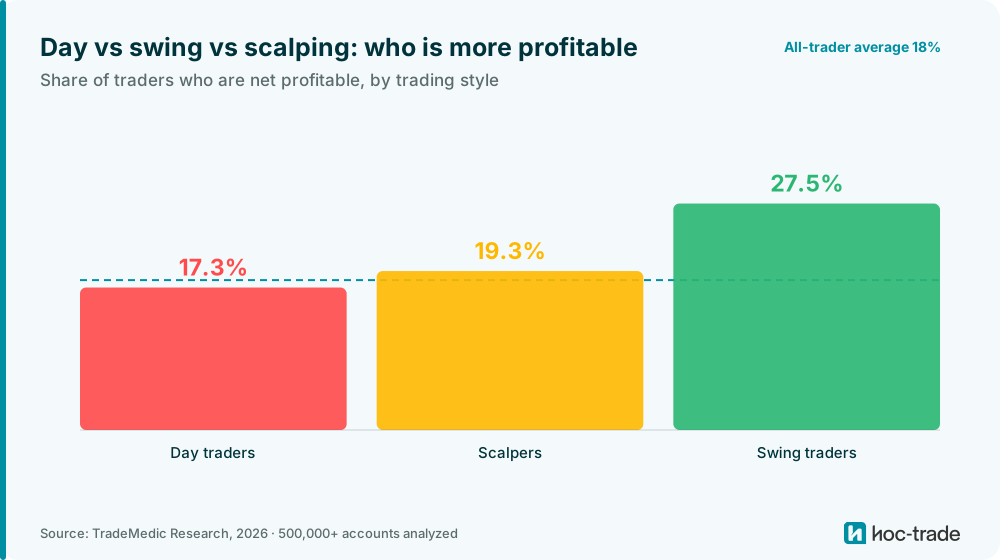
The relative gap is the headline. A swing trader's 27.5% profitable rate is about 60% higher than a day trader's 17.3%. In absolute terms, the difference is just over 10 percentage points, meaning roughly one extra profitable trader in every ten when you move from day trading to swing trading. Neither rate is a majority, and most traders in every style lose. But the style a trader chooses is associated with measurably different odds, and in this dataset the slower, less frequent approach carries the higher profitable rate. Why that is, and what it does and does not mean, is the rest of this article.
Why swing traders are more profitable: not just skill
It would be easy to assume swing traders are simply better or more disciplined. The data suggests the answer is partly structural and partly behavioral. Part of the advantage is built into the mechanics of the styles themselves, and it shows up before any question of talent. Two structural forces do much of the work: the share of each trade consumed by fees, and how often a trader pays those fees. Both weigh more heavily on the faster styles, and both are matters of arithmetic rather than ability. The behavioral half of the story comes later.
How trading fees quietly raise the bar
Every trade carries a cost: the spread plus any commission. Call it 1 pip for a typical trade. That cost is fixed, but the target a trader aims for is not, and this is where the styles begin to diverge.
To illustrate, take a representative target for each style: a scalper might aim for 15 pips per trade, a day trader 40, a swing trader 200. These are illustrative figures, and individual strategies vary widely, but a simple example shows the effect clearly. If all three use a balanced one-to-one risk-reward ratio, where the profit target equals the stop distance, the same 1-pip fee eats a different share of each trade. For the scalper it is about 7% of the target, for the day trader around 2.5%, and for the swing trader just 0.5%.
That difference changes the win rate each trader needs simply to break even. After a 1-pip fee, a scalper on a one-to-one setup needs to win 53.3% of trades just to break even, a day trader 51.25%, and a swing trader only 50.25%. Before fees, a one-to-one setup breaks even at exactly 50% for everyone. The fee pushes the scalper's required win rate up by more than 3 points, the day trader's by just over 1, and the swing trader's by a quarter of a point.
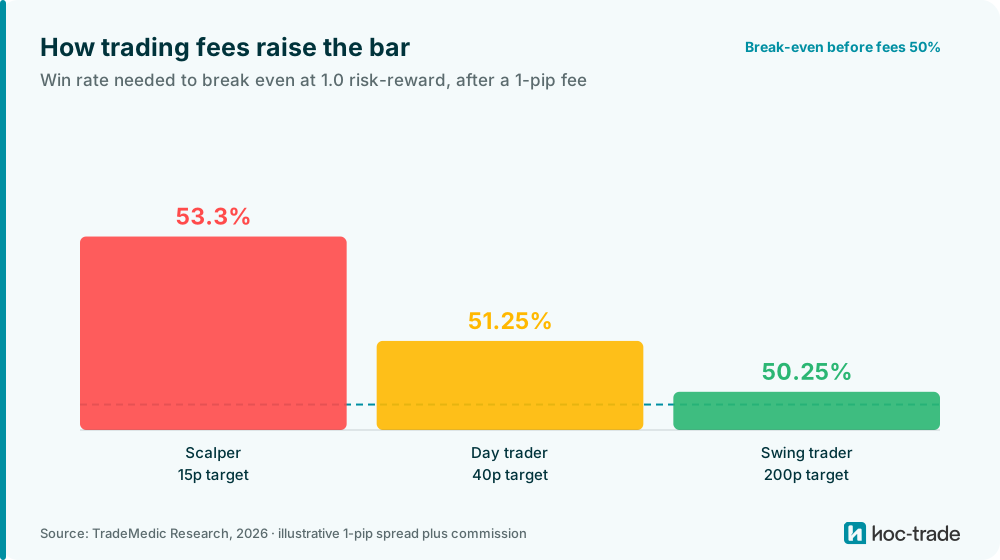
Seen another way, the fee silently degrades the risk-reward ratio a trader truly achieves. A scalper who sets up a one-to-one trade is, after fees, really trading a 0.88 ratio. For the day trader it becomes 0.95, and for the swing trader it stays at 0.99. The scalper aimed for balance and ended up with their average loss substantially larger than their average win, purely because of cost. The swing trader's ratio barely moved.
This is one structural reason the faster styles face a tougher starting point. It is not that scalpers lack skill. It is that the same cost takes a far larger bite out of a small target, forcing a win rate that very few traders can sustain. A real spread varies by instrument, and active traders often choose tighter-spread markets specifically to limit this drag, so the exact numbers shift. The direction does not.
Even a coin-flip market punishes the faster styles
The fee effect is easiest to see if you strip skill out entirely. Imagine a purely random market, where every trade is a coin flip: a 50% chance of hitting your target and a 50% chance of hitting your stop, on a balanced one-to-one setup. With no edge at all, you would expect to break even. The fee changes that, and it changes it by style.
It helps to see how this works with one trader, again as a simple illustration rather than a claim about any specific strategy. Take a scalper aiming for 15 pips with a 15-pip stop, paying a 1-pip fee. A win nets 14 pips after the fee; a loss costs 16. Over 100 coin-flip trades, the expected outcome is 50 wins and 50 losses, which leaves them at 50 times 14 minus 50 times 16, a loss of 100 pips. To merely break even they would need to win not 50 but about 53 of those 100 trades. In a fair market the chance of winning 53 or more out of 100 by luck is well under half, and it shrinks as the number of trades grows, because results cluster ever more tightly around the true 50%. The swing trader faces the same logic but a far gentler version: their 1-pip fee against a 200-pip target means they need only about 50 or 51 wins per 100, a threshold luck clears far more often.
Because the fee raises the win rate each style needs to break even, a random trader has to get lucky to finish ahead, and the more they trade, the less likely that luck holds. The numbers follow directly from probability. In a random market with a 1-pip fee, after 500 trades only about 7% of scalpers remain profitable by chance, against 29% of day traders and 46% of swing traders. Extend it further and the gap widens: by 2,000 trades, essentially no scalper is still profitable, day traders fall to around 13%, and swing traders remain above 40%.
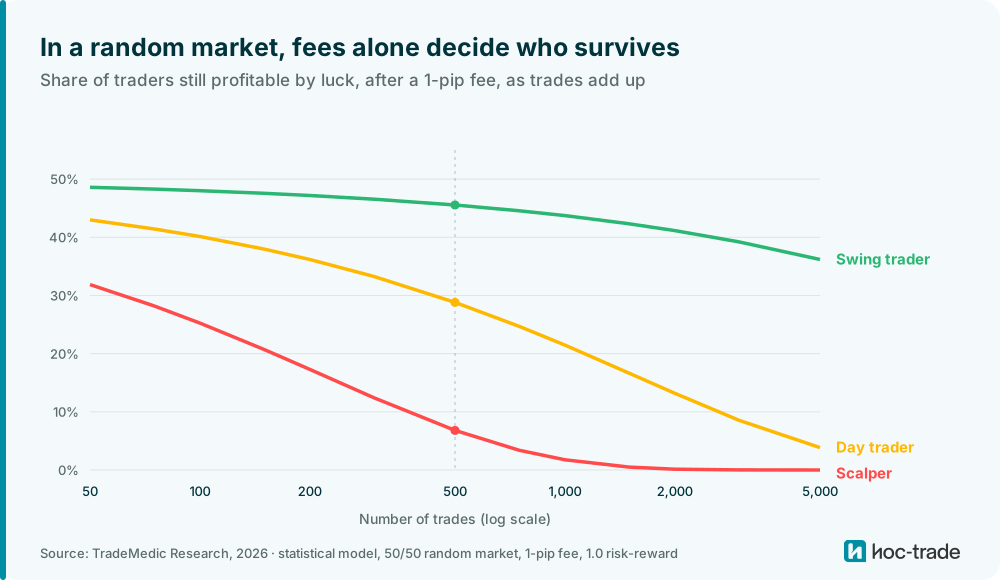
The reason is the same fixed-cost effect seen above, now compounded over many trades. A scalper needs to win 53.3% of coin flips to overcome the fee, against just 50.25% for a swing trader. That small difference, repeated over hundreds of trades, is the difference between near-certain loss and near-coin-flip survival. The faster style does not lose because the trader is worse. It loses because the cost structure tilts a fair game against it, and trading more simply gives that tilt more chances to show up.
One honest limitation: this model counts only the per-trade cost of spread and commission. It leaves out swap, or overnight financing, which a swing trader pays for holding positions across days and a day trader or scalper largely avoids by closing intraday. Swap costs work in the opposite direction, weighing on the slower styles, so the real-world advantage of swing trading is smaller than the transactional-fee model alone suggests. The model is a clean illustration of how per-trade costs punish frequency, not a complete account of every cost a trader faces.
The same number of trades, packed very differently
The cost story has a structural twist worth seeing directly. Across their account lifetimes, the three styles make a strikingly similar total number of trades: scalpers average about 990 trades, day traders about 1,058, and swing traders about 984. What differs is not how much they trade, but how tightly they pack it.
Scalpers compress their activity into about 21 active trading days, around 47 trades per day. Day traders spread a similar total across about 62 days at 17 trades per day, and swing traders across about 123 days at 8 trades per day. A scalper, in other words, pays the same fee on a roughly equal number of trades, but front-loads it into a short, intense burst, and does so on the smallest targets. The swing trader pays a comparable number of fees, but on the largest targets and stretched over a far longer period, which gives an edge, if one exists, the room and time to express itself. This is the activity pattern behind the cost math: it is not that faster traders trade more in total, it is that they concentrate the same volume into smaller, costlier increments.
The critical issues swing traders avoid
Cost and frequency are structural, but they are not the whole story. The same dataset measures behavioral patterns, and here the styles diverge in a way that compounds everything above. The fast pace of day trading and scalping does not just multiply fees, it breeds some habits that destroy accounts fastest.
Revenge trading, re-entering the market immediately after a loss to win it back, affects 41.5% of day traders and 47.1% of scalpers, but only 9.8% of swing traders. This is the single largest behavioral gap between the styles, and it matters enormously, because revenge trading is one of the most damaging patterns there is. When it is a trader's biggest issue, only 13.4% are net profitable, well below the 18% baseline. A swing trader, holding positions over days, simply does not face the same minute-by-minute trigger to chase a loss.
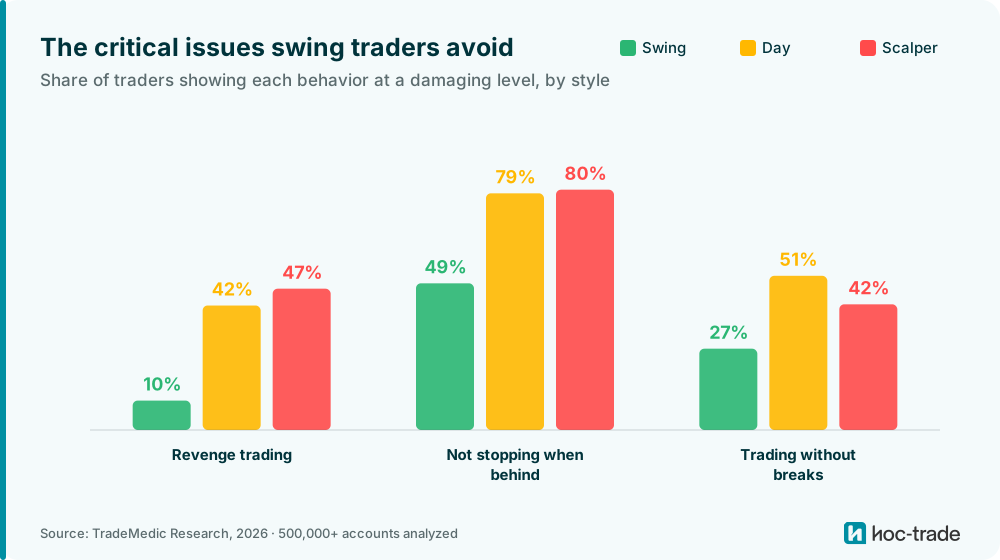
The same pattern holds for two other high-damage behaviors. Failing to stop trading after strong wins or losses 78.9% of day traders and 80.1% of scalpers, against 48.9% of swing traders, and it is among the most destructive issues in the data, with just 6.3% of traders profitable when it dominates. Trading without breaks affects 51.4% of day traders versus 27.1% of swing traders, and it is the most damaging issue of all when it is a trader's primary problem, where only 1.3% stay profitable. In each case, the structure of swing trading tends to reduce the trigger: there is less reason to sit in front of a screen all day, and less of a rapid sequence of trades pulling the trader past the point where they should have stopped.
This does not mean swing traders are more disciplined people. They are not cleaner across the board. Swing traders show higher rates of over-complexity, at 42.2% versus 19.4% for day traders, and doubling-down (53% vs. 31% for scalpers). Both of these are very dangerous patterns for an account profitability (14% and 7% of traders that show the behavior are profitable, respectively). The difference is not character, it is exposure. The faster the style, the more often a trader is placed in exactly the moments that produce revenge trading, failure to stop, and trading through fatigue, and those happen to be among the most profitability-destroying behaviors that exist. Swing trading does not make a trader immune to mistakes. It tends to keep them out of the situations that cause some of the most costly ones.
What the gap really says about edge
Here the story turns, because the most revealing comparison is not between the styles but between what each style should produce and what it does in reality.
Recall the random-market model. On transactional fees alone, with no skill involved, a swing trader should be profitable around 46% of the time after 500 trades, a day trader around 29%, and a scalper around 7%. The real figures run the other way relative to those expectations. Swing traders are net profitable 27.5% of the time, well below the roughly 46% that their gentle cost structure would hand them for free. Scalpers are net profitable 19.3% of the time, far above the near-zero that fees alone would predict for them.
Read carefully, this flips the easy conclusion. Swing traders enjoy a large structural tailwind, low costs relative to their targets and time for a position to work, yet they convert far less of it than the math allows. Much of that shortfall is behavioral, the ordinary errors that erode any trader's edge, and some is the swap cost the model leaves out. The point is that a swing trader can be quite mediocre and still land near the average, because the structure is carrying them. The style flatters the trader.
Scalpers face the opposite. The cost structure should wipe almost all of them out, and yet nearly one in five is profitable. That is only possible if the surviving scalpers possess a genuine edge, something real enough to overcome a fee headwind that would sink a random trader within a few hundred trades. A profitable scalper is, in a sense, more likely to have a real edge than a profitable swing trader, because they have had to prove it against a far harsher cost structure to get there.
This reframes the practical question for a retail trader. The honest difficulty is not which style produces the highest headline profitability, it is how hard it is to find a durable edge in each. Swing trading is more forgiving: a modest edge, or even no real edge with reasonable discipline, can survive because costs barely bite. Scalping is far less forgiving: a strong, repeatable edge is needed to survive the costs at all, which is part of why so many who try it struggle, and why the ones who do succeed are more likely to have a real, proven edge. Neither is the right answer for everyone. The slower styles give a developing trader more room to survive while they learn; the faster styles offer almost no margin for the absence of a real edge.
The lever underneath all of it is the same. What separates profitable traders, as our analysis of risk-reward ratio versus win rate shows, is whether their winners are larger than their losers, and fees and frequency both attack that ratio. For the broader question of how many traders make money at all, see our analysis of what percentage of traders are profitable.
How TradeMedic measures this in your trading
The figures here describe populations. TradeMedic applies the same analysis to an individual account. It reads a trader's real executed history and measures the things that move their profitability: the effective risk-reward ratio after costs, how trading frequency affects their results, how concentrated or scattered their activity is, and which behaviors are widening the gap between their wins and losses. Rather than a general statement that swing trading tends to be more profitable, it shows a specific trader where their own style and habits are helping or hurting, and what single change would most improve their odds. You can get your own TradeMedic™ report here for free.
The bottom line
Across more than 500,000 accounts, swing traders were net profitable 27.5% of the time against 17.3% for day traders, roughly 60% more likely to make money. Part of that gap is structural: trading fees consume a far larger share of a scalper's small target than a swing trader's large one, forcing a higher break-even win rate, and the faster styles pack the same number of trades into far fewer days. Part of it is behavioral, the errors the fast pace breeds, from revenge trading to failing to stop. But the most useful reading runs deeper than the headline. Swing traders underperform what their gentle cost structure should give them, which means the structure flatters them. Scalpers overperform what their harsh cost structure should allow, which means the profitable ones have likely proven a real edge. For a retail trader, the question is less which style wins on average and more how hard it is to find a durable edge in each, and on that measure the faster styles are far less forgiving.
Source: TradeMedic™ Research, 2026. Based on a dataset of more than 500,000 analyzed trading accounts; profitability is measured at the account level across accounts with a minimum of 50 trades. The trading-fee analysis is illustrative, using a representative 1-pip spread plus commission and a one-to-one risk-reward ratio; real costs vary by instrument and broker. Figures describe correlations across the population and are not a guarantee of individual results.
Frequently asked questions
Is day trading or swing trading more profitable?
Across more than 500,000 accounts, swing traders were net profitable 27.5% of the time against 17.3% for day traders, making swing traders roughly 60% more likely to be profitable. The gap is partly structural, driven by trading costs and frequency, and partly behavioral.
Why are swing traders more profitable than day traders?
Partly because of trading costs and frequency. A fixed fee consumes a larger share of a day trader's or scalper's small profit target than a swing trader's large one, raising the win rate needed to break even. Faster styles also pay that cost more often. Both effects attack the risk-reward ratio that drives profitability.
Is scalping profitable?
Scalpers were net profitable 19.3% of the time in the dataset, between day traders and swing traders. Scalping faces the steepest cost headwind: at a one-to-one risk-reward ratio, a 1-pip fee forces a scalper to win 53.3% of trades just to break even, against 50.25% for a swing trader.
Is day trading profitable?
Day traders were net profitable 17.3% of the time across more than 500,000 accounts, the lowest of the three styles and slightly below the all-trader average of about 18%. Day trading is not unprofitable for everyone, but it starts from a harder position than swing trading because trading costs consume a larger share of its smaller targets.
Swing trading vs scalping: which is more profitable?
Swing traders were net profitable 27.5% of the time against 19.3% for scalpers, making swing trading the more profitable of the two in the dataset. The main reason is cost: a fixed per-trade fee is a large share of a scalper's small target but a tiny share of a swing trader's large one, so scalpers need a much higher win rate just to break even.
Does trading more often make you less profitable?
Trading more often means paying the spread and commission more frequently, and on smaller targets that cost is a larger share of each trade. In a random-market model with a 1-pip fee, a high-frequency scalper is reduced to near-zero profitability within a few hundred trades, while a swing trader holding the same number of positions on larger targets is barely affected. Frequency itself is not the problem; paying a fixed cost more often on smaller targets is.
Is swing trading better for beginners?
The data does not measure experience level by style, but swing trading's structural advantages, lower costs as a share of each trade and less frequent trading, mean beginners face a smaller built-in headwind than they would scalping or day trading. Skill still matters, but the starting position is easier.
Day trading vs swing trading: which has more risk?
The data measures profitability rather than risk directly, but the structural picture is clear: day trading and scalping require a higher win rate just to overcome costs, which makes consistent profitability harder to achieve. Swing trading starts closer to break-even before skill enters the picture.
Do day traders revenge trade more than swing traders?
Yes, substantially. Revenge trading affects 41.5% of day traders and 47.1% of scalpers but only 9.8% of swing traders, the largest behavioral gap between the styles. Because revenge trading is one of the most damaging patterns, with only 13.4% of affected traders profitable, this is a major reason faster styles struggle.
Would scalpers lose money even in a fair market?
Yes, due to fees. In a model of a purely random 50/50 market with a 1-pip fee, after 500 trades only about 7% of scalpers remain profitable by chance, against 29% of day traders and 46% of swing traders. The fee raises the win rate each style needs to break even, and over many trades that small edge decides who survives.