Category:
 Author:
 Date:Aug 17, 2026
One Trade a Day in One Symbol: Myth or Reality? What 500,000+ Accounts Show
Look for advice on how often to trade and the same rule keeps coming back. One trade a day. One instrument. Take your setup, and whether it wins or loses, close the platform and come back tomorrow. Plenty of coaches teach it, plenty of traders swear by it, and as far as we can tell nobody has ever checked it against real trading data. So is it a myth or is it real?
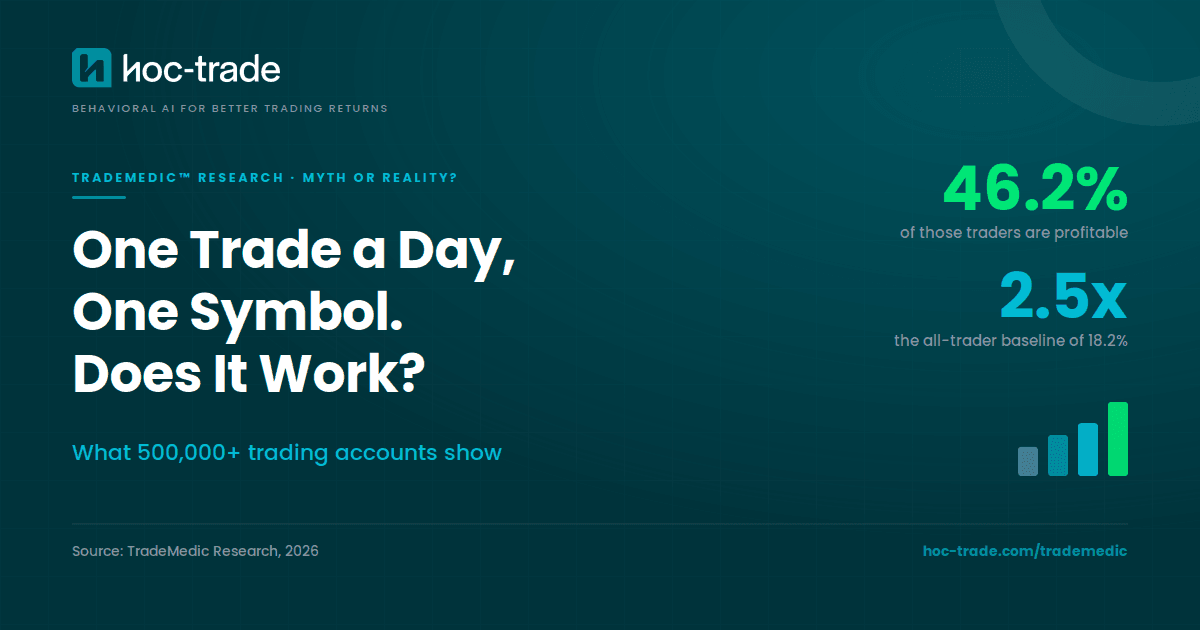
We can answer that. Across the 500,000+ trader accounts analysed by TradeMedic™ AI, traders who keep more than 99% of their trades in a single symbol are profitable 25.6% of the time. Traders who place fewer than two trades on an average day are profitable 33.0% of the time. Both sit above the 18.2% all-trader baseline. Traders who do both are profitable 46.2% of the time, 2.5 times the baseline rate, and but genuinely few traders are actually living up to this rule, only less than 0.5%.
What happens when low frequency and a single symbol combine?
The two habits reinforce each other rather than overlapping.
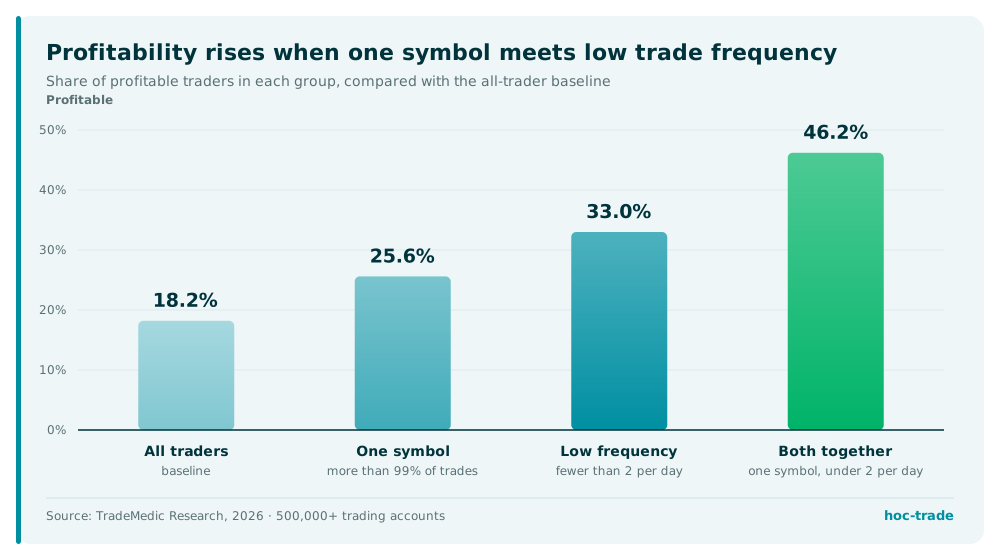
Taken alone, single-symbol concentration lifts the profitable share from 18.2% to 25.6%. Taken alone, low frequency lifts it to 33.0%. Together they reach 46.2%.
That final number is the highest we have attached to any behavioural combination, and it holds up against a simple check. If the two effects were independent and multiplied on the baseline, you’d predict 33.0% times 25.6% divided by 18.2%, which comes to 46.6%. The observed figure is 46.2%.
The two behaviours carry almost completely separate information about a trader. Neither is standing in for the other, and neither is doing the other’s work. A trader who does both gets close to the full benefit of each.
How rare are these traders?
Rare enough that this is a description of a small group, not a route most people will take. Fewer than half a percent of the accounts we analysed meet both conditions, around one trader in 270.
The scarcity comes from the frequency side. Total symbol concentration isn’t unusual: close to a quarter of traders keep more than 99% of their trades in one instrument. Trading fewer than twice a day is unusual, at roughly one trader in fifty.
The two habits also do not usually appear in the same account, which is why the overlap is small. Most people who concentrate on one symbol do it because they watch that symbol constantly, and watching something constantly tends to produce trades.
Why would one trade a day in one symbol work?
Not because markets reward sitting still. The mechanism is about what the two constraints remove and what they concentrate.
A trader placing one trade a day is selecting rather than reacting. Whatever their criteria are, those criteria are doing real work, because nearly everything that appears on the screen gets rejected. The waiting is what does the filtering.
A trader in one instrument builds an unusually deep reference set. They’ve seen this symbol in this session at this level of volatility hundreds of times. That kind of pattern recognition is slow to build and doesn’t transfer between instruments easily, which is the argument behind both the symbol expert and symbol focus strengths TradeMedic AI detects.
There is also a subtraction effect, and it comes from the walk-away half of the rule. Most of the costly behavioural patterns need a second trade to exist. A trader who closes the platform after one trade can’t fail to call it a day. They can’t trade without a break. Revenge trading has almost no surface to attach to. The behaviours aren’t being resisted, they’re being made structurally unavailable, which tends to hold up better than willpower.
Why more than half of this group still lost money
53.8% of the traders in it still finished with a loss.
That is the most disciplined-looking group in the whole dataset, traders who wait all day for one setup in an instrument they know well, and the majority still lost money.
Patience isn’t an edge. It removes the ways a trader destroys an edge, and it doesn’t supply one. If the single trade you take each day has negative expectancy, taking it once a day gives you a slower version of the same outcome, not a different one.
The rule is also silent on how much you put at risk, and that turns out to matter on its own. Accounts risking under 0.5% per trade are profitable 24.5% of the time, or more than 1.5x as often compared to the average. At 0.5% to 1% it’s 17.8%, and from 1% upward it sits at 15.0%. One trade a day at 5% of the account is still a fast route to a blown account, and nothing about the frequency or the symbol count protects against that. We covered the full picture in how much to risk per trade.
Can you turn this into a strategy?
Carefully, and not by copying the behaviour. In itself, it is not a trading strategy.
The behaviour is the output of a process, not the input. These traders don’t place one trade a day in order to become profitable. They place one trade a day because their criteria are strict enough that only one thing clears the bar, and the criteria are what produced the result. Adopt the trade count without the criteria and you have no edge, once a day.
What does transfer is the filter. Raise your standard until far fewer setups qualify, then look at what happens to your average performance per trade. Your own history will answer that.
Be realistic about the destination, too. Most traders won’t get to one trade a day and don’t need to. Our trades per day analysis shows the decline in profitability is almost entirely spent before the tenth trade, so a move from 15 trades to six captures most of what’s available.
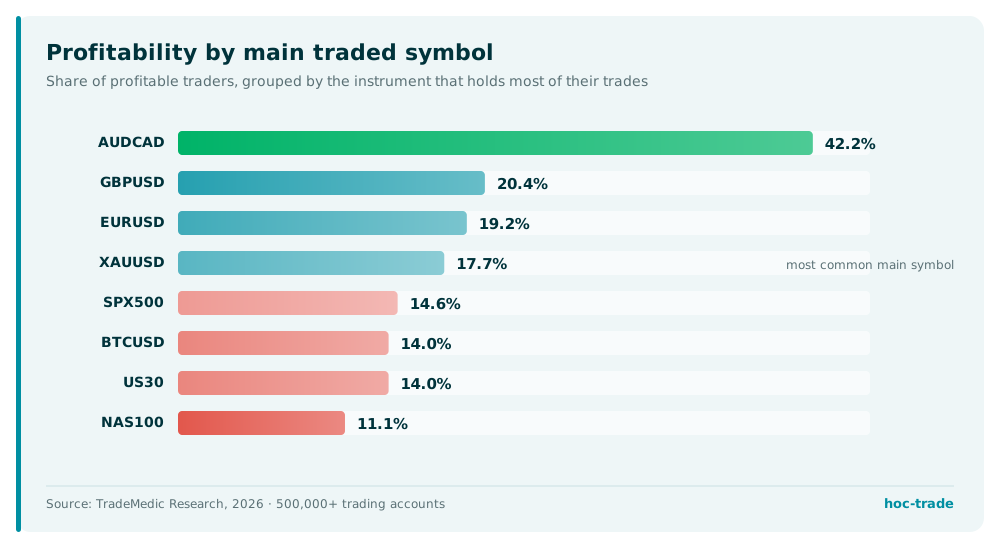
Which instrument you concentrate on is not a neutral choice either, and the spread is wide: profit rates by main traded instrument run from 11.1% at the bottom to 42.2% at the top. Concentration amplifies whatever the instrument gives you, in both directions. We ranked every instrument separately in best forex pair to trade, which is the place to look before picking one.
How does TradeMedic AI detect this in your own account?
None of the three components are self-reported. Each comes out of your trade history.
Selective trading is detected by classifying every trade according to how many trades you’d already placed that day, then testing whether your performance per trade falls as the count rises. Where your low-count days consistently outperform, it’s recorded as a strength and given a dollar value.
Symbol focus is detected by testing your performance against the number of different symbols you hold open at once, which measures whether you execute better with less to manage.
Symbol expert is detected separately, by testing whether you repeatedly outperform in specific instruments over time. You can be strong in one symbol without being disciplined about position count, and the two show up independently. All three sit among the 60+ behavioural patterns detected per account.
The bottom line
Not a myth. Traders who place fewer than two trades a day in a single instrument are profitable 46.2% of the time, 2.5 times the 18.2% baseline. The two behaviours contribute almost independently, so the combination lands close to the full product of both effects.
But the advice is not the whole story either. It’s the rarest configuration we found, at roughly one trader in 270, and 53.8% of the traders in it still lost money. The pattern describes what disciplined execution looks like from the outside. It doesn’t manufacture an edge for a trader who doesn’t have one.
See whether selective trading and symbol focus show up in your own history: connect your trading account to TradeMedic™ AI free.
Frequently asked questions
Is the one trade a day rule a myth?
No. Traders who place fewer than two trades a day in a single symbol are profitable 46.2% of the time, 2.5 times the 18.2% baseline across 500,000+ analysed accounts. The caveat is that only about one account in 270 does both, and 53.8% of that group still lose money, so the rule describes disciplined execution rather than creating an edge.
Is one trade a day a good strategy?
Among accounts placing fewer than two trades a day in a single symbol, 46.2% were profitable, against an 18.2% baseline across 500,000+ analysed accounts. That is the highest rate of any group in the dataset. The other 53.8% still lost money, which suggests low frequency removes ways of losing rather than creating an edge.
Can you make money trading once a day?
Some traders do, and they are profitable more often than any other group we measure. But the behaviour is the output of strict entry criteria rather than the cause of the result. Placing one trade a day without a filter that justifies it produces no edge, once a day.
Does low frequency and single-symbol focus work together or is one enough?
They contribute almost independently. Single-symbol concentration alone lifts the profitable share to 25.6% and fewer than two trades a day alone lifts it to 33.0%, against an 18.2% baseline. Traders doing both reach 46.2%, which is close to the 46.6% you would predict if the two effects simply multiplied.
Is trading one currency pair only profitable?
Traders who keep more than 99% of their trades in a single symbol are profitable 25.6% of the time, against an 18.2% baseline. The advantage only appears at that extreme level of concentration, and it carries the risk that an edge built on one instrument disappears when that instrument changes character.
How many trades a day do profitable traders make?
Traders placing fewer than two trades on an average day are profitable 33.0% of the time, the highest of any frequency band. They are also only about one trader in fifty. Profitability declines as the daily trade count rises and levels off above ten trades a day.