Category:
 Author:
 Date:Aug 17, 2026
How Many Trades Per Day Should You Make? The number is lower than you think
Most traders ask themselves how many trades per day they should take, especially because it is one of the easiest to control parameters in our trading. Starting from when are you overtrading, how does it differ with your trading strategy, and will you have enough mental bandwidth? However, while there is lots of qualitative advice out there, we did not come across a well-founded number.
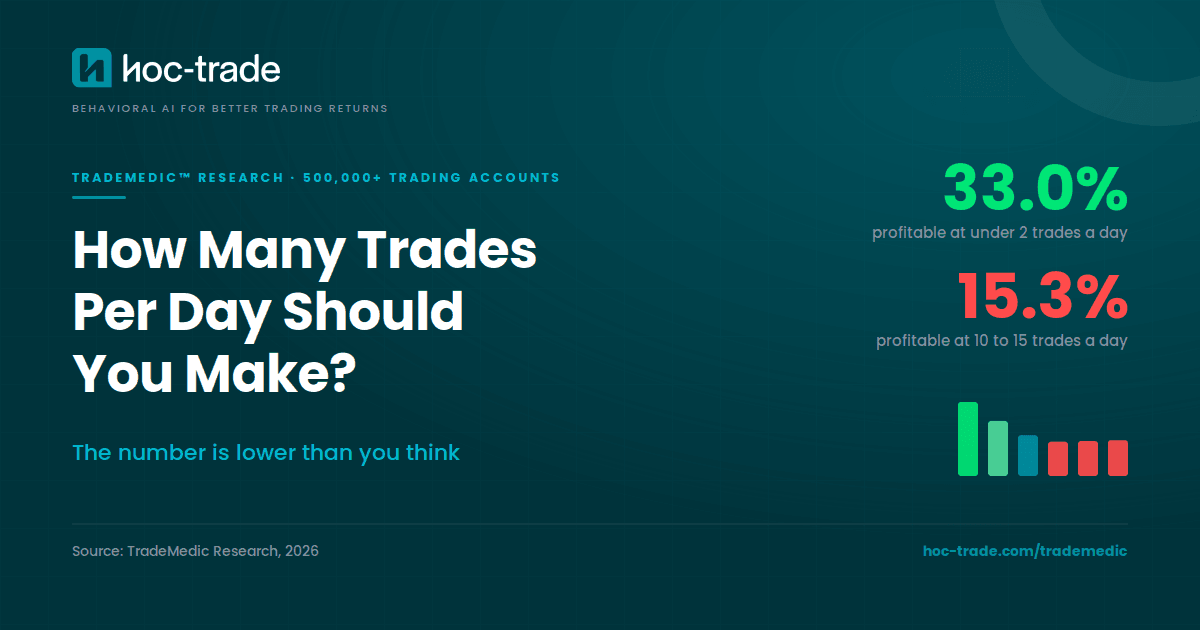
Across the 500,000+ trader accounts analysed by TradeMedic™ AI, there appears to be a correlation between the number of trades per day and the profitability of these traders. However, we have to look deeper than the obvious. Traders who place fewer than two trades on an average day are profitable 33.0% of the time. At 5 to 10 trades a day it’s 18.2%, exactly the baseline for all traders in our dataset. By 10 to 15 trades a day it’s 15.3%. The share of profitable traders more than halves across that stretch, and then it stops moving: from 10 trades a day out to the very heaviest traders, the odds barely change at all.
How many trades per day is best?
Fewer is better, and the data is not subtle about it. Traders in the lowest frequency band are profitable at nearly twice the rate of traders in the middle bands, and roughly 15 percentage points above the all-trader baseline.
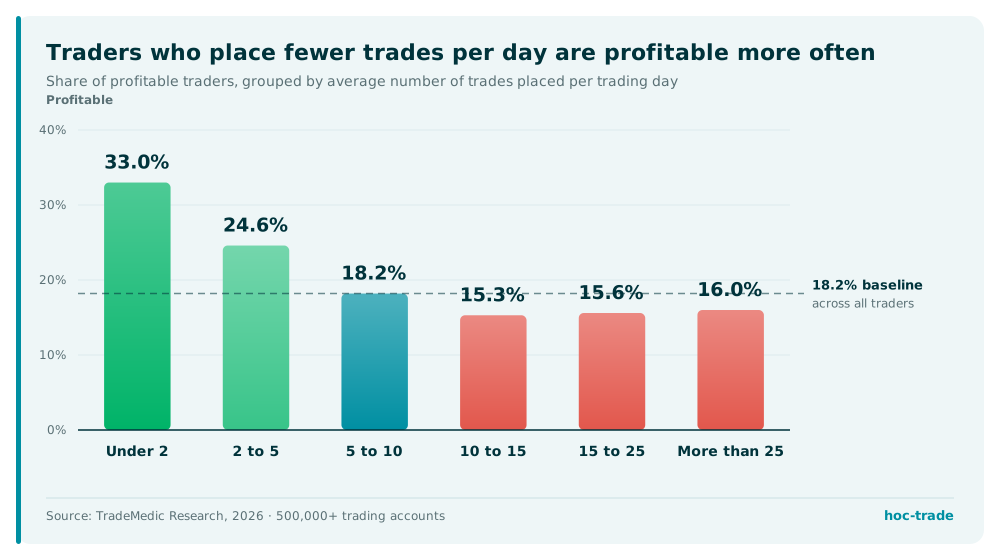
Reading left to right, the curve does something specific. It drops hard, then it flattens. Under 2 trades a day sits at 33.0%. Two to five drops to 24.6%. Five to ten lands on 18.2%. Ten to fifteen falls to 15.3%, and after that nothing much happens: 15.6% at 15 to 25 trades, and 16.0% above 25.
A trader placing 12 trades a day and a trader placing 40 have close to the same odds. Almost the entire difference is spent before the tenth trade of the day.
That matters for what you do with this. The advice to “trade less” is worth following, but only if it takes you into single digits. Cutting from 20 trades to 15 moves you along a flat part of the curve.
How many trades per day do most traders make?
Far more than the advice out there suggests. A quarter of the accounts in our dataset place more than 25 trades on an average trading day, and 40% place more than 15. Only about 2% place fewer than two.
So the band with the best odds is also the emptiest one. Whatever is happening at the low-frequency end, very few traders are doing it.
Why does profitability fall fastest before the tenth trade?
The first trades of a session tend to be the planned ones. You waited for them, you sized them deliberately, and you could write down the reason you took each one.
What comes after is a different kind of decision. By the sixth or seventh trade the conditions have changed. There’s an open loss to think about, or a run of wins, or a session that hasn’t delivered what it was supposed to. Trades placed in that state aren’t selected the same way, and the data reflects it.
Several of the most expensive patterns we track with TradeMedic AI exactly fall into this window. Failing to call it a day negatively affects 75.6% of accounts. Trading without a break negatively affects 46.2%. Revenge trading negatively affects 37.1%. None of them can happen on your first trade of the day. All of them become available the moment you take another one.
When does trading more become overtrading?
At the point where your own results start to fall, which is not a number anyone can hand you. Overtrading is detected against a trader’s own history rather than a fixed threshold, and we cover it in full separately, but two things about it are worth knowing here.
It separates loss-makers from profitable traders more cleanly than almost anything else in this article. Overtrading negatively affects 49.5% of all accounts and ranks as a top-five issue for 40.3%. Among loss-making traders that figure is 44.4%. Among profitable traders it’s 21.8%, roughly half as often.
The profitability gap is the clearest signal. Of the traders who show overtrading in their data at all, 12.3% are profitable, against the 18.2% baseline. Narrow it to the traders for whom overtrading is their single biggest issue and that falls to 6.3%, roughly a third of the baseline rate.
And it grows with experience rather than fading.
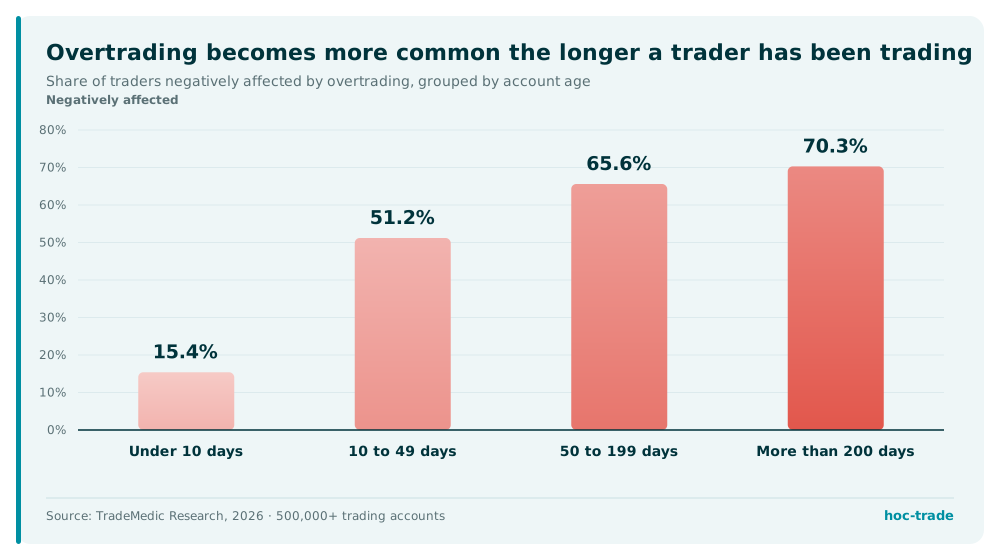
Overtrading negatively affects 15.4% of traders in their first ten days, 51.2% between 10 and 49 days, 65.6% between 50 and 199 days, and 70.3% past 200 days. For traders past 50 days it becomes the single most common top-five issue we detect. Note that this tracks time spent trading, not skill or results. The practical point is that whatever number works for you now is not settled: trade counts drift upward the longer you trade, so this is worth re-checking rather than deciding once.
How many trades per day for scalping, day trading and swing trading?
The three styles sit at very different frequencies, and the two extremes line up with the main finding.
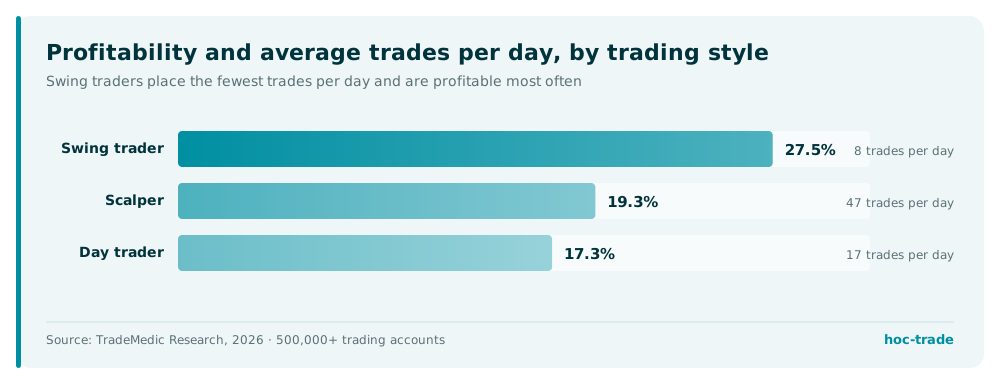
Swing traders place the fewest trades, around 8 a day, and are profitable 27.5% of the time, the strongest of the three styles. Day traders place about 17 a day and are profitable 17.3% of the time. Scalpers sit at roughly 47 trades a day and 19.3%.
Scalpers are the interesting case, and they make sense once you look at how they trade. A scalper’s method is built around high frequency: small, repeatable, mechanical decisions taken in seconds. The trade count isn’t a symptom of a session getting away from them, it’s the design. So the number that matters isn’t your absolute trade count, it’s whether your count fits the method you’re running. Scalpers are also the least affected style for overtrading, at 23.9% as a top-five issue against 41.7% of day traders and 43.3% of swing traders.
For everyone who isn’t running a genuine high-frequency method, the population finding stands: fewer trades, better odds.
What is selective trading?
Selective trading is the strength that sits on the other side of this. We flag it when a trader’s low-volume days consistently outperform their high-volume days, which means the trader has a real filter and it’s doing real work.
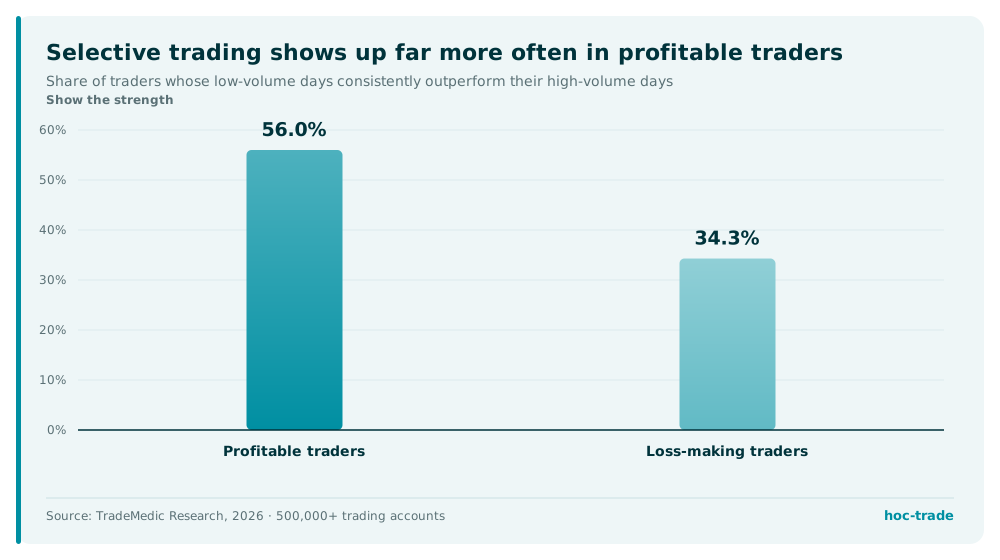
It shows up in 56.0% of profitable traders and 34.3% of loss-making ones. Across everyone in the dataset it appears in 38.3% of accounts, which makes it the third most commonly detected strength of the 25 we track.
What separates those traders isn’t that they force themselves to stop at a number. It’s that their criteria are strict enough that fewer things qualify, and the trade count falls out of that. You can read more in our piece on selective trading as a standalone edge.
How does TradeMedic AI find your own number?
The population curve tells you what happens across 500,000+ accounts. It doesn’t tell you where your own performance starts to slide, and that point varies a lot between traders.
TradeMedic™ AI classifies every trade in your account by how many trades you’d already placed that day, then measures your average performance per trade across those bands. If your results decline as the day’s count rises, you’ll see exactly where the decline starts and what it has cost you in real money. The bands adapt to how you trade, so a scalper is assessed across scalper ranges and a swing trader across swing ranges. It’s one of 60+ behavioural patterns detected from your trade history.
How to trade fewer, better trades
Cap the day rather than the trade. A daily limit is checkable in the moment. A vague intention to be more selective isn’t.
Watch the two states where an extra trade is most likely to be unplanned: right after a loss closes, and right after you hit your target for the day.
Raise the bar instead of counting down. Traders who end up in the low-frequency band don’t usually get there by rationing trades. They get there by tightening what qualifies as a setup until fewer things clear it.
And be honest about where you sit on the curve. If you’re at 20 trades a day, trimming to 15 won’t do much. The move that matters is into single digits, or fixing whatever is generating the extra trades in the first place.
The bottom line
Traders who place fewer trades per day are profitable more often, and the effect is large: 33.0% in the lowest frequency band against 15.3% at 10 to 15 trades a day, with an 18.2% baseline in between. The decline is front-loaded, so nearly all of it happens before your tenth trade of the day and the curve is flat after that.
The exception is a genuine high-frequency method. Scalpers trade the most and still beat day traders, because their count is by design rather than by drift. For everyone else, the fewer trades you take, the better the odds look.
There is an extreme version of this finding. Traders who combine very low frequency with a single instrument are profitable 46.2% of the time, 2.5 times the baseline rate. We broke that down in one trade a day in a single symbol.
See where your own performance per trade starts to decline: connect your trading account to TradeMedic™ AI free.
Frequently asked questions
How many trades per day should a day trader make?
There is no single correct number, but the odds change most below ten trades a day. Across 500,000+ analysed accounts, traders placing fewer than two trades a day were profitable 33.0% of the time, while traders placing 5 to 10 were profitable 18.2%, matching the overall baseline. Above ten trades a day the rate flattens out between 15% and 16%.
How many trades per week should you make?
The data is measured per trading day rather than per week, and the pattern is the same either way: the fewer trades you place in a session, the better the odds. A trader averaging under two a day sits at 33.0% profitable against an 18.2% baseline.
How many trades per day is right for scalping?
Scalpers average around 47 trades per day and are profitable 19.3% of the time, ahead of day traders at 17 trades per day and 17.3%. High frequency is built into the method, so the absolute count matters less than whether it matches the approach being run.
When does trading more become overtrading?
Overtrading is not defined by an absolute trade count. It is detected when a trader’s own performance per trade declines as their daily count rises. It negatively affects 49.5% of analysed accounts and is a top-five issue for 44.4% of loss-making traders against 21.8% of profitable ones.
Is it better to make fewer trades?
Across the trader population, yes. But almost all of the measurable difference occurs before the tenth trade of the day. Cutting from 20 trades to 15 changes very little, because that part of the curve is nearly flat. The meaningful move is into single digits.
What is selective trading?
Selective trading is a strength TradeMedic™ AI detects when a trader’s low-volume days consistently outperform their high-volume days. It appears in 56.0% of profitable traders and 34.3% of loss-making traders, and in 38.3% of all analysed accounts.