Category:
 Author:
 Date:Nov 16, 2026
How to Grow a Small Trading Account: What 500,000+ Trading Accounts Show
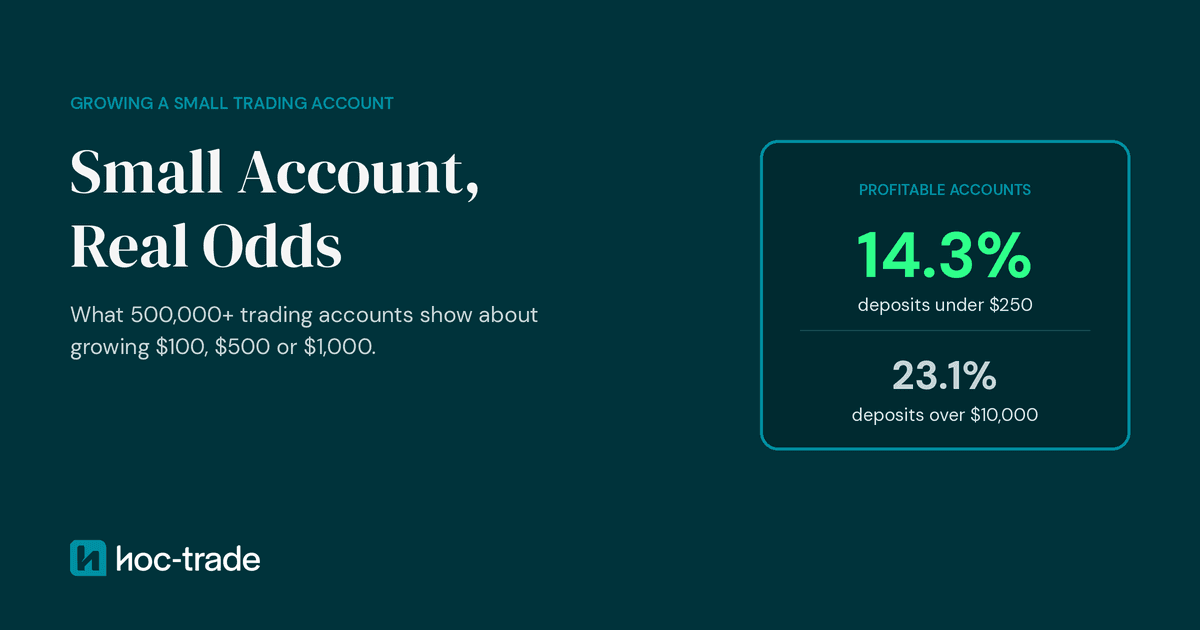
Most people start trading with a small account. A few hundred dollars, sometimes less, and a plan to grow it: 1% a day, $100 a day, or a challenge that turns $20 into $50,000 on paper. The question is not whether small accounts can grow. It is how they grow without disappearing first, whether that small forex account trades currency pairs, gold or both.
We looked at what TradeMedic AI data from 500,000+ trading accounts shows about small accounts. They are the most common accounts and the least often profitable. They are hit hardest by a few habits that multiply risk within a session. And the daily targets small traders set themselves push them towards exactly those habits.
Can you grow a small trading account?
Yes, but the odds start lower. In TradeMedic AI data from 500,000+ trading accounts, the share of profitable accounts rises with the amount deposited, from the smallest accounts to the largest:
14.3% of accounts that deposited less than $250 in total are profitable.
16.1% of accounts that deposited $250 to $1,000 are profitable.
19.0% of accounts that deposited $1,000 to $2,500 are profitable, and 19.7% of accounts that deposited $2,500 to $10,000.
23.1% of accounts that deposited more than $10,000 are profitable.
Small accounts are also the most common: 42.8% of accounts in the data deposited less than $1,000 over their whole life. These figures cover accounts with at least 50 trades, and the deposit amount is the total deposited, not only the first deposit.
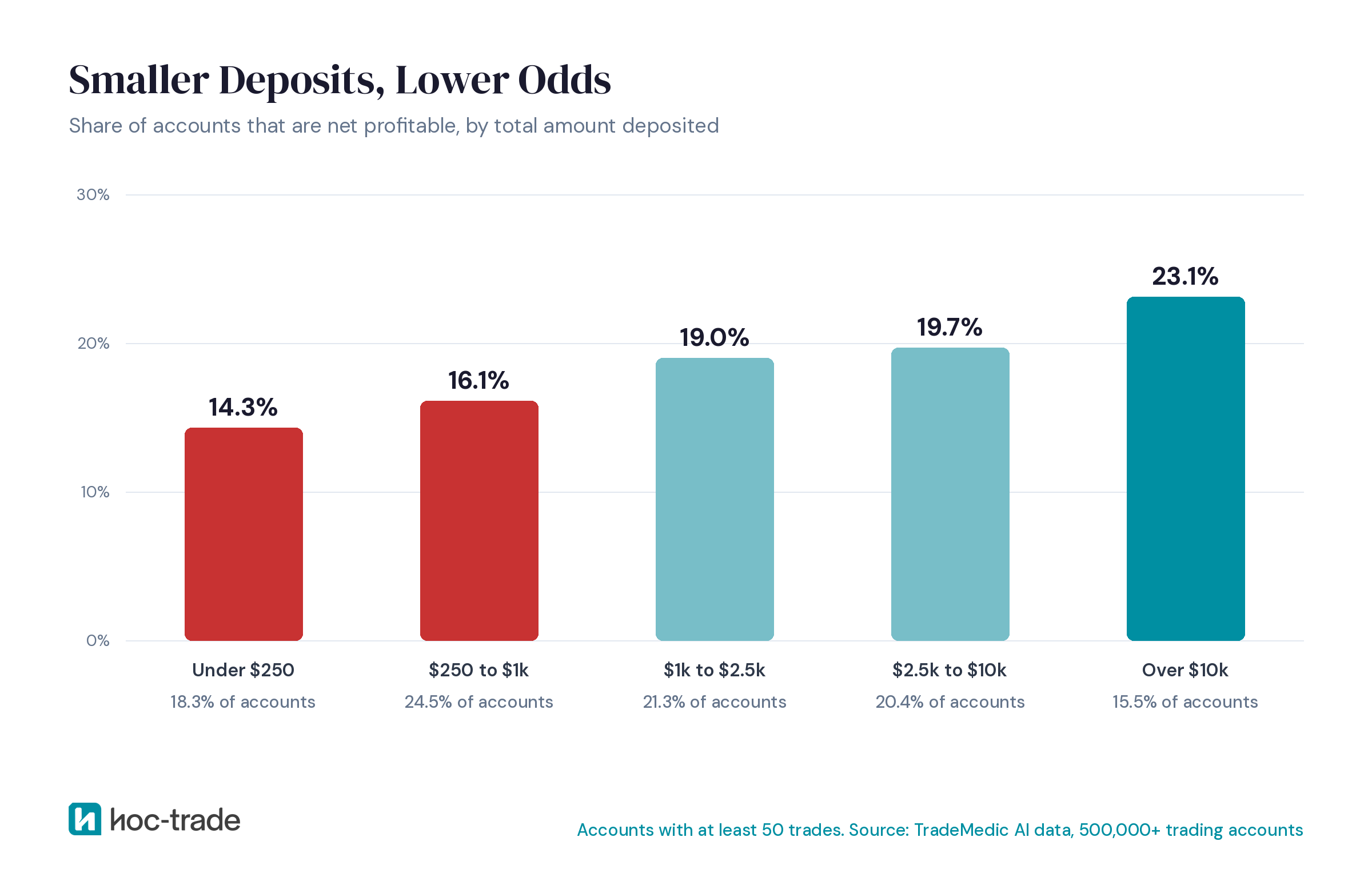
This is a correlation, not a reason to deposit more. Adding money does not make anyone a better trader, and larger accounts may belong to traders who differ in other ways. What the data shows is that small accounts face specific problems, and most of them can be dealt with.
Why is small account trading so hard?
Three things work against a small account. TradeMedic AI data shows the third one directly; the first two follow from the maths of position sizes and targets.
The smallest position is large for a small account. Most brokers set the minimum trade size at 0.01 lots. On EURUSD, that is worth about $0.10 per pip, so a trade with a 20 pip stop risks about $2. On a $1,000 account that is 0.2% of the balance. On a $100 account it is 2%, before the trader has made a single sizing decision. Keeping risk at 0.5% per trade with a 20 pip stop needs about $400 in the account. In TradeMedic AI data, 24.5% of accounts whose average losing trade costs less than 0.5% of the balance are profitable, compared with 13.4% of accounts whose average loss is 2% to 5%.
Small accounts come with big targets. A trader with $10,000 who wants $100 a day needs 1% a day. A trader with $500 who wants the same needs 20% a day. The smaller the account, the larger the risk needed to make a target that feels worth the effort, which is the logic behind plans like the 20 pip challenge.
Some habits cost small accounts more. TradeMedic AI measures what share of a trader's losses each pattern causes. Among the accounts each pattern affects, several take a much larger share in accounts that deposited less than $250 than in accounts that deposited more than $10,000:
Overtrading causes 39.3% of the losses of affected accounts under $250, compared with 25.4% for affected accounts over $10,000.
Trading without breaks causes 31.3%, compared with 26.1%.
Trading too many symbols causes 36.4%, compared with 21.8%.
Inefficient hedging causes 63.1%, compared with 28.6%.
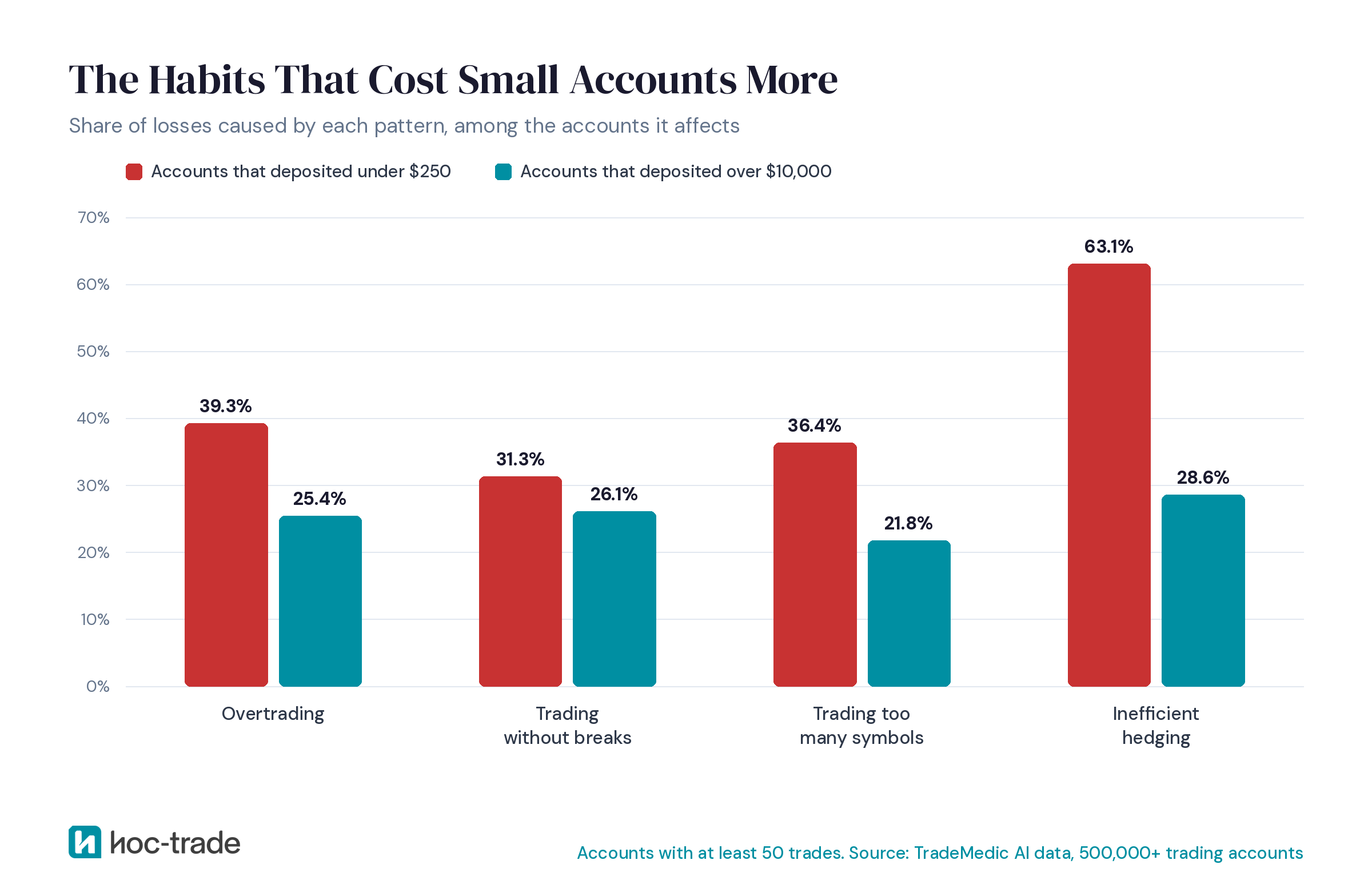
All four multiply exposure inside a single session: more trades, more positions, more symbols at once. Our article on overtrading shows how the damage builds with every extra trade in a day. On a small account, each extra trade carries a large share of the balance, so a busy session does far more damage. Doubling down follows the same pattern: it causes 33.1% of the losses of affected accounts under $250, one of the highest shares of any deposit group.
What does a losing trade cost your account? On a small account, that one number decides how many mistakes you can afford. TradeMedic AI works out your real risk per losing trade from your own trade history and flags all-in trades and trades without a stop loss.
Connect your account for freeIs 1% a day trading realistic?
Not as a steady target. TradeMedic AI data cannot show daily returns, but the maths shows what 1% a day would mean. Compounded over 250 trading days, 1% a day turns $500 into about $6,000 in one year, about $72,000 in two years and about $870,000 in three. A return like that, kept up for years, would put a trader far ahead of almost any professional fund.
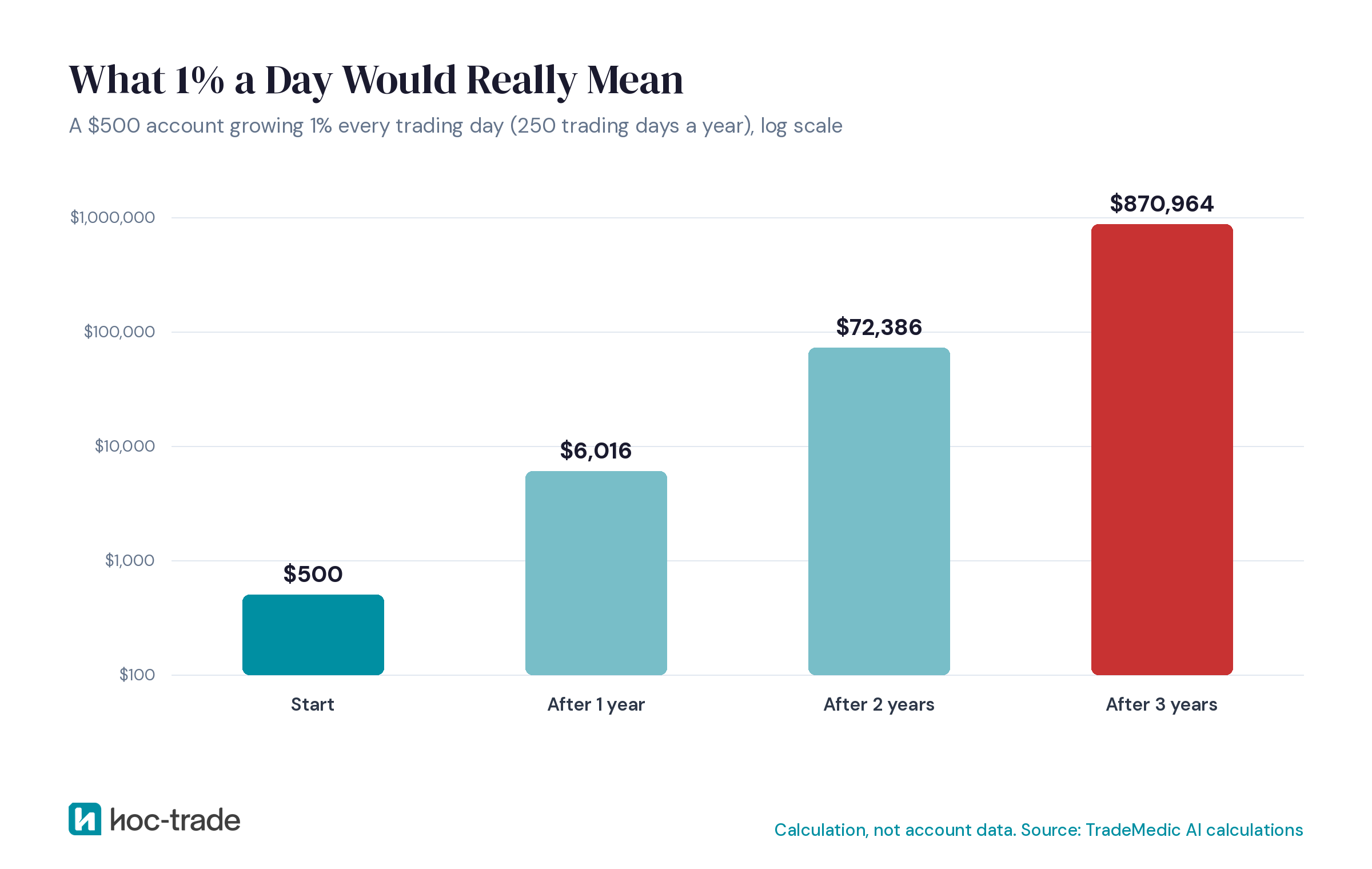
The target also shapes behaviour. With 1:1 trades, a trader who wins 55% of the time, which is already a strong edge, makes about 0.1 times their risk per trade on average before costs. To average 1% a day at 1% risk per trade, that trader needs about 10 trades a day. To get there with fewer trades, the risk per trade has to go up. Both routes lead towards the profiles with the lowest odds in the data:
33.0% of accounts that average fewer than 2 trades a day are profitable, compared with about 16% of accounts that average more than 25.
24.5% of accounts whose average losing trade costs less than 0.5% of the balance are profitable, compared with 13.4% at 2% to 5%.
A daily target also changes what happens on a bad day. A trader who is down 1% by lunchtime needs 2% before the close to stay on plan. TradeMedic AI detects the habit of carrying on after a big win or loss in a day as failing to call it a day, and it has a measurable negative effect for 72.5% of accounts that deposited less than $250.
How much money do you need to make $100 a day trading?
It depends on the daily return you assume, and every realistic assumption points to a large account. To make $100 a day, a trader needs:
$1,000 at 10% a day.
$10,000 at 1% a day.
$20,000 at 0.5% a day.
$100,000 at 0.1% a day, which still adds up to about 28% a year.
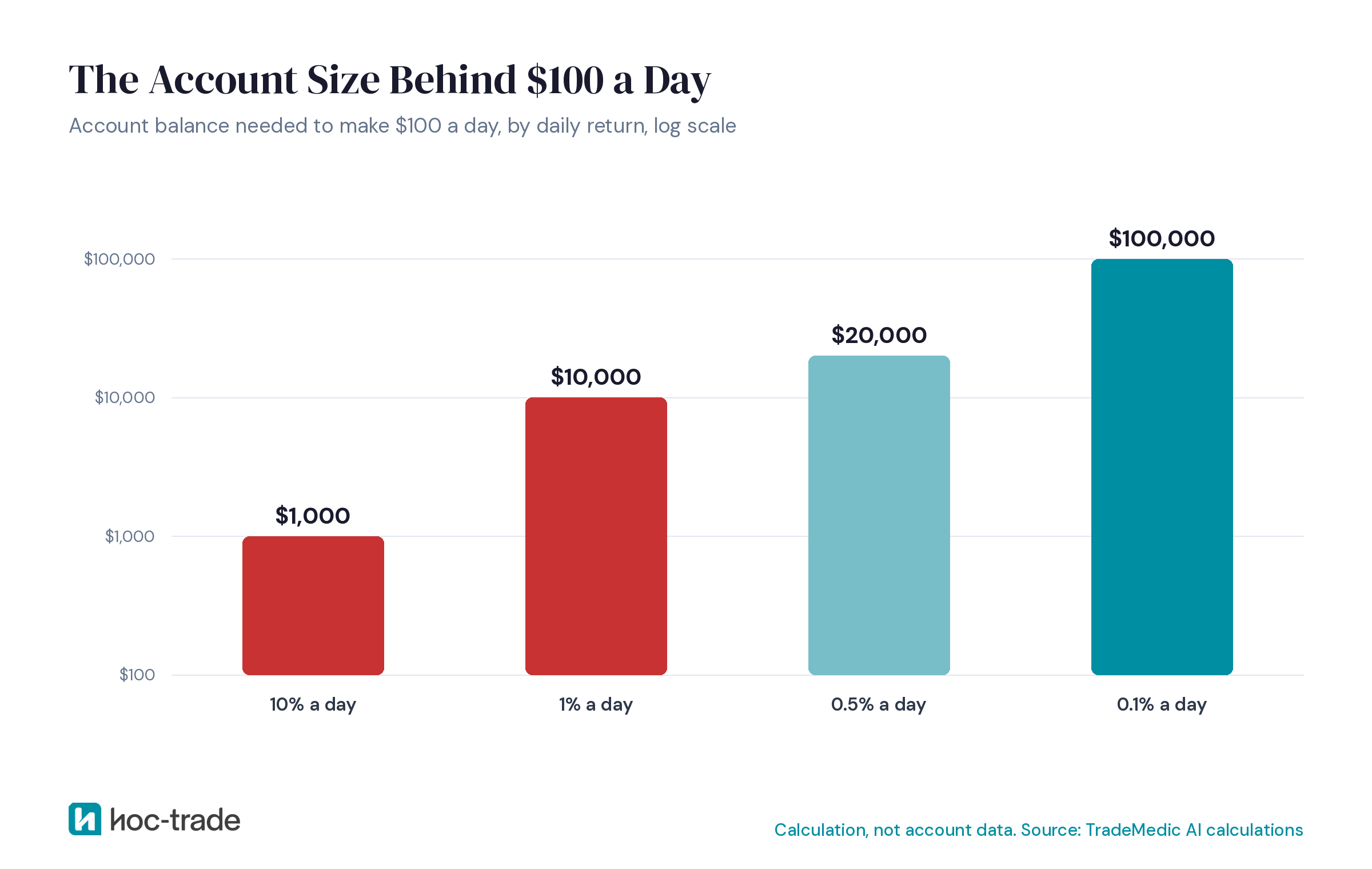
For most small accounts, $100 a day is a target that needs a much larger balance, not a better strategy. Chasing it with a small balance means risking a large share of the account on each trade, which is how the 90-90-90 rule comes true: at 30% risk per trade, 7 more losses than wins are enough to lose 90% of the account.
The more useful question for a small account is how many trades it can survive while the trader learns. At 0.5% risk per trade, losing 90% takes 460 more losing trades than winning ones. That is time to find out whether a strategy works.
Is your daily target shaping your trades? Traders with a target often trade more and size up after a bad morning without noticing it. TradeMedic AI shows how your results change with the number of trades per day and after a big win or loss in the same day.
See your own trading day in numbersHow do you grow a small trading account without blowing it?
By treating the first goal as survival, not growth. In TradeMedic AI data, these habits go with much better odds, whatever the account size:
Size every trade from the balance. Decide the risk per trade first, then the stop, then the lot size. If the smallest position is still too large for your stop, choose a setup with a shorter stop, an instrument with a smaller pip value, or a micro or cent account, rather than accepting 2% or more per trade.
Trade less. 33.0% of accounts that average fewer than 2 trades a day are profitable, and 46.2% of accounts that also place more than 99% of their trades in one symbol. Our analysis of one trade a day in one symbol looks at that group.
Stop after a big day, up or down. A daily loss limit and a daily profit cap protect a small account better than a daily target.
Never add to a losing position. Set the full size and one stop loss before the first order.
Let winners be bigger than losers. 44.6% of accounts whose average win is more than twice their average loss are profitable, compared with 10.2% of accounts whose average win is less than half their average loss.
Grow the account with savings as well as trades. Adding money from income does not make anyone a better trader, but it removes the pressure to force growth from a balance that is too small to carry it.
None of these makes a small account grow fast. They keep it alive long enough for a trader to find out whether their strategy has an edge, which is the only way a small account ever becomes a large one. How many trades that takes is covered in our analysis of how long it takes to learn trading.
How TradeMedic AI helps you trade a small account
TradeMedic AI connects to your MT4 or MT5 account with a read-only investor password and analyses your full trade history. It shows what an average losing trade costs you as a share of your balance, how many trades you place per day, your average win against your average loss, and which Improvement Opportunities weigh most on your results, each with the dollar effect from your own trades and real example trades.
On a small account, those numbers matter more than on any other, because the margin for mistakes is so thin. TradeMedic AI also tracks how each pattern develops over 1, 3 and 12 months, so you can see whether the habits that cost small accounts most are shrinking in yours.
Is your small account built to last? The balance shows where you are, not how you got there. TradeMedic AI shows your risk per trade, trades per day and the patterns behind your results, all from your own trades.
See how TradeMedic AI worksResearch behind this article
The account figures in this article come from TradeMedic AI data covering 500,000+ trading accounts from many brokers worldwide, counting accounts with at least 50 trades. A profitability figure means the share of accounts in a group that are net profitable over their analysed history, after commission and swap, not a return. Deposit groups are based on the total amount deposited over the life of the account.
The 1% a day, $100 a day, doubling time and position size figures are our own calculations, not account data. Pip values assume EURUSD, where 0.01 lots is worth about $0.10 per pip; other instruments differ.
Frequently asked questions
Can you make money trading with $100?
You can, but the odds are lower and the room for mistakes is small. In TradeMedic AI data from 500,000+ trading accounts, 14.3% of accounts that deposited less than $250 in total are profitable, the lowest share of any deposit group. With $100, even the smallest position on EURUSD with a 20 pip stop risks 2% of the account.
Is $500 enough to start trading forex?
It is enough to learn with, as long as the risk per trade stays small. On EURUSD, the smallest standard position of 0.01 lots with a 20 pip stop risks about $2, which is 0.4% of a $500 account. In TradeMedic AI data, 16.1% of accounts that deposited $250 to $1,000 are profitable.
What lot size should I use on a $100 account?
The lot size should come from your risk per trade and your stop distance, not from the account size alone. On a $100 account, 0.01 lots on EURUSD is worth about $0.10 per pip, so a 20 pip stop already risks 2%. In TradeMedic AI data, accounts whose average losing trade costs less than 0.5% of the balance are the most often profitable.
How long does it take to double a small trading account?
Much longer than most social media posts suggest. Doubling takes about 35 months at a steady 2% a month and about 14 months at 5% a month, and both are strong results to keep up. TradeMedic AI data shows that fast-growth plans, which rely on large risk per trade, go with lower profitability, not faster growth.
Is the 20 pip challenge a good way to grow a small account?
No. The 20 pip challenge risks about 30% of the account on every trade and needs 30 wins in a row. In TradeMedic AI data from 500,000+ trading accounts, 24.5% of accounts whose average losing trade costs less than 0.5% of the balance are profitable, compared with 13.4% of accounts whose average loss is 2% to 5%.
How can I tell if my small account is on the right track?
Look at your risk per losing trade as a share of the balance, your trades per day and your average win against your average loss, not only at the balance. TradeMedic AI retrieves your trades automatically and shows these numbers, along with the patterns behind your results and the dollar effect of each one.

Experienced trader and technology builder. Writes on behavioral trading patterns, CFD markets, and what 500,000+ retail accounts reveal about trader performance.