Category:
 Author:
 Date:Nov 16, 2026
How Long Does It Take to Learn Trading? What 500,000+ Trading Accounts Show
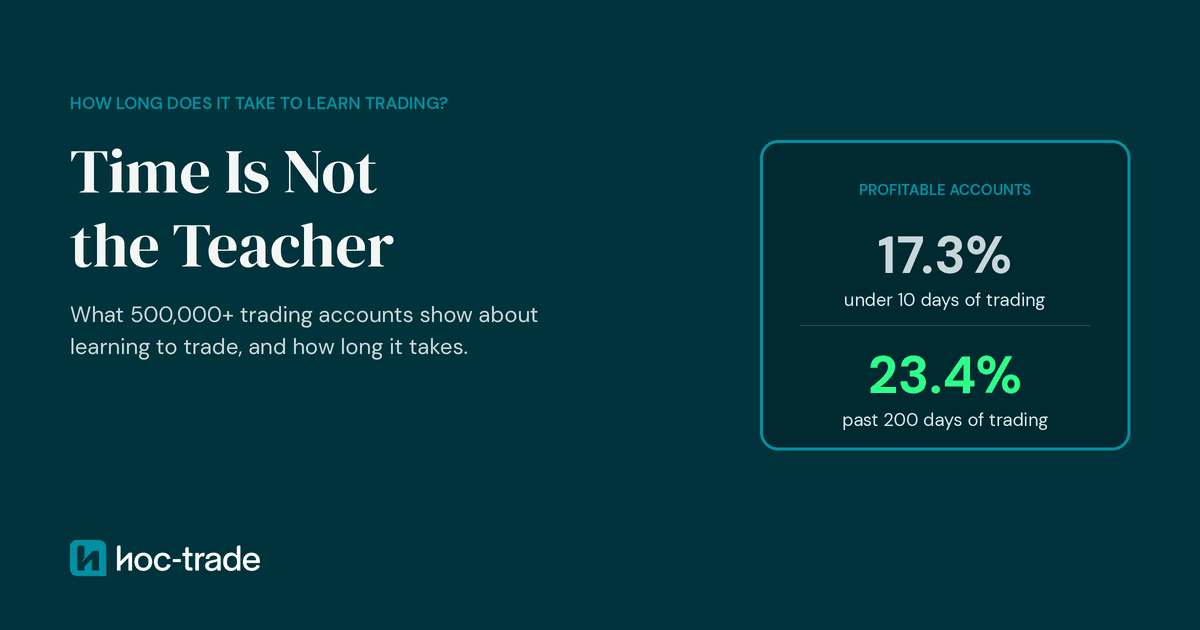
Ask ten traders how long it takes to learn trading and you will get answers from three months to ten years. Most of them describe their own path, and most of the people who never made it are not around to answer. Also, people that would like to sell you their product may make it sound easy and fast.
We looked at the question with TradeMedic AI data from 500,000+ trading accounts and two long-running studies of day traders. The short version: time alone helps only a little, experience fixes some mistakes and adds others, and the speed of learning depends far more on what a trader measures than on how many hours they put in.
How long does it take to learn trading?
Learning how trading works takes weeks: order types, position sizing, spreads, leverage and a simple strategy. Learning whether you can trade profitably takes much longer, often years, and many traders never get there. TradeMedic AI data shows why: the share of profitable accounts hardly moves in the first months of trading, and the mistakes that sink accounts change with experience rather than disappear.
There is no fixed number of months, because the clock that matters is not calendar time. It is the number of trades it takes to know whether a strategy works, and the number of times a habit has to show up before a trader notices it.
How long does it take to become a profitable trader?
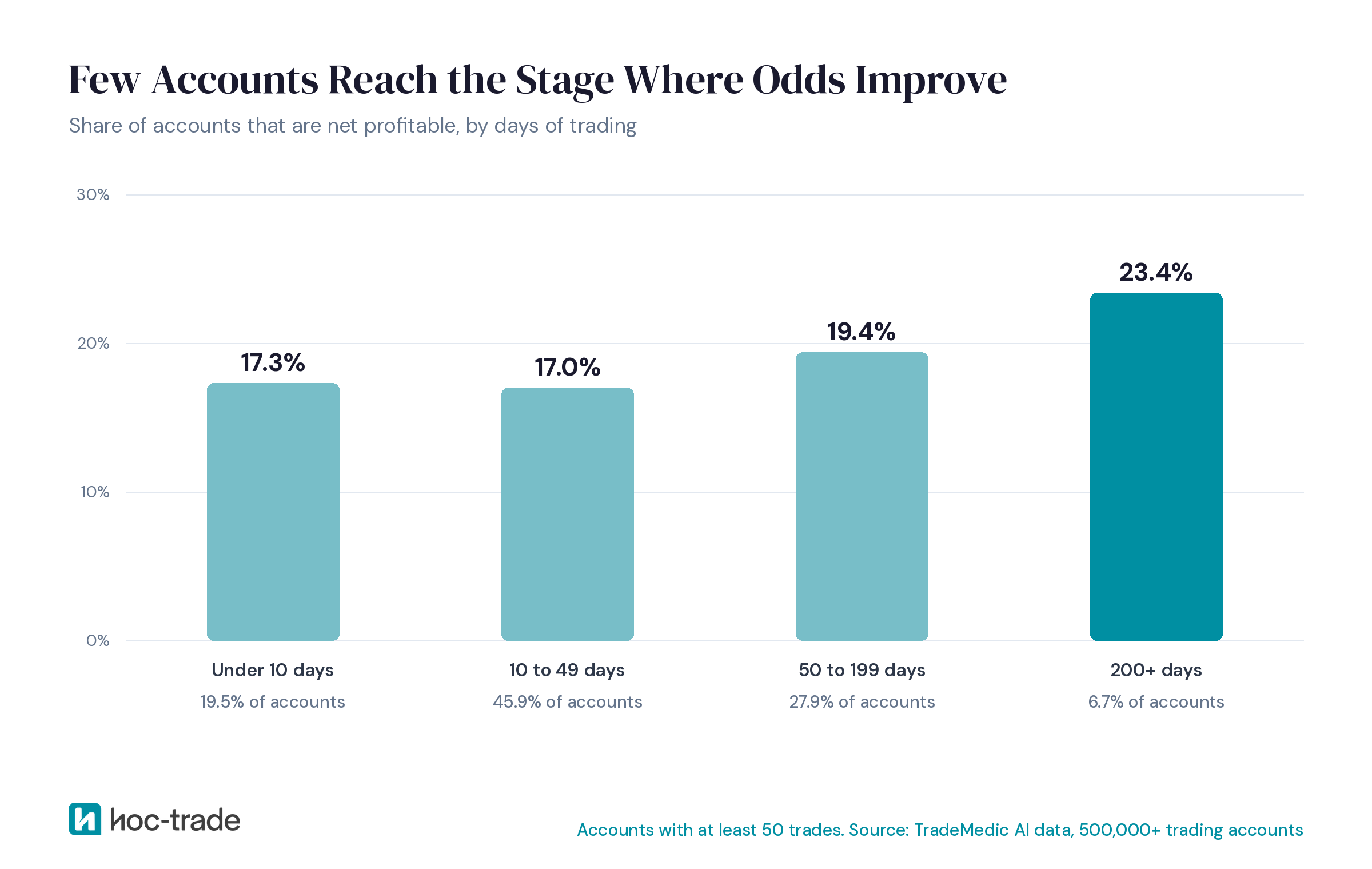
For most traders, longer than they keep trading. In TradeMedic AI data from 500,000+ trading accounts, the share of profitable accounts rises only slowly with days of trading, the days on which an account placed trades. It is 17.3% for accounts with fewer than 10 days of trading and 17.0% for 10 to 49 days, then 19.4% for 50 to 199 days and 23.4% for accounts past 200 days.
These figures cover accounts with at least 50 trades. There is almost no change in the first 50 days of trading, and only 6.7% of accounts reach 200. Part of the later rise is survivorship: the accounts that struggled most have already stopped, so the long-running group is not a picture of what time did to everyone.
Research on day traders points the same way. Brad Barber, Yi-Tsung Lee, Yu-Jane Liu, Terrance Odean and Ke Zhang followed day traders in Taiwan from 1992 to 2006. Unprofitable traders were more likely to quit, but most traders who kept going still lost money, and only traders who were both profitable and highly experienced earned predictable profits after costs. On an average day, that group made up less than 3% of day traders.
How many trades does it take to know if your strategy works?
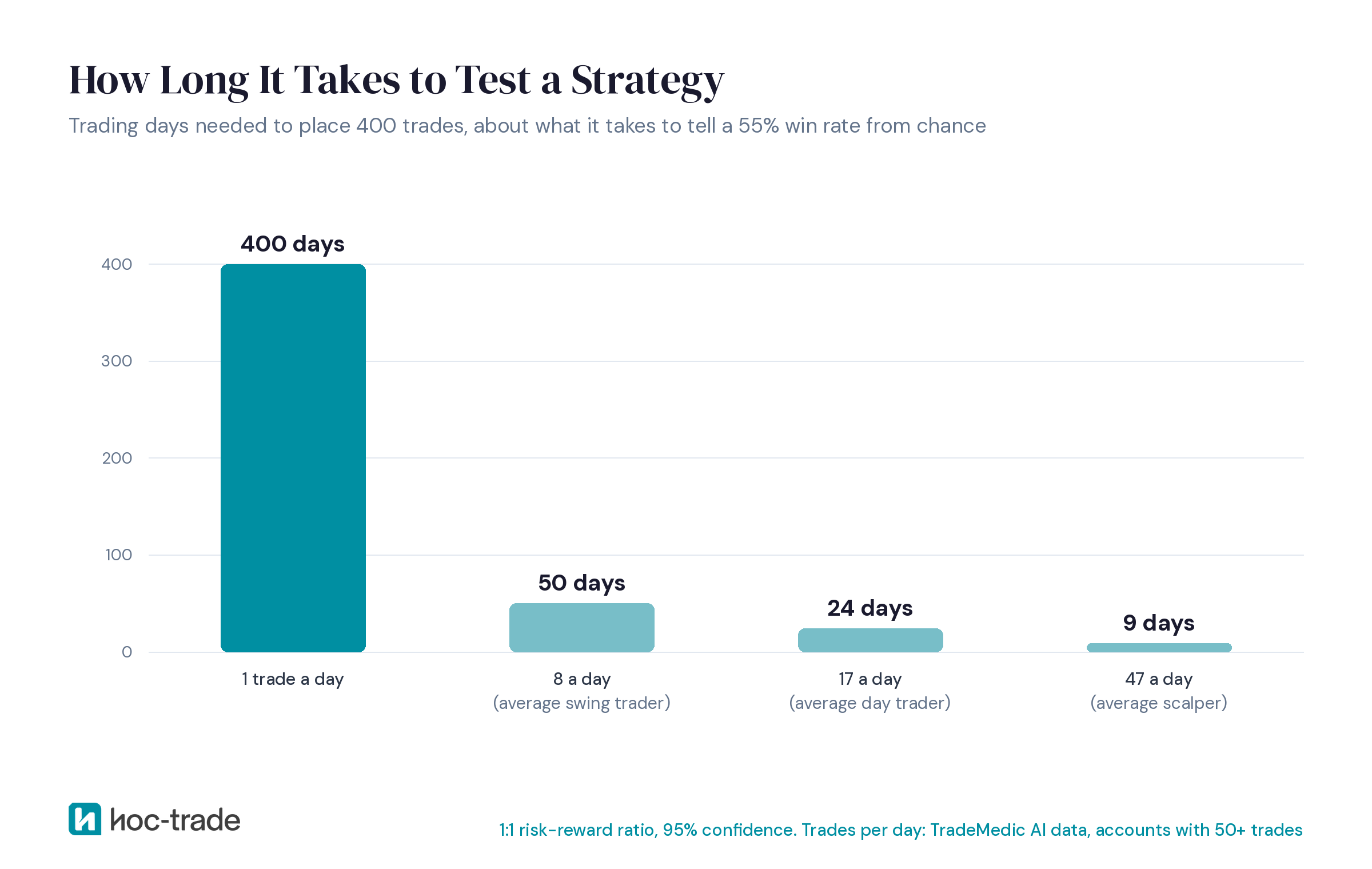
More than most traders expect. Over a short run, a strategy without an edge can look good and a good one can look bad, and judging each by its latest results is outcome bias. With a 1:1 risk-reward ratio, telling a 55% win rate apart from a coin flip with 95% confidence takes about 400 trades. A 52% win rate, a small edge that can still be profitable, takes about 2,400.
How long 400 trades take depends on how often you trade. TradeMedic AI data shows the average trades per trading day by style: about 47 for scalpers, 17 for day traders and 8 for swing traders. At those rates, 400 trades take about 9, 24 and 50 trading days. A trader who places one trade a day needs about 400 trading days, well over a year and a half.
Those averages describe how traders trade, not how they should. Fewer trades a day go with better odds in the data: 33.0% of accounts that average fewer than 2 trades a day are profitable, compared with about 16% of accounts that average more than 25. Our analysis of one trade a day in one symbol looks at the traders at the low end. So the slower test is often the better one, as long as the strategy and the risk stay the same for all 400 trades. A trader who changes the rules every 50 trades never finishes a single test.
Behaviour makes the test harder still. A trader's results mix the strategy with the habits around it, and a few costly habits can hide a real edge. A strategy can be working on most trades while revenge trades after losses, overtrading days or positions added to losers cost more than the good trades make. The account then shows a loss, and the trader drops a strategy that never got a fair test. In a TradeMedic AI effectiveness study on real-money trades, trades entered without a detected behavioural issue performed 63% better on average than trades with one.
That is the gap TradeMedic AI is built to close. It measures each behaviour across all of your trades and shows its dollar effect, so you can see what your strategy does on the trades where those habits are absent, and which habits are hiding it.
Is your edge hidden behind your habits? Most traders drop a strategy before it has had enough trades, often because a few habits dragged the results down. TradeMedic AI reads your full trade history and separates the patterns that cost you money from the rest of your trades, with the dollar effect of each.
Connect your account for freeHow long does it take to learn day trading?
Day trading gives the fastest feedback and the hardest odds. In TradeMedic AI data, 17.3% of day traders are profitable, the lowest share of any style, compared with 19.3% of scalpers and 27.5% of swing traders. The average day trader account trades on about 62 days over its history, at about 17 trades a day.
So most day traders place enough trades to learn from within weeks. What slows learning down is that the feedback is noisy: a bad trade can win and a good one can lose, which teaches the wrong lessons. In a study of Brazilian index futures, Fernando Chague, Rodrigo De-Losso and Bruno Giovannetti found that 97% of the people who day-traded for more than 300 days lost money, and no evidence that day traders improved with experience. Our article on whether trading is hard to learn looks at why the feedback misleads.
How long does it take to learn forex trading?
About as long as any other market, with a few extra things to learn early. Most accounts in the TradeMedic AI data trade forex, gold and indices, so the figures above largely describe these markets. Forex adds leverage, which magnifies both gains and losses, a market that trades around the clock, and costs that weigh more than many traders expect.
Costs matter most for fast traders. Measured against the daily range, spreads on major currency pairs are expensive: scalpers on EURUSD and GBPUSD are profitable just 7.1% of the time, compared with 20.2% for scalpers on gold. For a beginner, fewer and longer trades keep costs from deciding the result: each trade pays the spread once, so a small edge is less likely to disappear into costs before it can show up. Our ranking of the best forex pair to trade covers the differences between instruments.
What do traders learn with experience, and what do they not?
Experience changes the mistakes rather than removing them. TradeMedic AI ranks the Improvement Opportunities in each account by their effect on results. Comparing accounts in their first 10 days of trading with accounts past 200 days shows which mistakes fade and which grow.
Some mistakes fade. Revenge trading is among the five biggest issues for 23.1% of accounts in their first 10 days of trading and 10.2% of accounts past 200 days. Failing to call it a day drops from 60.7% to 42.0%, and late entries after a move has already run from 47.4% to 24.7%. Others grow: overtrading rises from 13.3% to 55.2%, inefficient hedging from 16.1% to 52.7% and trading too many symbols from 4.1% to 27.6%.
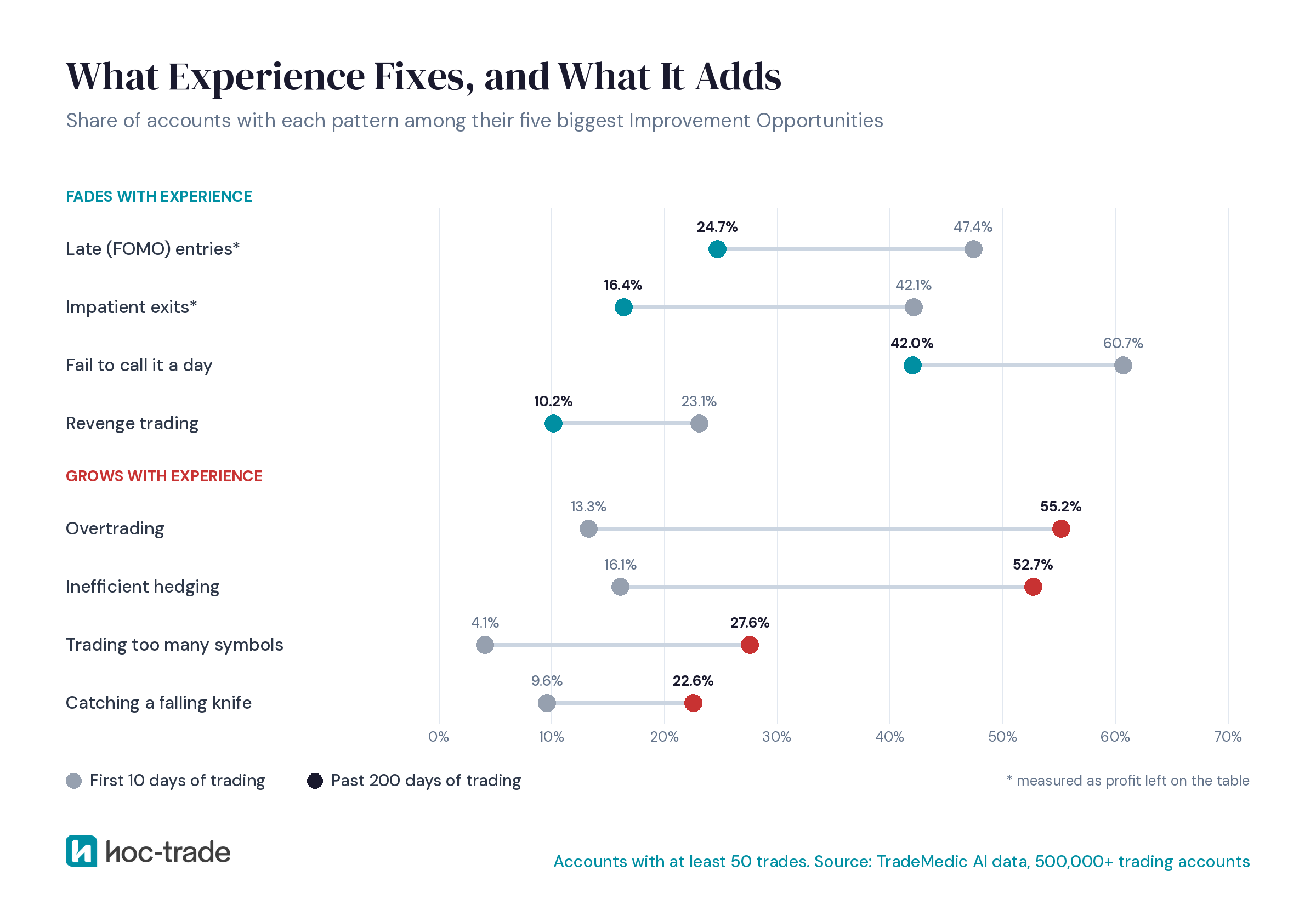
Late entries and impatient exits are measured as profit left on the table rather than money lost, and they fade the longer traders trade. So do the reactions to a single result: revenge trading after a loss, and carrying on after a big day. What grows is volume and complexity: more trades, more hedges, more symbols at once. The longer traders trade, the better they get at timing, and the more often they trade too much. Overtrading is the clearest example of that shift.
These figures compare accounts at different stages, not the same accounts over time, and a longer history gives the analysis more trades to work with.
Which of these are fading in your trading, and which are growing? Experience does not tell you on its own. TradeMedic AI ranks the patterns in your trades by their dollar effect and tracks each one over time, with real example trades from your account.
See how your patterns developHow can you learn trading faster?
By shortening the time between a mistake and noticing it. Psychologists Daniel Kahneman and Gary Klein found that intuition only becomes reliable in environments with regular patterns and quick, clear feedback. Short-term trading has plenty of feedback but little of it is clear, so faster learning comes from measuring more than the balance:
Keep risk small while you learn. At 0.5% risk per trade, losing 90% of an account takes 460 more losing trades than winning ones, enough time to finish several tests. In TradeMedic AI data, 24.5% of accounts whose average losing trade costs less than 0.5% of the balance are profitable, compared with 13.4% at 2% to 5%.
Fix the rules for a full test. Keep the strategy and the risk the same for at least a few hundred trades before judging them.
Measure behaviour, not just results. Track what you did after a loss, after a big day and on busy days, and compare those trades with the rest.
Trade less, and in fewer symbols. 46.2% of accounts that average fewer than 2 trades a day and place more than 99% of their trades in one symbol are profitable, against 18.2% of all accounts.
Judge by risk and reward, not by win rate. 44.6% of accounts whose average win is more than twice their average loss are profitable, compared with 10.2% of accounts whose average win is less than half their average loss.
None of these makes trading easy. They make each month of trading teach more, which is the only way to shorten the time it takes.
How TradeMedic AI shortens the feedback loop
TradeMedic AI connects to your MT4 or MT5 account with a read-only investor password and analyses your full trade history. Instead of judging single trades, it measures each behaviour across all of your trades, so a habit that costs money over hundreds of trades shows up even when individual trades went well.
It shows your Strengths and Improvement Opportunities with the dollar effect of each, real example trades, and how every pattern developed over 1, 3 and 12 months. That turns months of trading into a record you can learn from, rather than a balance you can only react to.
How long will it take you to learn trading? It depends less on time than on how quickly you see your own patterns. TradeMedic AI shows them from your own trades, ranked by what they cost or add.
See how TradeMedic AI worksResearch behind this article
The account figures in this article come from TradeMedic AI data covering 500,000+ trading accounts from many brokers worldwide, counting accounts with at least 50 trades. A profitability figure means the share of accounts in a group that are net profitable over their analysed history, after commission and swap, not a return. Days of trading count the days on which an account placed trades.
The number of trades needed to test a strategy is our own calculation, not account data: it assumes a 1:1 risk-reward ratio and a 95% confidence level.
Barber, B. M., Lee, Y.-T., Liu, Y.-J., Odean, T., and Zhang, K. (2020). Learning, Fast or Slow. The Review of Asset Pricing Studies, 10(1), 61 to 93.
Chague, F., De-Losso, R., and Giovannetti, B. (2020). Day Trading for a Living? Working paper, SSRN 3423101.
Kahneman, D., and Klein, G. (2009). Conditions for Intuitive Expertise: A Failure to Disagree. American Psychologist, 64(6), 515 to 526.
Frequently asked questions
Can you learn trading in 6 months?
You can learn how trading works in 6 months, but not whether you can trade profitably. In TradeMedic AI data from 500,000+ trading accounts, the share of profitable accounts barely changes in the first 50 days of trading, and testing a strategy with one trade a day takes about 400 trading days, well over a year.
Do most traders quit before they become profitable?
Most traders stop within their first year or two, and most of them were not profitable. In a study of day traders in Taiwan who had day-traded on at least 10 days, only 44% were still day trading after one year and 15% after three. In TradeMedic AI data, only 6.7% of accounts with at least 50 trades have traded on more than 200 days.
Does more screen time make you a better trader?
Not on its own. In TradeMedic AI data from 500,000+ trading accounts, overtrading is a top-five issue for 13.3% of accounts in their first 10 days of trading and 55.2% of accounts past 200 days. More time in front of the charts often turns into more trades, and more trades a day go with lower profitability.
How do I know if I am improving as a trader?
Compare your own behaviour over time, not just your balance. TradeMedic AI retrieves your trades automatically and shows how each pattern in your trading develops over 1, 3 and 12 months, along with your win rate, your average win against your average loss and your risk per trade.

Experienced trader and technology builder. Writes on behavioral trading patterns, CFD markets, and what 500,000+ retail accounts reveal about trader performance.