Category:
 Author:
 Date:Oct 29, 2026
The 20 Pip Challenge: What 30 Levels Really Require, Checked Against 500,000+ Trading Accounts
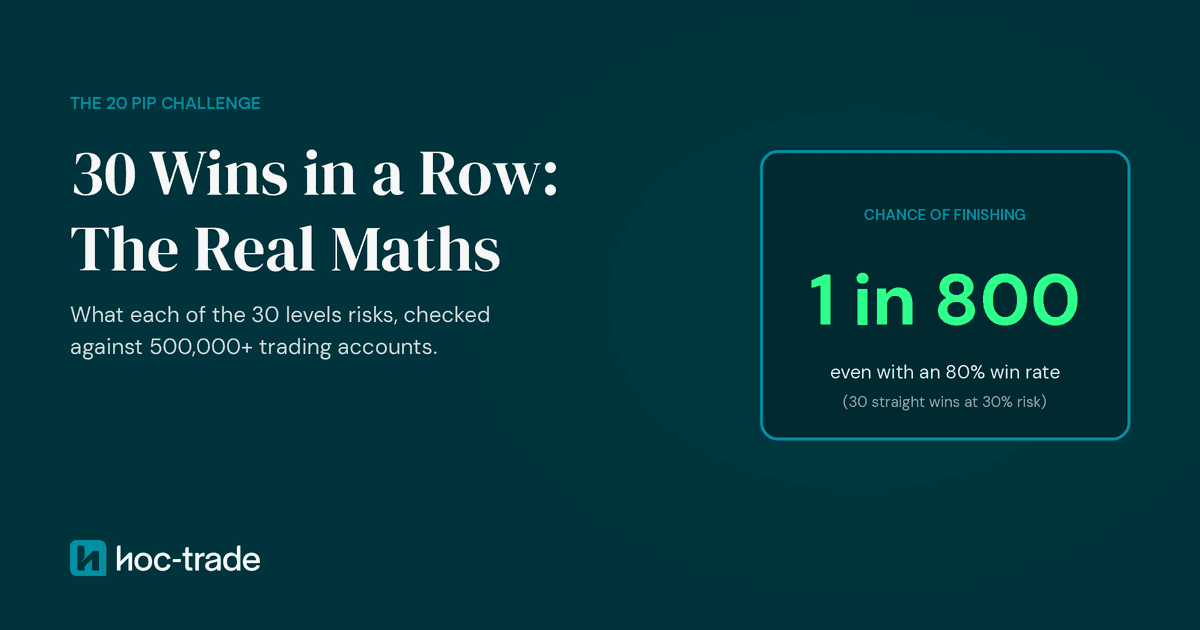
The 20 pip challenge is one of the most shared trading plans online: a spreadsheet with 30 levels that turns a $20 account into $52,404, one 20 pip trade at a time. It looks mechanical, and 20 pips feels like a small ask.
We broke the spreadsheet down level by level and compared what it asks for with what TradeMedic AI sees in 500,000+ real trading accounts. The ladder needs a winning streak that almost no account produces, and it risks far more per trade than anything our data links with profitable trading. But one habit inside the challenge, taking one trade and then stopping, is among the strongest positive signals in the whole dataset.
What is the 20 pip challenge?
The 20 pip challenge is a compounding plan where every trade aims for 20 pips, and every win moves you up one level with a larger position. Seen through TradeMedic AI data, it is a plan that depends on one thing above all: a long, unbroken run of winning trades.
The most common version has 30 levels. Level 1 starts at $20. Each level lists a balance, a risk amount, a lot size and the 20 pips needed, and level 30 finishes at $52,404. Other versions use 10 or 15 pip targets, or more levels with smaller lots, but the logic stays the same: win, size up, repeat.
How does the 30-level 20 pip challenge spreadsheet work?
Each level risks about 30% of the account on a single trade, with a 20 pip stop loss and a 20 pip target. That makes every trade a 1:1 reward-to-risk trade. A win adds 30% to the balance, and 30 wins in a row compound $20 into about $52,400, because 1.3 multiplied by itself 30 times is about 2,620.
The position size has to grow quickly to keep up. On EURUSD, level 1 risks $6, which is about 0.03 lots on a 20 pip stop. Level 15 risks about $236, close to 1.2 standard lots. Level 30 risks about $12,000 on one trade, which means about 60 standard lots.
This is the part most explanations skip. Twenty pips is a distance, not an amount of money. The challenge feels easy because the distance never changes, while the money riding on it goes from a few dollars to a five-figure sum.
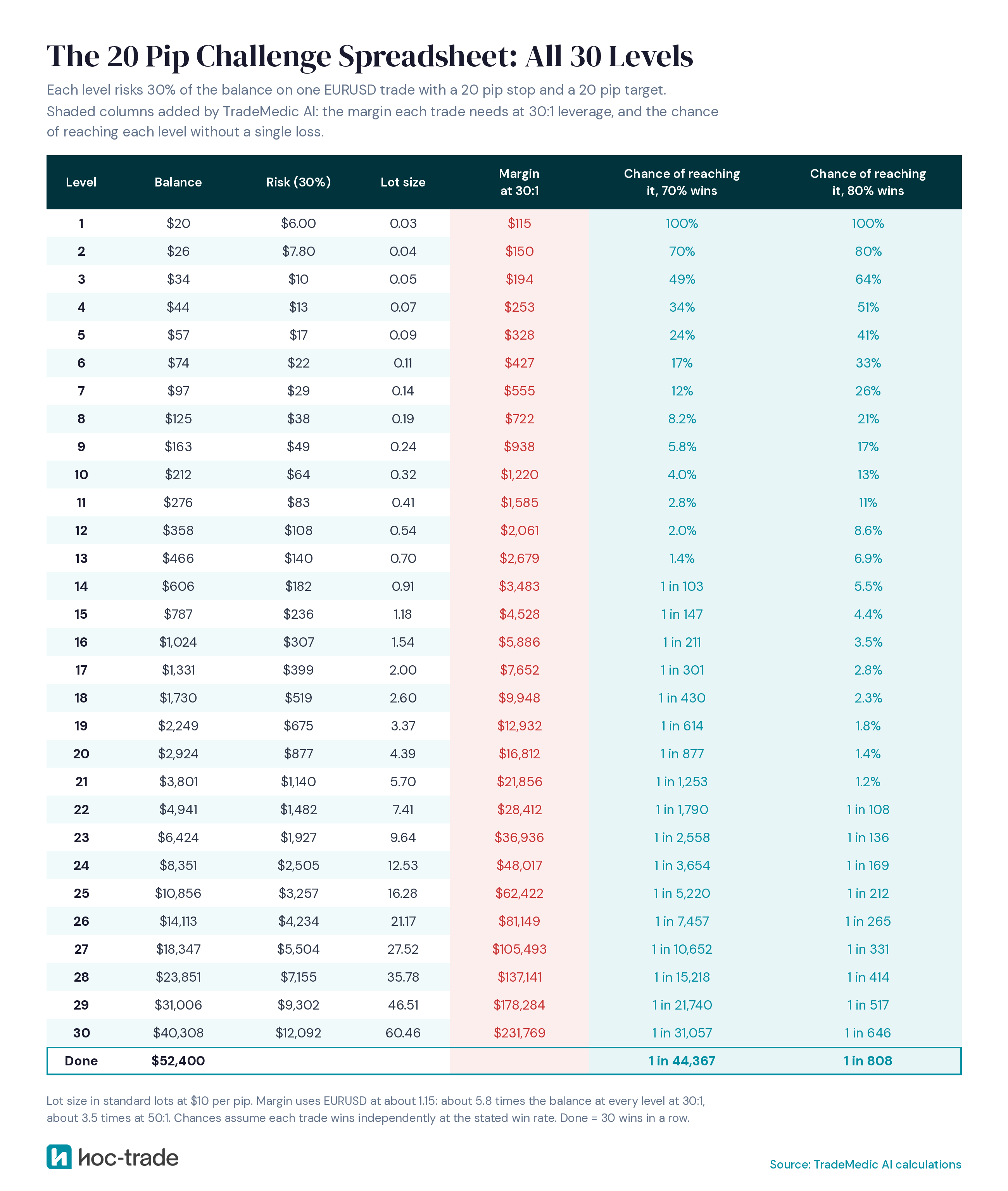
Here is the full 30-level table. Next to the usual columns we added two that most versions leave out: the margin each trade needs at 30:1 leverage, and the chance of reaching each level without a single loss.
Can you do the 20 pip challenge with a regulated broker?
In most cases, no, and the reason is leverage. Because the lot size grows in step with the balance, every level of the 20 pip challenge needs the same oversized position relative to the account. With EURUSD at around 1.15, each trade is worth roughly 170 times the balance.
At 30:1 leverage, the usual retail limit for major currency pairs in the EU, the UK and Australia, each level needs margin of about 5.8 times the balance.
At 50:1, the limit for major pairs in the US, each level needs about 3.5 times the balance.
Only from about 170:1 does the trade fit at all, with almost nothing left as a buffer.
This is why traders who try the challenge with a regulated broker often find they cannot open even level 1: a $20 account would need about $115 of margin. The challenge only runs at brokers that offer very high leverage. If you cut the risk to fit a regulated broker, the ladder no longer reaches $52,404 in 30 trades, so the challenge as advertised is not available to you.
Leverage limits exist to cap the size of position the challenge depends on. The same leverage that lets a $20 account open a 0.03 lot trade is what lets a 20 pip move against you take 30% of the account.
What are the odds of finishing the 20 pip challenge?
To finish the challenge you need 30 winning trades in a row, so the odds depend entirely on your win rate. In TradeMedic AI data, win rates high enough to make those odds reasonable are rare. Here is how fast the chances fall:
At a 60% win rate, the chance of 30 wins in a row is about 1 in 4.5 million.
At a 70% win rate, it is about 1 in 44,000.
At an 80% win rate, it is about 1 in 800.
Even at a 90% win rate, it is about 1 in 24.
In TradeMedic AI data from 500,000+ trading accounts, fewer than 1 in 10 accounts win more than 80% of their trades. And a high win rate on its own says little about results: 52.0% of traders win more than 60% of their trades, but only 23.7% of those traders are profitable. That gap is explained in our article on risk-reward ratio vs win rate.
The reason is that most high win rates are not clean 1:1 trades. Just over half of the accounts in the data have a realised reward-to-risk ratio below 0.5, meaning their average win is less than half the size of their average loss. The spreadsheet assumes the opposite habit: letting every winner run to the full 20 pips and every loser stop at exactly 20.
Every number in this table depends on one input: your win rate. The odds above use win rates we picked. TradeMedic AI shows the one you have, together with your average win against your average loss, from your own trade history. Connect your account for free and see where you would land on the ladder.
What happens to the 20 pip challenge after a losing trade?
Most people who try the challenge do not restart from $20 after a loss. They carry on from wherever the balance is, and at 30% risk per trade, that is where the maths turns against them. TradeMedic AI data also shows what usually happens to behavior after a loss, which makes this stage of the challenge the most dangerous.
A win multiplies the balance by 1.3. A loss multiplies it by 0.7. One win followed by one loss leaves you at 91% of where you started, not back at even. Because a loss takes away more than a win of the same size adds, a 1:1 trade at 30% risk needs a win rate of about 58% just to stop the account from shrinking over time.
A trader who wins 18 of 30 trades, a 60% win rate, turns $20 into about $31.
A trader who wins 21 of 30 trades, a 70% win rate, turns $20 into about $199.
Both are strong win rates. Neither gets anywhere near $52,404, and both have to sit through a long string of 30% swings on the way.
Those swings are where behavior breaks down. A lost level creates pressure to win it back straight away, which is revenge trading. In TradeMedic AI data, when revenge trading is a trader’s biggest issue, 13% of those traders are profitable, compared with 18.2% of all traders. The other common reaction is adding to a losing position to rescue the level, known as doubling down.
How do you trade after a losing trade? Most traders cannot answer this from memory. TradeMedic AI measures it on your own account: whether your trades after a loss perform worse, how long that effect lasts, and what it has cost you in dollars.
Why does risking 30% per trade make the challenge so hard?
TradeMedic AI measures how much each losing trade costs as a share of the account balance, and the accounts that lose small amounts per trade are the ones most likely to be profitable. The 20 pip challenge sits at the far opposite end of that range.
24.5% of accounts whose average losing trade costs less than 0.5% of the balance are profitable.
13.4% of accounts whose average losing trade costs 2% to 5% of the balance are profitable.
More than a third of all profitable accounts in the data keep their average loss below 0.5% of the balance. The challenge risks 30% on every trade, sixty times that level. Our guide on how much to risk per trade covers the full range.
A simulation shows why size matters even for a strategy that wins over time. With a 33% win rate and a reward-to-risk ratio of about 2.33, which is profitable, risking 3% per trade gave a 92% chance of a 50% drawdown over 1,000 trades. At 1% risk, the chance was 2%. The challenge risks ten times the 3% in that simulation.
The starting balance adds to the problem. In TradeMedic AI data, 14.3% of accounts that deposit less than $250 are profitable, the lowest share of any deposit group, compared with 23.1% of accounts that deposit more than $10,000. A $20 start puts the challenge in the group with the lowest success rate, and the ladder raises the risk exactly where the margin for error is smallest.
For comparison, growing $20 into $52,400 with 1:1 trades at 1% risk would take about 791 more wins than losses. That is slow, but it is the version of compounding an account can survive. TradeMedic AI flags single trades that risk more than 5% of the balance as excessive risk taking, and every level of the challenge is far above that line.
Which part of the 20 pip challenge is worth keeping?
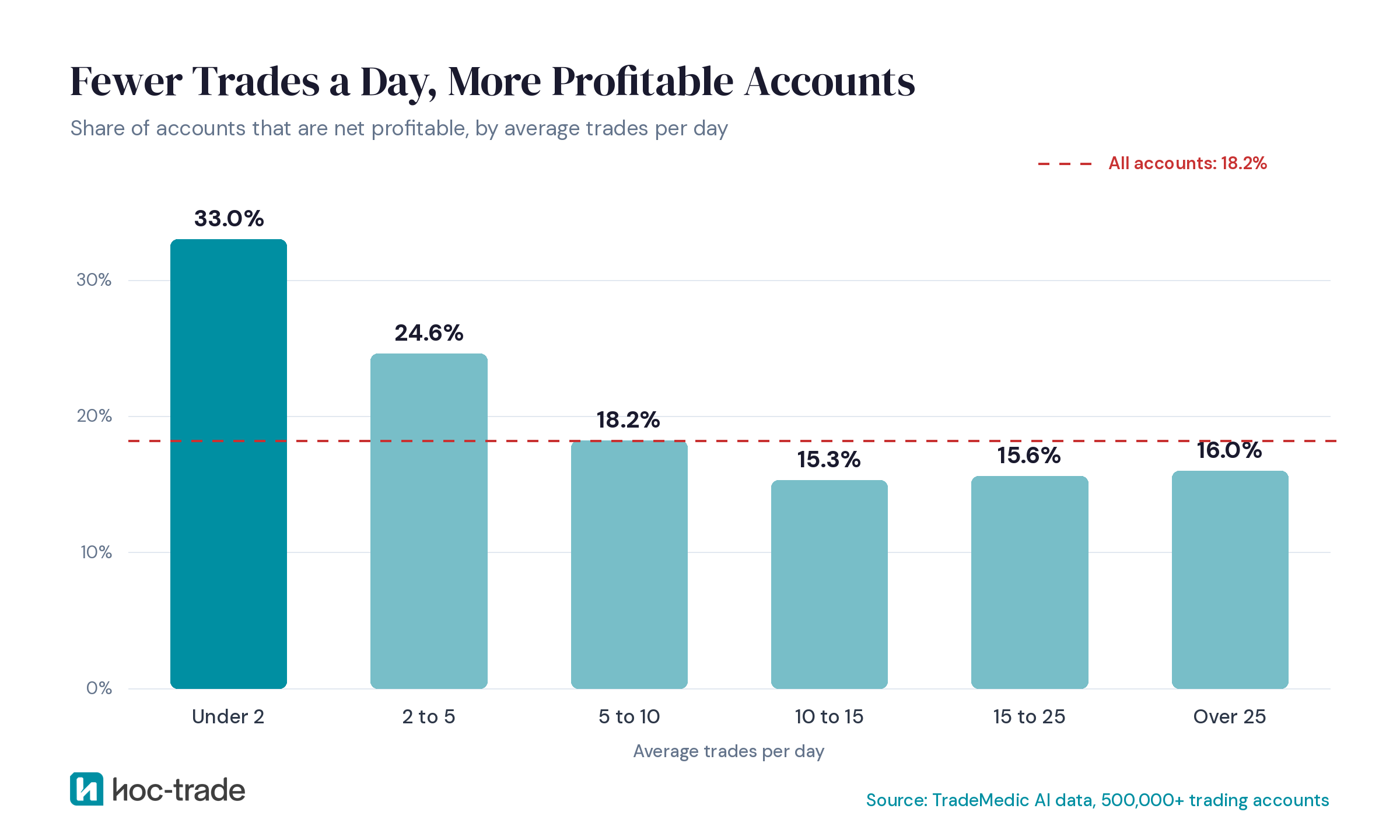
The challenge gets one thing right: it asks for one trade, then a stop. In TradeMedic AI data, trading very few times a day is one of the clearest markers of profitable accounts.
33.0% of accounts that average fewer than 2 trades a day are profitable.
About 15% to 16% of accounts that average more than 10 trades a day are profitable.
46.2% of accounts that average fewer than 2 trades a day and place more than 99% of their trades in one symbol are profitable, against 18.2% overall.
These figures show which accounts tend to be profitable, not that trading less causes profit on its own. Traders who wait for one setup a day may differ in other ways too. We look at this group in more detail in one trade a day in one symbol, and TradeMedic AI detects it as a strength called selective trading.
The stop after the trade matters as much as the trade itself. Not stopping once the day’s goal is reached, which TradeMedic AI detects as failed to call it a day, has a measurable effect for 75.6% of traders. When it is a trader’s biggest issue, only about 6% of those traders are profitable. Overtrading shows the same picture: when it is someone’s biggest issue, only about 6% of them are profitable.
So the useful part of the challenge is the daily cap and the single setup. The harmful part is the ladder.
Does trading less already work for you? TradeMedic AI compares your own profit per trade on quiet days with your busier days, and flags it as a strength when your fewer-trade days are the profitable ones. Many traders find their best days are the ones where they stopped early.
How do you run a safer version of the 20 pip challenge?
A safer version keeps the routine and removes the compounding ladder. TradeMedic AI data points to a few changes that move the plan towards the habits profitable accounts show.
Size every trade from a small, fixed share of the balance. The level number should never decide your lot size. Your stop distance and your risk per trade should.
Keep the one-trade structure and stop after it, win or lose. Hitting 20 pips is a reason to stop, not a reason to go for another level the same day.
Let reward-to-risk do the work instead of the streak. In TradeMedic AI data, 44.6% of accounts with a realised reward-to-risk ratio above 2.0 are profitable, compared with 10.2% of accounts below 0.5. A plan that wins less often but wins more per trade does not need 30 wins in a row.
Use the spreadsheet as a discipline log, not a balance target. Record whether you followed your own rule each day. Rules of thumb such as the 3-5-7 rule work the same way: they limit risk rather than promise a number.
Practice on a demo account before using real money. Thirty trades on demo will show you your real win rate and how you react to a lost level.
How can TradeMedic AI show whether your trading fits the 20 pip challenge?
TradeMedic AI connects to your MT4 or MT5 account with a read-only investor password and analyzes your full trade history. It shows the numbers the challenge depends on: your win rate, your average win against your average loss, how much of your balance each losing trade costs, and how many trades you place per day.
Those numbers answer the challenge question directly. If your win rate is below about 58%, the ladder shrinks your account at 30% risk. If your average loss is bigger than your average win, the 1:1 trades the spreadsheet assumes are not the trades you place.
It also flags the patterns that end challenges early, including overtrading, revenge trading, doubling down, failed to call it a day and all-in trades, each with the dollar effect measured on your own trades. Where your trading shows strengths such as selective trading, it shows those too, so you can see what to keep.
Learn more about TradeMedic AI or connect your account for free.
Research behind this article
The account figures in this article come from TradeMedic AI data covering 500,000+ trading accounts from many brokers worldwide. A profitability figure means the share of accounts in a group that are net profitable, not a return. The overall figure is 18.2%, which our article on what percentage of day traders are profitable explains in detail.
The level balances, lot sizes, odds of 30 straight wins and the 58% breakeven win rate are our own calculations from the 30-level spreadsheet, assuming 30% risk per trade on 1:1 trades in EURUSD. The 3% and 1% drawdown figures come from a simulation, not from account data.
Frequently asked questions
Is the 20 pip challenge realistic?
Making 20 pips on one good trade is realistic, but winning 30 trades in a row at 30% risk is not. Even at an 80% win rate, the chance of 30 straight wins is about 1 in 800, and in TradeMedic AI data from 500,000+ trading accounts, fewer than 1 in 10 accounts win more than 80% of their trades.
How much is 20 pips in dollars?
Twenty pips is a price distance, and what it is worth depends on your position size. On EURUSD, 20 pips is about $2 on 0.01 lots, $20 on 0.1 lots and $200 on 1 standard lot. In the 30-level challenge the same 20 pips risks $6 at level 1 and about $12,000 at level 30, which is why TradeMedic AI measures risk as a share of the balance, not in pips.
Can you start the 20 pip challenge with $10 or $20?
Many brokers allow it, but the smallest accounts have the lowest success rates. In TradeMedic AI data from 500,000+ trading accounts, 14.3% of accounts that deposit less than $250 are net profitable, compared with 23.1% of accounts that deposit more than $10,000. A small account is a reasonable way to learn, as long as the risk per trade stays small too.
How much should I risk per trade in the 20 pip challenge?
Far less than the 30% the spreadsheet uses. In TradeMedic AI data from 500,000+ trading accounts, 24.5% of accounts whose average losing trade costs less than 0.5% of the balance are profitable, compared with 13.4% of accounts whose average loss is 2% to 5%. At 30% risk, a 1:1 trade needs a win rate of about 58% just to stop the account from shrinking.
Is the 20 pip challenge good for gold?
Gold is the most traded symbol in the data, but it does not make the challenge easier. In TradeMedic AI data from 500,000+ trading accounts, about two thirds of accounts trade gold as their main symbol, and 17.7% of those accounts are profitable, slightly below the 18.2% overall. Pip definitions on gold also vary by broker, so check what 20 pips means on your platform first.
Is the 20 pip challenge the same as a prop firm challenge?
No. The 20 pip challenge is a compounding plan you set for your own account, while a prop firm challenge is a paid evaluation with profit targets and loss limits set by the firm. The habits that break both are similar: in TradeMedic AI data, when not stopping for the day is a trader’s biggest issue, only about 6% of those traders are profitable.
Why do 20 pip challenge results look so good on social media?
Because you mostly see the runs that worked. An account that loses at level 4 is rarely posted, while a run to level 10 gets a screenshot, and at 30% risk per trade even a short streak looks dramatic. TradeMedic AI looks at every trade in an account, so its figures come from full trading histories rather than highlights.
How can I check whether my trading could handle the 20 pip challenge?
Look at your own win rate, your average win against your average loss, your risk per trade and what you do after reaching a daily goal. TradeMedic AI retrieves your trades automatically and shows all of these, and flags patterns such as overtrading, revenge trading and not stopping for the day, each with the dollar effect measured on your own trades.