Category:
 Author:
 Date:Nov 15, 2026
The 90-90-90 Rule: What 500,000+ Trading Accounts Say About Each 90
Almost every new trader hears it in the first week: 90% of traders lose 90% of their money within 90 days. The 90-90-90 rule is repeated in courses, forums and comment sections, usually as a warning, sometimes as the opening line of a pitch for a course that promises to put you in the other 10%.
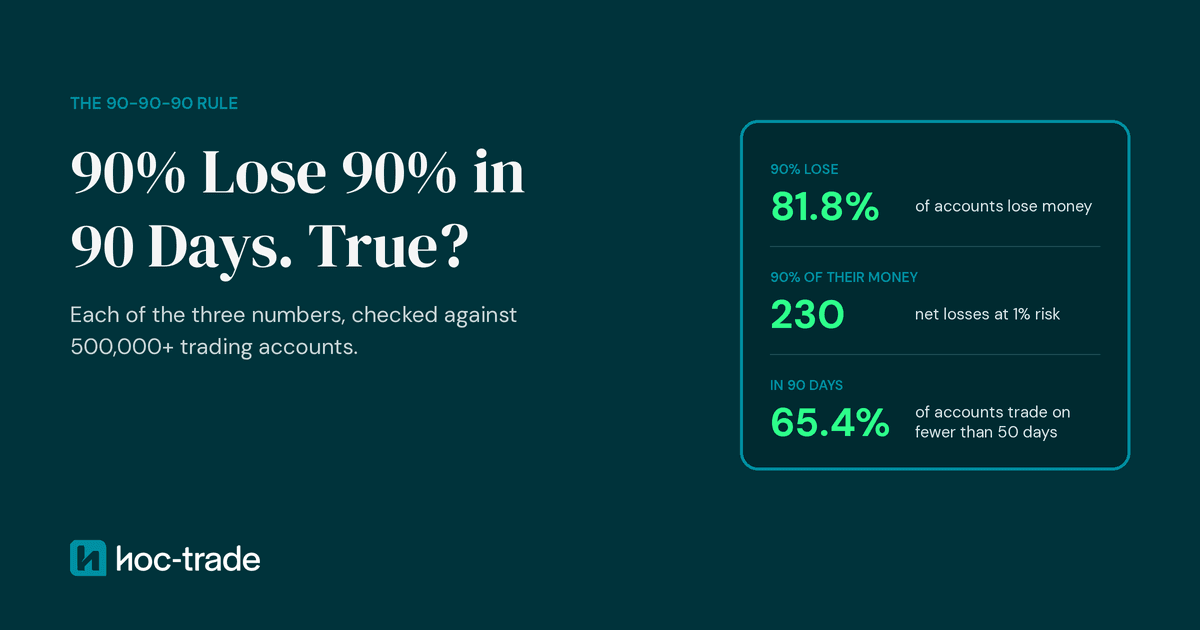
We checked each of the three numbers against TradeMedic AI data from 500,000+ trading accounts. The first 90 is close: 81.8% of accounts in the data are loss-making. The second depends almost entirely on how much you risk per trade. The third holds when you count days of trading: most accounts trade on fewer than 50 days in total, although in calendar time most traders stop within their first year rather than their first three months. And the data shows which habits do the damage in the first weeks, which is the part of the rule a trader can change.
What is the 90-90-90 rule in trading?
The 90-90-90 rule is the claim that 90% of new traders lose 90% of their trading capital within their first 90 days. TradeMedic AI cannot say where the saying comes from, but it can test each number: how many accounts lose money, how much they can lose, and how long they last.
None of the courses and posts that repeat the rule give a source, and it is not a regulation or the result of a study. It is a rule of thumb, and its value is as a warning: most people who start trading lose money, and many lose it quickly. Whether the three numbers hold is a separate question.
Do 90% of traders lose money?
Not quite 90%, but close. In TradeMedic AI data from 500,000+ trading accounts, 81.8% of accounts are loss-making over their full trading history, and 18.2% are net profitable. Regulators see a similar range: when ESMA restricted CFDs for retail clients in 2018, it found that 74% to 89% of retail CFD accounts lose money.
The TradeMedic AI figures in this article cover accounts with at least 50 trades, enough for an account's result to say something about its trading. Accounts that stopped after only a few trades are not included.
The share changes with how and with how much people trade:
17.3% of day traders are profitable, so 82.7% of day traders lose money.
19.3% of scalpers are profitable.
27.5% of swing traders are profitable, the highest share of any trading style.
14.3% of accounts that deposit less than $250 are profitable, compared with 23.1% of accounts that deposit more than $10,000.
So for the smallest accounts, the first 90 is almost right: 85.7% of accounts that deposit less than $250 are loss-making. Our guide on how to grow a small trading account covers what helps at that size.. For swing traders, it is closer to 7 in 10. Our analysis of what percentage of day traders are profitable explains why the figures quoted online range from 1% to 36%.
Do traders really lose 90% of their money?
Only if they risk a lot per trade or keep losing for a long time. TradeMedic AI data shows two numbers that come close: how much of all deposited money traders lost overall, and what an average losing trade costs, which decides how fast a single account can lose 90%.
Across all accounts in the data together, traders lost about 18% more on their losing trades than they made on their winning trades, after commission and swap. The net loss equals about 31% of all the money traders deposited. That figure is weighted by money, and accounts that deposited more than $10,000 hold most of it, so it describes the money in the market more than the typical trader. It is far from 90% overall, but it is an average across winners and losers, and it does not show how much individual accounts lost.
The maths is simple. If every loss costs the same share of the current balance, losing 90% takes this many more losing trades than winning trades:
At 0.5% risk per trade, 460 more losses than wins.
At 1% risk per trade, 230.
At 2% risk per trade, 114.
At 5% risk per trade, 45.
At 30% risk per trade, the level the [20 pip challenge](/blogs/trading-psychology/20-pip-challenge) uses, just 7.
A trader who keeps the dollar amount fixed instead of recalculating it from the balance gets there faster: at 1% of the starting balance, 90 more losses than wins remove 90% of the account.
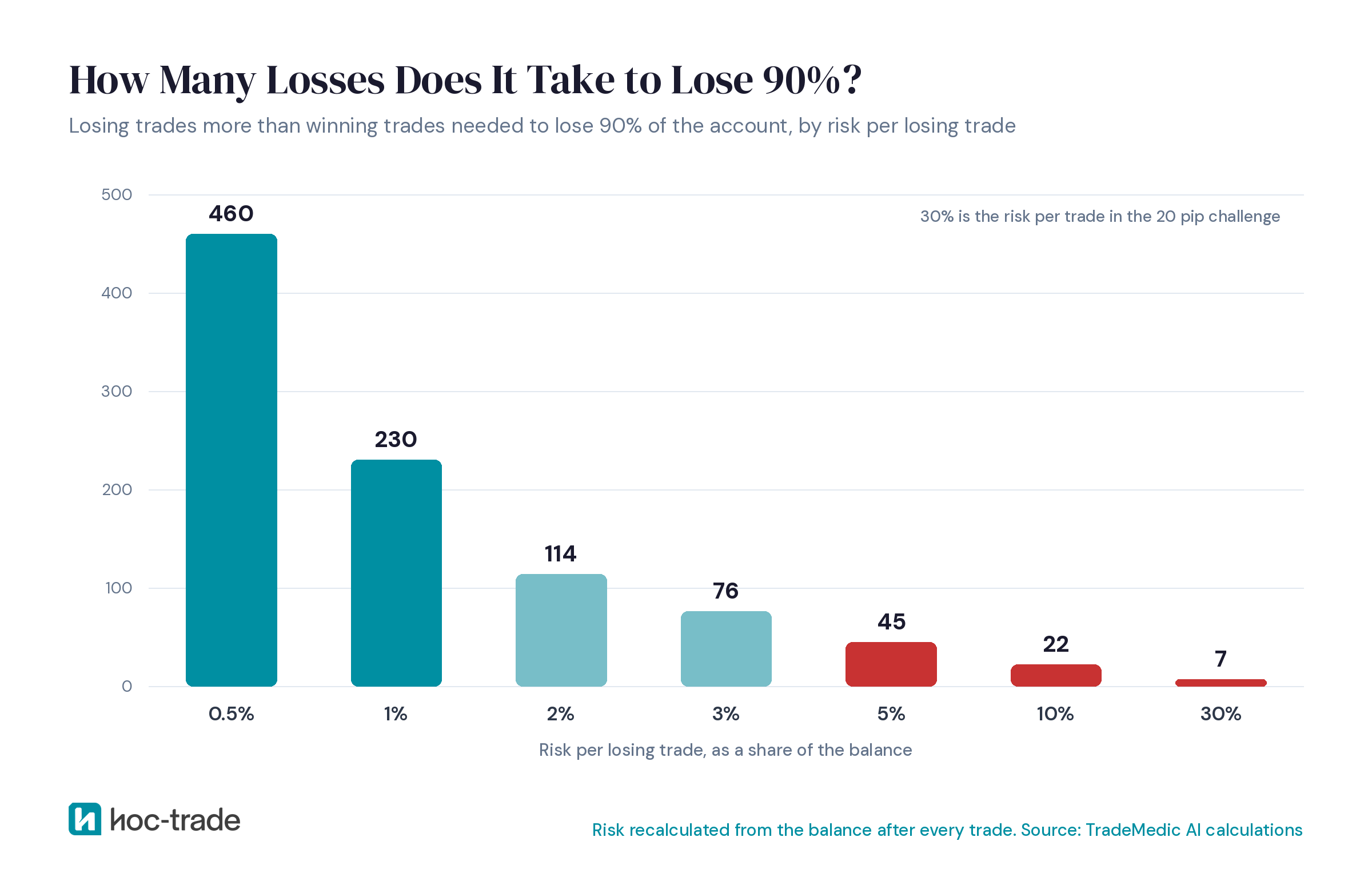
At small risk, losing 90% in 90 days takes a long and obvious run of bad trading, and it shows up in the balance long before the account is gone. At large risk, it can take a bad week, or even a single day. That is where many accounts in the data sit: 12.5% of accounts lose more than 5% of their balance on an average losing trade, and another 22.3% lose 2% to 5%.
Risk per trade also tracks with results. In TradeMedic AI data, 24.5% of accounts whose average losing trade costs less than 0.5% of the balance are profitable, compared with 13.4% of accounts whose average loss is 2% to 5%. Our guide on how much to risk per trade covers the full range.
The fastest routes to a 90% loss are the habits that make one trade, or one group of trades, far bigger than the rest: all-in trades, adding to losing positions, and sizing up after every loss as the martingale strategy does.
How many losing trades could your account take? The answer depends on a number most traders have never measured: what an average losing trade costs them. TradeMedic AI works it out from your own trade history and flags all-in trades and trades without a stop loss.
Connect your account for freeDo most traders quit within 90 days?
Counted in days of trading, most do. In TradeMedic AI data, 65.4% of accounts trade on fewer than 50 days in their whole history, less than 10 weeks of trading even for someone who trades every weekday. In calendar time, studies that follow new traders show that most stop within their first year.
Because TradeMedic AI data covers accounts with at least 50 trades, traders who gave up after a handful of trades are not in these figures. Even among the accounts that got that far, most trading histories are short:
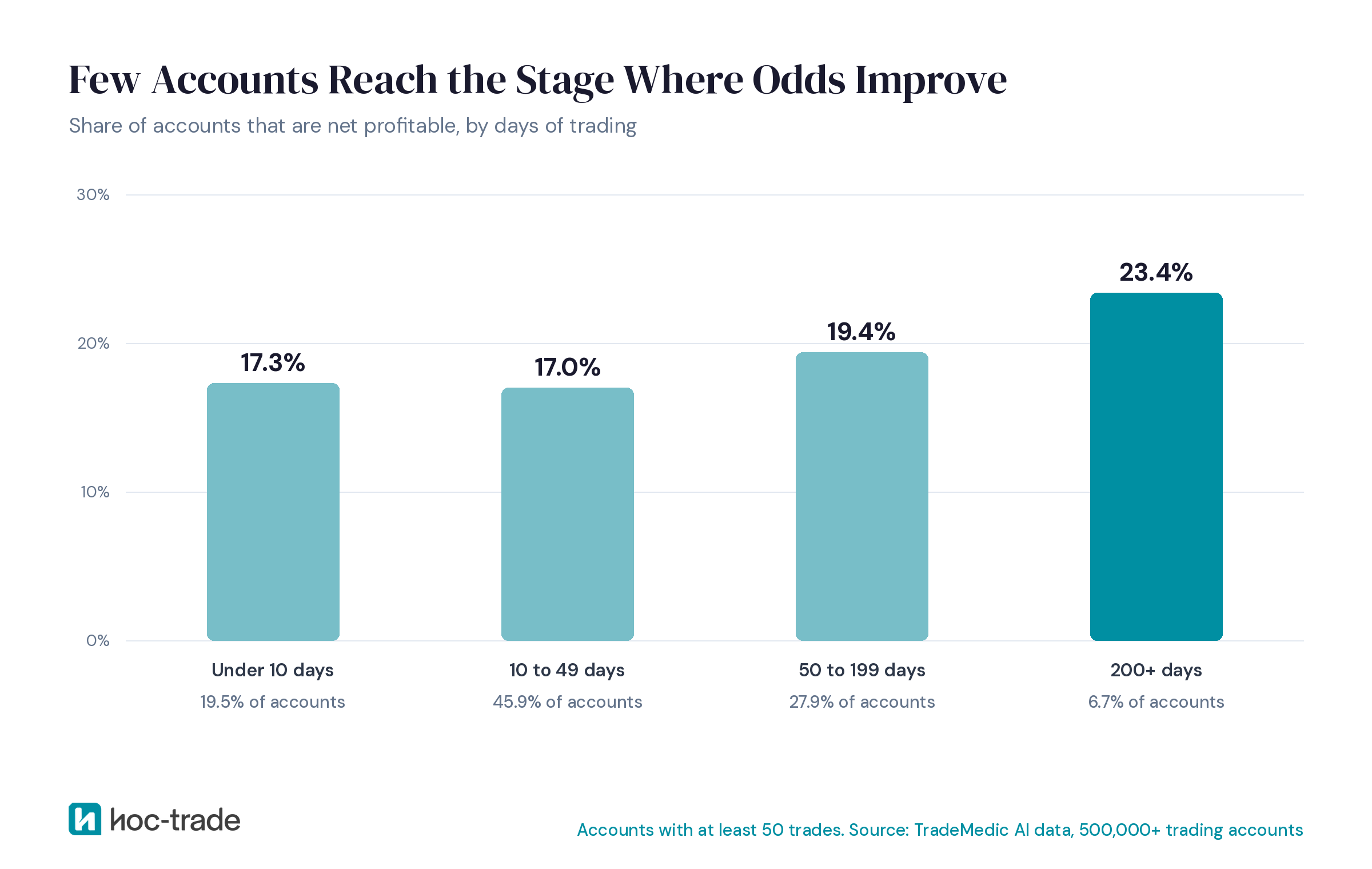
19.5% of accounts in the data have fewer than 10 days of trading in their history.
45.9% have 10 to 49 days of trading, and 27.9% have 50 to 199.
Only 6.7% have traded on more than 200 days.
On average, an account in the data trades on about 63 days over its history. Trading style changes the pace: about 21 days for the average scalper account, 62 for the average day trader account and 123 for the average swing trader account. Days of trading count only the days with trades, so the calendar time from first trade to last is longer.
Studies of new traders point the same way. In Australia, the regulator ASIC followed new retail clients who placed their first CFD trade between July and September 2023: about a third were no longer trading in the next quarter, and 67% had stopped by the end of that financial year. In Taiwan, Brad Barber, Yi-Tsung Lee, Yu-Jane Liu, Terrance Odean and Ke Zhang found that more than three quarters of day traders quit within two years.
So the third 90 holds for most accounts when counted in days of trading, and in calendar time most people who start trading stop within a year. These figures cannot show whether an account with 40 days of trading spread them over two months or six, only that its trading history is shorter than three months of trading days, and some of the newer accounts may still be trading. The accounts that keep going do a little better. 17.3% of accounts with fewer than 10 days of trading are profitable, and 17.0% of accounts with 10 to 49 days. The share then rises to 19.4% for 50 to 199 days and 23.4% past 200 days. There is almost no improvement in the first 50 days of trading, the stretch the 90-90-90 rule is about, and part of the later rise is survivorship: the accounts that struggled most have already stopped. Why so few traders get there is the subject of our analysis of how long it takes to learn trading.
What goes wrong in a trader's first 90 days?
New accounts make different mistakes from experienced ones. TradeMedic AI ranks the Improvement Opportunities in each account by their effect on results, and in accounts with fewer than 10 days of trading, the five biggest most often include these:
Failing to call it a day is a top-five issue for 60.7% of new accounts, compared with 42.0% of accounts past 200 days.
Distracted trading is a top-five issue for 51.2% of new accounts, compared with 42.6%.
Doubling down is a top-five issue for 23.6% of new accounts, compared with 20.6%.
Revenge trading is a top-five issue for 23.1% of new accounts, compared with 10.2%.
Most of these are about what happens after a result. A big day, up or down, leads to more trades the same day. A loss leads to a fast re-entry. A losing position leads to a bigger one. Failing to call it a day is the most common, and when it is a trader's biggest issue, only about 6% of those traders are profitable. When revenge trading is the biggest issue, 13% are, and when doubling down is, 5.3%.
Timing mistakes are common early too. Late entries after a move has already run, the pattern behind FOMO trading, are among the five biggest Improvement Opportunities for 47.4% of new accounts and 24.7% of accounts past 200 days. Unlike the patterns above, their effect is measured as profit left on the table, a better entry that was available, rather than money lost.
Other habits grow with time instead. Overtrading is a top-five issue for 13.3% of new accounts and 55.2% of accounts past 200 days, and emotional trading rises from 25.7% to 36.7%. The longer traders trade, the better they get at timing their entries, and the more often they trade too much, a shift our article on whether trading is hard looks at in more detail.
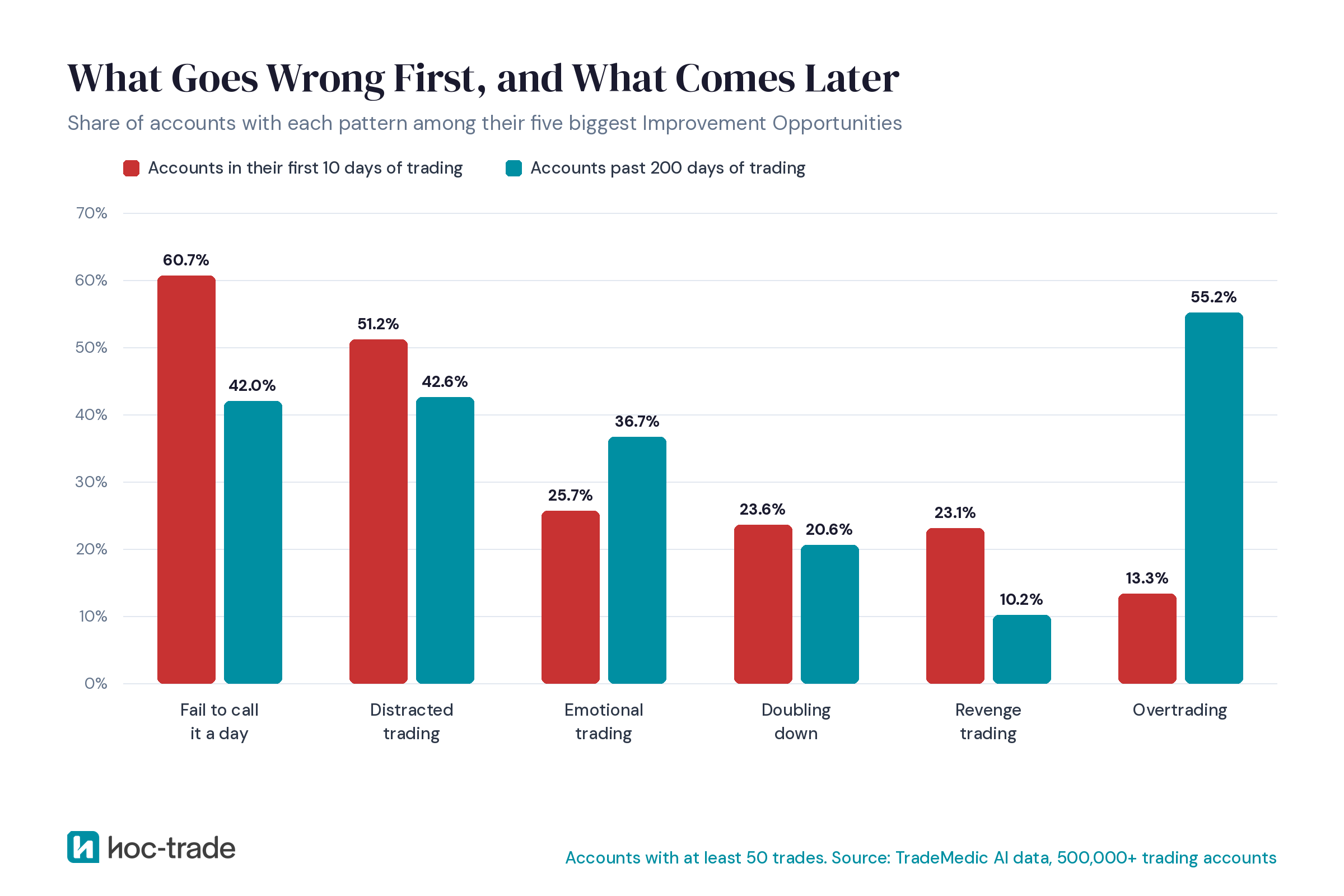
These figures compare accounts at different stages, not the same accounts over time, and a longer history gives the analysis more trades to work with.
Which of these habits are already in your account? They form in the first weeks, and most traders only notice them later, in the balance. TradeMedic AI ranks the patterns in your trades by their dollar effect, with real example trades from your own history.
See which patterns show up in your tradesHow do you avoid becoming part of the 90-90-90 rule?
By keeping losses small enough that they take a long time to add up, and by stopping the habits that do the most damage early. In TradeMedic AI data, these habits go with much better odds:
Keep each loss small. 24.5% of accounts whose average losing trade costs less than 0.5% of the balance are profitable, compared with 13.4% at 2% to 5%. At 0.5%, losing 90% takes 460 more losing trades than winning ones.
Stop after a big day, up or down. Set a daily loss limit and a daily profit target before the session, and stop when either is reached. Not stopping is the most common top-five issue in new accounts.
Pause after a loss. In TradeMedic AI data, the worst window after a loss is around 15 minutes on average, but it is personal: some traders need 5 minutes, some 45.
Never add to a losing position. Decide the full position size and one stop loss before you enter, so the worst case is known in advance.
Trade less. 33.0% of accounts that average fewer than 2 trades a day are profitable.
Let winners be bigger than losers. 44.6% of accounts whose average win is more than twice their average loss are profitable, compared with 10.2% of accounts whose average win is less than half their average loss. Our comparison of risk-reward ratio vs win rate explains why.
None of these guarantees a profit. They change how fast an account can lose money, and how much time a trader has to learn before it runs out.
How TradeMedic AI shows where your account stands
TradeMedic AI connects to your MT4 or MT5 account with a read-only investor password and analyses your full trade history. It shows what an average losing trade costs you as a share of your balance, how many trades you place per day, your average win against your average loss, and which Improvement Opportunities weigh most on your results, each with the dollar effect from your own trades and real example trades.
It also tracks how each pattern develops over 1, 3 and 12 months, so you can see whether the habits behind most early losses are shrinking or growing in your account.
Will your account follow the 90-90-90 rule? The rule describes the average new trader, not you. TradeMedic AI shows your own numbers: risk per losing trade, trades per day and the patterns behind your results.
See how TradeMedic AI worksResearch behind this article
The account figures in this article come from TradeMedic AI data covering 500,000+ trading accounts from many brokers worldwide, counting accounts with at least 50 trades. A profitability figure means the share of accounts in a group that are net profitable over their analysed history, after trading costs, not a return. Days of trading count the days on which an account placed trades. Accounts with fewer than 50 trades are not included, so traders who stopped very early are missing from the account-life figures, which makes them, if anything, more favourable than the full picture.
The number of losing trades needed to lose 90% is our own calculation, not account data. It assumes every losing trade costs the same share of the balance and that wins and losses are the same size.
Australian Securities and Investments Commission (2026). Risky business: Driving change in CFD issuers' distribution practices. Report 828, January 2026.
Barber, B. M., Lee, Y.-T., Liu, Y.-J., Odean, T., and Zhang, K. (2020). Learning, Fast or Slow. The Review of Asset Pricing Studies, 10(1), 61 to 93.
European Securities and Markets Authority (2018). ESMA agrees to prohibit binary options and restrict CFDs to protect retail investors. Press release, 27 March 2018.
Frequently asked questions
Who came up with the 90-90-90 rule?
No one knows. The rule is repeated in trading courses, forums and social media without a source, and it is not based on any published study. In TradeMedic AI data from 500,000+ trading accounts, its first number comes close: 81.8% of accounts are loss-making, and 18.2% are net profitable.
Why do 90% of traders fail?
Most traders lose because of several small, repeated habits rather than one bad strategy. In TradeMedic AI data from 500,000+ trading accounts, loss-making traders show 10.6 of 23 problem patterns on average, against 7.2 for profitable traders. In new accounts, not stopping after a big day and revenge trading are among the most common.
How long does it take to become a profitable trader?
There is no fixed time, and time alone helps only a little. In TradeMedic AI data from 500,000+ trading accounts, 17.3% of accounts with fewer than 10 days of trading are profitable, rising to 23.4% of accounts past 200 days, with almost no change in the first 50 days. Behaviour, such as risk per trade, moves the odds more.
Are small trading accounts more likely to lose money?
Yes. In TradeMedic AI data from 500,000+ trading accounts, 14.3% of accounts that deposit less than $250 are profitable, the lowest share of any deposit group, compared with 23.1% of accounts that deposit more than $10,000. A small account is a reasonable way to learn, as long as the risk per trade stays small too.
Do day traders lose more often than swing traders?
Yes. In TradeMedic AI data from 500,000+ trading accounts, 17.3% of day traders are profitable, compared with 19.3% of scalpers and 27.5% of swing traders. Revenge trading is one of the differences: it has a measurable negative effect for 38% of day traders and 9% of swing traders.
How can I check if my trading is on track to blow my account?
Look at what an average losing trade costs you as a share of your balance, how many trades you place per day, and what you do after a big win or loss. TradeMedic AI retrieves your trades automatically and shows all of these, together with the patterns behind your results and the dollar effect of each one.

Experienced trader and technology builder. Writes on behavioral trading patterns, CFD markets, and what 500,000+ retail accounts reveal about trader performance.