Category:
 Author:
 Date:Jun 27, 2026
What Percentage of Day Traders Are Profitable? 500,000 Accounts Analysis
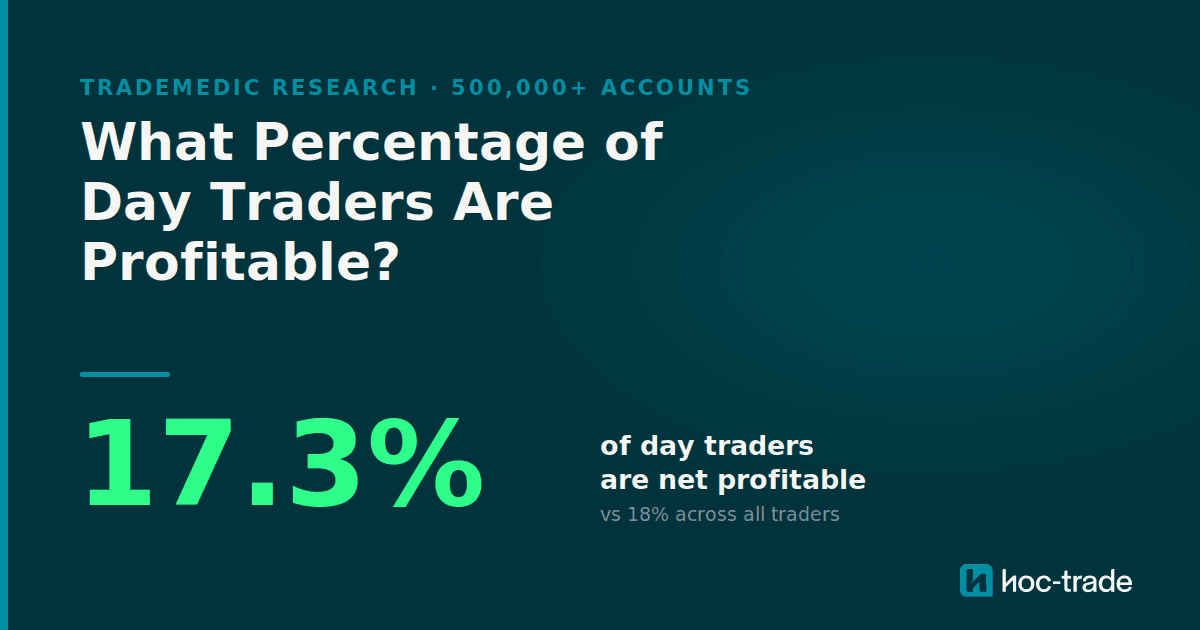
It is one of the most repeated claims in trading: that 90%, or even 95%, of traders lose money. The figure appears everywhere, almost always without a source. We can put a measured number in its place. In an analysis of more than 500,000 trading accounts, TradeMedic found that 17.3% of day traders were net profitable, against 18.2% across all traders in the dataset. Roughly one in five, not one in ten or one in twenty.
That is the headline. The more useful part is what the same data shows about the difference between the traders who make money and the ones who do not, because it is not what most people assume. It is not mainly about capital, and it is not mainly about screen time. The factor that moves profitability the most is behavioral.
What percentage of day traders are profitable?
Across more than 500,000 analyzed trading accounts, 17.3% of day traders were net profitable. Day traders make up the large majority of the dataset, so this figure is close to the all-trader rate of 18.2%. Put simply, roughly one in six day traders ends up net profitable, and just over five in six end up net losing. We break up the figure in more detail later in this article.
This is lower than the widely quoted but rarely sourced figures would suggest, in one direction, and higher in another. The commonly repeated "90 to 95% of traders lose" claims usually refer to different things, such as traders who abandon an account within a year, and are seldom tied to a measured dataset. The number here is a direct account-level measurement: what share of analyzed accounts finished net positive. It is not a projection or an estimate.
The honest framing matters. Trading is hard, and the large majority of accounts do lose. But the real rate of profitability is closer to one in five than the near-zero that the loudest claims imply, and the more important question is what separates that one in five from the rest.
This figure does not sit alone. In the European Union, regulators require brokers to publish the share of their retail accounts that lose money, which is why CFD adverts carry a line stating that a specific percentage of accounts lose. The supervisory analysis behind that rule found that between 74% and 89% of retail CFD accounts lose money, with average losses per client ranging from roughly 1,600 to 29,000 euros. There are some CFD brokers with higher or lower percentages, but the above is a range that covers most. That official range brackets our own finding: a net-losing rate of around 82% sits squarely inside it. The two measurements look at different populations, ours spans multiple instruments, brokers and regions while the regulator figure is EU retail CFD accounts specifically, but they point in the same direction from completely independent sources.
Why our number differs from the famous "3% of traders are profitable" figure
Search for this question and you will mostly find a much smaller number. One of the most cited figure is that only about 3% of day traders are profitable, drawn from a well-known study that followed 1,600 Brazilian day traders, of whom roughly 3% turned a profit and barely 1% earned more than the minimum wage. Other widely repeated figures put the rate at 1%, 13%, or 16%, while one older academic study of a US brokerage found a notably higher 35.8% of day traders finished with a net profit. The range across sources is enormous, from 1% to 36%, with no clear anchor.
Two things explain the spread, and both are worth understanding before trusting any single number.
The first is what "profitable" means. The 3% figures usually measure something stricter than finishing net positive: consistent profitability sustained over several years, or profitability after all fees while earning enough to live on. Our 17.3% measures whether an account finished net profitable at the trading account level, with one trader possibly having multiple accounts. Both are valid, but they answer different questions. The bar of "made money" is naturally cleared by more traders than the bar of "made a living, consistently, for years."
The second is sample size and recency. The most cited studies are mostly small and old: 1,600 traders in one country, or a few hundred accounts at a single brokerage two decades ago. Markets, instruments, and market access have changed enormously since. Our figure comes from more than 500,000 accounts analyzed recently. A larger, more recent sample does not automatically override a smaller one, but for a question this dependent on time and population, scale and recency matter.
The takeaway is not that trading is easy. The large majority of accounts lose, and that is consistent across every serious source. The takeaway is that the real profitable rate is most likely higher than the gloomiest 1 to 3% headlines and lower than the industry's optimistic claims, and that the more useful question is not the exact percentage but what separates the traders who make money from those who do not.
What separates profitable traders from the rest?
Three things in the data correlate with a higher chance of being profitable, and one matters far more than the other two. None of them is a strategy or an indicator. They are all structural or behavioral.
Trading style: swing traders are the most profitable group
Swing traders were the most profitable group at 27.5% net profitable, followed by scalpers at 19.3% and day traders at 17.3%. Day traders, despite being the largest group, had the lowest profitable rate of the three.
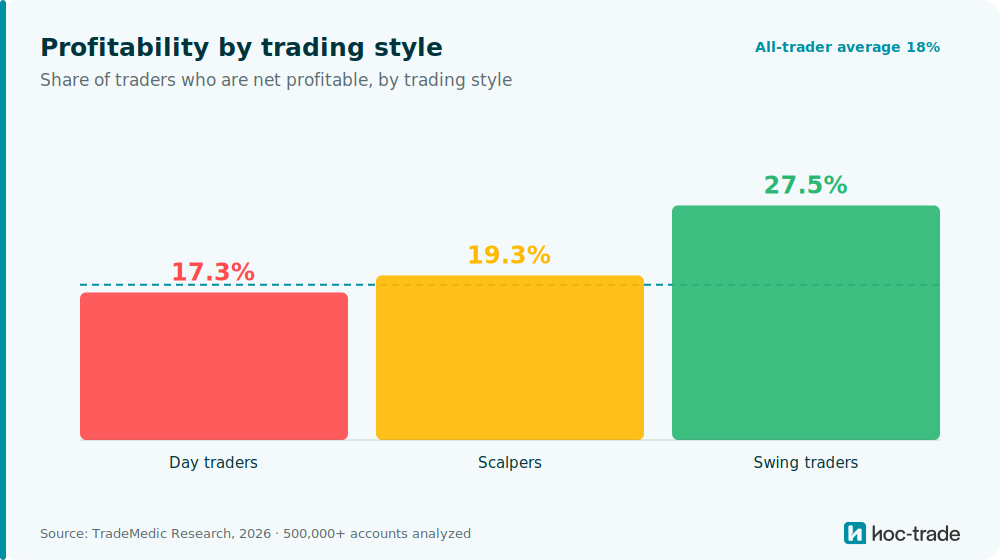
The likely reason connects to the behavioral factor below. Swing traders hold positions over longer horizons, which gives winning trades room to develop into larger gains and naturally supports a healthier ratio between average wins and average losses. With faster trading styles, it is harder to let a winner run, and the more pressure there is to take quick profits, both of which work against profitability. Moreover, trading fees are proportionally much more significant with strategies that produce smaller wins and losses.
Account size: bigger accounts are more often profitable
Profitability rose with account size, from 14.3% for accounts under $250 deposits to 23.1% for accounts over $10,000 deposits. The climb is steady across every deposit band in between.
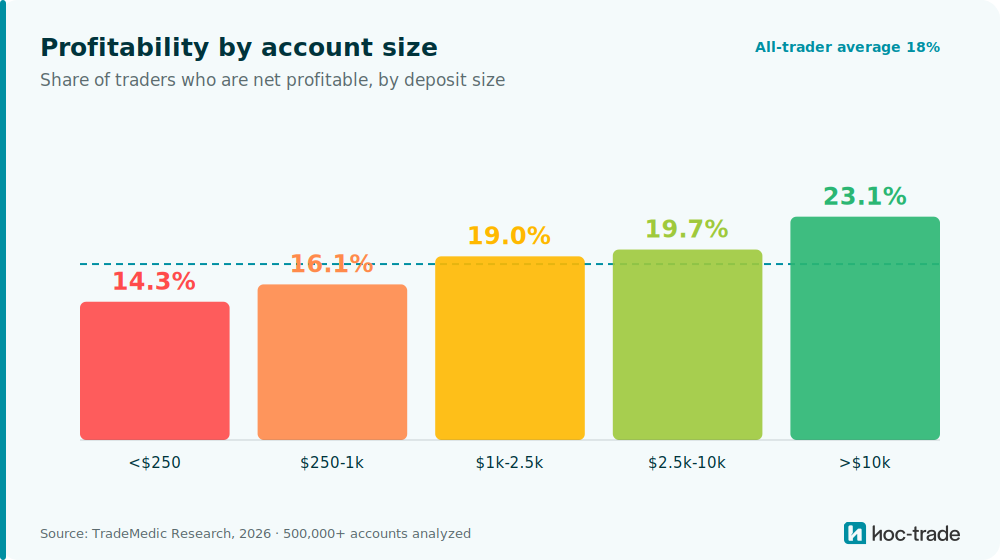
This is a correlation, not a prescription. Adding money to an account does not make a trader better. Larger accounts more likely reflect traders who are better capitalized, more committed, or further along, and who can size positions more sensibly relative to their balance. The takeaway is not "deposit more," it is that the smallest accounts, which are often the newest and least sized for survival, face the steepest odds.
Experience: time helps, but only a little
Profitability improved modestly with time spent trading, from 17.3% for accounts under 10 trading days to 23.4% for accounts active beyond 200 days. Notably, there is almost no improvement in the first 50 days; the gain comes later.
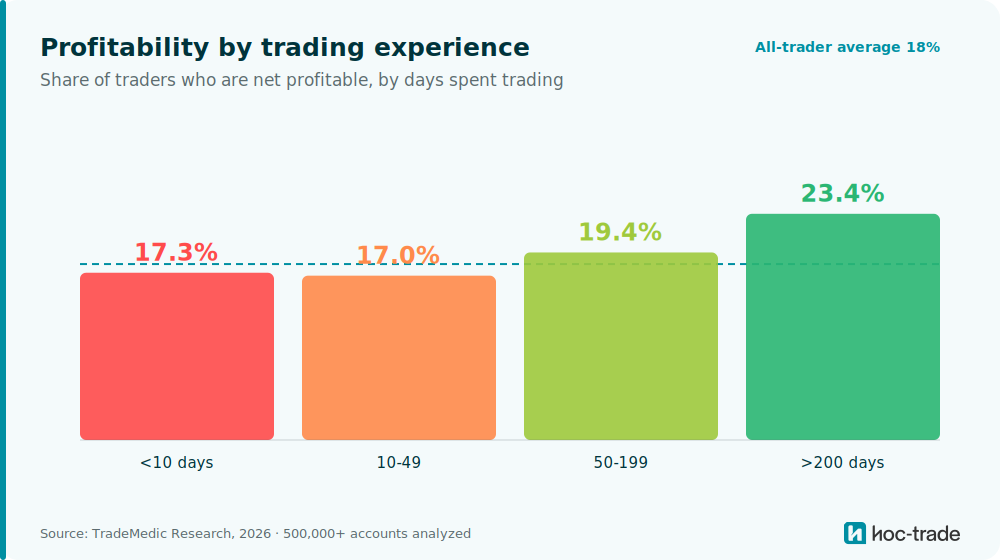
A clarification on what this measures: the data tracks how long an account has been trading, not skill. It cannot say a trader became "better." What it shows is that the traders who survive past 200 days are profitable at a somewhat higher rate, which is likely a mix of genuine learning and survivorship, the struggling accounts having already closed. Time on its own moves the profitable rate by only about six points. It helps, but it is not transformative.
The factor that matters most: risk-reward ratio
The three factors above each shift profitability by six to nine percentage points. One factor moves it far more. When traders are grouped by their risk-reward ratio, the profitable share runs from 10.2% (<0.5 RRR) in the worst band to 44.6% (>2.0 RRR) in the best, a spread of more than 34 points, larger than the effect of style, account size, and experience combined.
This is the single most important finding for any trader asking how to improve their odds. It is not capital and it is not time. It is whether your winning trades are larger than your losing trades, which is a behavior you directly control. We cover this in depth in our analysis of risk-reward ratio versus win rate, but the short version is that the traders who protect the size of their winners relative to their losers are profitable at several times the rate of those who do not.
The behaviors behind profitable and unprofitable traders
The factors above are structural. The deeper layer is behavioral, and the same dataset measures how specific habits track with profitability. A full treatment of each goes beyond the scope of this article, and we cover the why behind each one, and what it reveals about the trader, in dedicated articles. As a brief outlook, a few examples show how wide the range is.
Some behaviors mark the most fragile accounts. When doubling down, adding to a losing position, is a trader's single biggest issue, only 5.3% are profitable, against the 18% baseline. Revenge trading, re-entering immediately after a loss, sits at 13.4% when it is the top issue. These are among the clearest markers of an account heading toward losses.
Others are counterintuitive. When entering too early (being impatient in entries) is a trader's number one issue, 47.8% are profitable, well above baseline, because it tends to mark an active, decisive trader rather than a reckless one that shows to have other more catastrophic improvement areas.
And some are strengths that mark the profitable minority. The “boring” trades are oftentimes the most important marker. Traders whose top strength is performing well in calm, low-volatility markets are profitable at 49.9%, and those whose top strength is trading ranging markets at 50.4%, both close to three times the 18% baseline. These are among the strongest positive signals in the data: skill in quiet, directionless conditions, where there is no momentum to rescue an imprecise entry, tends to mark a mature, disciplined trader.
The point here is not to explain any of these in depth, that is what the dedicated articles do, and what each trader can see in their own personalized TradeMedic report based on their own trades, but to show that profitability is not a single number. It is the sum of many measurable behaviors, some of which sink an account and some of which quietly separate the profitable minority.
How TradeMedic measures trader profitability
The figures above come from TradeMedic's analysis of real trade histories, not surveys or self-reported results. The system ingests the actual executed trades from an account and classifies the account as net profitable or net losing based on realized outcomes. The results are net of all trading fees and only accounts with minimum 50 trades were included. It then analyzes the behavior behind that result across more than 60 patterns, identifying which specific habits are widening the gap between a trader's wins and losses and quantifying what each one costs.
For an individual trader, this turns a population statistic into a personal one. Rather than knowing that 17.3% of day traders are profitable, you can see where your own account sits, which behaviors are pulling your result down, and which single change would most improve your odds, drawn from comparison against the full dataset of analyzed accounts.
The bottom line
About one in five traders is net profitable, and for day traders specifically the figure is 17.3%, measured across more than 500,000 accounts rather than asserted. The traders who make money are not mainly distinguished by capital or experience, both of which help only modestly. They are distinguished by behavior, above all by maintaining a risk-reward ratio where winners outweigh losers. That is the factor that moves the odds the most, and it is the one most within a trader's control.
Learn more about how TradeMedic™ AI analyzes your trading or connect your account free to see whether you are in the profitable group and what's holding back your trading.
Research behind this article
All trading statistics: TradeMedic Research, 2026, based on a dataset of more than 500,000 trading accounts.
Comparative figures referenced: the "3% profitable" figure derives from Barber, Lee, Liu and Odean's study of Brazilian day traders; the 35.8% figure from Jordan and Diltz (2003), Financial Analysts Journal; the 74-89% retail CFD loss range from ESMA and EU national competent authority analyses (2018, the basis for the standardized broker risk warning). Profitability is measured at the account level across accounts with a minimum of 50 trades, the threshold below which results are not statistically reliable. Figures describe correlations across the population and are not a guarantee of individual results.
Frequently asked questions
What percentage of day traders are profitable?
In an analysis of more than 500,000 trading accounts, 17.3% of day traders were net profitable, against 18.2% across all traders. Roughly one in six day traders ends up net positive.
Do most traders lose money?
Yes. About 82% of traders in the dataset were net losing, meaning roughly one in five was profitable. This is a measured account-level rate, lower in losses than the commonly repeated but unsourced "90 to 95% lose" claims imply.
Which trading style is most profitable?
Swing traders were the most profitable group at 27.5% net profitable, followed by scalpers at 19.3% and day traders at 17.3%. Day traders were the largest group but had the lowest profitable rate.
Does account size affect profitability?
In the data, yes. Profitability rose from 14.3% for accounts under $250 to 23.1% for accounts over $10,000. This is a correlation rather than a cause; larger accounts tend to reflect more committed or better-capitalized traders.
Does trading experience make you profitable?
Only modestly. Profitability rose from 17.3% for accounts under 10 trading days to 23.4% beyond 200 days, with little improvement in the first 50 days. The data measures time spent trading, not skill, and part of the gain reflects struggling accounts closing.
What matters most for becoming a profitable trader?
Risk-reward ratio. Grouped by it, the profitable share runs from 10.2% in the worst band to 44.6% in the best, a larger effect than trading style, account size, and experience combined. Maintaining winners larger than losers is the factor most within a trader's control.
Why do some sources say only 3%, 5% or 10% of day traders are profitable?
The widely cited 3% figure comes from a small study of 1,600 Brazilian traders and typically measures consistent profitability over years, or profitability after fees sufficient to earn a living. Our 17.3% measures whether an account finished net profitable, a different and less strict bar, drawn from more than 500,000 accounts. Both show most traders lose; they differ on sample size, recency, and the definition of profitable.