Category:
 Author:
 Date:Sep 22, 2026
FOMO in Trading: The Most Common Mistake, and the One Winners Make Too
The price breaks out. You were watching it, you had the level marked, and you hesitated. Now it is running without you, and every candle makes it harder to sit still. So you jump in, late, at a worse price than you planned. That is FOMO in trading: the fear of missing out, turned into a trade.
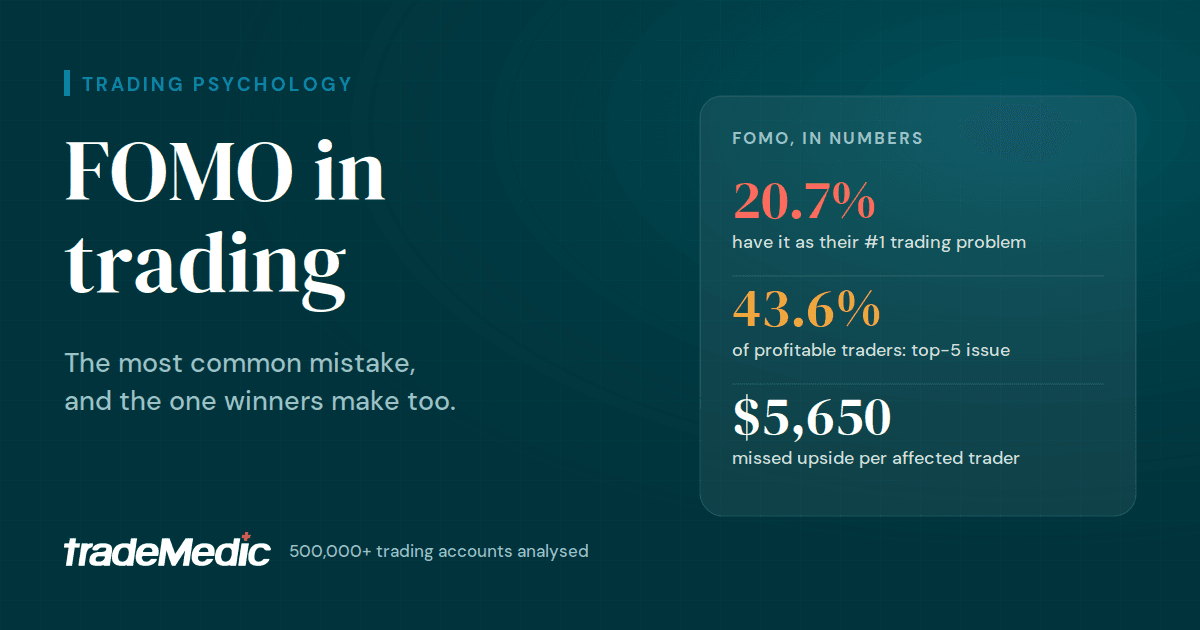
It is also the most common trading problem of all. Across more than 500,000 trading accounts analysed by TradeMedic AI, late, FOMO-driven entries are the single biggest improvement area for 20.7% of traders, more than any other pattern. And the data holds a surprise: profitable traders are more likely than losing ones to have FOMO among their five biggest improvement areas.
This article explains what FOMO in trading is, what it looks like, what it costs, who is most affected, the psychology behind it, and how to stop it.
Let's start with what FOMO means in trading.
What is FOMO in trading?
FOMO stands for fear of missing out. Psychologists Andrew Przybylski and colleagues, who developed the first scientific scale to measure it, describe it as a persistent worry that others are having rewarding experiences you are not part of. In trading, the rewarding experience is a move in the market, and the others are everyone who seems to be in it already.
FOMO in trading is the urge to enter a trade because a move is happening without you, not because your setup has appeared. In TradeMedic AI's analysis, it shows up as late entries: trades opened after the move has already started, at a worse price than the trader's own entries usually achieve. TradeMedic AI detects it by comparing each trade with a slightly earlier entry. When an earlier entry would consistently have given a better result, the pattern is flagged.
That makes FOMO the opposite of a different entry mistake. Entering trades too early, before a setup has confirmed, is driven by impatience. FOMO is driven by hesitation followed by chasing. The two are measured separately, and they rarely point in the same direction.
Recognising FOMO in the moment is the first step, so it helps to know what it looks like.
What does FOMO trading look like?
FOMO trades share a recognisable signature. The entry comes after the move is already well under way, often after a strong candle or a breakout the trader watched but did not act on. There is usually no predefined setup, only the feeling that the move is leaving without you. The exit plan is vague or missing. And many FOMO trades are closed quickly at the first pullback, because the late entry leaves little room before the position turns red.
A typical example: EURUSD breaks above a level at 1.1000 that a trader has marked. They hesitate, and the price moves to 1.1030. Worried about missing the rest of the move, they buy at 1.1030. The price pulls back to 1.1010, a normal retest of the breakout. On one standard lot, the trader who entered at the level is $100 in profit. The FOMO trader, who had the same idea, is $200 down and closes at a loss. Same idea, same market, a $300 difference that came entirely from the entry.
FOMO also has a close relative: trading in the direction of a strong move without any setup at all, simply because the market is moving. We look at that pattern, and how it differs, later in this article.
So how common is FOMO? The data gives a clear answer.
How common is FOMO in trading?
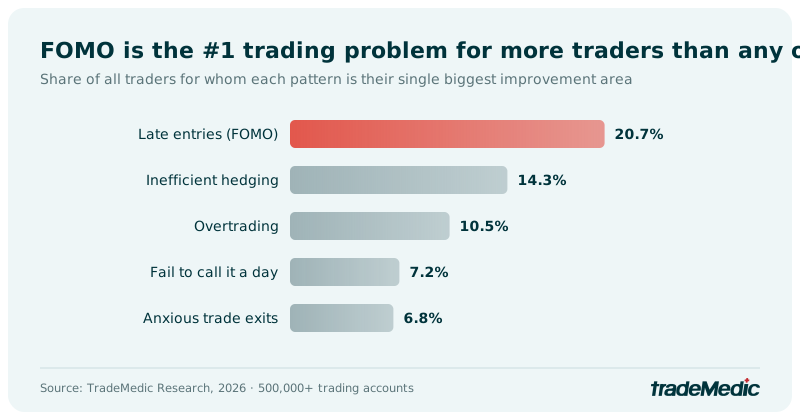
Late, FOMO-driven entries are the single biggest improvement area for 20.7% of traders, more than any other pattern TradeMedic AI detects. The next most common single biggest issue, inefficient hedging, affects 14.3%. Overall, the pattern is detected in 60.1% of traders, and 38.4% have it among their five biggest improvement areas.
If you want to know whether FOMO is your own biggest improvement area, TradeMedic AI checks your full trade history for it and 60+ other behavioural patterns, and shows how much better your entries could have been. Connect your trading account free.
Being common is one thing. What it costs is different from most trading mistakes.
What does FOMO cost traders?
TradeMedic AI measures the cost of FOMO as the better entry a trader missed: it compares each trade with a slightly earlier entry and adds up the difference. That makes FOMO a cost in missed upside rather than in money lost directly. Among traders who show the pattern, the better entries they missed add up to an average of $5,650 per trader across their analysed trading history.
That is a real cost, but a different kind from patterns that drain an account directly. The profitability data reflects this. 15.9% of traders who show FOMO entries are profitable, compared with 21.7% of traders where it is not detected. The gap exists, but it is small compared with patterns such as doubling down, where only 7.2% of traders are profitable.
That leads to the most surprising finding in the data.
Why do profitable traders show FOMO too?
43.6% of profitable traders have FOMO entries among their five biggest improvement areas, compared with 37.2% of loss-making traders. As a top-five issue, FOMO is one of the few mistakes that shows up more often among winners than among losers. It is not that winners are immune to other mistakes: counting every trader who shows the pattern at all, it is still slightly more common among loss-making traders (61.8%) than profitable ones (52.5%).
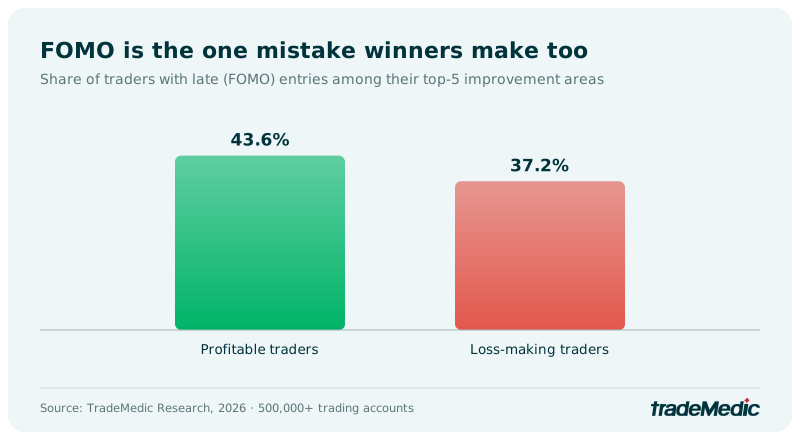
One plausible explanation is that profitable traders have fewer of the patterns that cause heavy losses, so FOMO rises higher in their ranking. Another is the nature of the cost: FOMO takes the edge off good trades rather than creating bad ones. A trader can enter late, still be right about the direction, and still make money, just less than they could have.
For profitable traders, that makes FOMO one of the clearest opportunities for improvement: the idea is right, only the timing gives money away. For losing traders, fixing FOMO alone is unlikely to turn an account around, because it costs upside rather than capital.
The data also shows who is most exposed.
Who is most affected by FOMO in trading?
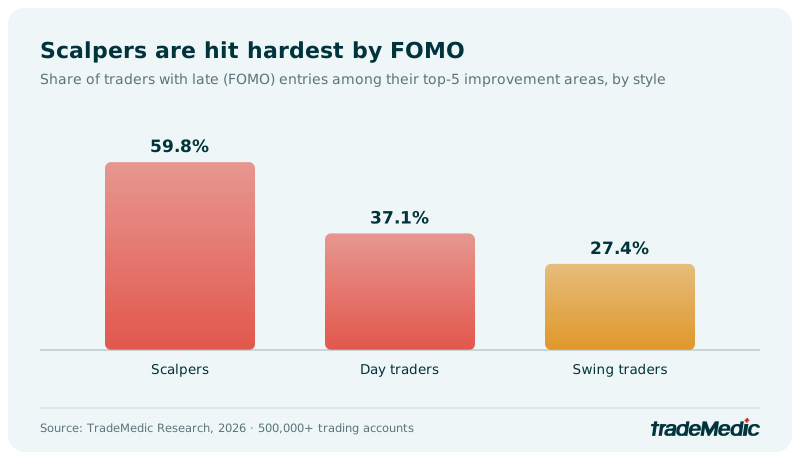
Scalpers are hit hardest. 59.8% of scalpers have FOMO entries among their five biggest improvement areas, compared with 37.1% of day traders and 27.4% of swing traders. One plausible reason is speed: at the pace scalpers trade, even a short hesitation means entering after the move has started. On longer timeframes, a few minutes of hesitation matter far less.
Unlike most trading mistakes, FOMO fades the longer traders trade. It is among the five biggest improvement areas for 47.4% of accounts under 10 days old, falling to 40.1% at 10 to 49 days, 32.6% at 50 to 199 days and 24.7% of accounts trading for 200 days or more. That is the opposite of patterns such as overtrading and catching a falling knife, which become more common with time.
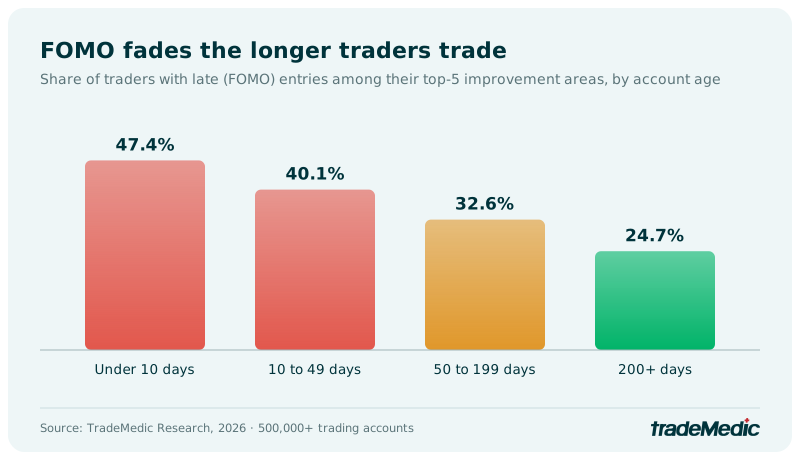
A likely reason is familiarity. New traders see every move as a unique chance. Traders with more experience have seen enough moves come and go to know that another setup will appear.
FOMO rarely shows up in isolation. Its closest relatives in the data tell a story of their own.
Which trading patterns are linked to FOMO?
Blindly following momentum is FOMO without a plan. Where a late entry chases a move the trader had spotted, blindly following momentum means jumping into any strong move without a setup at all. It is rarer but more directly costly: it is detected in 14.8% of traders, and among those traders it causes 7.1% of their losses, an average of $1,518 per trader. Only 13.5% of them are profitable, compared with 18.2% across all traders. And unlike late entries, it becomes more common the longer traders trade, rising from 9.5% of accounts under 10 days old to 19.2% of accounts trading for 200 days or more, and it is most common among swing traders (20.4%).
The two are linked: traders with late entries are 12.5% more likely to also blindly follow momentum. But they differ in one telling way. Traders who blindly follow momentum are 32% more likely to also trade around news (54.8% versus 41.4% of all traders), while traders with late entries are 18% less likely to. Late-entry FOMO is mostly about hesitation at the trader's own level. Momentum chasing is about reacting to whatever the market is doing.
To understand why FOMO is so common in the first place, it helps to look at the psychology behind it.
What causes FOMO in trading? The psychology behind it
Attention pulls traders into moves. Research by Brad Barber and Terrance Odean found that individual investors are much more likely to buy stocks that have caught their attention, such as those with extreme price moves or in the news. A later study by Zhi Da, Joseph Engelberg and Pengjie Gao used Google search volume as a direct measure of investor attention. Stocks that suddenly attracted more searches rose over the following two weeks, then reversed within the year. By the time a move has everyone's attention, much of it may already have happened.
Apps and alerts amplify it. In a study of Robinhood users, Barber, Xing Huang, Odean and Christopher Schwarz found that these investors engaged in more attention-induced trading than other retail investors, partly because of the app's features, such as lists of the day's biggest movers. The stocks they bought most heavily went on to fall by about 4% on average over the next 20 trading days. Price alerts, top-mover lists and social feeds all turn the market's biggest moves into prompts to act.
Following the crowd. A survey of 323 retail investors by Shilpi Gupta and Monica Shrivastava found that FOMO strengthened the influence of both herd behaviour and loss aversion on investment decisions. Seeing others profit from a move makes staying out feel like a loss, even when no money has been lost.
The pain of watching a move without you. For many traders, missing a move they had spotted feels worse than taking a small loss. That anticipated regret pushes them into the next move before it gets away, often at exactly the moment the move is most extended.
Discipline matters, but FOMO is also a predictable response to attention, social comparison and regret, which is why rules set in advance tend to work better than willpower in the moment.
FOMO shows up in every market, but one market gives it more fuel than most.
What is FOMO in crypto trading?
FOMO in crypto trading is the urge to buy a coin because its price is rising fast and others seem to be profiting, rather than because of a planned setup. Crypto markets trade around the clock, move quickly and are discussed constantly on social media, which gives the fear of missing out more fuel than almost any other market.
Research shows that crypto really does bring out different behaviour. In a study of 200,000 eToro retail traders, Shimon Kogan, Igor Makarov, Marina Niessner and Antoinette Schoar found that in stocks and gold these traders leaned against price moves, buying after falls and selling after rises. In crypto, the same traders held on after big rises instead of taking profits. The authors' explanation is that traders read rising crypto prices as a sign of wider adoption to come, so a rise makes them expect more rises. That is not FOMO by definition, but it is the belief that makes FOMO feel rational: the fact that a price has already risen becomes the reason to be in it.
Online communities add to the pull. On Reddit, crypto forums and trading communities such as WallStreetBets turn big moves into shared excitement within hours. A study of WallStreetBets by Daniel Bradley and colleagues found that its investment recommendations used to predict stock returns, but that this predictive value disappeared after the GameStop short squeeze, when posts increasingly focused on attention-grabbing stocks and price pressure. When a move is already trending on Reddit, much of it has often already happened.
In our own data, crypto is a small share of trading: 2.3% of traders have Bitcoin as their main instrument, and 14.0% of them are profitable, compared with 18.2% across all traders. Most accounts trade forex, gold and indices, so the FOMO figures in this article describe those markets. The pattern, and the fixes below, are the same in crypto.
Whatever the market, the fix starts with rules set before the move.
How to stop and overcome FOMO in trading
The most effective way to stop FOMO is to make the entry decision before the move starts, and to know how often you chase. TradeMedic AI shows the second from your own trade history. These six steps take care of the first.
1. Mark your entry zone before the move, and use a limit order. Decide where you want to enter while the market is quiet, and place a limit order at that level. If the market reaches it, you are in at your price. If it runs without you, the decision was made in advance.
2. Set a maximum chase distance. Decide how far beyond your planned entry you are willing to go, for example a few pips or a fixed fraction of your stop. If the price is already beyond that, the trade is gone. Wait for a pullback or the next setup.
3. Plan the exit before the entry. FOMO trades often have no exit plan, which is why they are closed at the first pullback. Set the stop loss and profit target before entering. If the late entry makes the reward-to-risk unattractive, that is the answer.
4. Reduce the prompts. Price alerts, top-mover lists and social feeds are built to grab attention. Keep only the alerts tied to your own levels, and trade from your plan rather than from notifications.
5. Keep a missed-trades list. Write down the moves you missed instead of chasing them. Over a few weeks, most traders find that missed setups were followed by new ones, which takes much of the urgency out of the next move.
6. Review your late entries. Compare the entries you took after a move had started with those you took at your level. That comparison shows how much the chasing is costing you, and it is exactly what TradeMedic AI measures automatically.
Here is how that measurement works.
How does TradeMedic AI detect FOMO in trading?
TradeMedic AI detects FOMO as late entries by re-simulating each trade with a slightly earlier entry, holding everything else constant. If the earlier entry would consistently have produced a better result across a trader's history, the pattern is flagged, and the value of the better entries is calculated in dollars. Because the comparison uses each trader's own trades, it separates traders who enter late from those who simply trade breakouts well.
The same framework detects the opposite mistake. When a later entry would consistently have been better, TradeMedic AI flags impatient entries instead. Seeing both side by side shows whether a trader's timing leans towards hesitation or impatience. More on the methodology is on our research page.
The bottom line on FOMO in trading
FOMO is the most common trading problem there is: the single biggest improvement area for 20.7% of traders, and a top-five issue for more profitable traders than losing ones. It costs traders mainly in better entries they did not take, worth $5,650 per affected trader on average, and it fades the longer traders trade. The fix is to make the entry decision before the move starts: mark your level, use a limit order, set a maximum chase distance, and accept that some moves will leave without you.
→ Learn more about TradeMedic AI
Research behind this article
Przybylski, A. K., Murayama, K., DeHaan, C. R., and Gladwell, V. (2013). Motivational, Emotional, and Behavioral Correlates of Fear of Missing Out. Computers in Human Behavior, 29(4), 1841 to 1848.
Barber, B. M., and Odean, T. (2008). All That Glitters: The Effect of Attention and News on the Buying Behavior of Individual and Institutional Investors. The Review of Financial Studies, 21(2), 785 to 818.
Da, Z., Engelberg, J., and Gao, P. (2011). In Search of Attention. The Journal of Finance, 66(5), 1461 to 1499.
Barber, B. M., Huang, X., Odean, T., and Schwarz, C. (2022). Attention-Induced Trading and Returns: Evidence from Robinhood Users. The Journal of Finance, 77(6), 3141 to 3190.
Gupta, S., and Shrivastava, M. (2022). Herding and Loss Aversion in Stock Markets: Mediating Role of Fear of Missing Out (FOMO) in Retail Investors. International Journal of Emerging Markets, 17(7), 1720 to 1737.
Kogan, S., Makarov, I., Niessner, M., and Schoar, A. (2024). Are Cryptos Different? Evidence from Retail Trading. Journal of Financial Economics, 159.
Bradley, D., Hanousek, J., Jame, R., and Xiao, Z. (2024). Place Your Bets? The Value of Investment Research on Reddit's Wallstreetbets. The Review of Financial Studies, 37(5), 1409 to 1459.
TradeMedic Research (2026). Behavioural pattern analysis of 500,000+ retail trading accounts. Source: TradeMedic Research, 2026.
Frequently asked questions
Why do I keep FOMO trading?
Most traders keep FOMO trading because a move they spotted but did not take feels like a loss, and the urge to avoid that regret is strongest when the move is most extended. It is also very common: in TradeMedic AI data from 500,000+ trading accounts, late FOMO entries are the single biggest improvement area for 20.7% of traders.
Does FOMO trading get better with experience?
Yes, more than most trading mistakes. In TradeMedic AI data, late FOMO entries are among the five biggest improvement areas for 47.4% of accounts under 10 days old, falling to 24.7% of accounts trading for 200 days or more.
Can FOMO trades still be profitable?
Yes. FOMO mainly costs traders a better entry rather than the whole trade, so a late entry can still make money, just less. In TradeMedic AI data, 15.9% of traders who show FOMO entries are profitable, compared with 21.7% of traders where the pattern is not detected.
What does FOMO mean in the stock market?
In the stock market, FOMO describes investors buying shares because they are rising fast or in the news, for fear of missing further gains. Research on Robinhood users found that the stocks they bought most heavily went on to fall by about 4% on average over the next 20 trading days.
What is FOMO in forex trading?
FOMO in forex trading is entering a currency pair after a move has already started, usually after a breakout the trader watched but did not act on. The entry comes at a worse price, leaving little room before a normal pullback turns the trade red.
Is FOMO the same as entering too early?
No, they are opposite timing mistakes. Entering too early means jumping in before a setup has confirmed, out of impatience. FOMO means hesitating and then chasing after the move has started. TradeMedic AI measures them separately: FOMO when an earlier entry would have been better, impatient entries when a later one would have been.
Is chasing the market the same as FOMO?
Chasing the market is what FOMO looks like in practice: entering after a move has started because it is leaving without you. FOMO is the feeling, chasing is the action. TradeMedic AI measures it as late entries, compared with a slightly earlier entry on the same trade.
How can I tell if I trade out of FOMO?
The clearest sign is that your entries are consistently worse than an entry a little earlier would have been, especially after breakouts you watched. TradeMedic AI checks this automatically across your full trade history and shows how much better your entries could have been in dollars.