Category:
 Author:
 Date:Sep 23, 2026
Is Trading Hard? Why Most Traders Lose, and What the Winners Do Differently
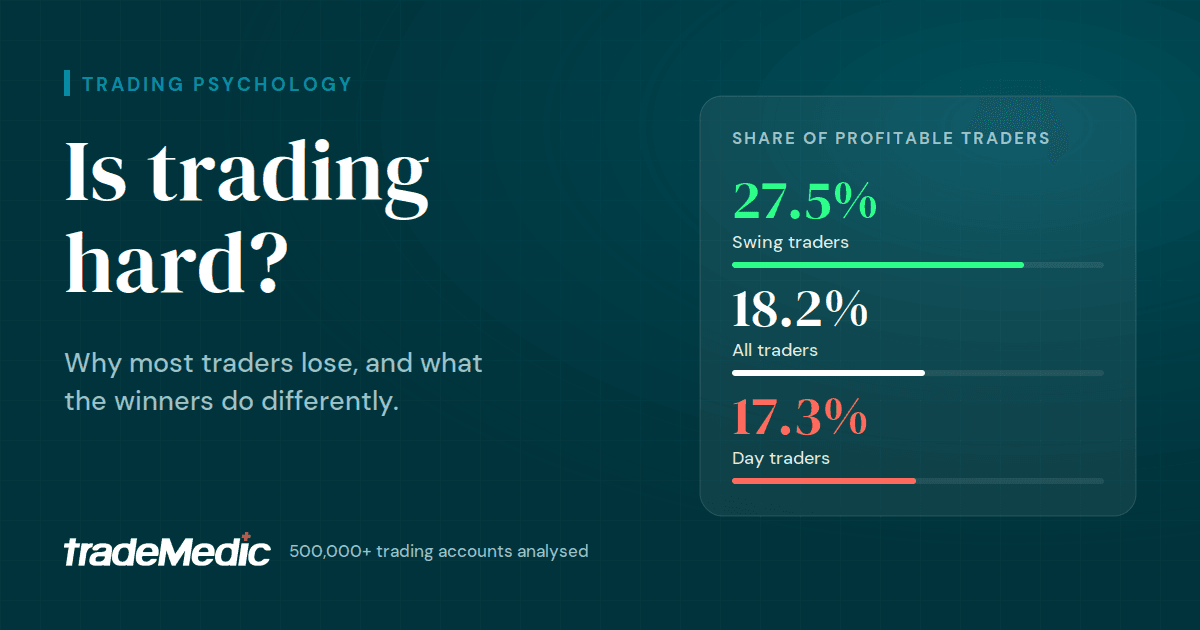
Is trading hard? Yes, and the numbers are clearer than most traders expect. Across more than 500,000 trading accounts analysed by TradeMedic AI, only 18.2% of traders are profitable. Among day traders, the largest group, it is 17.3%. Research from other markets tells the same story: in one study, 97% of people who day-traded for more than 300 days lost money.
But hard is not the same as random. The same data shows that the traders who succeed behave measurably differently, and that most of what makes trading hard comes from how the market trains the human brain, not from the charts. This article explains why trading is so hard, why experience alone does not fix it, whether trading is worth it, and what the traders who beat the odds do differently.
Let's start with the most direct question.
Is trading hard?
Trading is hard in a specific way: it is easy to start, easy to win individual trades and very hard to stay profitable over hundreds of them. In TradeMedic AI data from 500,000+ trading accounts, 18.2% of traders are profitable, meaning their account is net positive across all the trades analysed. European regulators see a similar picture: when ESMA restricted CFDs for retail clients, it found that 74% to 89% of retail CFD accounts lose money.
What makes it hard is not a single big mistake. The average trader in the dataset shows 10 of the 23 problem patterns TradeMedic AI detects, from exiting too early to adding to losing positions. Each one costs a little, and together they are enough to turn a workable strategy into a losing account.
For one style in particular, the odds are even steeper.
Is day trading hard?
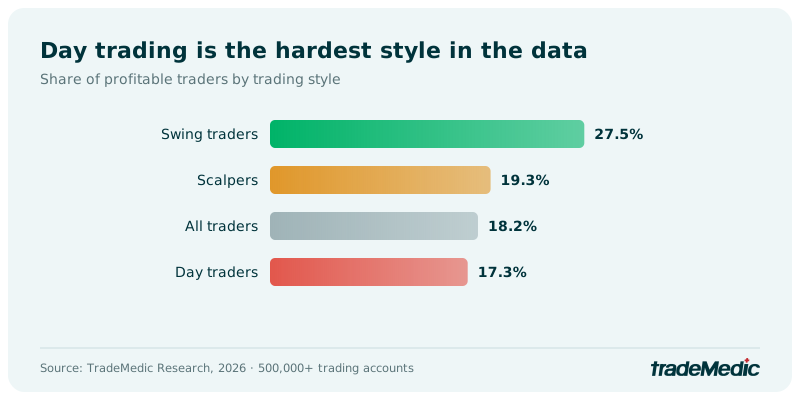
Day trading is the hardest style in the data. Day traders make up most of the accounts TradeMedic AI analyses, and 17.3% of them are profitable, compared with 19.3% of scalpers and 27.5% of swing traders.
Long-term research on day traders is even more sobering. In a study of Brazilian index futures by Fernando Chague, Rodrigo De-Losso and Bruno Giovannetti, 97% of the 1,551 people who day-traded for more than 300 days lost money, and only 1.1% earned more than the Brazilian minimum wage. A study of Taiwanese day traders by Brad Barber, Yi-Tsung Lee, Yu-Jane Liu and Terrance Odean found that fewer than 1% could predictably and reliably earn positive returns after fees.
Day trading concentrates everything that makes trading hard: many decisions, little time for each, constant feedback that is mostly noise, and costs that add up with every trade. Our analysis of how many day traders are profitable covers the numbers in more detail.
So why exactly is trading so hard?
Why is trading so hard?
The feedback is noisy. In most skills, good decisions lead to good results quickly and reliably. In trading, a good decision can lose money and a bad one can win. Psychologists Daniel Kahneman and Gary Klein concluded that real intuitive expertise only develops in environments that are predictable enough to learn from, with enough opportunity to learn their regularities. They also found that how confident someone feels is not a reliable guide to how accurate their judgement is. Short-term trading gives traders plenty of confidence and very little reliable feedback. Worse, the noise teaches the wrong lessons: a reckless trade that happens to win feels like a good decision, which is outcome bias at work. This is the gap TradeMedic AI is built to close: instead of judging single trades, it measures each behaviour across a trader's whole history, so a pattern that costs money over hundreds of trades shows up even when individual trades went well.
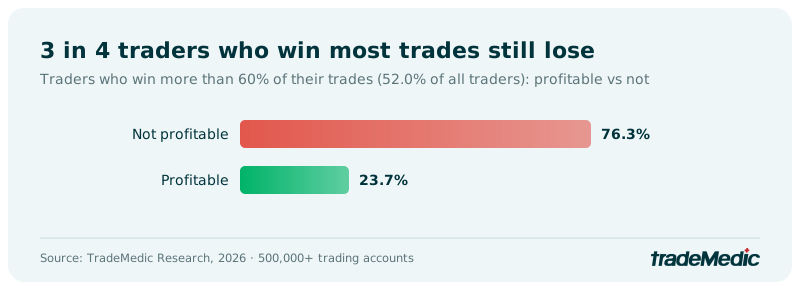
Winning trades is not the same as winning. More than half of traders win most of their trades, and most of them still lose money. In TradeMedic AI data, 52.0% of traders win more than 60% of their trades, yet only 23.7% of those traders are profitable. Many small wins and a few large losses feel like success, trade by trade, while the account goes down. Our article on the disposition effect explains why.
Overconfidence grows with every win. In a classic study of 66,465 brokerage households, Brad Barber and Terrance Odean found that the households that traded most earned 11.4% a year, while the market returned 17.9%. They pointed to overconfidence as the most likely explanation. A few winning trades make a trader feel more skilled than the results justify, and that feeling leads to more trades, larger positions and looser rules.
Losses hurt more than gains feel good. People feel a loss more strongly than a gain of the same size, which makes it hard to close losing trades and easy to close winning ones too early. Our article on loss aversion covers this in depth.
Together, these explain why most traders lose. The data shows exactly where.
Why do most traders lose money?
Most traders do not lose because of one bad strategy. They lose because of many small, repeated habits. The average trader shows 10 of the 23 problem patterns TradeMedic AI detects. Loss-making traders show 10.6 on average, and profitable traders 7.2.
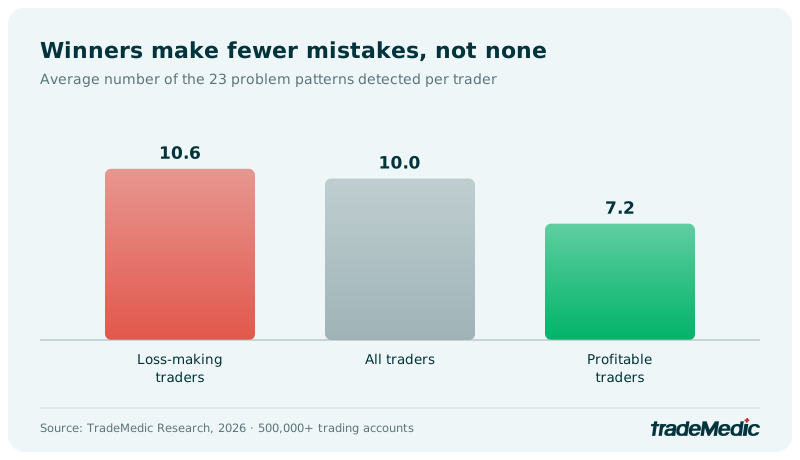
Even profitable traders make several mistakes. The difference is that they make fewer, and fewer of the costly ones. The patterns most likely to wipe out an account, such as trading without breaks, doubling down and overtrading, all build up within a single session. Our ranking of the most common trading mistakes shows which ones cost the most.
If you want to know which of these patterns show up in your own trading, TradeMedic AI retrieves your trades automatically from your MT4 or MT5 account and checks them for all 23. Connect your trading account free.
A natural assumption is that experience fixes all of this. The data says otherwise.
Is trading hard to learn?
Trading is hard to learn because experience changes the mistakes rather than removing them. In TradeMedic AI data, timing mistakes fade the longer traders trade: late, FOMO-driven entries drop from 47.4% of new accounts' five biggest issues to 24.7% after 200 days. But volume and complexity mistakes grow: overtrading rises from 13.3% to 55.2%, and inefficient hedging from 16.1% to 52.7%.
In other words, experienced traders learn when to act, and then act too often. The Brazilian day-trading study found the same thing from another angle: its authors found no evidence that day traders improved with experience. Time in the market alone is not a teacher, because the feedback is too noisy to learn from without measuring it.
Many traders who search this question are trading forex, so it is worth looking at that market specifically.
Is forex trading hard?
Forex trading is hard for the same reasons, with a few of its own. Currency markets trade around the clock, react fast to news and are usually traded with leverage, which magnifies both gains and losses. The ESMA figures, 74% to 89% of retail CFD accounts losing money, include rolling spot forex. Costs matter more here than most traders expect. Every trade pays a spread, often a commission, and a swap if it is held overnight, and measured against the daily range, currency spreads are expensive. Our analysis of trading fees by instrument shows what that does to results: scalpers trading EURUSD and GBPUSD are profitable just 7.1% of the time, against 20.2% for scalpers trading gold, the same behaviour in a cheaper instrument. Most accounts in the TradeMedic AI dataset trade forex, gold and indices, so the 18.2% profitability figure largely reflects these markets.
Which raises the question many traders are really asking.
Is trading worth it?
It depends on what you expect from it. As a way to get rich quickly, the evidence is discouraging: most retail traders lose money, and very few earn a steady living from short-term trading. As a skill to build, with small risk and realistic expectations, the picture is more nuanced, because the data also shows that some behaviours are linked to much better odds.
Traders who recover calmly after a loss are profitable 48.3% of the time. Traders who place fewer than two trades a day in a single symbol are profitable 46.2% of the time. Those are not guarantees, and more than half of that second group still lost money. But they show that the odds are not fixed: they move with behaviour. It is also worth remembering how the picture reaches you. Traders who do well post about it, while traders who lose mostly go quiet, so social media shows a heavily filtered sample of the outcomes in the data above. A realistic goal in a first year is not a profitable account but a cleaner one: getting the costliest patterns out of your five biggest issues, with small risk per trade while you do it. Whether trading is worth it for you depends on whether you can find and change the behaviours that are costing you, and that is something your own trade history can show. This is not financial advice, and anyone considering trading should only risk money they can afford to lose.
That leaves the most practical question: what do the traders who beat the odds do differently?
What makes trading easier: what the winners do differently
The traders who succeed are not free of mistakes, but they tend to share a few habits. They make fewer trades and wait for their setups. They stop after a big loss instead of trying to win it back. They keep their risk per trade small. And they judge their trading over many trades, not one day at a time. Our article on trading discipline covers the rules that support these habits.
The hardest part is seeing your own habits clearly, because every trade feels reasonable when you place it. TradeMedic AI makes that visible: it analyses your full trade history without needing a trading journal, shows which of the 23 patterns cost you money or upside, and tracks them over time, so you can see whether you are moving towards the traders who beat the odds.
The bottom line: is trading hard?
Yes. Only 18.2% of traders in the TradeMedic AI dataset are profitable, day trading is the hardest style, and research from Brazil and Taiwan shows that very few day traders succeed over time. Trading is hard because the feedback is noisy, winning trades feels like skill, overconfidence grows with each win and losses hurt more than gains feel good. But the odds are not fixed. They move with behaviour, and the traders who beat them make fewer and less costly mistakes, not zero.
→ Learn more about TradeMedic AI
→ See what makes trading hard for you: connect your trading account to TradeMedic AI free
Research behind this article
Chague, F., De-Losso, R., and Giovannetti, B. (2020). Day Trading for a Living? Working paper, SSRN 3423101.
Barber, B. M., Lee, Y.-T., Liu, Y.-J., and Odean, T. (2014). The Cross-Section of Speculator Skill: Evidence from Day Trading. Journal of Financial Markets, 18(1), 1 to 24.
Kahneman, D., and Klein, G. (2009). Conditions for Intuitive Expertise: A Failure to Disagree. American Psychologist, 64(6), 515 to 526.
Barber, B. M., and Odean, T. (2000). Trading Is Hazardous to Your Wealth: The Common Stock Investment Performance of Individual Investors. The Journal of Finance, 55(2), 773 to 806.
European Securities and Markets Authority (2018). ESMA agrees to prohibit binary options and restrict CFDs to protect retail investors. Press release, 27 March 2018.
TradeMedic Research (2026). Behavioural pattern analysis of 500,000+ retail trading accounts. Source: TradeMedic Research, 2026.
Frequently asked questions
Why do I keep losing money in trading?
Usually because of a few repeated habits rather than one bad strategy. In TradeMedic AI data from 500,000+ trading accounts, loss-making traders show 10.6 of 23 problem patterns on average, against 7.2 for profitable traders. The costliest ones, such as trading without breaks, doubling down and overtrading, tend to build up within a single session.
How long does it take to learn trading?
There is no fixed timeline, and time alone does not guarantee progress. A study of Brazilian day traders found no evidence that they improved with experience. In TradeMedic AI data, timing mistakes fade the longer traders trade, but overtrading and complexity mistakes grow, so learning depends on measuring your own behaviour rather than on time in the market.
Can you make a living from day trading?
Very few people do. In a study of 1,551 Brazilian day traders who traded for more than 300 days, 97% lost money and only 1.1% earned more than the minimum wage. In TradeMedic AI data, 17.3% of day traders are profitable, the lowest share of any trading style.
Is trading harder than investing?
For most people, yes. In a study of 66,465 brokerage households, the ones that traded most earned 11.4% a year, while the market returned 17.9%. Frequent trading adds costs and decisions, and every extra decision is a chance for behavioural mistakes, which TradeMedic AI data shows are the main reason traders lose.
Is scalping harder than swing trading?
In TradeMedic AI data, swing traders are the most profitable group at 27.5%, compared with 19.3% of scalpers and 17.3% of day traders. Scalpers mostly struggle with timing mistakes such as late entries, while swing traders struggle more with complexity, such as inefficient hedging.
Is trading hard for beginners?
Yes, but beginners mostly make different mistakes from experienced traders. In TradeMedic AI data, new accounts most often struggle with timing, such as late FOMO-driven entries and entering too early, which tend to fade with experience. Experienced traders more often struggle with overtrading and complexity.