Category:
 Author:
 Date:Sep 22, 2026
Trading Discipline: What 500,000 Trading Accounts Show It Really Takes
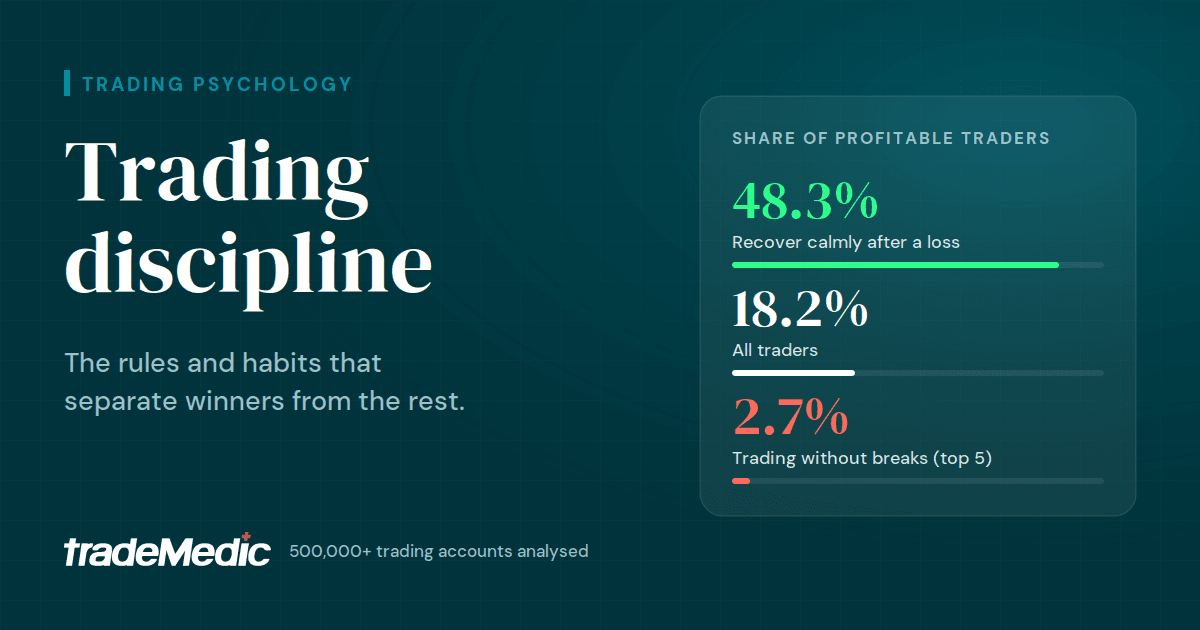
Everyone talks about trading discipline. Few can say which parts of it make the difference. Trading discipline means following the rules you set before a trade, especially when a trade or a trading day is going against you, so we checked which of those rules show up in the results of more than 500,000 trading accounts analysed by TradeMedic AI. The gap is striking: among traders whose biggest issues include trading without breaks, only 2.7% are profitable, while among traders who recover calmly after a loss, 48.3% are.
Almost every trader agrees that discipline matters. Far fewer know what it looks like in their own trading, which parts exactly matter for them, or how to build it. This article shows what trading discipline looks like in real trading data, what a lack of it costs, why willpower alone rarely delivers it, and which rules and habits do.
Let's start with what trading discipline really means.
What is trading discipline?
Trading discipline is the ability to act on a plan made before the trade, rather than on the feelings that come during it. TradeMedic AI measures it the only way it can be measured reliably: as behaviour in each trader's own trade history. It covers the decisions that matter most under pressure: entering only when a setup appears, keeping the stop loss where it was set, not adding to a losing position, stopping for the day when the plan says stop, and taking a break after a loss.
It is usually described as a personality trait, something some traders have and others lack. The research gives good reason to doubt that view. In a study of 80 day traders, Andrew Lo, Dmitry Repin and Brett Steenbarger found no specific "trader personality" that predicted success, which suggests that different personality types can learn to trade well with the right preparation and practice. Discipline is better understood as a set of behaviours, and behaviours can be measured and changed.
That is what makes the data useful: it shows which behaviours separate disciplined trading from the rest.
What does a lack of trading discipline cost?
In TradeMedic AI data from 500,000+ trading accounts, we looked for the clearest signs of undisciplined trading. Those are the patterns that build up within a session: trading without breaks, adding to losing positions, taking too many trades and not stopping after a big day. Undisciplined behaviour indeed appears to be very costly! Across all traders, 18.2% are profitable. Among traders who have these patterns among their five biggest improvement areas, the share of profitable traders falls to 10.0% for failing to call it a day, 9.9% for overtrading, 5.7% for doubling down and 2.7% for trading without a break.
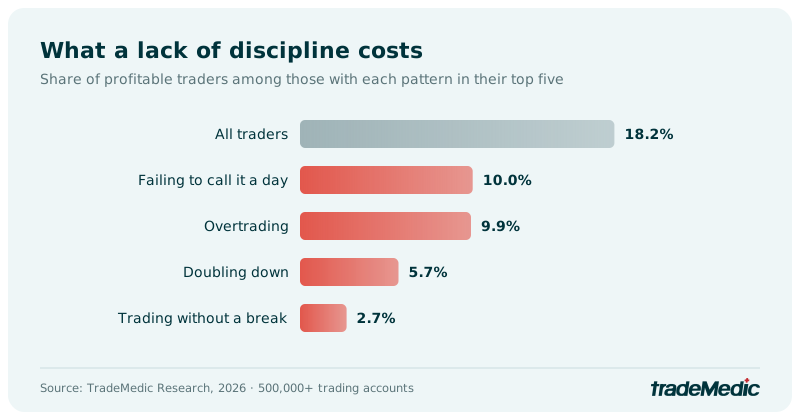
What these patterns have in common is that none of them is a single bad decision. Each one is a way for one bad trade to turn into many. Our ranking of the most common trading mistakes shows where they sit among all 23 problem patterns TradeMedic AI detects.
The data also shows the opposite side: what disciplined trading looks like when it works.
What does trading discipline look like in the data?
TradeMedic AI also detects strengths, and several of them are discipline in action. Traders who recover calmly after a loss, instead of jumping straight back into the market, are profitable 48.3% of the time. Traders who profit from their initial trade setup, without adjusting it or adding to losing positions, are profitable 42.9% of the time. Both are more than twice the 18.2% average.
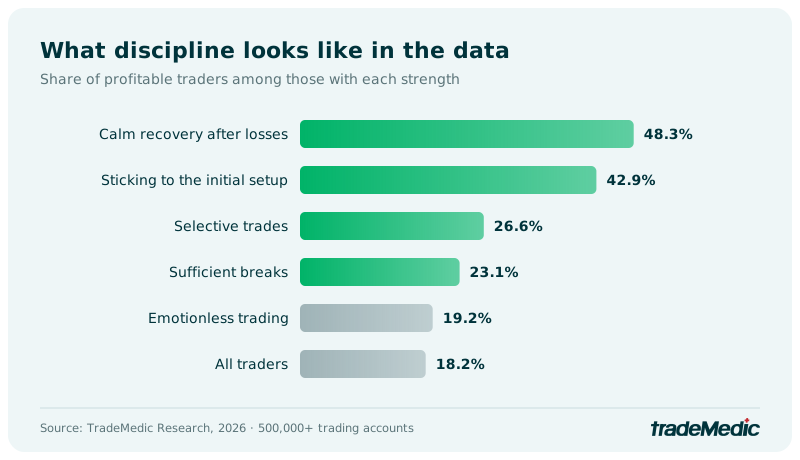
Two more strengths point the same way. Selective Trades, performing better on days with fewer trades, appears in 56.0% of profitable traders compared with 34.3% of loss-making ones. Taking sufficient breaks between trades is linked to a smaller but positive difference, at 23.1% profitable.
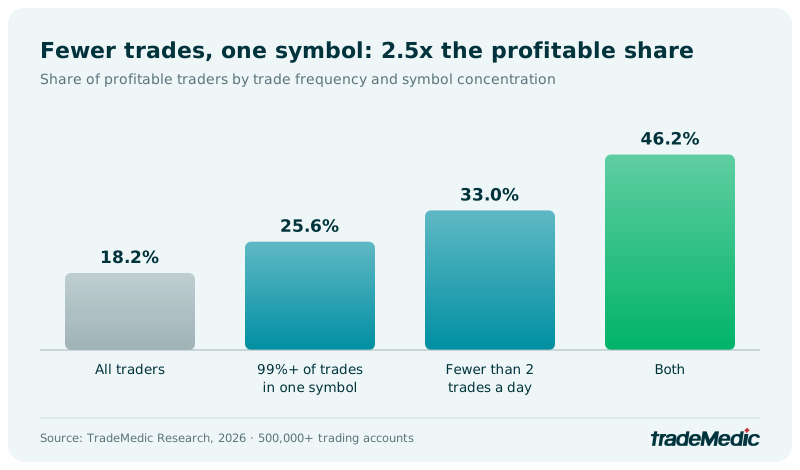
Regardless of any strengths or issues detected by TradeMedic AI, our study of one trade a day in one symbol shows how far this kind of restraint can go. Traders who place fewer than two trades on an average day are profitable 33.0% of the time. Traders who keep more than 99% of their trades in a single symbol are profitable 25.6% of the time. Traders who do both are profitable 46.2% of the time, two and a half times the average. It is a small group, fewer than 0.5%, and more than half of them (53.8%) still lost money: that shows restraint removes many of the ways to lose an edge, but it does not create one.
One result is worth noting. Emotionless trading, performing well regardless of the profit or loss in other open positions, is linked to a profitability rate of 19.2%, barely above average. Staying calm is not enough on its own. Discipline shows up most clearly in what traders do after a loss and in how they treat their original plan, not in how they feel.
If discipline is a set of behaviours, the next question is why so many traders struggle to keep them up.
Why self-discipline in trading is so hard: the psychology
Willpower is less reliable than it feels. For years, psychologists described self-control as a muscle that gets tired with use, a theory known as ego depletion. In 2016, a large replication across 23 laboratories and 2,141 participants, led by Martin Hagger and Nikos Chatzisarantis, found an effect close to zero. The debate continues, and the original authors dispute the replication. But the practical lesson for traders is the same either way: a plan that depends on having enough willpower at the worst moment is a fragile plan.
Disciplined people face fewer temptations, not stronger ones. In an experience-sampling study, Wilhelm Hofmann and colleagues collected 7,827 reports of everyday desires from 205 adults. People with higher self-control reported fewer conflicts between their desires and their goals. They were not resisting harder. They were putting themselves in situations that needed less resistance. For traders, that means closing the platform after the daily limit, turning off alerts that invite impulse trades and not watching a losing position tick by tick.
Strong emotional reactions hurt performance, on both sides. In the same study of 80 day traders, Lo and his colleagues found that traders whose emotional reactions to gains and losses were more intense performed significantly worse, and this applied to the highs as well as the lows. That is why emotional discipline in trading is not about suppressing fear after a loss. It is about keeping both euphoria and frustration from changing the plan.
If willpower in the moment is unreliable, the answer is to make the decisions before the moment arrives.
Trading discipline rules that work
Turn goals into if-then rules. Psychologists Peter Gollwitzer and Paschal Sheeran reviewed 94 studies of what they call implementation intentions: plans in the form "if situation X occurs, then I will do Y". These plans had a medium-to-large effect on reaching goals, including helping people disengage from courses of action that were failing. Trading rules work best in exactly that form: if I lose 2% today, then I stop trading for the day. If a trade hits my stop, then I close it without moving the stop. If I have taken three trades, then I take no more until tomorrow.
Set budgets in advance. Research by Chip Heath found that people escalate commitment mainly when they have not set a budget, as we cover in our article on the sunk cost fallacy in trading. In trading, that means a maximum position size and a maximum daily loss, decided before the session starts.
Let orders enforce the rules. In a laboratory experiment by Urs Fischbacher and colleagues, automatic stop-loss and take-profit orders reduced harmful exit behaviour, while reminders did not, as covered in our article on the disposition effect. A rule in a notebook asks you to make the hard decision in the moment. An order in the market makes it for you.
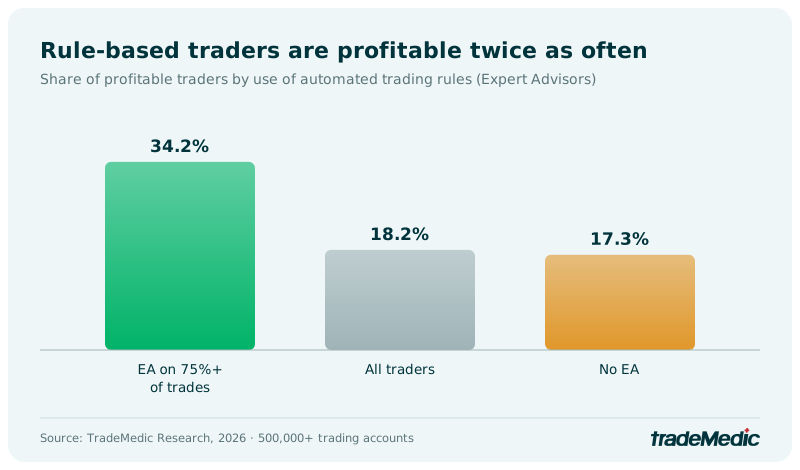
The data points the same way. Traders who run more than 75% of their trades through automated rules, known as Expert Advisors, are profitable 34.2% of the time, compared with 17.3% for traders who never use them. Traders who build rule-based systems are likely to differ in other ways too, so this is an association rather than proof. But it shows how closely consistent, rule-based execution is linked to better results.
Five trading discipline rules to start with. Each one is written as an if-then rule, so the decision is made before the moment arrives:
1. If I lose 2% of my account today, I stop trading until tomorrow.
2. If a trade hits my stop loss, I close it. I never move the stop further away.
3. If a position is losing, I do not add to it.
4. If I close a losing trade, I wait 30 minutes before opening the next one.
5. If I have reached my maximum number of trades for the day, I close the platform.
The exact numbers should fit your own strategy and history. Every rule above can be checked against your own trade history with TradeMedic AI: whether you stopped after a bad day, whether you added to losers, how your results changed after a loss.
Rules only help if you keep following them, which is where most traders get stuck.
How to stick to your trading plan
Fix one pattern at a time, with one rule. A daily trade cap for overtrading, a maximum position size for doubling down, a daily loss stop for failing to call it a day, a fixed pause after every losing trade. One clear rule for your costliest pattern is easier to follow than a list of good intentions.
Expect it to take weeks, not days. In a study of habit formation by Phillippa Lally and colleagues, new daily behaviours took anywhere from 18 to 254 days to become automatic. Missing a single day did not materially set the process back. For traders, that means a broken rule is not a reason to give up on it. What matters is returning to it the next session.
Review after a set number of trades, not after every loss. Give each rule 50 to 100 trades before judging it. Short-term results are noisy, and changing rules after every bad day is itself a form of indiscipline and outcome bias.
Measure the behaviour, not just the result. A profitable week can hide broken rules, and a losing week can follow good ones. A trading journal helps, but most journals record trades, not behaviour. Track whether you followed each rule, separately from your profit and loss.
That last step is the hardest to do by hand, because most traders never log their behaviour, only their trades. The good news is that the behaviour is already in the trade history. You do not need a trading journal to find it: TradeMedic AI retrieves your trades automatically from your MT4 or MT5 account, shows which discipline patterns and strengths appear in your trading and what they cost or earn you, and keeps tracking them over time, so you can see whether a new rule is working.
The bottom line on trading discipline
Trading discipline is less a personality trait than a set of behaviours, and the data shows how much they matter: among traders whose biggest issues include trading without breaks, 2.7% are profitable, while among traders who recover calmly after a loss, 48.3% are. The research is clear that willpower in the moment is an unreliable way to get there. What works is deciding in advance: if-then rules, budgets set before the session, orders that enforce them, and a review of your behaviour rather than just your results.
→ Learn more about TradeMedic AI
→ See your own discipline patterns: connect your trading account to TradeMedic AI free
Research behind this article
Lo, A. W., Repin, D. V., and Steenbarger, B. N. (2005). Fear and Greed in Financial Markets: A Clinical Study of Day-Traders. American Economic Review, 95(2), 352 to 359.
Hagger, M. S., Chatzisarantis, N. L. D., et al. (2016). A Multilab Preregistered Replication of the Ego-Depletion Effect. Perspectives on Psychological Science, 11(4), 546 to 573.
Hofmann, W., Baumeister, R. F., Förster, G., and Vohs, K. D. (2012). Everyday Temptations: An Experience Sampling Study of Desire, Conflict, and Self-Control. Journal of Personality and Social Psychology, 102(6), 1318 to 1335.
Gollwitzer, P. M., and Sheeran, P. (2006). Implementation Intentions and Goal Achievement: A Meta-Analysis of Effects and Processes. Advances in Experimental Social Psychology, 38, 69 to 119.
Heath, C. (1995). Escalation and De-escalation of Commitment in Response to Sunk Costs: The Role of Budgeting in Mental Accounting. Organizational Behavior and Human Decision Processes, 62(1), 38 to 54.
Fischbacher, U., Hoffmann, G., and Schudy, S. (2017). The Causal Effect of Stop-Loss and Take-Gain Orders on the Disposition Effect. The Review of Financial Studies, 30(6), 2110 to 2129.
Lally, P., van Jaarsveld, C. H. M., Potts, H. W. W., and Wardle, J. (2010). How Are Habits Formed: Modelling Habit Formation in the Real World. European Journal of Social Psychology, 40(6), 998 to 1009.
TradeMedic Research (2026). Behavioural pattern analysis of 500,000+ retail trading accounts. Source: TradeMedic Research, 2026.
Frequently asked questions
Can trading discipline be learned?
Yes. A study of 80 day traders by Andrew Lo and colleagues found no specific trader personality that predicted success, which suggests that different personality types can learn to trade well. In TradeMedic AI data, discipline shows up as behaviours, such as recovering calmly after a loss, which can be practised and measured.
How long does it take to build trading discipline?
Longer than most traders expect. In a study of habit formation, new daily behaviours took between 18 and 254 days to become automatic, and missing a single day did not materially set the process back. Giving each trading rule at least 50 to 100 trades before judging it is a realistic minimum, and tracking it over that period, for example with TradeMedic AI, shows whether the new behaviour is holding.
How can I improve my trading discipline?
Replace general intentions with specific if-then rules, such as stopping for the day after a set loss, and set position-size and daily-loss budgets before each session. Use real stop-loss orders rather than alerts, and track whether you followed each rule separately from your results. TradeMedic AI does this from your trade history, so you do not need a trading journal to start.
What is emotional discipline in trading?
Emotional discipline in trading means not letting strong feelings about wins or losses change the plan. Research on day traders found that those with more intense emotional reactions to both gains and losses performed significantly worse, so it applies to euphoria after a win as much as frustration after a loss. In TradeMedic AI data, traders who recover calmly after a loss are profitable 48.3% of the time.
How do you become a consistent trader?
Consistency comes from repeating the same process, not from getting the same results every week. Trade a defined setup, keep risk per trade and per day fixed, follow the same rules after wins and losses, and review your behaviour over at least 50 to 100 trades rather than day by day. TradeMedic AI shows whether your behaviour is consistent across your trade history, not just your results.
Do automated trading systems improve discipline?
They can, because they execute rules without hesitation. In TradeMedic AI data from 500,000+ trading accounts, traders who run more than 75% of their trades through Expert Advisors are profitable 34.2% of the time, against 17.3% for traders who never use them. This is an association, not proof, since systematic traders may differ in other ways too.
Is discipline more important than a trading strategy?
Both matter, but discipline decides whether a strategy's edge ever reaches the account. A strategy with a positive edge still loses money if traders move stops, add to losers or keep trading after a bad day. In TradeMedic AI data, traders who profit from their initial setup without adjusting it are profitable 42.9% of the time.