Category:
 Author:
 Date:Sep 23, 2026
Trading Habits of Profitable Traders: What 500,000 Accounts Show
Most trading advice about habits is opinion. This one is not. TradeMedic AI detects 22 strengths in trading behaviour across more than 500,000 trading accounts, which makes it possible to ask a simple question: which habits appear more often in profitable accounts than in losing ones?
The answer is not what most trading content suggests. The habits that separate winners from losers are the quiet ones: choosing conditions, trading less, staying inside the original plan and handling losses calmly. The exciting ones, catching breakouts and riding momentum, separate almost nobody. This article ranks them, explains why patience is the habit that divides traders most sharply, and names the one habit that looks like a strength but is not.
Let's start with the short version.
What habits do profitable traders have?
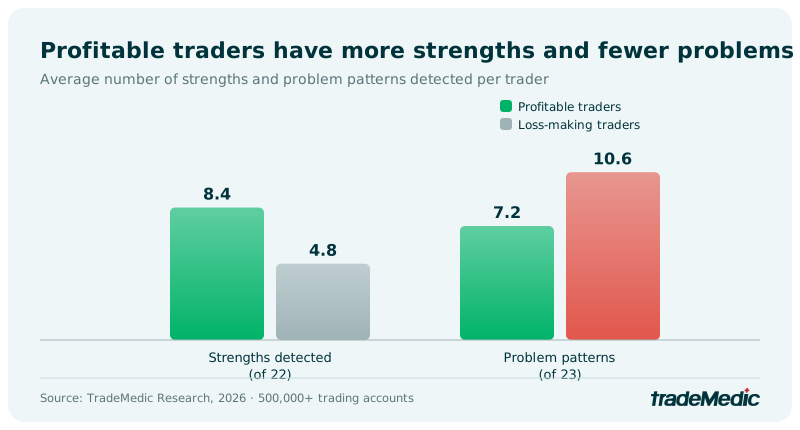
TradeMedic AI detects 22 strengths in each trader's own history, which makes them comparable across 500,000+ accounts. Profitable traders show 8.4 of those 22 strengths on average, compared with 4.8 for loss-making traders, and they show fewer problem patterns at the same time: 7.2 of 23, against 10.6. They are not free of mistakes. They have more working in their favour and less working against them.
Six habits stand out in particular, and none of them is about calling the market right more often:
1. They trade the conditions that suit them rather than every market, above all ranging and calm markets.
2. They trade selectively, taking fewer trades in fewer instruments.
3. They stay with the setup they planned, without moving stops or adding to losing positions.
4. They keep their average win larger than their average loss, instead of chasing a high win rate.
5. They recover calmly after a loss rather than trading it back.
6. They know which instruments and sessions suit them, and mostly stay there.
The clearest way to see this is to compare how often each strength appears in profitable accounts and in losing ones. Let’s look at some numbers.
The trading habits that separate winners from losers
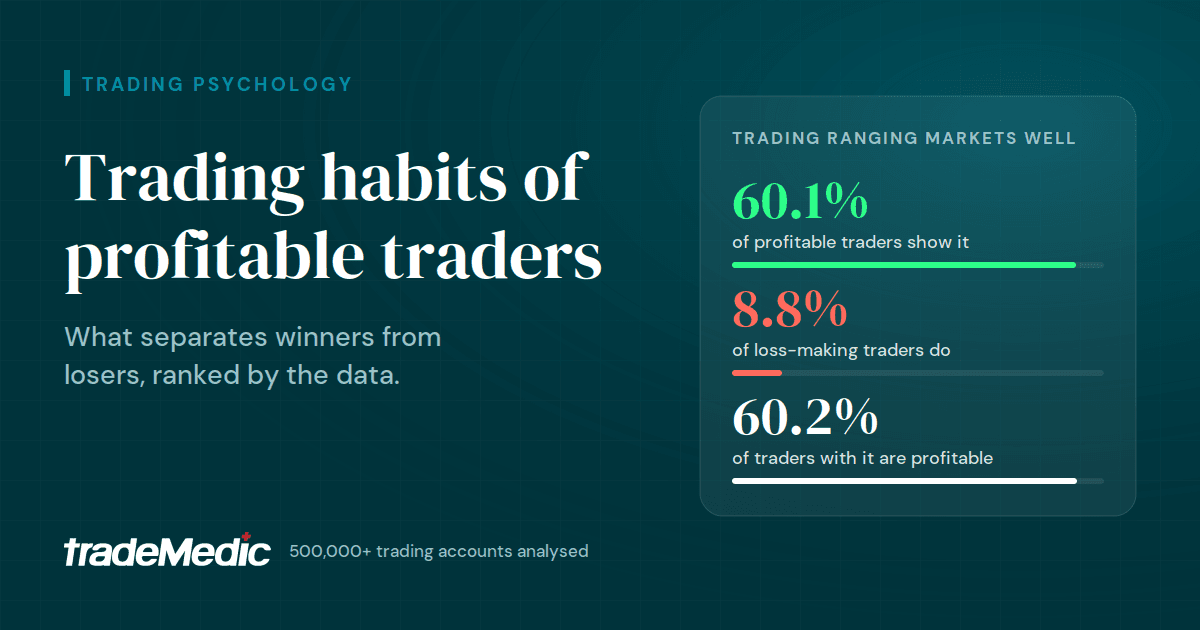
Trading ranging markets well is the single most separating habit in the data: it appears in 60.1% of profitable traders and just 8.8% of loss-making traders, a ratio of almost seven to one. Performing well in calm, low-volatility markets follows at 58.6% against 11.7%, then recovering calmly after a loss at 42.4% against 10.1%.
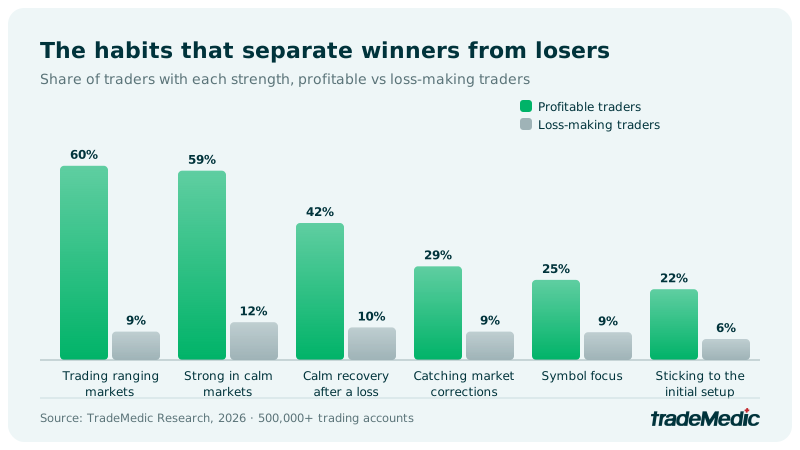
Catching market corrections appears in 29.0% of profitable traders against 8.8% of loss-makers, symbol focus in 24.8% against 8.6%, being a symbol expert, consistently strong in one instrument, in 54.5% against 32.2%, and sticking to the initial trade setup, without adjusting it or adding to losing positions, in 21.9% against 6.5%.
What these have in common is restraint rather than prediction. Each one is about knowing which conditions suit you and staying inside your own plan.
Looked at from the other direction, the same habits come with very different odds.
Which trading habits make the biggest difference to profitability?
Across all traders, 18.2% are profitable. Among traders who trade ranging markets well, 60.2% are profitable. Among those who perform well in calm markets, 52.6%. Among those who recover calmly after a loss, 48.3%.
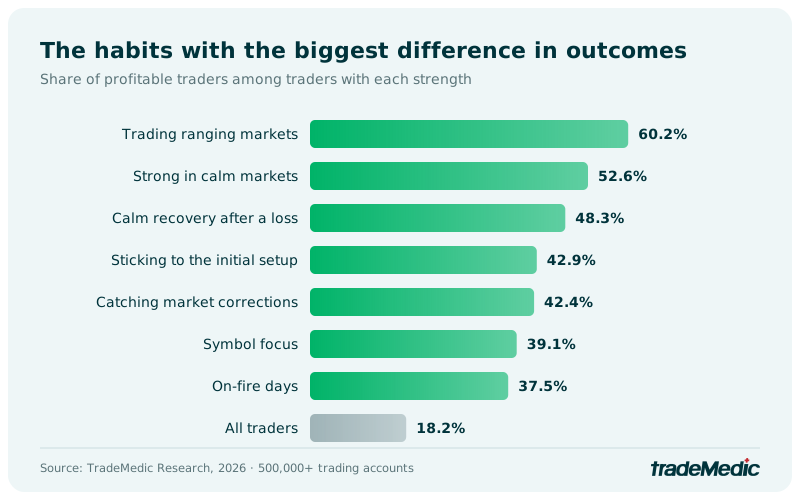
Sticking to the initial setup (42.9%), catching market corrections (42.4%), symbol focus (39.1%) and recognising on-fire days (37.5%) follow. These are associations rather than proof: a trader who is profitable for other reasons will also show more strengths. But the direction is consistent across every cut of the data. You can use TradeMedic AI to automatically check your trade history for all of these.
The next question is what these traders do differently trade by trade.
How profitable traders manage risk and reward
The clearest difference is not how often they win, but how much they win when they do. More than half of all traders (51.6%) have an average win smaller than half their average loss, and only 10.2% of them are profitable. Among traders whose average win is more than twice their average loss, 44.6% are profitable.
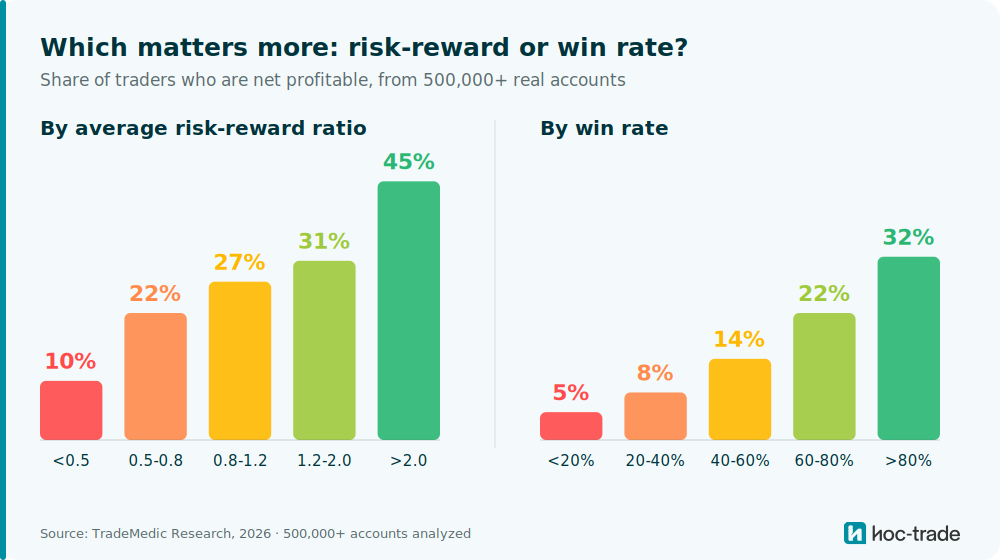
Win rate on its own says surprisingly little. 52.0% of traders win more than 60% of their trades, and only 23.7% of those traders are profitable. Our analyses of risk-reward ratio vs win rate and of the disposition effect explain why the size of wins and losses matters more than how often a trader is right. TradeMedic AI shows both numbers side by side for your own account, which is the quickest way to see whether a comfortable win rate is hiding an unprofitable balance between wins and losses.
The second difference is how much they risk. Traders whose losing trades cost them less than 0.5% of their balance on average are profitable 24.5% of the time, more than 1.5x as likely compared with 15.0% for traders averaging more than 2%. Our guide on how much to risk per trade covers the full breakdown.
How often they trade matters just as much.
How often do profitable traders trade?
Less than most people expect. Selective Trades, performing better on days with fewer trades, appears in 56.0% of profitable traders and 34.3% of loss-making ones. Taken to its extreme, the effect is striking. Traders who place fewer than two trades on an average day are profitable 33.0% of the time. Traders who keep more than 99% of their trades in a single symbol are profitable 25.6% of the time. Traders who do both are profitable 46.2% of the time.
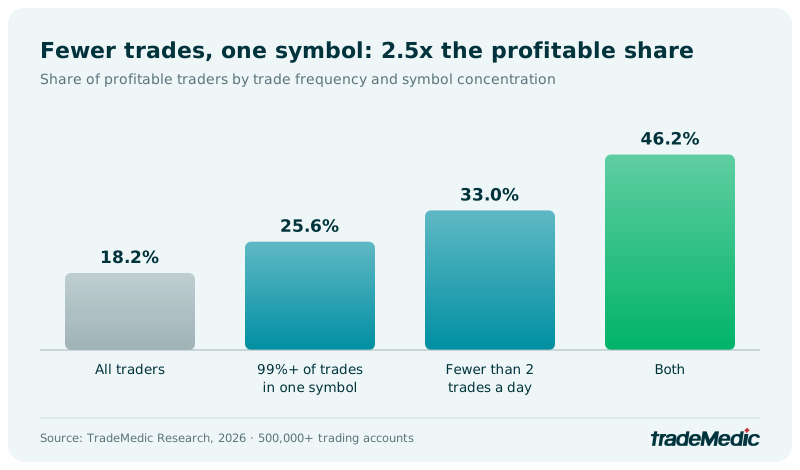
Two caveats matter here. It is a rare group, fewer than 0.5% of traders, and 53.8% of them still lost money. Trading less removes many of the ways to lose an edge, but it does not create one. The detail is in our study of one trade a day in one symbol.
What they trade also makes a difference, though less than how they trade it.
What do profitable traders trade?
TradeMedic AI records the instrument each trader trades most, so the ranking below covers the whole dataset. By main instrument, the share of profitable traders runs from 11.1% for NAS100 to 20.4% for GBPUSD, with gold at 17.7% and EURUSD at 19.2%. One instrument stands out: traders whose main pair is AUDCAD are profitable 42.2% of the time, more than twice the average. AUDCAD is a slow, range-bound pair, which fits the finding that trading ranging markets well is the most separating habit of all. It is a small group of 5,950 traders in our dataset, and a pair that has ranged in the past can start trending, so it is not a reason to switch markets. The full comparison is in our analysis of the best forex pair to trade.
Trading style shows a similar pattern: swing traders are profitable 27.5% of the time, compared with 19.3% of scalpers and 17.3% of day traders, as covered in our article on why trading is hard. Costs are part of the reason, and so is time pressure: the fewer decisions a trader has to make under pressure, the fewer chances there are to break a rule.
There is a pattern behind all of this, and it is worth naming.
Why patience is the habit that separates traders
Line the strengths up by how much they separate winners from losers and the picture is consistent. Trading ranging markets is 6.8 times more common among profitable traders than among loss-making ones. Performing well in calm, low-volatility markets is 5.0 times more common. Recovering calmly after a loss, 4.2 times. Seizing volatility is 1.4 times, riding momentum 1.2 times, and trend following 1.0 times, which is to say not at all.
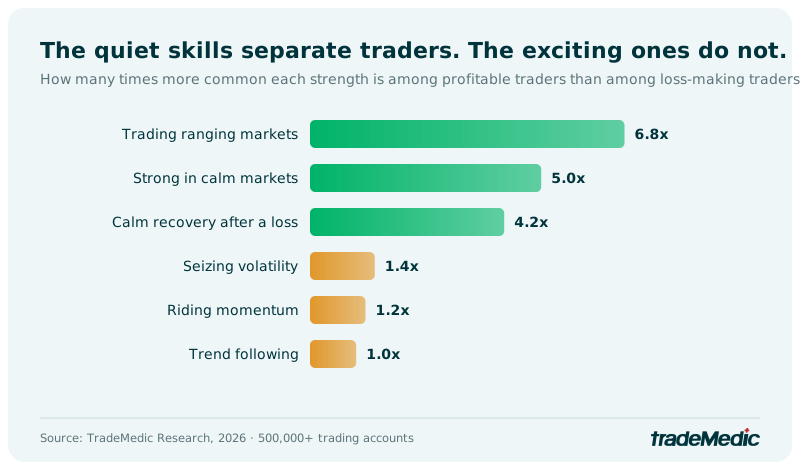
Every habit at the top of that list is a form of patience: waiting for conditions that suit you, waiting for your level instead of chasing price, waiting before trading again after a loss. Every habit at the bottom is a form of action: catching the move, riding the momentum, trading the volatility.
This runs against how trading is usually taught and sold. The content that gets attention is about big moves, breakouts and news. The behaviour that shows up in profitable accounts is the opposite, and it is duller: waiting through quiet markets, taking a defined trade between two levels, and being unremarkable about it. Trading patience is not a personality trait you either have or lack. In the data it looks like a set of choices, about which conditions to trade and how many trades to take, and those choices can be measured and changed.
Some habits, though, turn out to separate almost nobody
The trading habits that separate almost nobody
Not every strength is a differentiator. Trading at favourable times of day appears in 94.7% of profitable traders, but also in 66.2% of loss-making ones. Trading on favourable days of the week appears in 93.1% against 69.5%. Almost everyone has some hours and days that suit them better, so finding them is normal rather than an edge.
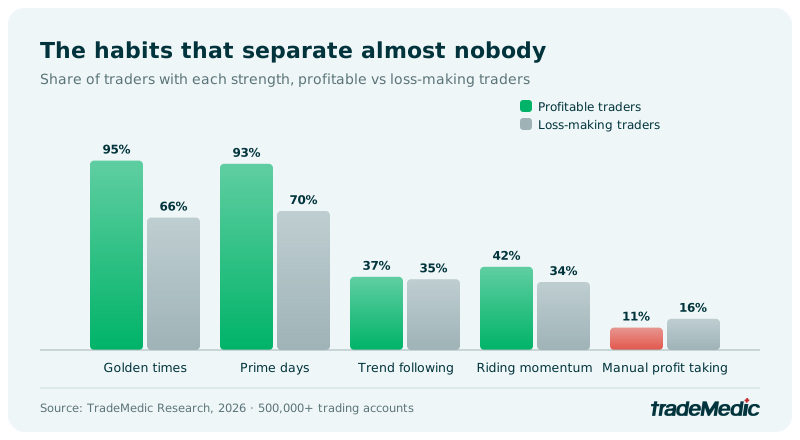
More surprisingly, the direction-based strengths barely separate the two groups either. Trend following appears in 36.6% of profitable traders and 35.4% of loss-makers, and riding momentum in 41.6% against 34.0%. Being good at following trends is common. Being good at knowing when not to trade is rare.
And one habit points the other way entirely.
The trading habit that looks good but is not
Manual profit taking, closing trades by hand in profit rather than letting a target do it, appears in 11.2% of profitable traders and 15.6% of loss-making ones. Only 13.8% of the traders who show it are profitable, below the 18.2% average. It is the only strength in the dataset that is more common among losing traders.
The likely reason is that taking profit by hand usually means taking it early. It feels disciplined, and it reliably produces winning trades, but it caps the winners that pay for the losers. That is the disposition effect in action, and it is why letting a planned target or a trailing stop do the work tends to beat closing trades on instinct. Our article on when to take profits covers the nuance.
So what does a profitable trader's routine look like, and where should you start?
How to become a profitable trader: where to start
A profitable trader's routine is unremarkable and hard to keep: trade the conditions that suit you rather than every session, take fewer trades in fewer instruments, set the stop and target before entering and leave them alone, keep risk per trade small, stop after a big loss instead of trading it back, and review your behaviour over many trades rather than day by day.
None of that requires predicting the market better than anyone else. It requires removing the behaviours that cost money, which is where our ranking of the most common trading mistakes and our article on trading discipline come in.
The last part is knowing which of these habits you already have. TradeMedic AI detects all 22 strengths and 23 problem patterns from your trade history, without needing a trading journal, and tracks them over time. Most traders find they already have two or three strengths they did not know about, alongside the patterns that cost them.
The bottom line on the habits of profitable traders
The habits that separate profitable traders from losing ones are about restraint, not prediction. Trading ranging markets well appears in 60.1% of profitable accounts and 8.8% of losing ones. Recovering calmly after a loss, sticking to the initial setup, focusing on fewer instruments and keeping average wins larger than average losses all point the same way. Meanwhile the habits most traders already have, such as trading at their best times or following trends, separate almost nobody, and taking profit by hand is more common among losers than winners.
→ Learn more about TradeMedic AI
→ See which trading habits you already have: connect your trading account to TradeMedic AI free
Research behind this article
Lo, A. W., Repin, D. V., and Steenbarger, B. N. (2005). Fear and Greed in Financial Markets: A Clinical Study of Day-Traders. American Economic Review, 95(2), 352 to 359.
TradeMedic Research (2026). Behavioural pattern analysis of 500,000+ retail trading accounts. Source: TradeMedic Research, 2026.
Frequently asked questions
What are good trading habits?
Good trading habits are the behaviours that appear far more often in profitable accounts: trading the conditions that suit you, taking fewer trades in fewer instruments, sticking to the setup you planned, keeping risk per trade small and recovering calmly after a loss. In TradeMedic AI data, trading ranging markets well appears in 60.1% of profitable traders and 8.8% of loss-making ones.
What do profitable traders do differently?
They choose conditions rather than trade everything, and they keep their average win larger than their average loss. Among traders whose average win is more than twice their average loss, 44.6% are profitable, against 10.2% of those whose average win is less than half their average loss.
What is a good trading routine?
A routine that fixes decisions in advance: trade only your defined setups, in the sessions that suit you, with a fixed risk per trade, a stop and target set before entry, a break after each losing trade, and a daily loss limit that ends the session. TradeMedic AI can show which parts of that routine you already follow in practice.
Do profitable traders win most of their trades?
Not necessarily. In TradeMedic AI data, 52.0% of all traders win more than 60% of their trades, yet only 23.7% of those traders are profitable. What separates the profitable ones is the size of their wins relative to their losses, not how often they are right.
Are successful traders born or made?
The research points to made. A study of 80 professional day traders found no trader personality profile that predicted success, and in TradeMedic AI data the habits that separate winners are measurable behaviours, such as recovering calmly after a loss, which can be practised.
Should I take profit manually or use a target?
The data favours a planned target. Manual profit taking appears in 11.2% of profitable traders but 15.6% of loss-making ones, and only 13.8% of traders who show it are profitable. Closing by hand usually means closing early, which caps the winners that pay for the losers.
Why is patience so important in trading?
Because the habits that separate profitable traders from losing ones are all forms of waiting. In TradeMedic AI data from 500,000+ trading accounts, trading ranging markets well is 6.8 times more common among profitable traders than among loss-making ones, and performing well in calm markets 5.0 times. The action-based strengths, such as riding momentum and trend following, separate the two groups barely at all.