Category:
 Author:
 Date:Sep 22, 2026
The Most Common Trading Mistakes, Ranked by 500,000 Trading Accounts
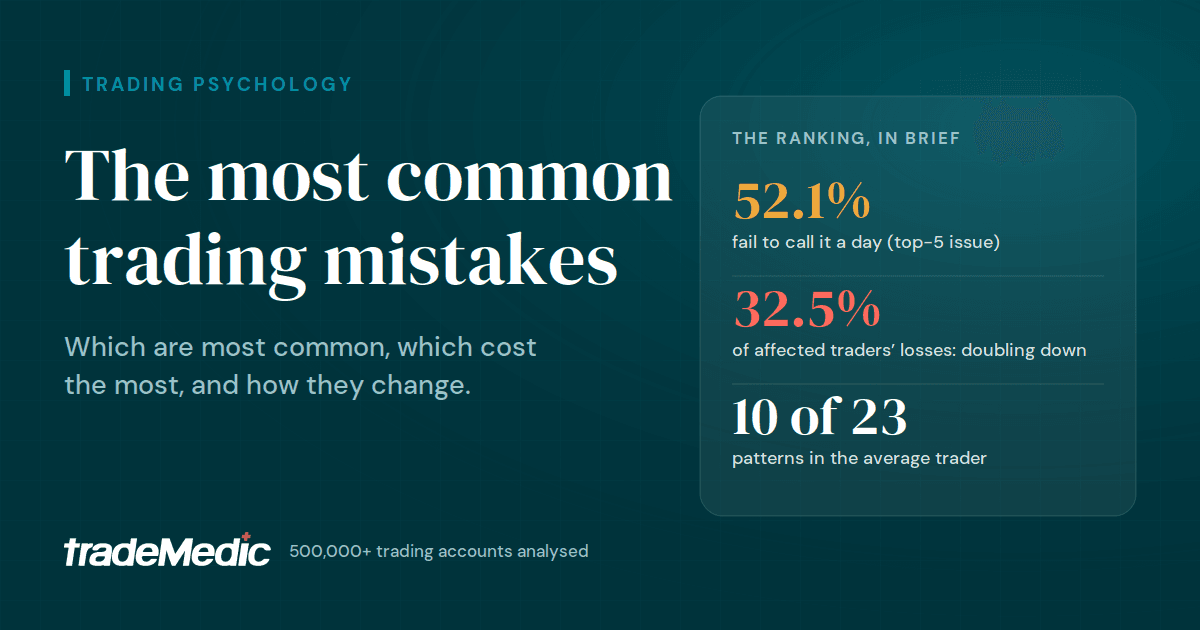
The most common trading mistakes are failing to call it a day, distracted trading, overtrading and late, FOMO-driven entries. The most costly is doubling down: adding to positions that are already losing. That is what the data from more than 500,000 trading accounts analysed by TradeMedic AI shows.
Only 18.2% of those traders are profitable, and most traders know they are making mistakes. What most do not know is which of their own habits is doing the damage.
TradeMedic AI detects 23 problem patterns in trading behaviour, from exiting too early to adding to losing positions. This article ranks them using data from those 500,000+ accounts: which trading mistakes are the most common, which cost the most, which cost upside rather than money, and which change as traders gain experience. Each mistake links to its own in-depth article.
Let's start with the mistakes that show up most often.
What are the most common trading mistakes?
The average trader in the dataset shows 10 of the 23 problem patterns. To find the ones that matter most, TradeMedic AI identifies each trader's five biggest improvement areas. These are the trading mistakes that most often appear among traders' five biggest improvement areas:
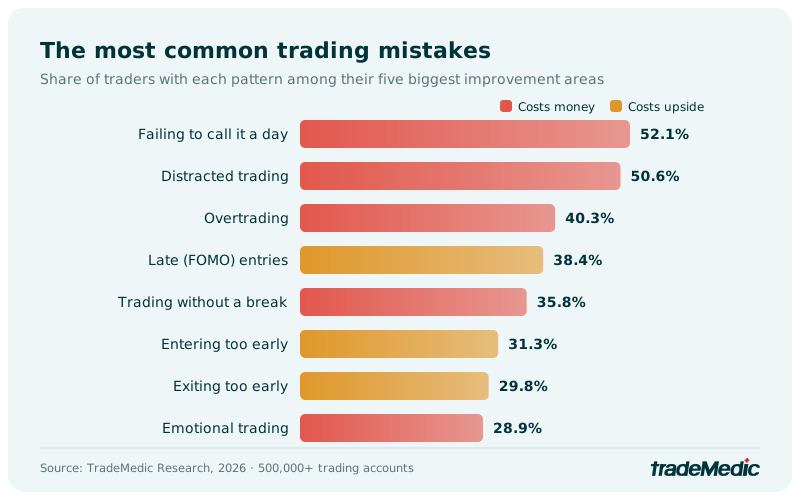
1. Failing to call it a day (52.1%). Results get worse after a large daily gain or loss because the trader keeps going instead of stopping. It is the most common top-five issue of all. Read more about failing to call it a day.
2. Distracted trading (50.6%). Results are worse at a particular time of day, often when trading alongside a day job, while commuting or while doing other things. Read more about distracted trading.
3. Overtrading (40.3%). Taking more trades than an edge can support, so that each additional trade in a day performs worse. Read more about overtrading.
4. Late, FOMO-driven entries (38.4%). Entering after a move has started, at a worse price. This is also the pattern that most often ranks as a trader's single biggest issue, for 20.7% of traders. Read more about anxious trade entries.
5. Trading without a break (35.8%). Taking trades back to back without time to reset, with worse results as a result. Read more about trading without breaks.
Close behind are entering trades too early (31.3%), exiting trades too early (29.8%) and emotional trading (28.9%), where trades opened while other positions are in large profit or loss perform worse.
Common is not the same as costly, though. Some of these mistakes drain accounts directly. Others mainly cost traders the better result they could have had.
Which trading mistakes cost the most?
TradeMedic AI measures the cost of 14 of the 23 patterns as money lost. Among traders who show each pattern, these are the ones that cause the largest share of their losses:
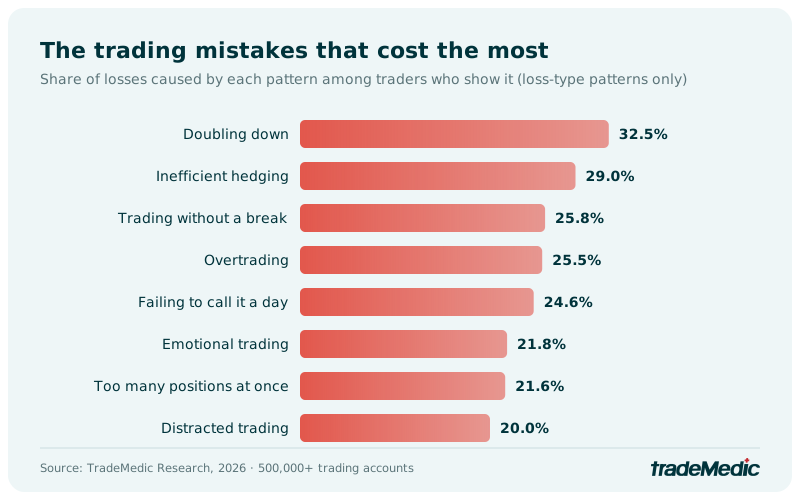
1. Doubling down (32.5% of affected traders' losses, $9,988 per trader). Adding to a position that is already losing. It is the most expensive pattern in the dataset. Read more about doubling down.
2. Inefficient hedging (29.0%, $9,404). Opening opposing positions that end up costing more than they protect. It is also the second most common single biggest issue, for 14.3% of traders. Read more about inefficient hedging.
3. Trading without a break (25.8%, $4,913). Traders who show it are also the least likely of all to be profitable: just 5.4%.
4. Overtrading (25.5%, $7,248). Each additional trade in a day performs worse than the ones before it, until the extra trades start costing money.
5. Failing to call it a day (24.6%, $5,610). Trading on after a big winning or losing day instead of stopping. It is the only mistake that is both among the most common and among the most costly.
They are followed by emotional trading (21.8%), running too many positions at once (21.6%) and distracted trading (20.0%). Each share is measured on its own group of affected traders, and most traders show several patterns at once, so the shares cannot be added up.
The rest of the loss-type patterns complete the ranking: trading around news (16.2% of affected traders' losses, $4,640 per trader), catching a falling knife (16.0%, $5,346), revenge trading (10.0%, $1,917), blindly following momentum (7.1%, $1,518), fighting the trend (6.4%, $2,565) and weekend trading (3.7%, $3,827).
The link to profitability tells the same story. Across all traders, 18.2% are profitable. Among traders who trade without breaks, it is 5.4%; among those who double down, 7.2%; among those who fight the trend, 9.8%; and among those who catch falling knives, 10.2%.
If you want to know which of these mistakes are costing you, and how much, TradeMedic AI checks your full trade history for all 23 patterns and ranks them by their impact on your results. Connect your trading account free.
Cost per trader is one way to measure damage. Another is to ask which mistakes are most common among traders who end up losing.
Which trading mistakes are most likely to wipe out an account?
Across all traders, 18.2% are profitable. Among traders who have one of these five mistakes among their five biggest improvement areas, the share of profitable traders falls far lower:
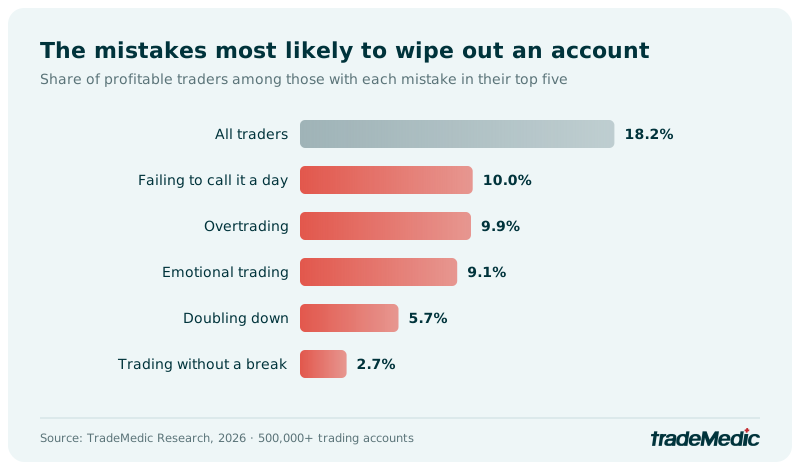
Trading without a break is the clearest account killer in the data. Among the 112,000+ traders who have it in their top five, only 2.7% are profitable, about one in 37. When it is a trader's single biggest issue, the share falls to 1.3%. Doubling down follows at 5.7%, then emotional trading (9.1%), overtrading (9.9%) and failing to call it a day (10.0%).
What these five have in common is that they all compound within a session. Trades pile up without a pause, positions are added to while they lose, and decisions are made while the day's profit and loss is running hot. None of them is a single bad trade. Each is a way for one bad trade to turn into many.
Not every mistake works this way. For traders whose biggest issues are timing mistakes that cost upside, such as entering or exiting too early, the share of profitable traders is well above average, at 33% to 37%. One plausible reason is that when a trader's five biggest issues are about timing, the costlier patterns are not among them. The mistakes that cost upside take the edge off good trades. The ones above destroy accounts.
The other nine patterns, the ones that cost upside, work differently.
Which trading mistakes cost you upside instead of money?
Nine of the 23 patterns are measured by comparing each trade with a simulated alternative, such as an earlier entry, a later exit or a different stop. Their cost is the better result that was available but not captured. It is a real cost, but a different kind: these mistakes take the edge off trades rather than draining the account directly, so they are never mixed into the loss ranking above.
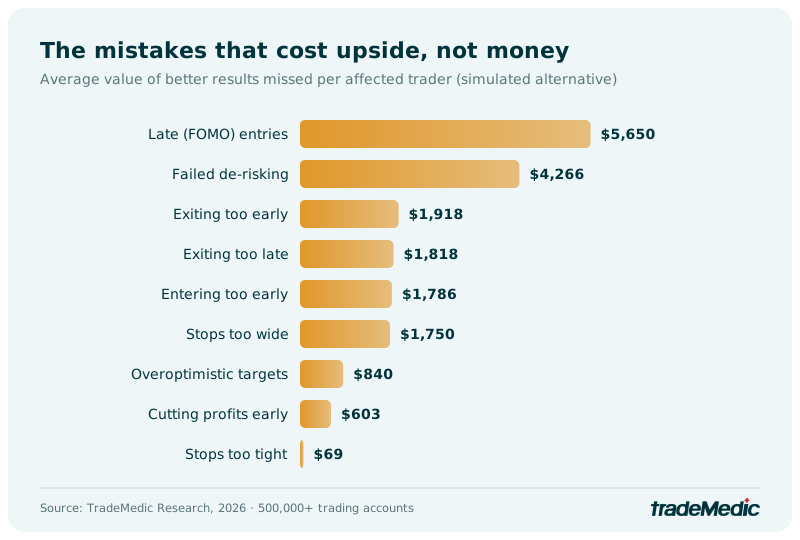
The biggest missed upside comes from late, FOMO-driven entries: $5,650 per affected trader on average. Next is failed de-risking, not moving a stop to break even once a trade is well in profit, at $4,266. The timing mistakes follow: exiting too early ($1,918), exiting too late ($1,818) and entering too early ($1,786). Then come stops that are too wide ($1,750), overoptimistic profit targets ($840), cutting profits early ($603) and stops that are too tight ($69).
For profitable traders, these are often the most useful mistakes to fix: the trading idea is right, and only the execution gives money away.
The data also shows that the mix of mistakes changes as traders gain experience.
Beginner trading mistakes vs experienced trader mistakes
Comparing accounts under 10 days old with accounts trading for 200 days or more shows a clear pattern. Beginners mostly mistime their trades. Experienced traders mostly overdo them.
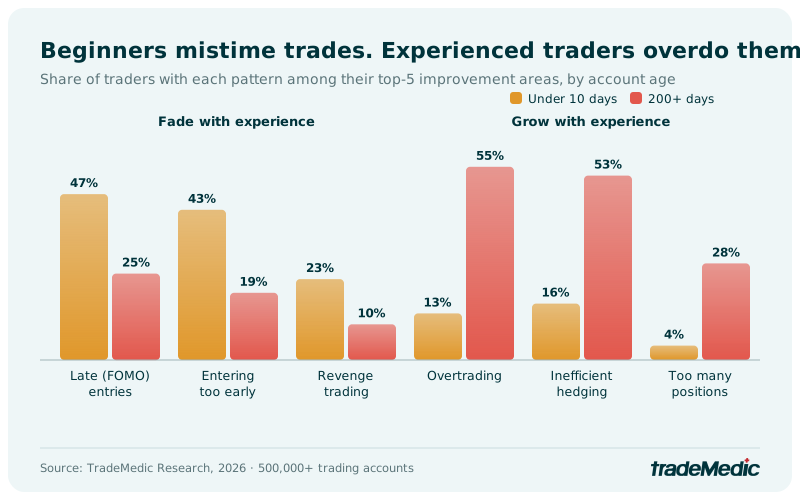
The timing mistakes fade. Late, FOMO-driven entries fall from 47.4% of new accounts' top five to 24.7% after 200 days, entering too early from 42.9% to 19.2%, and revenge trading from 23.1% to 10.2%. The volume and complexity mistakes grow. Overtrading rises from 13.3% to 55.2%, inefficient hedging from 16.1% to 52.7%, and running too many positions at once from 4.1% to 27.6%.
One plausible reading is that experience teaches traders when to act, but also gives them the confidence to act more often, with more positions and more complex strategies. The mistakes do not disappear with experience. They change shape.
Trading style shapes the mistakes too.
Which mistakes do scalpers, day traders and swing traders make?
Each trading style has its own profile of mistakes. Looking at the patterns that most often appear among traders' five biggest improvement areas shows three clearly different pictures.
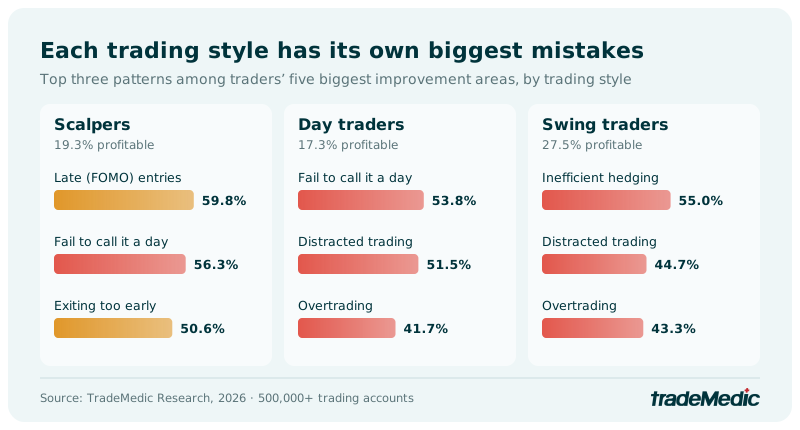
Scalpers mostly struggle with timing. Their most common top-five issues are late, FOMO-driven entries (59.8%), failing to call it a day (56.3%) and exiting too early (50.6%). At the speed scalpers trade, a moment of hesitation or impatience is enough to miss the best price, which is why three of their top five issues are about timing. 19.3% of scalpers are profitable.
Day traders mostly struggle with managing the session. Their most common top-five issues are failing to call it a day (53.8%), distracted trading (51.5%), overtrading (41.7%) and trading without a break (38.0%). These are the mistakes that build up over a trading day: too many trades, too little rest and not knowing when to stop. 17.3% of day traders are profitable.
Swing traders mostly struggle with complexity. Their most common top-five issue is inefficient hedging (55.0%), followed by distracted trading (44.7%), overtrading (43.3%) and entering too early (40.6%). Running too many positions at once is also a top-five issue for 36.3% of them. Longer holding periods leave more room for hedges and extra positions, and more time for them to go wrong. Swing traders are also the most profitable group, at 27.5%.
Many of these mistakes also share a common root.
Which emotional and psychological mistakes do traders make?
Several of the most common trading mistakes are emotional at their core. Failing to call it a day and revenge trading are reactions to wins and losses. Emotional trading means trades opened while other positions are in large profit or loss perform worse. Late entries are driven by the fear of missing out.
Behind them sit a small number of well-researched biases. Loss aversion makes losses feel bigger than gains of the same size, which drives holding losers and doubling down. The disposition effect makes traders sell winners too early and ride losers too long. The sunk cost fallacy makes money already lost a reason to risk more. And overconfidence, the tendency to overrate one's own skill, fits the mistakes that grow with experience.
Knowing the biases helps. Knowing which mistakes you personally make is what lets you fix them.
How to find and fix your biggest trading mistake
Every trader's mix of mistakes is different, and the average trader shows 10 of the 23 patterns. Trying to fix all of them at once rarely works. The most effective approach is to find the one or two that cost you the most and work on those first.
1. Rank your mistakes by cost, not by how they feel. The mistakes that feel worst, such as a painful loss, are not always the ones that cost the most over time. Look at the patterns across hundreds of trades, not the memorable ones.
2. Separate money lost from upside missed. If your biggest issues cost money, fix them first. If they mostly cost upside, your trading idea may already be working, and better execution is where the gains are.
3. Fix one pattern at a time. Pick the costliest mistake and set one clear rule for it before your next session. One rule you follow beats a list of good intentions.
The answer is already in your trade history, and you do not need to have kept a trading journal to find it. TradeMedic AI retrieves your trades automatically from your MT4 or MT5 account, gives you a snapshot of which of the 23 patterns show up in your trading and what each one costs you, whether in money or in missed upside, and keeps tracking them over time, so you can see whether your fixes are working.
The bottom line on trading mistakes
The most common trading mistakes are failing to call it a day, distracted trading, overtrading and late, FOMO-driven entries. The most costly are doubling down, inefficient hedging, trading without breaks and overtrading. Beginners mostly mistime their trades, while experienced traders mostly overdo them. And the average trader shows 10 of the 23 patterns, so the biggest improvement usually comes from finding the one or two that matter most for you.
→ Learn more about TradeMedic AI
→ Find your own biggest trading mistake: connect your trading account to TradeMedic AI free
Research behind this article
TradeMedic Research (2026). Behavioural pattern analysis of 500,000+ retail trading accounts. Source: TradeMedic Research, 2026.
Frequently asked questions
What is the biggest trading mistake?
It depends on how you measure it. In TradeMedic AI data from 500,000+ trading accounts, the most common single biggest issue is entering late out of FOMO, for 20.7% of traders. The most expensive is doubling down, which causes 32.5% of the losses of the traders who do it.
How many trading mistakes does the average trader make?
The average trader shows 10 of the 23 problem patterns TradeMedic AI detects. Loss-making traders show 10.6 on average and profitable traders 7.2, so even winning traders make several mistakes. They make fewer of them, and usually less costly ones.
Do profitable traders make trading mistakes?
Yes. Profitable traders show 7.2 of the 23 problem patterns on average, compared with 10.6 for loss-making traders. Their most common issues are often timing mistakes, such as late FOMO entries, which cost upside rather than money.
What are the most common forex trading mistakes?
Most accounts in the TradeMedic dataset trade forex, gold and indices, so its ranking applies directly to forex. The most common top-five issues are failing to call it a day, distracted trading, overtrading and late entries. The most costly are doubling down, inefficient hedging and trading without breaks.
What are common crypto trading mistakes?
The same behavioural mistakes appear in crypto, often amplified by round-the-clock markets and fast moves: chasing rallies out of FOMO, overtrading and trading without breaks. The TradeMedic dataset is mostly forex, gold and indices, with 2.3% of traders trading Bitcoin as their main instrument.
What are bad trading habits?
Bad trading habits are repeated behaviours that cost money or upside over many trades, such as trading on after a big loss, taking trades without breaks, adding to losing positions or chasing moves late. Unlike single errors, they show up as patterns across a trader's history.