Category:
 Author:
 Date:Sep 18, 2026
The Disposition Effect: Why Winning Most Trades Isn't Enough
Most traders win more trades than they lose. Most traders still lose money. Those two facts sit side by side in almost every retail trading dataset, and one of the best-documented biases in behavioural finance explains how both can be true at the same time: the disposition effect.
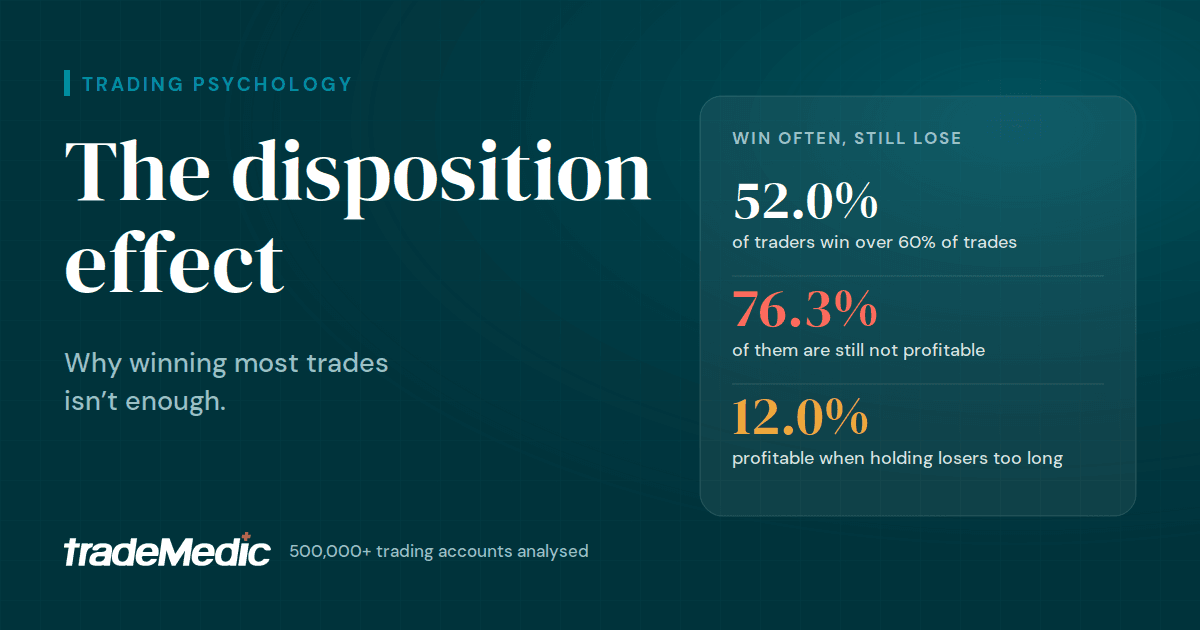
Across more than 500,000 trading accounts analysed by TradeMedic AI, 52.0% of traders win more than 60% of their trades. Yet among those traders, only 23.7% are profitable. Three in four traders who win most of their trades still end up losing money. This article explains what the disposition effect is, what decades of research show about it, what it does to real trading accounts, and how to stop it from working against you.
Let's start with what the disposition effect is.
What is the disposition effect?
The disposition effect is the tendency to sell winning positions too early and hold losing positions too long. The term was introduced by economists Hersh Shefrin and Meir Statman in 1985, in a paper titled The Disposition to Sell Winners Too Early and Ride Losers Too Long.
In practice, it means that the decision to close a trade depends less on what the market is likely to do next and more on whether the trade is currently in profit or at a loss. A winning trade gets closed to lock in the gain before it disappears. A losing trade gets held in the hope that it comes back, because closing it would turn a paper loss into a real one.
It is the opposite of the old trading rule to cut your losses and let your profits run. Almost every trader knows that rule. The disposition effect is the reason so few follow it.
A single trade shows how it plays out.
A disposition effect example in trading
A trader buys one standard lot of EURUSD, where each pip is worth about $10. The plan is sensible: a stop loss 20 pips below the entry and a profit target 40 pips above it, so a winner should make twice what a loser costs.
The trade moves 15 pips into profit, then stalls. The gain feels fragile, so the trader closes it early and books $150 instead of the planned $400. Nobody ever went broke by taking a profit, right? On the next trade, the price moves against the position and reaches the stop level. Closing now would mean accepting a $200 loss, being in an overall loss, so the trader moves the stop and waits for a recovery. The price keeps falling, and the trade is finally closed at 60 pips down, a loss of $600.
Now repeat that pattern. A trader who wins three trades out of four this way, at $150 each, makes $450 on the winners and loses $600 on the one loser. A 75% win rate, and still a net loss of $150. Nothing about the market caused that result. The exits did.
This is not a rare quirk of inexperienced traders. It is one of the most consistently documented patterns in financial research.
How common is the disposition effect? What the research shows
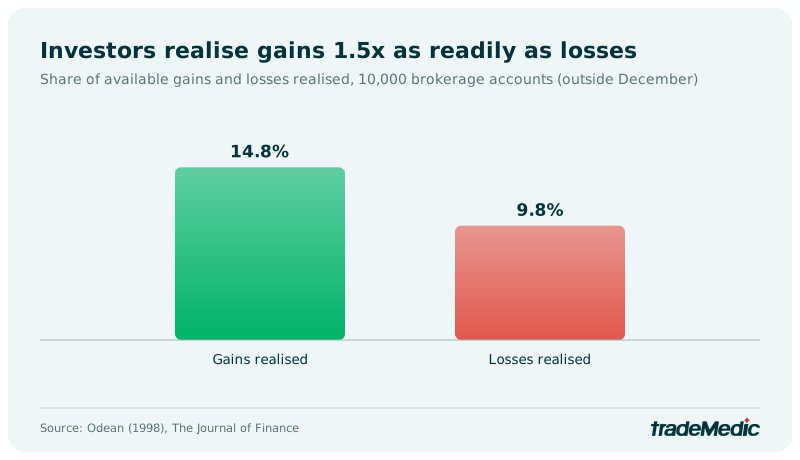
The most influential study came from Terrance Odean, who analysed the trading records of 10,000 accounts at a US discount brokerage between 1987 and 1993. Outside December, investors realised 14.8% of the gains available to them but only 9.8% of the losses, about one and a half times more likely to sell a winner than a loser. The preference was not explained by portfolio rebalancing or trading costs.
It was also costly. The winners investors sold went on to outperform the losers they kept by 3.4 percentage points over the following year. Later research has shown that part of that gap reflects momentum, the tendency of recent winners to keep rising for a while, but the conclusion holds: the trades investors chose to keep were, on average, the worse ones.
Professionals are not immune either. Peter Locke and Steven Mann studied full-time futures traders on the trading floor and found that they, too, held losing trades significantly longer than winning ones. The successful traders in their sample were the ones who showed disciplined behaviour.
Decades of research establish that the disposition effect exists. Our data shows what it looks like in today's trading accounts.
What the disposition effect does to real trading accounts
The clearest sign of the disposition effect in a trading account is a high win rate combined with a poor ratio between the size of wins and losses: many small winners, a few large losers. The data shows that combination everywhere.
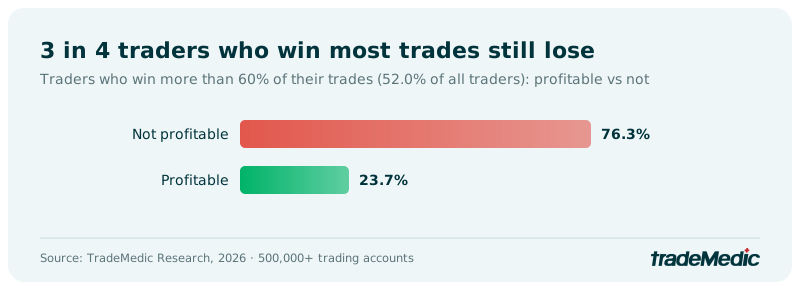
52.0% of traders in our dataset win more than 60% of their trades. Among those traders, only 23.7% are profitable, while 76.3% are not. Winning often is clearly not the same as winning overall. Not all of this is the disposition effect: some strategies produce high win rates by design, such as scalping with tight profit targets or grid systems that take many small gains. But the pattern of many small wins and a few large losses is exactly what the disposition effect creates.
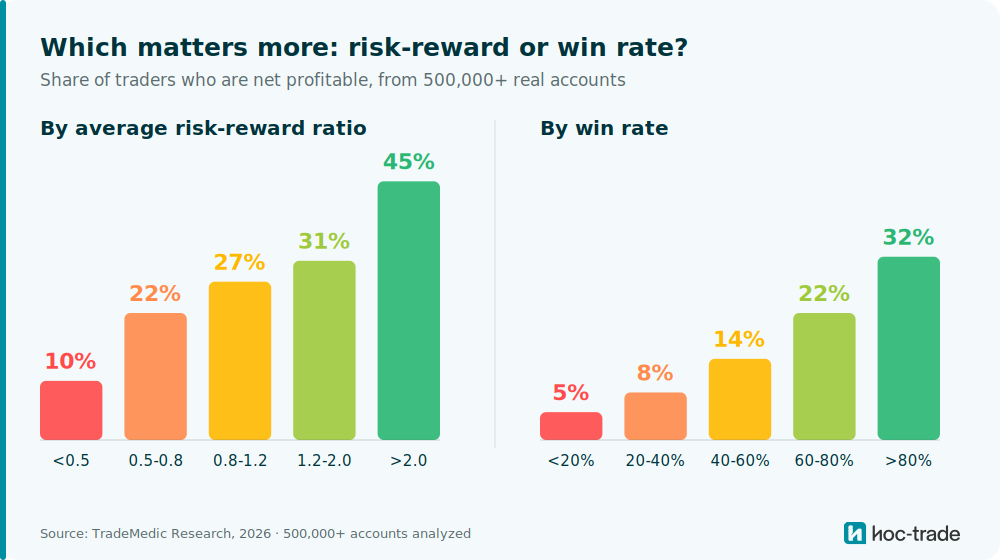
The other half of the picture is the reward-to-risk ratio, the size of the average win compared with the average loss. 51.6% of traders have an average win that is less than half their average loss, and only 10.2% of them are profitable. Among the few traders whose average win is more than twice their average loss, 44.6% are profitable. Our analysis of risk-reward ratio vs win rate shows the full breakdown, and why the size of wins and losses matters more than how often a trader wins.
If you want to see where your own trading sits on both measures, TradeMedic AI calculates your win rate and your reward-to-risk ratio from your full trade history, and shows which exit patterns are driving them. Connect your trading account free.
The disposition effect has two halves, and they are not equally harmful.
Which half costs more: cutting winners or riding losers?
TradeMedic AI detects both sides of the disposition effect separately, and the difference in results between them is striking.
On the winning side, traders who tend to close winners too early are profitable 20.3% of the time, slightly above the 18.2% average across all traders. Closing trades too early leaves money on the table, but it rarely destroys an account on its own. Cutting profits early, the more specific pattern of manually closing trades that would have gone on to hit their target, is a cost of a different kind: it is upside left on the table, not money lost. The profit these traders give up by closing early is equivalent to 2.7% of their losses.
On the losing side, the picture changes. Traders who tend to hold losing trades too long, waiting for a reversal, are profitable only 12.0% of the time. And the most active form of riding losers, adding to them, is the most expensive pattern in the entire dataset: traders who double down are profitable just 7.2% of the time, and it causes 32.5% of their losses.
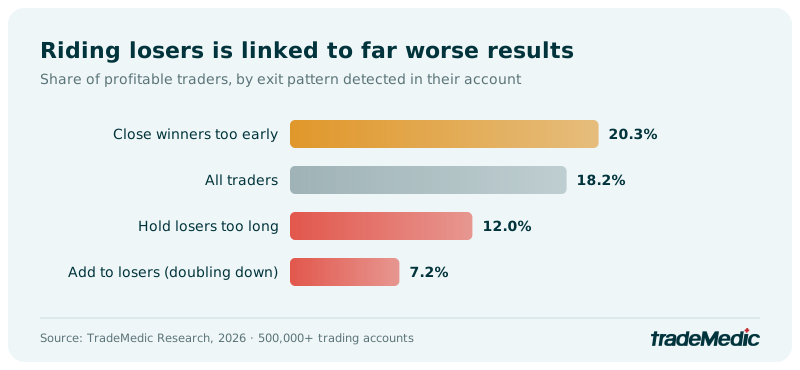
These are associations, not proof of cause and effect: traders who close winners early may differ in other ways too. But the direction is clear. The data suggests both halves of the disposition effect hurt, and that holding on too long is linked to far worse results than closing too early. Anxious trade exits and failing to cut losses are where most of the damage happens.
The market a trader chooses can change how expensive this habit is. Holding a loser only pays off if the price comes back, and some markets come back more often than others. AUDCAD, a slow, range-bound pair that tends to revert to its average, is the clearest example in our data. Traders whose main pair is AUDCAD are profitable 42.2% of the time, more than twice the 18.2% average. One plausible explanation is that on a pair that tends to revert, the natural urge to wait for a losing trade to recover is punished far less often than elsewhere.
Our data cannot prove that link, and it is a small group of 5,950 traders. It is also not a reason to switch pairs. A market that has reverted in the past can start trending, and then the same habit becomes as expensive as anywhere else. The more reliable fix is to change the habit, not the market. We cover the full comparison in our analysis of the best forex pair to trade.
Why would anyone keep making a mistake that costs so much? The answer lies in how the brain treats gains and losses.
Why traders sell winners too early and hold losers too long
Losses loom larger than gains. The starting point is prospect theory, developed by Daniel Kahneman and Amos Tversky: people feel a loss more strongly than a gain of the same size, and they become more willing to take risks when facing a certain loss. Closing a winner locks in a gain that could disappear, so it feels safe. Closing a loser locks in a loss that could still be avoided, so it feels premature. Our article on loss aversion covers this bias in depth. That said, research by Nicholas Barberis and Wei Xiong has shown that prospect theory alone does not fully explain the disposition effect, which is why the next two mechanisms matter.
The entry price becomes the reference point. Traders judge a position by where they entered, not by where the market is likely to go next. A trade below its entry price feels like a loss waiting to be repaired, even though the entry price has no influence on the market's next move. The market does not know where you bought.
Closing a winner feels good in itself. Researchers Cary Frydman, Nicholas Barberis, Colin Camerer, Peter Bossaerts and Antonio Rangel scanned the brains of participants while they traded in a lab experiment. Participants showed a strong disposition effect, even though it was not the best strategy. When they sold a stock at a gain, activity rose in the ventral striatum, a key part of the brain's reward system. The act of realising a gain was rewarding on its own, separate from the money. Economists call this realisation utility. Closing a losing trade offers no such reward, only the admission that the trade did not work.
None of this is a character flaw. It is how people are wired to handle wins and losses. That is also why good intentions alone rarely fix it.
It helps to know how the disposition effect relates to two other biases it is often confused with.
Disposition effect vs loss aversion vs sunk cost fallacy
The three are closely related, but each describes a different part of the problem. Loss aversion is the underlying feeling: losses hurt more than equal gains feel good. The disposition effect is what that feeling does to exits: winners closed early, losers held too long. The sunk cost fallacy is what it does to commitment after entry: continuing or adding to a position because of what has already been invested in it, rather than because of what it is likely to do next.
In trading, the three often appear together. A trader who feels a loss more strongly (loss aversion) holds the losing trade (disposition effect) and then adds to it to justify the original decision (sunk cost). Understanding which one is at work makes it easier to pick the right fix.
The good news is that the disposition effect is one of the few biases with a well-tested remedy.
How to overcome the disposition effect
There is good news here. In a review of the research, Markku Kaustia of Aalto University concluded that household investors are more affected than professionals, and that investors can learn to avoid the disposition effect. These steps are where that learning starts.
1. Decide your exits before you enter. Set the stop loss and the profit target when you open the trade, while you are thinking about the setup rather than about your P&L. Once the trade is open, the disposition effect starts working on every decision. If you want to let winners run rather than cap them at a fixed target, a trailing stop does both jobs: it follows the price as the trade moves in your favour and protects the gain without forcing an early exit.
2. Use real orders, not reminders. In a laboratory experiment by Urs Fischbacher, Gerson Hoffmann and Simeon Schudy, investors who could place automatic stop-loss and take-gain orders showed a significantly smaller disposition effect. Investors who only received a reminder when their planned limit was hit showed no improvement. Earlier experiments by Martin Weber and Colin Camerer pointed the same way: when positions were closed automatically, the effect was greatly reduced. A price alert asks you to make the hard decision in the moment. A stop-loss order makes it for you. Our article on trading without a stop loss explains why this single rule matters so much.
3. Judge your trading by reward-to-risk, not win rate. A high win rate feels reassuring, but as the data shows, it is a poor guide to profitability. Track the size of your average win against your average loss. If your average win is less than half your average loss, the disposition effect is almost certainly part of the reason.
4. Ask whether you would open the trade today. For a losing position, ask: if I had no position, would I open this trade now, at this price? If the answer is no, the only reason to keep it is the entry price, and the market does not care about that.
5. If you must err, the data points towards closing early. Traders who close winners too early are far more likely to be profitable than traders who hold losers too long. That does not prove one causes the other, but both are mistakes, and the data suggests they are not equally expensive.
6. Review winners and losers separately. Compare how long you hold winning trades with how long you hold losing ones, and how far you let each run. If losers consistently run further and longer, you have found the disposition effect in your own trading.
The last step is the one most traders never do, because it needs a full breakdown of their trade history.
How TradeMedic AI detects the disposition effect
TradeMedic AI does not look for the disposition effect as a single label. It measures both halves separately from each trader's own history. On the winning side, it checks whether trades closed manually in profit would have gone on to reach their take profit, and whether exits consistently come too early. On the losing side, it checks whether traders wait too long to exit, hoping for a reversal, and whether they add to positions that are already losing. It also calculates win rate and reward-to-risk ratio, so a trader can see whether a high win rate is hiding a poor balance between wins and losses.
The result shows which half of the disposition effect is present, how often it happens, and what it costs in dollars, compared with 500,000+ other traders.
The bottom line on the disposition effect
The disposition effect explains one of the most puzzling facts in trading: how most traders can win most of their trades and still lose money. It pushes traders to close winners early and hold losers long, and the data shows that the second half is by far the more expensive one. Decades of research, from Odean's 10,000 accounts to brain-imaging studies, show that it is a deeply human tendency. The most effective fix is also one of the simplest: decide your exits before you enter, and let real orders carry them out.
→ Learn more about TradeMedic AI
→ Check your own exits: connect your trading account to TradeMedic AI free
Research behind this article
Shefrin, H., and Statman, M. (1985). The Disposition to Sell Winners Too Early and Ride Losers Too Long: Theory and Evidence. The Journal of Finance, 40(3), 777 to 790.
Odean, T. (1998). Are Investors Reluctant to Realize Their Losses? The Journal of Finance, 53(5), 1775 to 1798.
Locke, P. R., and Mann, S. C. (2005). Professional Trader Discipline and Trade Disposition. Journal of Financial Economics, 76(2), 401 to 444.
Kahneman, D., and Tversky, A. (1979). Prospect Theory: An Analysis of Decision under Risk. Econometrica, 47(2), 263 to 291.
Barberis, N., and Xiong, W. (2009). What Drives the Disposition Effect? An Analysis of a Long-Standing Preference-Based Explanation. The Journal of Finance, 64(2), 751 to 784.
Frydman, C., Barberis, N., Camerer, C., Bossaerts, P., and Rangel, A. (2014). Using Neural Data to Test a Theory of Investor Behavior: An Application to Realization Utility. The Journal of Finance, 69(2), 907 to 946.
Weber, M., and Camerer, C. F. (1998). The Disposition Effect in Securities Trading: An Experimental Analysis. Journal of Economic Behavior and Organization, 33(2), 167 to 184.
Fischbacher, U., Hoffmann, G., and Schudy, S. (2017). The Causal Effect of Stop-Loss and Take-Gain Orders on the Disposition Effect. The Review of Financial Studies, 30(6), 2110 to 2129.
Kaustia, M. (2010). Disposition Effect. In H. K. Baker and J. R. Nofsinger (eds.), Behavioral Finance: Investors, Corporations, and Markets. Wiley.
TradeMedic Research (2026). Behavioural pattern analysis of 500,000+ retail trading accounts. Source: TradeMedic Research, 2026.
Frequently asked questions
What is the disposition effect?
The disposition effect is the tendency to sell winning positions too early and hold losing positions too long. It was named by Hersh Shefrin and Meir Statman in 1985 and is one of the most consistently documented biases in behavioural finance. In TradeMedic AI data from 500,000+ trading accounts, 52.0% of traders win more than 60% of their trades, yet only 23.7% of them are profitable.
What is an example of the disposition effect?
A trader closes a winning EURUSD trade at a $150 profit instead of the planned $400, then holds a losing trade past its stop and closes it at a $600 loss. Winning three of four trades this way still produces a net loss, because the winners are cut short and the loser is allowed to run.
Why does the disposition effect happen?
Losses feel stronger than gains of the same size, traders anchor on their entry price, and closing a winner is rewarding in itself. A lab brain-imaging experiment found that realising a gain activates the brain's reward system, while closing a loser means admitting the trade did not work.
How common is the disposition effect?
Very common. In Odean's study of 10,000 brokerage accounts, investors realised 14.8% of available gains but only 9.8% of available losses. Across 500,000+ trading accounts analysed by TradeMedic AI, 52.0% of traders win more than 60% of their trades, yet only 23.7% of them are profitable.
How does the disposition effect affect win rate?
It pushes win rate up and profitability down. Closing winners early produces many small wins, while holding losers produces a few large losses. The result is a high win rate combined with an average win that is much smaller than the average loss.
Is the disposition effect the same as loss aversion?
No. Loss aversion is the underlying feeling that losses hurt more than equal gains feel good. The disposition effect is the trading behaviour it helps produce: closing winners early and holding losers too long.
What does cut your losses and let your profits run mean?
It is a classic trading rule: close losing trades quickly and give winning trades room to reach their full potential. The disposition effect is the natural tendency to do the opposite.
Which is worse, cutting winners early or holding losers too long?
Holding losers is linked to far worse results. In the TradeMedic data, traders who close winners too early are profitable 20.3% of the time, slightly above average, while traders who hold losers too long are profitable only 12.0% of the time.
Is the disposition effect common in forex trading?
Yes. Most accounts in the TradeMedic dataset trade forex, gold and indices, and the typical disposition pattern is widespread among them: 52.0% of traders win more than 60% of their trades, yet only 23.7% of those traders are profitable. Traders who hold losing trades too long, waiting for a reversal, are profitable just 12.0% of the time.
Do professional traders show the disposition effect?
Yes. Peter Locke and Steven Mann studied full-time professional futures traders and found that they also held losing trades significantly longer than winning ones. The successful traders in the sample were the ones who showed disciplined behaviour. A review by Markku Kaustia concluded that investors can learn to avoid the effect.
Do stop-loss orders help with the disposition effect?
Yes. In a 2017 laboratory experiment by Fischbacher, Hoffmann and Schudy, investors who could place automatic stop-loss and take-gain orders showed a significantly smaller disposition effect, while investors who only received reminders showed no improvement. Real orders work because they remove the decision from the moment it is hardest to make.
How can I overcome the disposition effect?
Set your stop loss and profit target before you enter, use real orders rather than alerts, judge your trading by reward-to-risk rather than win rate, and ask whether you would open a losing trade today at the current price. Reviewing winners and losers separately shows whether the effect is present in your own trading.
What is realization utility?
Realization utility is the pleasure investors get from the act of selling an investment at a gain, separate from the money itself. A 2014 brain-imaging experiment by Frydman and colleagues found that selling at a gain activated the ventral striatum, part of the brain's reward system. It helps explain why traders close winners too early.
What is the disposition effect in finance?
In finance, the disposition effect describes investors' tendency to realise gains more readily than losses. In Terrance Odean's study of 10,000 brokerage accounts, investors realised 14.8% of available gains but only 9.8% of available losses, and the winners they sold went on to outperform the losers they kept.