Category:
 Author:
 Date:Sep 19, 2026
The Sunk Cost Fallacy in Trading: Why Traders Throw Good Money After Bad
You have already lost $400 on a trade. Closing it now would make that loss real. Adding to it, or simply waiting, keeps the hope alive that the money is not really gone. Almost every trader has felt that pull. It has a name: the sunk cost fallacy.
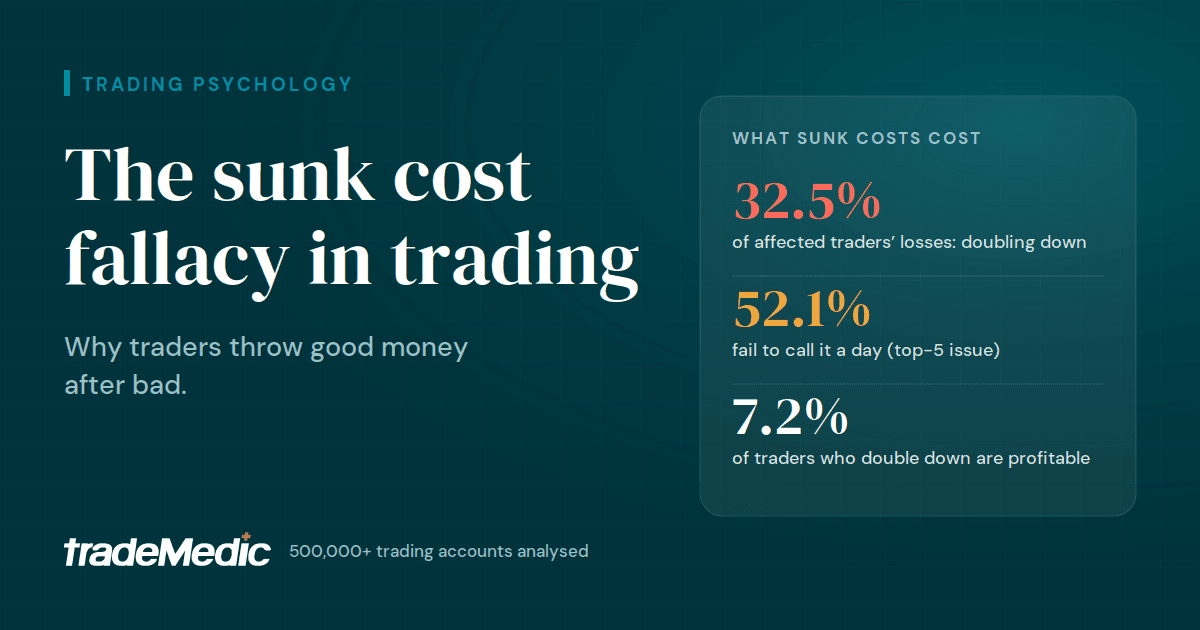
In trading, it is more than a curiosity of human psychology. The behaviours it drives sit behind some of the most expensive patterns in trading data. Across more than 500,000 trading accounts analysed by TradeMedic AI, doubling down, the clearest sunk-cost behaviour in trading, causes 32.5% of the losses of the traders who show it, more than any other pattern. And failing to call it a day, trading on after a big gain or loss instead of stopping, is the most common issue among traders' five biggest improvement areas, at 52.1%.
This article explains what the sunk cost fallacy is, what it looks like in real trading, what it costs, why it is so hard to escape, and how to protect your trading from it.
Let's start with what the sunk cost fallacy is.
What is the sunk cost fallacy?
A sunk cost is money, time or effort that has already been spent and cannot be recovered. The sunk cost fallacy is the tendency to keep investing in something because of what has already gone into it, rather than because of what it is likely to deliver from here. In everyday language, it is throwing good money after bad.
The classic demonstration comes from psychologists Hal Arkes and Catherine Blumer. At a university theatre, customers buying season tickets were randomly offered either the full price or a discount. The tickets were identical, yet those who had paid full price went to more plays in the first half of the season. Having paid more, they felt more committed to getting their money's worth.
Economist Richard Thaler brought the idea into economics in 1980, showing that people routinely let past costs shape future decisions. The fallacy is sometimes also called the Concorde fallacy, after the supersonic airliner that the British and French governments kept funding long after it was clear it would never recover its costs.
The logic is always the same: the past cost cannot be changed by anything you do next. Only the future matters. The fallacy is that it rarely feels that way.
In trading, sunk costs take several concrete forms.
Sunk cost fallacy examples in trading
The losing trade you keep adding to. A trader buys one lot of EURUSD, and the price falls 40 pips, an open loss of $400. Closing would lock in that loss, so the trader buys a second lot to bring the average price down. If the price keeps falling, every pip now costs twice as much. This is doubling down, and the $400 already lost is doing the deciding.
The day you have to win back. By midday, a trader is down $500. The plan was to stop after a loss like that, but ending the day in the red feels like wasting the whole session. So the trader keeps going, with more trades and looser setups, to get the day back to zero. This is failing to call it a day, and the sunk cost is the morning's loss. The same pattern also shows up after a big winning morning, but that side has a different driver: Thaler and Johnson found that after a gain, people become more willing to take risks, as if they were playing with the market's money. The sunk cost fallacy explains the losing side.
The analysis you cannot let go of. A trader spends hours building a case for a reversal. The market keeps moving the other way, but walking away would mean the analysis was wasted, so the trader keeps taking positions against the move. This is fighting the trend, and the sunk cost is the time and conviction invested in the idea.
The strategy you have spent months on. Months invested in a system, a course or an indicator setup make poor results easy to explain away. Switching feels like admitting the time was wasted, so the trader keeps trading it. A backtest can have the same pull. A trader spends weeks testing a strategy on historical data, and the results look convincing. Live, it keeps losing. But after all that work, "the backtest proved it works" becomes the reason to keep going, even though a backtest only shows how a strategy would have performed in the past, not how it will perform from here.
The challenge fee you have already paid. A trader buys a prop firm challenge. Days pass without a good setup, and the fee starts to feel wasted, so the trader forces trades to make the challenge count. The fee is gone either way. The only question is whether the next trade is a good one.
In each case, the decision is being made by something that has already happened. The data shows what that costs.
What the sunk cost fallacy costs traders: the data
TradeMedic AI does not detect the sunk cost fallacy as a single label, because it is a way of thinking rather than one behaviour. But three of the patterns it can drive are measured directly in every account, and all three are expensive.
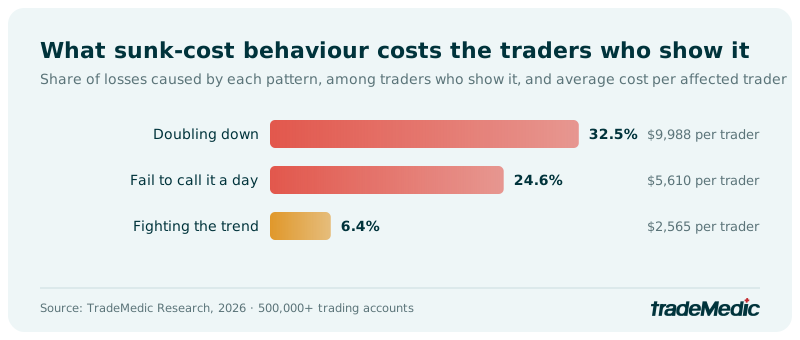
Doubling down is detected in 46.5% of traders. Among those who show it, it causes 32.5% of their losses, an average of $9,988 per trader, the largest share of any of the 23 problem patterns TradeMedic AI tracks. Failing to call it a day is detected in 75.6% of traders, and for 52.1% it is one of their five biggest improvement areas, more often than any other pattern. Among the traders who show it, it causes 24.6% of their losses, an average of $5,610. This figure covers trading on after large gains as well as large losses, so only part of it reflects sunk costs. Fighting the trend is detected in 35.8% of traders and causes 6.4% of their losses, an average of $2,565.
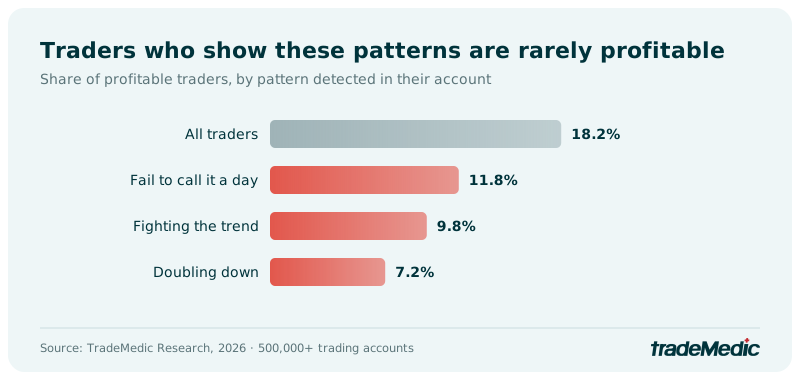
The link to profitability is just as clear. Across all traders, 18.2% are profitable. Among traders who fail to call it a day, 11.8% are profitable. Among those who fight the trend, 9.8%. Among those who double down, just 7.2%.
These patterns also tend to appear together. When doubling down is detected, fighting the trend is 40% more likely to be present as well. It is the same logic applied twice: stay with the position, and stay with the view behind it.
If you want to know which of these patterns show up in your own trading, and what each one is costing you, TradeMedic AI checks your full trade history for all of them. Connect your trading account free.
Knowing the cost is one thing. Understanding why the pull is so strong is what makes it possible to resist.
The psychology of the sunk cost fallacy: why it is so hard to escape
Sunk costs change how likely success looks. In the same research by Arkes and Blumer, people who had already invested in a project rated its chance of success higher than people who had not, even with identical information. For a trader, that means the money already lost in a trade quietly makes a recovery look more likely than it is.
Responsibility drives commitment. In a classic study by Barry Staw, 240 business students made investment decisions for a simulated company. Those who were personally responsible for an earlier decision that had gone badly committed the most money to it afterwards. Psychologists call this escalation of commitment. A trader chose the entry, and a losing trade feels like a verdict on that choice. Adding to it, or staying in the day, is a way of defending the decision.
Breaking even becomes the goal. In real-money experiments, Richard Thaler and Eric Johnson found that after a loss, options that offer a chance to get back to zero become especially attractive. The goal quietly shifts from trading well to getting back to where you started, and that shift is what keeps traders in losing positions and losing sessions.
It starts the moment you commit. For a long time, researchers thought the fallacy was uniquely human: in 1999, Hal Arkes and Peter Ayton argued there was no convincing evidence that animals commit it. A 2018 study in Science by Brian Sweis and colleagues found otherwise: mice, rats and humans all showed a similar sensitivity to sunk costs. The surprise was when it started: the sensitivity to time already invested built up only after an initial decision had been made. In trading terms, before the click you judge the setup. After the click, what you have already put in starts to weigh on every decision that follows.
The effect is robust, but not uniform. A 2015 meta-analysis of 98 effect sizes confirmed that the sunk cost effect is real, while showing that its strength varies with the type of decision. That is useful news: it means the right conditions can weaken it.
The sunk cost fallacy is closely related to two other biases, and it helps to keep them apart.
Sunk cost fallacy vs loss aversion vs the disposition effect
Loss aversion is the underlying feeling: losses hurt more than equal gains feel good. Our article on loss aversion covers it in depth. The disposition effect is what that feeling does to exits: closing winners too early and holding losers too long, covered in our article on the disposition effect. The sunk cost fallacy is what happens to commitment after entry: continuing, adding or staying in the session because of what has already been invested.
In practice, they often appear in sequence. A loss hurts (loss aversion), so the trader holds it (disposition effect), and then adds to it or keeps trading to justify what has already been spent (sunk cost fallacy). Knowing which one is at work makes it easier to choose the right defence.
The best defence against the sunk cost fallacy is well researched, and it is simpler than most traders expect.
How to avoid the sunk cost fallacy in trading
1. Set your budgets before you trade. Research by Chip Heath found that escalation of commitment happens mainly when people fail to set a budget, or when their spending is hard to track. In trading, the budget is a maximum position size per trade and a maximum loss per day, both decided before the session starts. Once the budget is spent, the decision has already been made.
2. Ask whether you would open this trade fresh. Before adding to a position or staying in a losing one, ask: if I had no position right now, would I open this trade here, at this size? If the answer is no, the only reason to stay is the money already lost.
3. Judge the day by the process, not the P&L. A losing morning is not a reason to trade the afternoon. If you have hit your daily loss limit, the right decision is to stop, however much the morning cost. Tomorrow starts at zero whether you trade on or not.
4. Separate the analysis from the ego. An analysis is a hypothesis, not a promise. Decide in advance what price action would prove it wrong, and treat that level as the end of the idea, not the start of a new argument with the market.
5. Judge each trade on its own, not against the day. The pull to win back a bad morning comes from watching the running profit and loss for the day. Before each new trade, ask whether it meets your criteria on its own merits. Some traders hide the daily P&L during the session for exactly this reason, so that the next decision is about the setup, not about what has already been lost.
6. Review your decisions, not just your trades. Look back at the trades you added to, the sessions you extended and the views you held against the market. Compare their results with the rest of your trading. That review shows whether sunk costs are shaping your decisions.
That last step is exactly what TradeMedic AI does automatically.
How TradeMedic AI detects sunk cost behaviour
TradeMedic AI measures the behaviours the sunk cost fallacy produces, from each trader's own history. For doubling down, it looks at trades opened while a losing position in the same instrument was already open, and checks whether those additions made or lost money. For failing to call it a day, it checks whether results get worse after a large daily gain or loss. For fighting the trend, it checks how trades placed against the prevailing direction perform compared with the rest.
The result shows which of these patterns are present, how often they happen, and what each one costs in dollars, compared with 500,000+ other traders.
The bottom line on the sunk cost fallacy in trading
The sunk cost fallacy turns money already lost into a reason to risk more. In trading, it shows up as adding to losing trades, trading on after a bad start to the day, and holding a view the market has already rejected, and those behaviours are among the most expensive in the data. The research is clear that the pull is strong and starts the moment you commit. It is just as clear on the fix: set your budgets before you trade, and let every decision start from where the market is now, not from what you have already spent.
→ Learn more about TradeMedic AI
Research behind this article
Arkes, H. R., and Blumer, C. (1985). The Psychology of Sunk Cost. Organizational Behavior and Human Decision Processes, 35(1), 124 to 140.
Thaler, R. (1980). Toward a Positive Theory of Consumer Choice. Journal of Economic Behavior and Organization, 1(1), 39 to 60.
Staw, B. M. (1976). Knee-Deep in the Big Muddy: A Study of Escalating Commitment to a Chosen Course of Action. Organizational Behavior and Human Performance, 16, 27 to 44.
Thaler, R. H., and Johnson, E. J. (1990). Gambling with the House Money and Trying to Break Even: The Effects of Prior Outcomes on Risky Choice. Management Science, 36(6), 643 to 660.
Heath, C. (1995). Escalation and De-escalation of Commitment in Response to Sunk Costs: The Role of Budgeting in Mental Accounting. Organizational Behavior and Human Decision Processes, 62(1), 38 to 54.
Sweis, B. M., Abram, S. V., Schmidt, B. J., Seeland, K. D., MacDonald, A. W., Thomas, M. J., and Redish, A. D. (2018). Sensitivity to "Sunk Costs" in Mice, Rats, and Humans. Science, 361(6398), 178 to 181.
Arkes, H. R., and Ayton, P. (1999). The Sunk Cost and Concorde Effects: Are Humans Less Rational Than Lower Animals? Psychological Bulletin, 125(5), 591 to 600.
Roth, S., Robbert, T., and Straus, L. (2015). On the Sunk-Cost Effect in Economic Decision-Making: A Meta-Analytic Review. Business Research, 8, 99 to 138.
TradeMedic Research (2026). Behavioural pattern analysis of 500,000+ retail trading accounts. Source: TradeMedic Research, 2026.
Frequently asked questions
What is the sunk cost fallacy?
The sunk cost fallacy is the tendency to keep investing in something because of what has already been spent on it, rather than because of what it is likely to deliver from here. Money, time or effort already spent cannot be recovered, so it should not affect the next decision, but it often does. In everyday terms, it means throwing good money after bad.
What is the sunk cost fallacy in trading?
In trading, the sunk cost fallacy means letting money already lost decide what you do next: adding to a losing position, trading on to win back a bad day, or holding a view the market has rejected. According to TradeMedic AI data from 500,000+ trading accounts, doubling down, the clearest form of it, causes 32.5% of the losses of the traders who show it.
What is an example of the sunk cost fallacy in trading?
A trader who is down $400 on a EURUSD trade buys a second lot to lower the average price, because closing would make the loss real. The $400 is already gone either way, but it is driving a decision to take on more risk. Trading on after a losing morning to get the day back to zero is another common example.
What is the sunk cost fallacy in investing?
In investing, the sunk cost fallacy means holding or adding to an investment because of what has already been put into it, instead of judging it on its future prospects. The purchase price feels important, but it has no influence on what the investment does next.
What does throwing good money after bad mean in trading?
It means putting more money into a position or a trading day that is already losing, in the hope of recovering what has been lost. In trading, it most often takes the form of doubling down, which TradeMedic Research found to be the most expensive of 23 problem patterns across 500,000+ trading accounts.
What is the psychology behind the sunk cost fallacy?
Several mechanisms combine. Research by Arkes and Blumer found that money already invested makes success look more likely. Staw showed that people commit more to decisions they feel responsible for. Thaler and Johnson found that the chance to break even becomes especially attractive after a loss. A 2018 study in Science found that sensitivity to sunk costs builds up once a decision has been made.
Is sunk cost bias the same as the sunk cost fallacy?
Yes. Sunk cost bias, the sunk cost effect and the sunk cost fallacy all describe the same tendency: letting past, unrecoverable costs influence future decisions. Psychologists often say sunk cost effect, while fallacy emphasises that the reasoning is flawed.
What is escalation of commitment?
Escalation of commitment is the tendency to invest more in a failing course of action, especially when you are personally responsible for the original decision. Barry Staw demonstrated it in 1976 with 240 business students, and it is closely linked to the sunk cost fallacy.
What is the Concorde fallacy?
The Concorde fallacy is another name for the sunk cost fallacy. It refers to the supersonic airliner that the British and French governments kept funding long after it was clear it would never recover its costs.
Is holding a losing trade always the sunk cost fallacy?
No. Holding or even adding to a losing trade can be the right decision if its prospects from here justify it, based on your original plan and current market conditions. It becomes the sunk cost fallacy when the main reason for staying is the money already lost, rather than what the trade is likely to do next.
Is the sunk cost fallacy the same as loss aversion?
No. Loss aversion is the feeling that losses hurt more than equal gains feel good. The sunk cost fallacy is the behaviour of continuing or adding to something because of what has already been invested. Loss aversion is one of the reasons the sunk cost fallacy is so powerful.
How do you avoid the sunk cost fallacy in trading?
Set a maximum position size and a daily loss limit before the session, and treat them as fixed budgets: research by Chip Heath found that escalation happens mainly when people fail to set a budget. Before adding to or staying in a losing trade, ask whether you would open it fresh at this price and size, and judge each new trade on its own merits rather than against the day's P&L.
How does the sunk cost fallacy affect day traders?
For day traders, it often shows up as trading on after a bad start to the day, trying to win the session back. In TradeMedic AI data, failing to call it a day is the most common issue among traders' five biggest improvement areas, at 52.1%, and only 11.8% of traders who show it are profitable.